
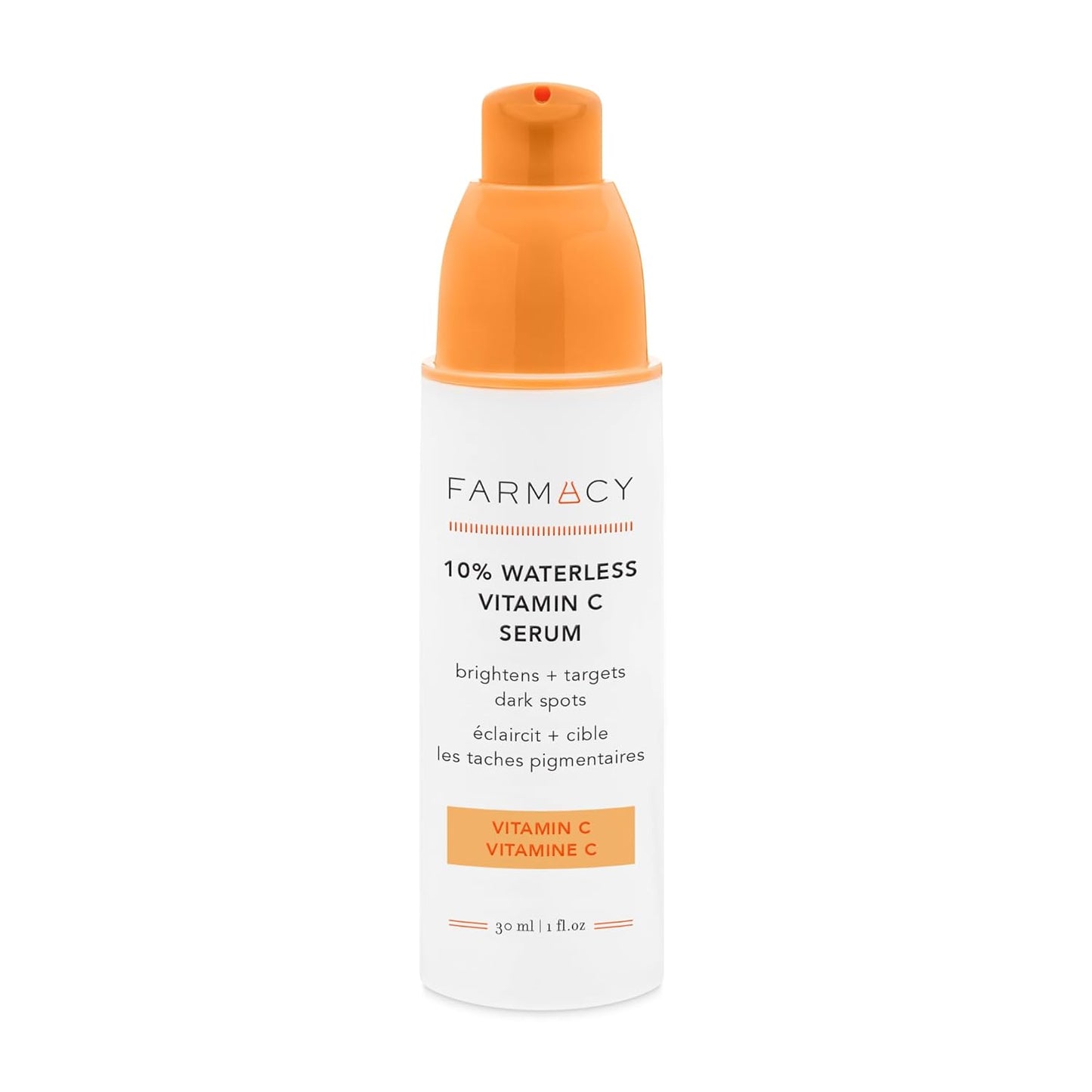

Farmacy Beauty
10% Waterless Vitamin C Serum

10% Waterless Vitamin C Serum
Farmacy Beauty
10-waterless-vitamin-c-serum
Serum
9628163080485
Morning or Evening?
How often will you use this product?
Notes


Highlights
WHAT IS IT?
Waterless vitamin C serum
FEATURES
Waterless formula, 10% L-ascorbic acid, Infused with ferulic acid, Oil-free, Gentle on skin
BEST FOR
All skin types, Combination, Oily
CHECKS
Oil-free, alcohol-free, fragrance-free, essential oil-free
Who Is It For?
Adults Women And MenWhat Does It Help With?
Brightening Dark Spots HyperpigmentationBudget
Mid-rangeHow To Use
Which routine should it be used in?
Instructions:
Key Information


What Farmacy Beauty Says
Product Description:
A first-of-its-kind, this waterless vitamin C serum visibly brightens, targets dark spots + reduces hyperpigmentation. The clinically tested oil-free concentrate is highly stable, gentle on skin + infused with antioxidant-rich ferulic acid for maximum stability + potency.
About the Brand:
Ingredients Overview
Ingredients List
propanediol; pentylene glycol; ascorbic acid; betaine; alpha-arbutin; ferulic acid; citrus aurantium amara (bitter orange) fruit extract; citrus reticulata (tangerine) fruit extract; citrus aurantium sinensis peel extract; glycerin; lactic acid; citric acid
Key Ingredients
10% L-ascorbic acid, Ferulic acid
Ingredients Details
Alpha-arbutin
Common Name(s): 4-hydroxyphenyl-alpha-d-glucopyranoside
DESCRIPTION
What It Does: Provides potent tyrosinase inhibition with improved stability and tolerability over other arbutin forms.
Why It's Used: Premium arbutin — alpha configuration provides 10× greater tyrosinase inhibition than beta-arbutin at equivalent concentration, making alpha-arbutin the most effective arbutin form.
How It Works: Alpha-glucoside linkage provides enhanced metabolic stability vs beta-arbutin (less enzymatic hydrolysis to free hydroquinone in skin). inhibits tyrosinase via competitive substrate inhibition (ic50 ~24μg/ml vs beta-arbutin ~525μg/ml — 20× more potent). inhibits dopa oxidase step in melanogenesis.
Typically Found In: Brightening serums,anti-spot products,premium lightening
TECHNICAL DETAILS
Primary Category: Active ingredient – arbutin brightening agent
Secondary Functions: Melanin inhibition,hyperpigmentation reduction
Application Areas:

Facial Skincare

Body Care
Hair Care
Beard Care
Color Cosmetics (Makeup)
Dietary/Oral Supplements
Typical Concentration Range: 0.5%–2%
SOURCING & ETHICS
Vegan Status: Yes – synthetic enzymatic synthesis
Halal Status: Yes
Source Notes: Synthetic or plant-derived.
SKIN COMPATIBILITY
Irritancy Rating: 1/5 – very low
Comedogenicity Rating: 0/5 – non-comedogenic
Sensitivity Concerns: Non-irritating; well-tolerated.
Safe for Sensitive Skin: Yes
SAFETY & COMPATIBILITY
Safety Profile: Excellent safety profile. use with spf for maximum efficacy. ewg score: 1.
Works Well With: Niacinamide,vitamin c,alpha-arbutin,tranexamic acid,spf
Avoid Combining With: No significant incompatibilities
SCIENTIFIC NOTE
Alpha-arbutin's 10–20× greater potency vs beta-arbutin at equivalent concentration arises from the alpha-glycosidic bond geometry — the alpha configuration positions the hydroquinone aglycone at a specific orientation relative to the glucose that fits the tyrosinase active site copper more precisely than the beta isomer's different spatial arrangement.
Last Verified: ##########
Primary Sources: Cosing database,sugimoto et al. arbutin tyrosinase study
Ascorbic Acid
Common Name(s): Vitamin c,l-ascorbic acid,l-ascorbate
CAS Number: 50-81-7
DESCRIPTION
What It Does: Ascorbic acid neutralizes free radicals, stimulates collagen production, inhibits melanin synthesis for a brighter complexion, and supports skin repair.
Why It's Used: It is used because it offers comprehensive antioxidant and brightening benefits supported by extensive clinical evidence. it is the most bioavailable form of vitamin c for topical application.
How It Works: As an antioxidant, it donates electrons to neutralize reactive oxygen species. it is an essential cofactor for the hydroxylation of proline and lysine in collagen synthesis. it inhibits tyrosinase, the enzyme responsible for melanin production, reducing hyperpigmentation.
Typically Found In: Vitamin c serums,brightening moisturizers,antioxidant formulations,spf products,eye creams
TECHNICAL DETAILS
Primary Category: Active ingredient – vitamin c
Secondary Functions: Collagen booster,tyrosinase inhibitor,ph adjuster
Application Areas:
Facial Skincare
Body Care
Hair Care
Beard Care
Color Cosmetics (Makeup)
Dietary/Oral Supplements
Typical Concentration Range: 5%–20% (effective range: 10–20%; ph must be below 3.5 for activity)
SOURCING & ETHICS
Vegan Status: Yes – synthetically produced or corn/plant-derived
Halal Status: Yes
Source Notes: Commercially produced by reichstein synthesis or guangxi fermentation process from glucose. some plant-derived versions exist.
SKIN COMPATIBILITY
Irritancy Rating: 2/5 – low to moderate; low ph formulations can cause initial tingling or stinging, especially at concentrations above 15%
Comedogenicity Rating: 0/5 – non-comedogenic
Sensitivity Concerns: Acidic ph can irritate sensitive or compromised skin barriers. highly unstable – oxidizes rapidly when exposed to air, light, and heat (turns orange/brown). use in the morning under spf.
Safe for Sensitive Skin: Use with caution – start at lower concentrations (5–10%). stabilized derivative forms (vitamin c derivatives) may be better tolerated.
SAFETY & COMPATIBILITY
Safety Profile: Very safe; well-studied. key concern is formulation stability, not safety. ewg hazard score: 1.
Works Well With: Vitamin e (tocopherol) – synergistic antioxidant effect,ferulic acid – stabilizing and boosting,spf,hyaluronic acid,niacinamide (use at different times if concentrations are high)
Avoid Combining With: Retinol (use at separate times – ph incompatibility),benzoyl peroxide (oxidizes vitamin c),ahas/bhas (cumulative irritation risk)
SCIENTIFIC NOTE
L-ascorbic acid is the only form of vitamin c that is proven bioactive in skin at the molecular level. its instability (rapid oxidation) has driven development of numerous stable derivatives including ascorbyl glucoside, magnesium ascorbyl phosphate, and ascorbyl tetraisopalmitate.
Last Verified: ##########
Primary Sources: Cosing database,cir safety assessment,pinnell et al. studies,journal of the american academy of dermatology
Betaine
Common Name(s): Trimethylglycine,tmg,natural betaine
CAS Number: 107-43-7
DESCRIPTION
What It Does: Provides osmoprotective humectant conditioning with anti-irritant and mild foam-boosting activity.
Why It's Used: Natural-origin multifunctional osmolyte from sugar beet providing hydration, anti-irritancy, and conditioning in virtually every cosmetic category.
How It Works: Quaternary ammonium betaine provides zwitterionic character for water binding via ionic hydration. osmoprotective function at 100–500mm as compatible solute protecting cells from osmotic stress. reduces surfactant irritation by competing with sls for protein binding sites. mild foam enhancement.
Typically Found In: Virtually all categories — moisturisers, shampoos, cleansers
TECHNICAL DETAILS
Primary Category: Functional ingredient – humectant
Secondary Functions: Tewl reduction,skin plumping
Application Areas:
Facial Skincare
Body Care
Hair Care
Beard Care
Color Cosmetics (Makeup)
Dietary/Oral Supplements
Typical Concentration Range: 0.5%–10%
SOURCING & ETHICS
Vegan Status: Conditional - feedstock declaration required
Halal Status: Unverified - feedstock declaration required (plant, animal and petrochemical routes all exist)
Source Notes: Synthetic or naturally derived. excellent aqueous solubility. [audit 2026-07-29 rev2: origin-dependent: the same inci exists in plant, animal and petrochemical versions and the name does not discriminate. determination requires shariah-panel sign-off.]
SKIN COMPATIBILITY
Irritancy Rating: 1/5 – very low
Comedogenicity Rating: 0/5 – non-comedogenic
Sensitivity Concerns: Non-irritating; suitable for all skin types.
Safe for Sensitive Skin: Yes
SAFETY & COMPATIBILITY
Safety Profile: Excellent safety profile. ewg score: 1.
Works Well With: Ceramides,emollients,occlusives,glycerin,hyaluronic acid
Avoid Combining With: No significant incompatibilities
SCIENTIFIC NOTE
Betaine's anti-irritant mechanism for surfactant systems involves competitive protein protection: betaine at high concentrations preferentially interacts with skin proteins, occupying binding sites that would otherwise be occupied by surfactant molecules causing protein denaturation. this competition reduces available protein binding for irritating surfactants, explaining betaine's well-documented ability to reduce sls irritation when co-formulated.
Last Verified: 2026-03-12
Primary Sources: Cosing database,craig betaine osmoprotective review,cir safety assessment
Citrus Aurantium Amara Bitter Orange Fruit Extract
Common Name(s): Citrus aurantium amara bitter orange fruit extract extract
DESCRIPTION
What It Does: Provides antioxidant protection, soothing anti-inflammatory effects, and skin-conditioning benefits through plant-derived polyphenols and phytochemicals.
Why It's Used: Plant extracts concentrate bioactive phytochemicals evolved for environmental protection — uv, microbial, and oxidative stressors — that translate to skin benefits.
How It Works: Polyphenols (flavonoids, phenolic acids) inhibit nf-κb-mediated inflammatory signaling, scavenge reactive oxygen species through electron donation, and chelate pro-oxidant metal ions to reduce oxidative skin damage.
Typically Found In: Serums,toners,moisturizers,masks,essences
TECHNICAL DETAILS
Primary Category: Botanical extracts
Secondary Functions: Antioxidant,anti-inflammatory
Application Areas:
Facial Skincare
Body Care
Hair Care
Beard Care
Color Cosmetics (Makeup)
Dietary/Oral Supplements
Typical Concentration Range: 0.1–10%
SOURCING & ETHICS
Vegan Status: Yes
Halal Status: Yes
Source Notes: Plant-derived extract; no animal components.
SKIN COMPATIBILITY
Irritancy Rating: 1899-12-31 00:00:00 -0800
Sensitivity Concerns: Low sensitization potential at recommended use concentrations.
Safe for Sensitive Skin: Yes
SAFETY & COMPATIBILITY
Safety Profile: Well-characterized cosmetic ingredient with established safety profile. generally non-irritating at typical use concentrations. suitable for leave-on and rinse-off cosmetics.
Works Well With: Niacinamide,hyaluronic acid,vitamin c,ceramides
Avoid Combining With: Strong oxidizing agents
SCIENTIFIC NOTE
Plant secondary metabolites (flavonoids, terpenes, phenolic acids) are biosynthesized as defense compounds against uv, herbivores, and pathogens. their anti-inflammatory activity typically derives from competitive inhibition of cox-2 and 5-lox enzymes (ic50 1–50 µm), while antioxidant activity involves single electron transfer (set) and hydrogen atom transfer (hat) mechanisms with structure-dependent rate constants.
Last Verified: 2025-01-15
Primary Sources: Cosing eu database; pcpc cosmetic ingredient safety reviews; phytochemical and ethnobotanical literature