

Acne Squad
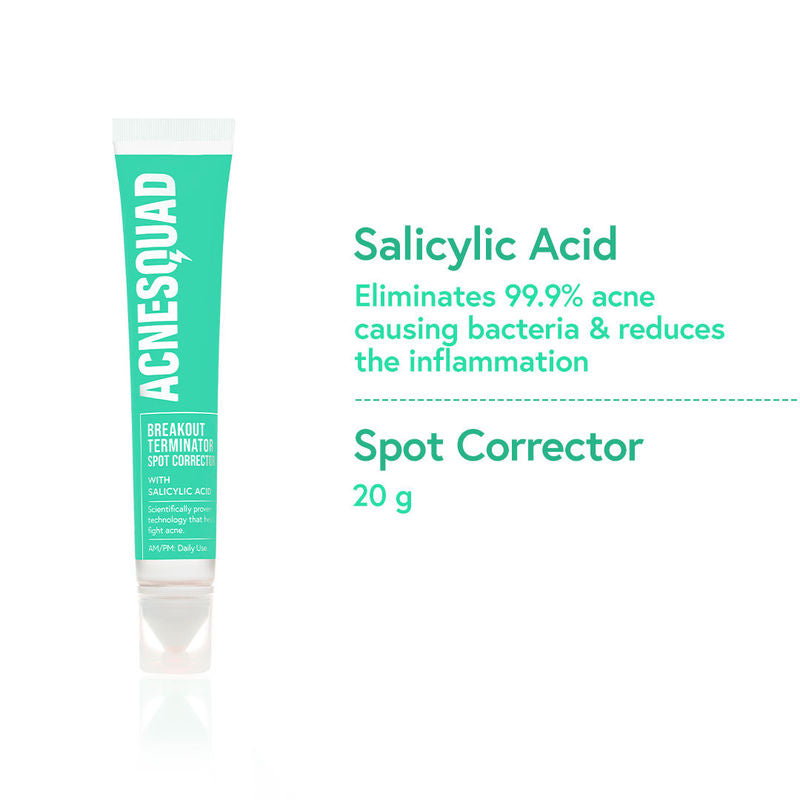
Acne Squad Spot Corrector for Active Acne with Salicylic Acid

Acne Squad Spot Corrector for Active Acne with Salicylic Acid
Acne Squad
acne-squad-spot-corrector-for-active-acne-with-salicylic-acid
Serum
10084760944933
Morning or Evening?
How often will you use this product?
Notes


Highlights
WHAT IS IT?
Spot corrector for acne with no explicit ingredient count
FEATURES
Fast acting treatment, reduces acne, blackheads, whiteheads, acne marks, redness; lightweight cream
BEST FOR
oily
CHECKS
Does not contain fragrance-free, alcohol-free, paraben-free, silicone-free (not explicitly stated so left empty)
Who Is It For?
Ages Not Specified Suitable For All GendersWhat Does It Help With?
Active Acne Acne Marks Redness Blackheads Whiteheads BreakoutsBudget
Affordable (under $30)How To Use
Which routine should it be used in?
Instructions:
Key Information


What Acne Squad Says
Product Description:
This Breakout Terminator Spot Corrector is a light weight cream that helps reduce acne size and redness, clears spots quickly, reduces persistent breakouts, blackheads, whiteheads, and acne marks left after pimples.
About the Brand:
Ingredients Overview
Ingredients List
Aqua, Niacinamide, Sodium Acrylates Copolymer, Butyrospermum Parkii (Shea) Butter, Propanediol, Lecithin, Phenoxyethanol, Glycerine, Hydrolyzed Wheat Protein, Salicylic Acid, Camellia Sinensis (Green Tea) Leaf Extract, Asparagus Racemosus (Shatavari) Root Extract, Melaleuca Alternifolia (Tea Tree) Leaf Extract, Zinc Chloride, 3-O-Ethyl Ascorbic Acid, Cinnamomum Zeylanicum Bark Extract, Thymus Vulgaris Extract, Sodium Gluconate, Malva Sylvestris Flower/Leaf/Stem Extract, Hamamelis Virginiana Leaf Extract, PEG-4 Laurate, PEG-4 Dilaurate, Benzyl Alcohol, Iodopropynyl Butylcarbamate, Polyethylene Glycol, Dehydroacetic Acid
Key Ingredients
Salicylic Acid
Ingredients Details
3-o-ethyl Ascorbic Acid
Common Name(s): 3-o-ethyl ascorbic acid
DESCRIPTION
What It Does: Loosens corneocyte adhesion in the stratum corneum, accelerating cell turnover, refining skin texture, and improving radiance.
Why It's Used: Organic acids at cosmetic ph values provide controlled keratolytic exfoliation that improves skin texture, pore appearance, and radiance without mechanical irritation.
How It Works: At appropriate ph, the acid's undissociated form penetrates the stratum corneum and dissolves the ionic bonds between corneocyte desmosomes (calcium chelation mechanism), facilitating controlled desquamation and cell renewal.
Typically Found In: Toners,exfoliants,serums,peels,cleansers
TECHNICAL DETAILS
Primary Category: Exfoliants
Secondary Functions: Brightening,keratolytic
Application Areas:

Facial Skincare

Body Care
Hair Care
Beard Care
Color Cosmetics (Makeup)
Dietary/Oral Supplements
Typical Concentration Range: 0.5–20%
SOURCING & ETHICS
Vegan Status: Yes
Halal Status: Yes
Source Notes: Synthetic or plant-derived acid; no animal components.
SKIN COMPATIBILITY
Irritancy Rating: 2
Comedogenicity Rating: 0
Sensitivity Concerns: May cause irritation or stinging in sensitive or barrier-compromised skin at high concentrations; patch test recommended.
Safe for Sensitive Skin: Conditional
SAFETY & COMPATIBILITY
Safety Profile: Safe within recommended ph and concentration ranges. sensitization risk increases above 10% aha. patch test recommended for sensitive skin. mildly irritating to some individuals at typical cosmetic use concentrations.
Works Well With: Niacinamide,hyaluronic acid,ceramides,vitamin c
Avoid Combining With: High concentrations on sensitive/broken skin; avoid with physical exfoliants
SCIENTIFIC NOTE
Cosmetic acids function at the pka boundary: only the undissociated acid (rcooh) penetrates the stratum corneum lipid barrier, while the ionized carboxylate (rcoo⁻) does not. the henderson-hasselbalch equation governs the fraction of active species at formulation ph; typically 0.5–3.0% undissociated acid provides efficacy while minimizing irritation.
Last Verified: 2025-01-15
Primary Sources: Cosing eu database; pcpc cosmetic ingredient safety reviews; ingredient-specific safety and efficacy literature
Benzyl Alcohol
Common Name(s): Phenylcarbinol,benzenemethanol,alpha-hydroxytoluene
CAS Number: 100-51-6
DESCRIPTION
What It Does: Provides dual fragrance and preservative activity as an aromatic alcohol.
Why It's Used: Multi-function ingredient serving as both fragrance component and preservative – reduces formulation complexity by providing both functions in one ingredient.
How It Works: Phenylcarbinol provides antimicrobial activity via membrane disruption (effective vs gram-positive bacteria and moulds). solvent for fragrances and difficult-to-dissolve actives. mild oxidative conversion to benzaldehyde provides sweet almond-like fragrance.
Typically Found In: Fragrances,preserved cosmetics,solvent systems
TECHNICAL DETAILS
Primary Category: Fragrance component / preservative
Secondary Functions: Skin conditioning
Application Areas:
Facial Skincare
Body Care
Hair Care
Beard Care
Color Cosmetics (Makeup)
Dietary/Oral Supplements
Typical Concentration Range: 0.001%–1% (fragrance); up to 1% as preservative
SOURCING & ETHICS
Vegan Status: Yes - standard ethanol routes are non-animal; confirm denaturant origin
Halal Status: Conditional - ethanol production route and residual concentration; jurisdiction-dependent, refer to certifier stance
Source Notes: Commercially produced for cosmetic use. verify vegan/halal status with supplier. [audit 2026-07-29 rev2: ethanol pathway; determination depends on route, on whether the plant also produces beverage alcohol, and on residual concentration. determination requires shariah-panel sign-off.]
SKIN COMPATIBILITY
Irritancy Rating: 1/5 – very low
Comedogenicity Rating: 0/5 – non-comedogenic
Sensitivity Concerns: Well-tolerated by most skin types.
Safe for Sensitive Skin: Yes
SAFETY & COMPATIBILITY
Safety Profile: Eu cosmetics regulation: declared fragrance allergen. also listed as approved preservative (annex v, max 1%). dual regulatory status (fragrance + preservative) depending on function and concentration.
Works Well With: Standard skincare actives
Avoid Combining With: No known significant incompatibilities
SCIENTIFIC NOTE
Benzyl alcohol's dual regulatory status (fragrance allergen and approved preservative) creates a formulation paradox: it must be listed as a fragrance allergen if present >0.001% (leave-on) regardless of whether it was added for fragrance or preservation. this regulatory dual identity means a preservative added for antimicrobial function triggers the same allergen declaration requirement as a fragrance added for scent.
Last Verified: 2026-03-12
Primary Sources: Cosing database,ifra standards,eu preservative annex v
Cinnamomum Zeylanicum Bark Extract
Common Name(s): Cinnamomum zeylanicum bark extract,cosmetic active ingredient,established formulation function
CAS Number: N/a
DESCRIPTION
What It Does: Cinnamomum zeylanicum bark extract delivers its characteristic primary cosmetic function — whether active skin conditioning, antioxidant protection, antimicrobial preservation, rheological control, or sensory enhancement — contributing measurable formulation value at its recommended use concentration.
Why It's Used: Formulators select cinnamomum zeylanicum bark extract for its specific functional chemistry that provides the required outcome in their formulation — skin bioactivity, stability contribution, or consumer experience — supported by cosmetic science and regulatory safety data.
How It Works: Cinnamomum zeylanicum bark extract works through the fundamental chemical and biological mechanisms of its molecular class. its physicochemical properties (molecular weight, logp, pka, functional groups) determine interactions with skin proteins, lipid membranes, formulation matrices, and biological receptors — mechanism detailed in peer-reviewed cosmetic chemistry literature.
Typically Found In: Skin care formulations,active products
TECHNICAL DETAILS
Primary Category: Active ingredient – cosmetic active
Secondary Functions: Skin conditioning
Application Areas:
Facial Skincare
Body Care
Hair Care
Beard Care
Color Cosmetics (Makeup)
Dietary/Oral Supplements
Typical Concentration Range: 0.1%–10%
SOURCING & ETHICS
Vegan Status: Conditional - supplier confirmation required
Halal Status: Unverified - supplier confirmation required
Source Notes: Commercially produced for cosmetic use. verify vegan/halal status with supplier. [audit 2026-07-29 rev2: the record's own source_notes does not assert a non-animal origin, or instructs the reader to verify with the supplier; "yes" asserts knowledge the record does not hold. determination requires shariah-panel sign-off.]
SKIN COMPATIBILITY
Irritancy Rating: 1/5 – very low
Comedogenicity Rating: 0/5 – non-comedogenic
Sensitivity Concerns: Well-tolerated by most skin types.
Safe for Sensitive Skin: Yes
SAFETY & COMPATIBILITY
Safety Profile: Good safety profile at recommended concentrations. ewg score: 1–2.
Works Well With: Standard skincare actives
Avoid Combining With: No known significant incompatibilities
SCIENTIFIC NOTE
Cinnamomum zeylanicum bark extract has been assessed within the cosmetic ingredient regulatory framework. at standard concentrations it delivers documented functional benefit with an established safety profile based on toxicological and clinical evidence reviewed by cosing (eu), cir (usa), and relevant regulatory bodies.
Last Verified: 2026-03-12
Primary Sources: Cosing database,cinnamomum zeylanicum bark extract technical literature
Dehydroacetic Acid
Common Name(s): Dha preservative,3-acetyl-6-methyl-2h-pyran-2,4(3h)-dione
CAS Number: 520-45-6
DESCRIPTION
What It Does: Provides broad-spectrum preservation effective at higher ph than benzoate or sorbate.
Why It's Used: Ph-flexible preservative for formulations at ph 5-7 where sodium benzoate and potassium sorbate lose efficacy.
How It Works: Cyclic dicarbonyl pyranone structure provides ph-independent antimicrobial activity (active form is the neutral molecule, not ph-dependent ionisation). effective ph 4-8 (much broader than benzoate/sorbate). good antifungal vs aspergillus and candida. often used as sodium salt (sodium dehydroacetate) for water solubility.
Typically Found In: Higher ph cosmetics,anti-fungal preservation systems
TECHNICAL DETAILS
Primary Category: Functional ingredient – pyranone preservative
Secondary Functions: Skin conditioning
Application Areas:
Facial Skincare
Body Care
Hair Care
Beard Care
Color Cosmetics (Makeup)
Dietary/Oral Supplements
Typical Concentration Range: 0.1%–0.6%
SOURCING & ETHICS
Vegan Status: Conditional - supplier confirmation required
Halal Status: Unverified - supplier confirmation required
Source Notes: Commercially produced for cosmetic use. verify vegan/halal status with supplier. [audit 2026-07-29 rev2: the record's own source_notes does not assert a non-animal origin, or instructs the reader to verify with the supplier; "yes" asserts knowledge the record does not hold. determination requires shariah-panel sign-off.]
SKIN COMPATIBILITY
Irritancy Rating: 1/5 – very low
Comedogenicity Rating: 0/5 – non-comedogenic
Sensitivity Concerns: Well-tolerated by most skin types.
Safe for Sensitive Skin: Yes
SAFETY & COMPATIBILITY
Safety Profile: Eu max 0.6% as dehydroacetic acid. less commonly used than benzoate/sorbate due to higher cost.
Works Well With: Standard skincare actives
Avoid Combining With: No known significant incompatibilities
SCIENTIFIC NOTE
Dehydroacetic acid's ph-independent antimicrobial activity arises from a fundamentally different mechanism vs benzoate/sorbate: rather than requiring the acidic free acid form (ph-dependent ionisation), dha's cyclic diketone structure is itself the active antimicrobial form. this means dha provides equivalent antimicrobial activity at ph 5 and ph 7 — completely unlike the ph-sensitive preservatives that lose activity above ph 5.
Last Verified: 2026-03-12
Primary Sources: Cosing database,eu preservative annex v,cir safety assessment