

Nubian Heritage
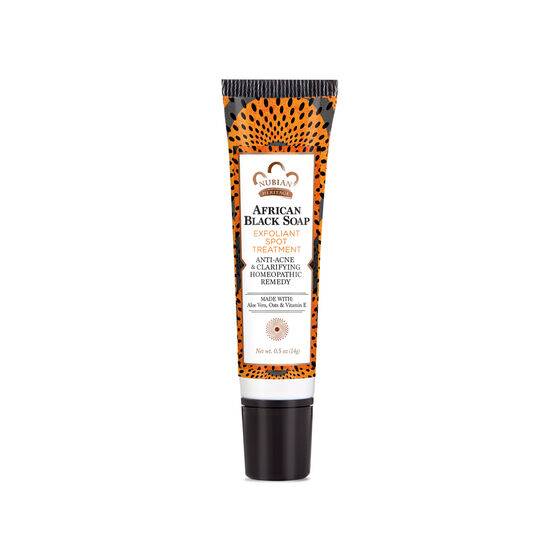
African Black Soap Targeted Exfoliant Spot Treatment

African Black Soap Targeted Exfoliant Spot Treatment
Nubian Heritage
african-black-soap-targeted-exfoliant-spot-treatment
Exfoliation
9706851500325
Morning or Evening?
How often will you use this product?
Notes


Highlights
WHAT IS IT?
Exfoliating spot treatment for acne-prone skin
FEATURES
Helps clear blemishes, prevents future breakouts, contains African Black Soap
BEST FOR
Acne-prone skin
CHECKS
Free of sulfates, parabens, phthalates, silicone, petroleum products
Who Is It For?
Suitable For Adults 18+What Does It Help With?
Acne BlemishesBudget
AffordableHow To Use
Which routine should it be used in?
Instructions:
Key Information


What Nubian Heritage Says
Product Description:
African Black Soap Targeted Exfoliant Spot Treatment from Nubian Heritage puts you in control of acne-prone skin. Our homeopathic formula helps clear up visible blemishes while targeting problem areas to prevent future breakouts.
About the Brand:
Ingredients Overview
Ingredients List
Water, Xanthan Gum, Glycerin (Vegetable), Butyrospermum Parkii (Shea) Butter, Butyrospermum Parkii (Shea) Oil, Simmondsia Chinensis (Jojoba) Seed Oil, Sodium Palm Kernelate, Sodium Shea Butterate, Sodium Cocoate, Theobroma Cacao (Cocoa) Pod Ash, Aloe Barbadensis Leaf Juice, Vitis Vinifera (Grape) Seed Oil, Chamomilla Recutita (Matricaria) Flower Extract, Leptospermum Scoparium Branch/Leaf Oil, Limnanthes Alba (Meadowform) Seed Oil, Tocopherol, Tamarind us lndica Fruit Extract, Musa Paradisiaca Extract, Melaleuca Alternifolia (Tea Tree) Leaf Oil, Avena Sativa (Oat) Bran Extract, Calendula Officinalis Flower Extract, Avena Sativa (Oat) Peptide, Beta Glucan, Hamamelis Virginiana (Witch Hazel), lsopropyl Alcohol, Salicylic Acid, Niacinamide, Sodium Benzoate, Caprylhydroxamic Acid , Phenethyl Alcohol, Sodium Phytate, Fragrance (Essential Oil Blend).
Key Ingredients
African Black Soap, Shea Butter, Jojoba Seed Oil, Aloe Vera, Tea Tree Oil
Ingredients Details
Butyrospermum Parkii Shea Butter
Common Name(s): Butyrospermum parkii shea butter
DESCRIPTION
What It Does: Delivers targeted skin-conditioning or bioactive benefits through a specific mechanism of action suited to the formulation's intended purpose.
Why It's Used: Specialty actives address specific skin concerns through targeted molecular mechanisms, providing efficacy beyond what base formulation ingredients alone can achieve.
How It Works: The bioactive compound interacts with specific molecular targets in skin cells or the extracellular matrix — enzymes, receptors, structural proteins, or signaling molecules — triggering beneficial biological responses.
Typically Found In: Serums,treatments,moisturizers,specialty products
TECHNICAL DETAILS
Primary Category: Specialty actives
Secondary Functions: Skin-conditioning,anti-aging
Application Areas:

Facial Skincare

Body Care
Hair Care
Beard Care
Color Cosmetics (Makeup)
Dietary/Oral Supplements
Typical Concentration Range: 0.01–5%
SOURCING & ETHICS
Vegan Status: Yes
Halal Status: Yes
Source Notes: Specialty active ingredient; check individual sourcing for vegan status.
SKIN COMPATIBILITY
Irritancy Rating: 1899-12-31 00:00:00 -0800
Sensitivity Concerns: Low sensitization potential at recommended use concentrations.
Safe for Sensitive Skin: Yes
SAFETY & COMPATIBILITY
Safety Profile: Well-characterized cosmetic ingredient with established safety profile. generally non-irritating at typical use concentrations. suitable for leave-on and rinse-off cosmetics.
Works Well With: Niacinamide,hyaluronic acid,vitamin c,peptides
Avoid Combining With: Incompatible with oxidizing agents; check ph stability
SCIENTIFIC NOTE
Specialty actives typically work through enzyme inhibition (e.g., tyrosinase inhibition for brightening, mmp inhibition for anti-aging), receptor activation (e.g., retinoid receptors, ppar-γ for barrier genes), or transcription factor modulation (e.g., nrf2 for antioxidant gene upregulation). structure-activity relationships determine potency and selectivity.
Last Verified: Cosing eu database; pcpc cosmetic ingredient safety reviews; ingredient-specific safety and efficacy literature
Primary Sources: 2025-01-15
Butyrospermum Parkii Shea Oil
Common Name(s): Butyrospermum parkii shea oil oil
DESCRIPTION
What It Does: Nourishes and softens skin through its balanced fatty acid profile, while antioxidant compounds protect against oxidative skin damage.
Why It's Used: Plant oils provide physiologically compatible lipid structures that integrate into the skin barrier and deliver fat-soluble antioxidants directly to skin cells.
How It Works: Fatty acids integrate into stratum corneum lipid lamellae, reinforcing the lipid barrier. antioxidants (tocopherols, carotenoids, polyphenols) neutralize ros through electron donation or singlet oxygen quenching.
Typically Found In: Face oils,serums,moisturizers,hair treatments,body oils
TECHNICAL DETAILS
Primary Category: Plant oils
Secondary Functions: Emollient,antioxidant
Application Areas:
Facial Skincare
Body Care
Hair Care
Beard Care
Color Cosmetics (Makeup)
Dietary/Oral Supplements
Typical Concentration Range: 0.5–30%
SOURCING & ETHICS
Vegan Status: Yes
Halal Status: Yes
Source Notes: Cold-pressed or solvent-extracted plant oil; no animal components.
SKIN COMPATIBILITY
Irritancy Rating: 1899-12-31 00:00:00 -0800
Comedogenicity Rating: 1900-01-01 00:00:00 -0800
Sensitivity Concerns: Low sensitization potential at recommended use concentrations.
Safe for Sensitive Skin: Yes
SAFETY & COMPATIBILITY
Safety Profile: Well-characterized cosmetic ingredient with established safety profile. generally non-irritating at typical use concentrations. suitable for leave-on and rinse-off cosmetics.
Works Well With: Vitamin e,ceramides,other plant oils,squalane
Avoid Combining With: Strong oxidizers (accelerate rancidity)
SCIENTIFIC NOTE
Vegetable oils are triglyceride matrices where the fatty acid composition determines skin compatibility, barrier function, and comedogenicity. oleic acid-rich oils (>60%) soften barrier lipids and enhance penetration; linoleic acid-rich oils reinforce ceramide-poor stratum corneum; saturated fatty acid-rich oils provide occlusion without skin penetration.
Last Verified: Cosing eu database; pcpc cosmetic ingredient safety reviews; aocs plant oil composition databases; fatty acid pharmacology reviews
Primary Sources: 2025-01-15
Glycerin
Common Name(s): Glycerol,glycerine,1,2,3-propanetriol
CAS Number: 56-81-5
DESCRIPTION
What It Does: Glycerin pulls water from the environment and deeper skin layers into the outer skin layer (epidermis), boosting moisture levels and keeping skin soft, smooth, and plump.
Why It's Used: It is used in virtually every moisturizer, serum, and cleanser because it is highly effective at hydrating skin, is well-tolerated by all skin types, and enhances the texture and spreadability of formulations.
How It Works: As a humectant, glycerin forms hydrogen bonds with water molecules, trapping them in the skin. it also reinforces the skin barrier by integrating into lipid structures between skin cells.
Typically Found In: Moisturizers,serums,cleansers,toners,sheet masks,sunscreens,body lotions,shampoos,conditioners
TECHNICAL DETAILS
Primary Category: Humectant
Secondary Functions: Skin barrier support,emollient,solvent
Application Areas:
Facial Skincare
Body Care
Hair Care
Beard Care
Color Cosmetics (Makeup)
Dietary/Oral Supplements
Typical Concentration Range: 1%–30% (typical: 3–10%)
SOURCING & ETHICS
Vegan Status: Yes – plant-derived (coconut, soy, palm) or synthetic
Halal Status: Yes – when plant-derived or synthetic; verify source with supplier
Source Notes: Derived from plant oils via hydrolysis or saponification; synthetic versions also available. palm-derived glycerin carries sustainability concerns.
SKIN COMPATIBILITY
Irritancy Rating: 1/5 – very low; non-irritating at all standard concentrations
Comedogenicity Rating: 0/5 – non-comedogenic
Sensitivity Concerns: Extremely rare allergic reactions; generally safe for all skin types including sensitive and baby skin
Safe for Sensitive Skin: Yes
SAFETY & COMPATIBILITY
Safety Profile: Widely recognized as safe. ewg hazard score: 1. no significant concerns for irritation, sensitization, or toxicity at typical concentrations (up to 50%).
Works Well With: Hyaluronic acid,ceramides,niacinamide,panthenol,urea,peptides,retinol,ahas/bhas
Avoid Combining With: No known incompatibilities at standard concentrations
SCIENTIFIC NOTE
Glycerin is an endogenous skin component found naturally in the stratum corneum. aquaporin-3 channels in keratinocytes facilitate glycerin transport, making it integral to natural skin hydration pathways.
Last Verified: Cosing database,cir safety assessment,ewg skin deep,inci decoder
Primary Sources: 2026-03-12
Simmondsia Chinensis (jojoba) Seed Oil
Common Name(s): Simmondsia chinensis (jojoba) seed oil,botanical oil,phytochemical active
CAS Number: N/a
DESCRIPTION
What It Does: Provides antioxidant protection from reactive oxygen species, reduces inflammatory cytokine production in skin, and conditions skin through the plant's phytochemical complex.
Why It's Used: Natural origin narrative, traditional use heritage, and multi-functional phytochemical profile supporting concurrent skin care claims from one ingredient.
How It Works: Polyphenols, terpenoids, and alkaloids scavenge ros via h• donation, inhibit nf-kb or cox-2 inflammatory pathways, and interact with skin surface proteins for conditioning.
Typically Found In: Botanical skin care,natural products
TECHNICAL DETAILS
Primary Category: Active ingredient – antioxidant
Secondary Functions: Free radical scavenging,anti-aging
Application Areas:
Facial Skincare
Body Care
Hair Care
Beard Care
Color Cosmetics (Makeup)
Dietary/Oral Supplements
Typical Concentration Range: 0.1%–10%
SOURCING & ETHICS
Vegan Status: Conditional
Halal Status: Yes
Source Notes: Plant-derived extract or synthetic.
SKIN COMPATIBILITY
Irritancy Rating: 1/5 – very low
Comedogenicity Rating: 0/5 – non-comedogenic
Sensitivity Concerns: Non-irritating; well-tolerated.
Safe for Sensitive Skin: Yes
SAFETY & COMPATIBILITY
Safety Profile: Excellent safety profile. ewg score: 1.
Works Well With: Vitamin c,vitamin e,ferulic acid,spf,other antioxidants
Avoid Combining With: No significant incompatibilities
SCIENTIFIC NOTE
Plant secondary metabolites evolved as photoprotectants and antimicrobials — mechanisms directly applicable to cosmetic antioxidant and anti-inflammatory activity in human skin.
Last Verified: Cosing database,simmondsia chinensis (jojoba) seed botanical review
Primary Sources: 2026-03-12
