
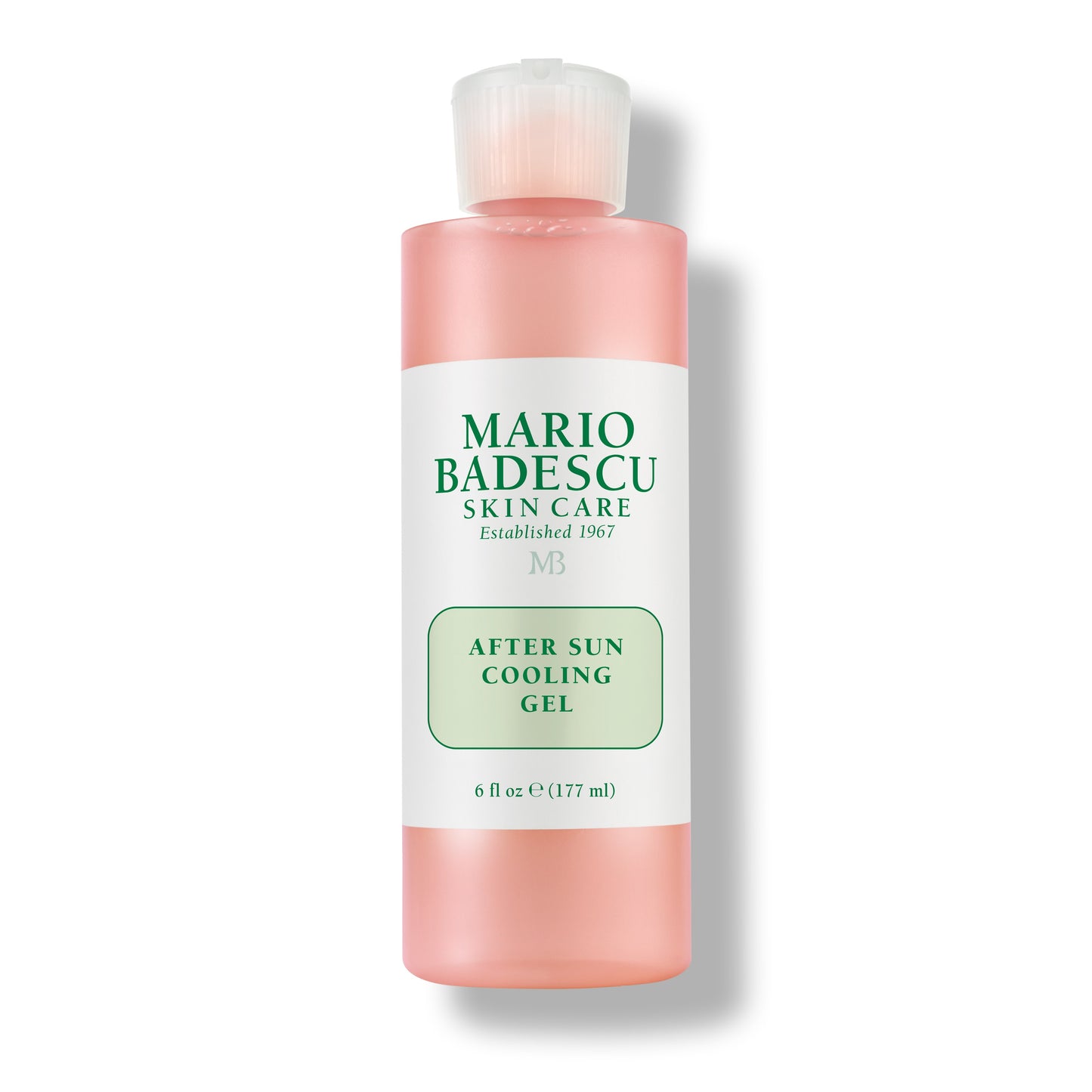

Mario Badescu
After Sun Cooling Gel

After Sun Cooling Gel
Mario Badescu
after-sun-cooling-gel
Body care
9818372964645
Morning or Evening?
How often will you use this product?
Notes


Highlights
WHAT IS IT?
After-sun cooling gel with Aloe Vera and Menthol
FEATURES
Lightweight, non-greasy gel formula that provides instant cooling and soothing relief
BEST FOR
all skin types
CHECKS
Free of sulfate
Who Is It For?
All Skin Types All AgesWhat Does It Help With?
Soothes And Cools Sun-exposed Skin Provides Relief From Sun Discomfort Hydrates SkinBudget
Affordable (under $30)How To Use
Which routine should it be used in?
Instructions:
Key Information


What Mario Badescu Says
Product Description:
Comfort skin exposed to sun with this soothing and cooling after-sun gel with Aloe Vera and Menthol. This cooling gel refreshes summer skin and works at providing relief after a day of too much sun.
About the Brand:
Ingredients Overview
Ingredients List
Aqua (Water, Eau), Glycerin, Butylene Glycol, Aloe Barbadensis Leaf Juice, Sorbitol, Propylene Glycol, Rosa Canina Fruit Extract, Parfum (Fragrance), Rosmarinus Officinalis Leaf Oil, Menthol, Glyceryl Acrylate/Acrylic Acid Copolymer, Diazolidinyl Urea, Sodium Chloride, Methylparaben, Propylparaben, Geraniol, Citronellol, Hexyl Cinnamal, Linalool, Benzyl Benzoate, Cinnamyl Alcohol, Hydroxyisohexyl 3-Cyclohexene Carboxaldehyde, Eugenol, Citral, CI 42090 (Blue 1), CI 45410 (Red 28)
Key Ingredients
Aloe Vera, Menthol, Rosehip Extract, Rosemary Oil
Ingredients Details
Aloe Vera
Common Name(s): Aloe vera juice,aloe vera gel,aloe barbadensis
CAS Number: 85507-69-3
DESCRIPTION
What It Does: Provides acemannan-based wound healing and comprehensive moisturising skin conditioning from the quintessential healing plant.
Why It's Used: The most universally recognised natural healing plant — aloe vera's acemannan polysaccharides, vitamins, and enzymes provide a comprehensive wound healing and soothing profile with thousands of years of documented use.
How It Works: Acemannan (poly-mannose) activates dectin-1 for wound healing immune stimulation. gibberellin promotes fibroblast growth. salicylic acid derivative provides anti-inflammatory. vitamins c and e provide antioxidant. glucomannan provides humectant.
Typically Found In: After-sun products,wound healing,moisturisers,virtually all skin care categories
TECHNICAL DETAILS
Primary Category: Active ingredient – aloe vera gel
Secondary Functions: Redness reduction,anti-inflammatory,calming
Application Areas:

Facial Skincare
Body Care

Hair Care
Beard Care
Color Cosmetics (Makeup)
Dietary/Oral Supplements
Typical Concentration Range: 0.5%–99%
SOURCING & ETHICS
Vegan Status: Yes – from aloe barbadensis leaf
Halal Status: Yes
Source Notes: Plant-derived extract or synthetic.
SKIN COMPATIBILITY
Irritancy Rating: 1/5 – very low
Comedogenicity Rating: 0/5 – non-comedogenic
Sensitivity Concerns: Non-irritating; ideal for reactive and sensitive skin.
Safe for Sensitive Skin: Yes – particularly recommended for sensitive skin
SAFETY & COMPATIBILITY
Safety Profile: Excellent safety profile. ewg score: 1.
Works Well With: Ceramides,panthenol,allantoin,hyaluronic acid,centella asiatica
Avoid Combining With: No significant incompatibilities
SCIENTIFIC NOTE
Aloe vera's clinical evidence for sunburn relief is among the best for any botanical wound healing ingredient. multiple rcts demonstrate that aloe vera gel reduces healing time of first and second degree burns and sunburns, attributed primarily to acemannan's immunomodulatory wound healing activity and the anti-inflammatory salicylate derivatives providing prostaglandin inhibition.
Last Verified: Cosing database,surjushe et al. aloe vera skin review,cir safety assessment
Primary Sources: 2026-03-12
Menthol
Common Name(s): L-menthol,peppermint camphor,(-)-menthol
CAS Number: 89-78-1
DESCRIPTION
What It Does: Activates trpm8 cold thermoreceptors for intense cooling sensation and analgesic activity.
Why It's Used: The most potent cosmetic cooling agent – direct trpm8 agonist providing cooling sensation without actual temperature reduction for refreshing and analgesic formulations.
How It Works: Potent trpm8 (menthol receptor/cold thermosensor) agonist – activation at room temperature mimics cold sensation without actual cooling. anti-pruritic via trpm8 activation competing with itch c-fiber signaling. antimicrobial via membrane disruption.
Typically Found In: Cooling products,scalp treatments,oral care,pain relief,foot care,after-sun
TECHNICAL DETAILS
Primary Category: Active ingredient – cooling sensory terpenoid
Secondary Functions: Redness reduction,anti-inflammatory,calming
Application Areas:
Facial Skincare
Body Care
Hair Care
Beard Care
Color Cosmetics (Makeup)
Dietary/Oral Supplements
Typical Concentration Range: 0.1%–2%
SOURCING & ETHICS
Vegan Status: Yes – from mentha piperita or synthetic
Halal Status: Yes
Source Notes: Plant-derived extract or synthetic.
SKIN COMPATIBILITY
Irritancy Rating: 2/5 – low to moderate; potential sensitizer
Comedogenicity Rating: 0/5 – non-comedogenic
Sensitivity Concerns: Non-irritating; ideal for reactive and sensitive skin.
Safe for Sensitive Skin: Avoid near eyes. use with caution at concentrations above 1% for sensitive skin.
SAFETY & COMPATIBILITY
Safety Profile: Eu max 4.5% (leave-on); regulations vary by application site. avoid on infants' face.
Works Well With: Ceramides,panthenol,allantoin,hyaluronic acid,centella asiatica
Avoid Combining With: No significant incompatibilities
SCIENTIFIC NOTE
Menthol's exceptional cooling potency stems from its ec50 for trpm8 activation of approximately 10μm (vs camphor's ec50 of ~5mm – 500× lower potency). this 500× potency advantage explains why even tiny concentrations of menthol provide intense cooling, while much higher concentrations of camphor are required for equivalent sensation.
Last Verified: Cosing database,mckemy et al. menthol trpm8 discovery,cir safety assessment
Primary Sources: 2026-03-12
