
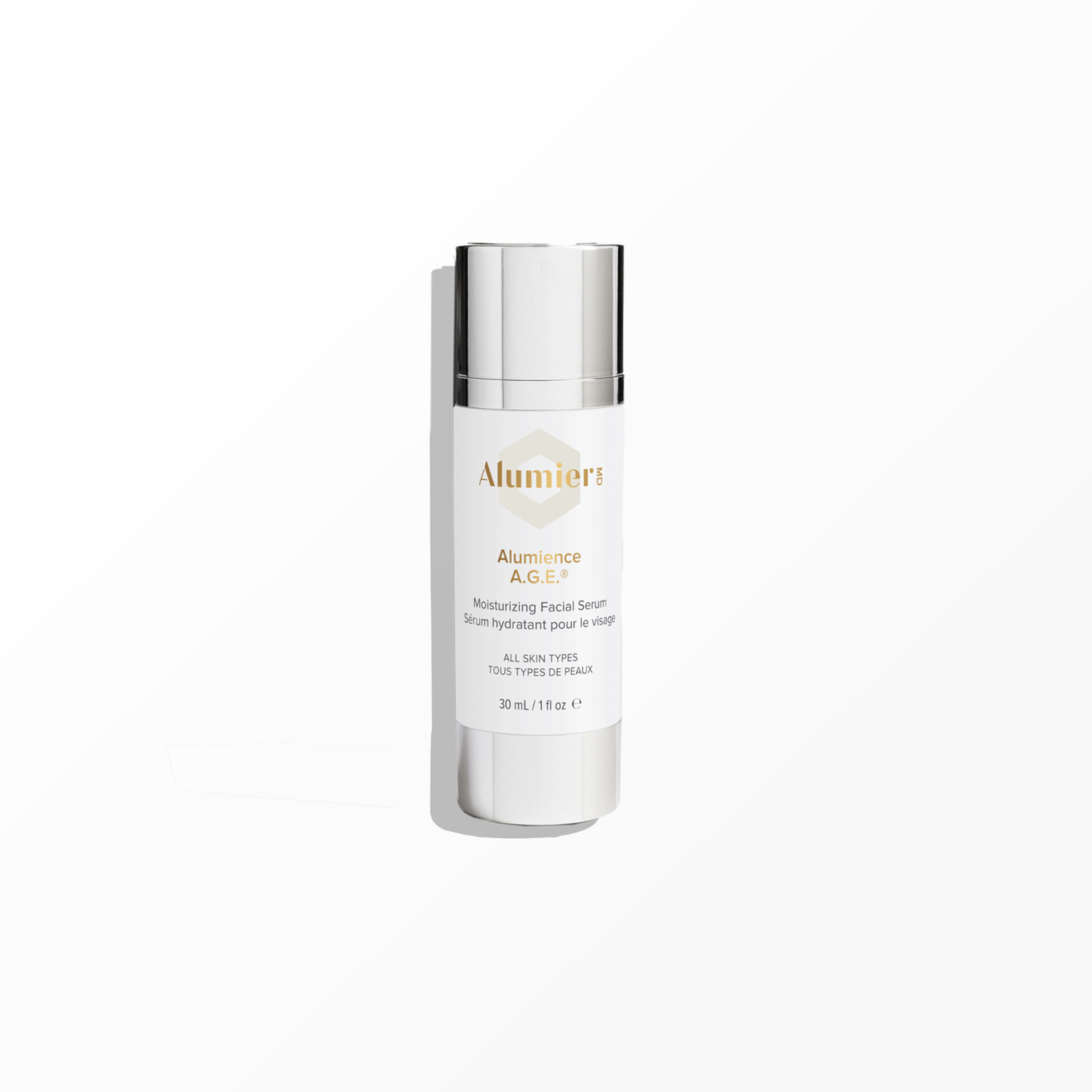

AlumierMD
Alumience A.G.E.®

Alumience A.G.E.®
AlumierMD
alumience-a-g-e-r
Serum
9643600675109
Morning or Evening?
How often will you use this product?
Notes


Highlights
WHAT IS IT?
An advanced age defense serum
FEATURES
Protects against premature aging and oxidative stress, defends against pollution and free radicals
BEST FOR
Not specifically mentioned, but suitable for those concerned with aging and environmental damage
CHECKS
Dye free, Paraben Free, Sulfate Free, Phthalate Free
Who Is It For?
Adults Concerned With Skin Aging (specific Age Range Not Provided)What Does It Help With?
Premature Aging Oxidative Stress Protection From Pollution And Free RadicalsBudget
PremiumHow To Use
Which routine should it be used in?
Instructions:
Key Information


What AlumierMD Says
Product Description:
An advanced age defense serum formulated with potent antioxidants protects the skin from premature aging and oxidative stress triggered by pollution, free radicals, and AGEs (advanced glycation end products).
About the Brand:
Ingredients Overview
Ingredients List
WATER/AQUA/EAU, DIMETHICONE, PROPANEDIOL, COCO-CAPRYLATE/CAPRATE, BUTYLENE GLYCOL, POLYSILICONE-11, CAPRYLYL GLYCOL, GLYCERIN, ARGININE PCA, DICAPRYLYL CARBONATE, SODIUM ACRYLATE/SODIUM ACRYLOYL DIMETHYL TAURATE COPOLYMER, HYDROLYZED HYALURONIC ACID, TETRAHEXYLDECYL ASCORBATE, TOCOPHERYL ACETATE, SODIUM HYALURONATE, TOCOPHEROL, SILYBUM MARLANUM (SILIBININ), ACETYL TYROSINE, PROLINE, CARNOSINE, ALTEROMONAS FERMENT FILTRATE, ADENOSINE TRIPHOSPHATE, DECYL GLUCOSIDE, YEAST EXTRACT, HYDROLYZED VEGETABLE PROTEIN, LECITHIN, CAPRYLYL/CAPRYL GLUCOSIDE, COCO-GLUCOSIDE, CAPRYLIC ACID, SORBITAN OLEATE, POLYISOBUTENE, ACRYLATES/C10-30 ALKYL ACRYLATE CROSSPOLYMER, ETHANOL, DISODIUM EDTA, XYLITOL, SODIUM HYDROXIDE, 1,2-HEXANEDIOL, ETHYLHEXYLGLYCERIN.
Key Ingredients
Carnosine, Silymarin, Vitamin E, Acetyl Tyrosine, Proline, ATP, Arginine, Exo-P™ (Alteromonas Ferment Extract), Tocopherol Acetate (Vitamin E), Tetrahexyldecyl Ascorbate (Vitamin C)
Ingredients Details
Arginine Pca
Common Name(s): Arginine pca,arginine pca,arginine salt of nmf pca,natural moisturising factor humectant
CAS Number: N/a
DESCRIPTION
What It Does: Replenishes pca as an nmf component for hygroscopic moisture retention — the 12% nmf contribution of pca directly maintaining sc softness and flexibility.
Why It's Used: Pca is the most physiologically compatible cosmetic humectant because it is native to healthy sc — restoring nmf pca content addresses the specific deficiency in dry and ageing skin rather than adding foreign humectants.
How It Works: Pca (pyrrolidone carboxylic acid, 5-membered cyclic amide of glutamate) at skin ph 5.5 carries a single negative charge (pka 3.6) providing h-bonding water retention from the carboxylate and the ring carbonyl. in healthy skin, pca is produced by filaggrin hydrolysis → urocanic acid → pca, maintaining the 10-12% nmf free amino acid/pca fraction.
Typically Found In: Natural moisturisers,nmf-focused care,sensitive skin
TECHNICAL DETAILS
Primary Category: Active ingredient – humectant
Secondary Functions: Moisture retention,hydration
Application Areas:

Facial Skincare
Body Care

Hair Care
Beard Care
Color Cosmetics (Makeup)
Dietary/Oral Supplements
Typical Concentration Range: 0.5%–5%
SOURCING & ETHICS
Vegan Status: Conditional - feedstock declaration required
Halal Status: Unverified - feedstock declaration required (plant, animal and petrochemical routes all exist)
Source Notes: Plant-derived or fermentation-produced. [audit 2026-07-29 rev2: origin-dependent: the same inci exists in plant, animal and petrochemical versions and the name does not discriminate. determination requires shariah-panel sign-off.]
SKIN COMPATIBILITY
Irritancy Rating: 1/5 – very low
Comedogenicity Rating: 0/5 – non-comedogenic
Sensitivity Concerns: Non-irritating; suitable for sensitive skin.
Safe for Sensitive Skin: Yes
SAFETY & COMPATIBILITY
Safety Profile: Excellent safety profile. ewg score: 1.
Works Well With: Ceramides,emollients,occlusives,barrier actives
Avoid Combining With: No significant incompatibilities
SCIENTIFIC NOTE
Nmf pca deficiency: in dry and atopic skin, pca levels are 20-40% lower than healthy controls. the mechanism: reduced filaggrin expression (common flg gene mutation in eczema) produces less pca precursor. topical pca replenishment directly compensates for this filaggrin-pathway deficit.
Last Verified: 2026-03-22
Primary Sources: Cosing database,arginine pca nmf pca humectant review
Butylene Glycol
Common Name(s): 1,3-butanediol,bg,1,3-butylene glycol
CAS Number: 107-88-0
DESCRIPTION
What It Does: Provides humectant hydration and active ingredient solubilization with excellent skin feel.
Why It's Used: Preferred glycol humectant in premium and k-beauty formulations for superior skin feel vs propylene glycol with equivalent functionality.
How It Works: Two hydroxyl groups at 1,3-positions provide water binding and solvent activity. better tolerated than propylene glycol with minimal sensitization risk. 4-carbon backbone provides slightly greater hydrophobic character enabling dissolution of less polar actives vs pg.
Typically Found In: Toners,essences,serums,k-beauty formulas
TECHNICAL DETAILS
Primary Category: Functional ingredient – glycol humectant
Secondary Functions: Tewl reduction,skin plumping
Application Areas:
Facial Skincare
Body Care
Hair Care
Beard Care
Color Cosmetics (Makeup)
Dietary/Oral Supplements
Typical Concentration Range: 1%–10%
SOURCING & ETHICS
Vegan Status: Yes – synthetic
Halal Status: Yes
Source Notes: Synthetic or naturally derived. excellent aqueous solubility.
SKIN COMPATIBILITY
Irritancy Rating: 1/5 – very low
Comedogenicity Rating: 0/5 – non-comedogenic
Sensitivity Concerns: Non-irritating; suitable for all skin types.
Safe for Sensitive Skin: Yes
SAFETY & COMPATIBILITY
Safety Profile: Excellent safety profile. ewg score: 1.
Works Well With: Ceramides,emollients,occlusives,glycerin,hyaluronic acid
Avoid Combining With: No significant incompatibilities
SCIENTIFIC NOTE
K-beauty's preference for butylene glycol over propylene glycol is driven by two factors: bg's superior skin feel (less tacky than pg's higher viscosity) and its lower sensitization potential (1,3-bg has better spatial distribution of hydroxyl groups that reduces protein interaction vs pg's 1,2-position oh groups).
Last Verified: 2026-03-12
Primary Sources: Cosing database,cir safety assessment
Caprylyl Glycol
Common Name(s): 1,2-octanediol,octanediol,sensiva sc 50
CAS Number: 1117-86-8
DESCRIPTION
What It Does: Provides the most potent antimicrobial diol activity alongside skin feel enhancement.
Why It's Used: Premium antimicrobial diol — caprylyl glycol's c8 chain provides the strongest membrane-disrupting antimicrobial activity of common diol preservative boosters with unique skin-feel enhancement.
How It Works: C8 1,2-diol: c8 chain length provides strongest bacterial and fungal membrane disruption of common diols. emollient skin feel improvement from c8 chain length interaction with skin surface. active at lower concentrations than shorter-chain diols. synergistic with ethylhexylglycerin.
Typically Found In: Natural preservation systems,skin feel enhancement
TECHNICAL DETAILS
Primary Category: Functional ingredient – antimicrobial humectant
Secondary Functions: Skin conditioning
Application Areas:
Facial Skincare
Body Care
Hair Care
Beard Care
Color Cosmetics (Makeup)
Dietary/Oral Supplements
Typical Concentration Range: 0.1%–1%
SOURCING & ETHICS
Vegan Status: Conditional - supplier confirmation required
Halal Status: Unverified - supplier confirmation required
Source Notes: Commercially produced for cosmetic use. verify vegan/halal status with supplier. [audit 2026-07-29 rev2: the record's own source_notes does not assert a non-animal origin, or instructs the reader to verify with the supplier; "yes" asserts knowledge the record does not hold. determination requires shariah-panel sign-off.]
SKIN COMPATIBILITY
Irritancy Rating: 1/5 – very low
Comedogenicity Rating: 0/5 – non-comedogenic
Sensitivity Concerns: Well-tolerated by most skin types.
Safe for Sensitive Skin: Yes
SAFETY & COMPATIBILITY
Safety Profile: Good safety profile at recommended concentrations. ewg score: 1–2.
Works Well With: Standard skincare actives
Avoid Combining With: No known significant incompatibilities
SCIENTIFIC NOTE
Caprylyl glycol's antimicrobial potency follows the chain-length dependent membrane activity of fatty acids: c8 is the optimal chain length for membrane disruption (same as caprylic acid's antimicrobial optimum), providing maximum membrane integration without the skin sensitisation associated with longer chain lengths. this chain-length pharmacophore relationship is why c8 > c6 > c5 in diol antimicrobial potency despite identical head group chemistry.
Last Verified: 2026-03-12
Primary Sources: Cosing database,schülke sensiva sc 50 technical data,cir safety assessment
Coco Caprylate/caprate
Common Name(s): Coco caprylate/caprate
DESCRIPTION
What It Does: Smooths and softens skin by filling intercorneocyte spaces, reducing friction, and providing a pleasant aesthetic skin feel in formulations.
Why It's Used: Synthetic esters provide tailored aesthetic properties — spreadability, skin feel, volatility, refractive index — that natural oils alone cannot consistently deliver.
How It Works: The ester molecule fills microscopic surface irregularities between corneocytes, reducing coefficient of friction, reflecting light uniformly, and providing a lubrication layer that protects the skin surface.
Typically Found In: Moisturizers,sunscreens,color cosmetics,body lotions,lip products
TECHNICAL DETAILS
Primary Category: Synthetic emollients
Secondary Functions: Emollient
Application Areas:
Facial Skincare
Body Care
Hair Care
Beard Care
Color Cosmetics (Makeup)
Dietary/Oral Supplements
Typical Concentration Range: 1–20%
SOURCING & ETHICS
Vegan Status: Conditional - feedstock declaration required
Halal Status: Unverified - feedstock declaration required (plant, animal and petrochemical routes all exist)
Source Notes: Synthetically produced ester emollient; no animal components. [audit 2026-07-29 rev2: origin-dependent: the same inci exists in plant, animal and petrochemical versions and the name does not discriminate. determination requires shariah-panel sign-off.]
SKIN COMPATIBILITY
Irritancy Rating: 1
Comedogenicity Rating: 1
Sensitivity Concerns: Low sensitization potential at recommended use concentrations.
Safe for Sensitive Skin: Yes
SAFETY & COMPATIBILITY
Safety Profile: Well-characterized cosmetic ingredient with established safety profile. generally non-irritating at typical use concentrations. suitable for leave-on and rinse-off cosmetics.
Works Well With: Silicones,uv filters,other emollients
Avoid Combining With: Strongly alkaline conditions (risk of saponification of ester-type emollients)
SCIENTIFIC NOTE
The spreading coefficient of an emollient is governed by its surface tension, viscosity, and polarity. esters with branched alkyl chains (e.g., isopropyl, isostearyl) spread rapidly and leave a non-tacky film; linear long-chain esters provide more substantive moisturization. hlb value determines the preferred formulation system (w/o vs o/w emulsions).
Last Verified: 2025-01-15
Primary Sources: Cosing eu database; pcpc cosmetic ingredient safety reviews; ingredient-specific safety and efficacy literature