
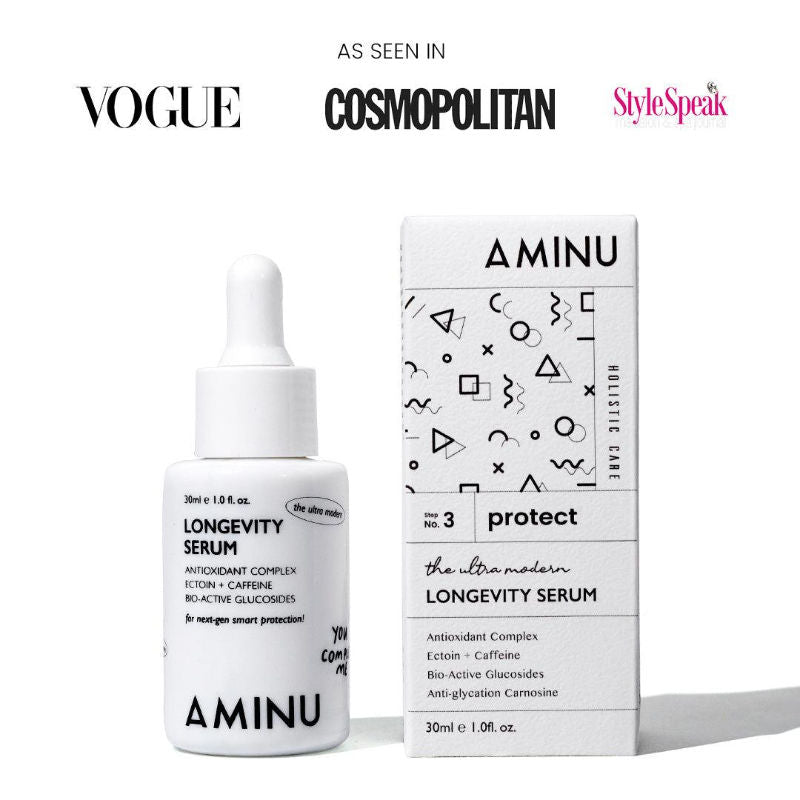

Aminu Wellness Pvt Ltd
Aminu Longevity Serum (10 ml)

Aminu Longevity Serum (10 ml)
Aminu Wellness Pvt Ltd
aminu-longevity-serum-10-ml
Serum
10084987470117
Morning or Evening?
How often will you use this product?
Notes


Highlights
WHAT IS IT?
Longevity Serum with 25 ingredients
FEATURES
Contains caffeine and flavonoids for anti-pollution and skin longevity, hydrating humectants like hyaluronic acid and glycerine, rich in botanical extracts and bio-degradable stabilizers
BEST FOR
sensitive
CHECKS
No parabens, No sulfates, No silicones, No fragrances
Who Is It For?
Suitable For All Genders Recommended For Sensitive Skin UsersWhat Does It Help With?
Anti-pollution Skin Longevity Hydration Soothing Sensitive Skin Antioxidant ProtectionBudget
Premium ($76-$150)How To Use
Which routine should it be used in?
Instructions:
Key Information


What Aminu Wellness Pvt Ltd Says
Product Description:
Longevity Serum featuring Jasmine Officinale Floral Water, Coffee Seed Extract, Rutinyl Succinate, Siloxanetriol Alginate, Caffeine, and other botanicals designed for sensitive skin and anti-pollution benefits.
About the Brand:
Ingredients Overview
Ingredients List
Jasmine-Officinale-Floral-Water,Coffee-Seed-Extract,Rutinyl-Succinate,Siloxanetriol-Alginate,Caffeine,Butylene-Glycol,Decarboxy-Carnosine-HCl,Ascorbyl-Methylsilanol-Pectinate,Methylpropanediol,Caprylyl-Glycol,Phenylpropanol,Methylsilanol-Mannuronate,SilaneTriol,Hyaluronic-Acid,Niacinamide,Glycerine,Licorice-Root-Extract,Asafetida-Gum-Extract,Damiana-Leaf-Oil,Elderflower-Extract,Mulberry-Leaf-Extract,Grape-Seed-Extract,Uva-Ursi-Leaf-Extract,Sodium-Benzoate,Potassium-Sorbate,Trisodium-Ethylenediamine-Disuccinate,Hydroxypropyl-Starch-Phosphate,Xanthan-Gum
Key Ingredients
Jasmine Officinale Floral Water,Coffee Seed Extract,Caffeine,Hyaluronic Acid,Niacinamide
Ingredients Details
Caffeine
Common Name(s): Caffeine,methylxanthine anti-cellulite,antioxidant vasoactive
CAS Number: N/a
DESCRIPTION
What It Does: Stimulates lipolysis in adipocytes by inhibiting phosphodiesterase (preventing camp breakdown), reduces eye puffiness through vasoconstriction of periorbital capillaries, and provides antioxidant dna repair stimulation for photoprotective benefit.
Why It's Used: The only cosmetic active with a well-defined mechanism for anti-cellulite claims — phosphodiesterase inhibition elevating adipocyte camp is the documented biochemical pathway, providing mechanism-based efficacy substantiation superior to most slimming actives.
How It Works: Caffeine inhibits phosphodiesterase (pde3, pde4) preventing camp hydrolysis → elevated camp activates protein kinase a → phosphorylates hormone-sensitive lipase → lipolysis of triglycerides in adipocytes. for eye puffiness: caffeine's adenosine receptor antagonism reduces prostaglandin-mediated capillary dilation in periorbital tissue, reducing fluid accumulation.
Typically Found In: Anti-cellulite,eye creams,antioxidant products
TECHNICAL DETAILS
Primary Category: Active ingredient – antioxidant
Secondary Functions: Free radical scavenging,anti-aging
Application Areas:

Facial Skincare
Body Care

Hair Care
Beard Care
Color Cosmetics (Makeup)
Dietary/Oral Supplements
Typical Concentration Range: 0.1%–3%
SOURCING & ETHICS
Vegan Status: Yes
Halal Status: Yes
Source Notes: Plant-derived extract or synthetic.
SKIN COMPATIBILITY
Irritancy Rating: 1/5 – very low
Comedogenicity Rating: 0/5 – non-comedogenic
Sensitivity Concerns: Non-irritating; well-tolerated.
Safe for Sensitive Skin: Yes
SAFETY & COMPATIBILITY
Safety Profile: Excellent safety profile. ewg score: 1.
Works Well With: Vitamin c,vitamin e,ferulic acid,spf,other antioxidants
Avoid Combining With: No significant incompatibilities
SCIENTIFIC NOTE
Caffeine has one of the highest sc penetration rates of any cosmetic active (logp -0.07, mw 194 da) — the combination of small size and moderate logp providing excellent aqueous solubility with sufficient sc lipid partitioning for effective transdermal delivery to adipose tissue.
Last Verified: Cosing database,caffeine pde inhibitor anti-cellulite lipolysis review
Primary Sources: 2026-03-12
Glycerine
Common Name(s): Glycerin,universal humectant,water-binding skin conditioning
CAS Number: N/a
DESCRIPTION
What It Does: Attracts and retains moisture in the sc, improves skin barrier function at low concentrations, provides gentle keratolytic softening, and acts as a co-solvent for water-soluble actives.
Why It's Used: The reference humectant — lowest cost, best safety profile, universal formulation compatibility, and present naturally in the sc via lipase-mediated glycerolipid hydrolysis makes glycerin the industry standard against which all humectants are benchmarked.
How It Works: Three hydroxyl groups form 6 h-bonds with water molecules per glycerol unit — the highest oh-group density per carbon of any commercial humectant. glycerin also down-regulates epidermal serine proteases that overactivate in dry sc, improving desquamation and barrier integrity.
Typically Found In: All cosmetics,universal
TECHNICAL DETAILS
Primary Category: Functional ingredient – humectant
Secondary Functions: Tewl reduction,skin plumping
Application Areas:
Facial Skincare
Body Care
Hair Care
Beard Care
Color Cosmetics (Makeup)
Dietary/Oral Supplements
Typical Concentration Range: 1%–40%
SOURCING & ETHICS
Vegan Status: Yes
Halal Status: Yes
Source Notes: Synthetic or naturally derived. excellent aqueous solubility.
SKIN COMPATIBILITY
Irritancy Rating: 1/5 – very low
Comedogenicity Rating: 0/5 – non-comedogenic
Sensitivity Concerns: Non-irritating; suitable for all skin types.
Safe for Sensitive Skin: Yes
SAFETY & COMPATIBILITY
Safety Profile: Excellent safety profile. ewg score: 1.
Works Well With: Ceramides,emollients,occlusives,glycerin,hyaluronic acid
Avoid Combining With: No significant incompatibilities
SCIENTIFIC NOTE
Epidermal lipases hydrolyse sc glycerophospholipids during cornification, releasing glycerol that contributes to the natural nmf — topical glycerin directly supplements this endogenous sc humectant pool.
Last Verified: Cosing database,glycerin universal humectant review
Primary Sources: 2026-03-12
Methylpropanediol
Common Name(s): 1,3-butylene glycol alternative,2-methyl-1,3-propanediol,proline-2-propanediol
CAS Number: 2163-42-0
DESCRIPTION
What It Does: Provides humectant and solvent functionality with improved skin feel vs butylene glycol.
Why It's Used: Premium humectant solvent with superior skin feel to conventional diols for elegant premium formulation textures.
How It Works: Branched c4 structure provides good humectant activity. branching reduces viscosity and stickiness vs linear propylene glycol. excellent solvent for challenging actives. antimicrobial boosting from diol structure.
Typically Found In: Premium serums,active delivery systems
TECHNICAL DETAILS
Primary Category: Functional ingredient – humectant
Secondary Functions: Tewl reduction,skin plumping
Application Areas:
Facial Skincare
Body Care
Hair Care
Beard Care
Color Cosmetics (Makeup)
Dietary/Oral Supplements
Typical Concentration Range: 1%–10%
SOURCING & ETHICS
Vegan Status: Yes – synthetic
Halal Status: Yes
Source Notes: Synthetic or naturally derived. excellent aqueous solubility.
SKIN COMPATIBILITY
Irritancy Rating: 1/5 – very low
Comedogenicity Rating: 0/5 – non-comedogenic
Sensitivity Concerns: Non-irritating; suitable for all skin types.
Safe for Sensitive Skin: Yes
SAFETY & COMPATIBILITY
Safety Profile: Excellent safety profile. ewg score: 1.
Works Well With: Ceramides,emollients,occlusives,glycerin,hyaluronic acid
Avoid Combining With: No significant incompatibilities
SCIENTIFIC NOTE
Methylpropanediol's methyl branch provides a 25% reduction in dynamic viscosity vs linear butylene glycol at equivalent concentration — a physically measurable skin feel improvement from the branching's reduction of intermolecular attractive forces. this viscosity reduction translates directly to the 'less sticky, lighter' skin feel that premium formulations require.
Last Verified: Cosing database,cir safety assessment
Primary Sources: 2026-03-12
Niacinamide
Common Name(s): Vitamin b3,nicotinamide,pyridine-3-carboxamide
CAS Number: 98-92-0
DESCRIPTION
What It Does: Niacinamide strengthens the skin barrier, reduces visible pore size, regulates sebum production, fades dark spots, and improves skin texture and tone.
Why It's Used: It is used because it addresses multiple skin concerns at once without irritation, making it suitable for all skin types. it is stable in formulations and pairs well with most other actives.
How It Works: Niacinamide inhibits the transfer of melanosomes (pigment packets) to skin cells, reducing hyperpigmentation. it also stimulates ceramide synthesis to strengthen the skin barrier and reduces inflammation by modulating cytokine activity.
Typically Found In: Serums,moisturizers,toners,cleansers,eye creams,sunscreens,primers
TECHNICAL DETAILS
Primary Category: Active ingredient – vitamin
Secondary Functions: Barrier repair,brightening,anti-inflammatory
Application Areas:
Facial Skincare
Body Care
Hair Care
Beard Care
Color Cosmetics (Makeup)
Dietary/Oral Supplements
Typical Concentration Range: 2%–10% (typical: 5%; higher concentrations may cause flushing in some individuals)
SOURCING & ETHICS
Vegan Status: Yes – synthetically produced
Halal Status: Yes – synthetic origin
Source Notes: Commercially produced via synthesis from nicotinic acid or 3-cyanopyridine. no animal-derived sources used in cosmetic-grade niacinamide.
SKIN COMPATIBILITY
Irritancy Rating: 1/5 – very low; concentrations above 10% may cause temporary flushing in sensitive individuals
Comedogenicity Rating: 0/5 – non-comedogenic
Sensitivity Concerns: At concentrations >10%, some users experience niacin flush (transient redness/tingling). generally very well-tolerated.
Safe for Sensitive Skin: Yes – one of the best-tolerated actives for sensitive skin
SAFETY & COMPATIBILITY
Safety Profile: Extensively studied and considered very safe. ewg hazard score: 1. no significant systemic toxicity concerns at topical concentrations.
Works Well With: Retinol,peptides,ahas/bhas,hyaluronic acid,ceramides,zinc,vitamin c,spf
Avoid Combining With: High concentrations of vitamin c (ascorbic acid) may theoretically convert to niacin – use at different times if using pure l-ascorbic acid above 15%
SCIENTIFIC NOTE
Niacinamide is a precursor to nad+ and nadp+, coenzymes vital to cellular energy metabolism. its benefits for dna repair and mitochondrial function make it a key ingredient in anti-aging strategies.
Last Verified: Cosing database,cir safety assessment,ewg skin deep,pubmed clinical studies
Primary Sources: 2026-03-12
