

Earth Harbor Naturals
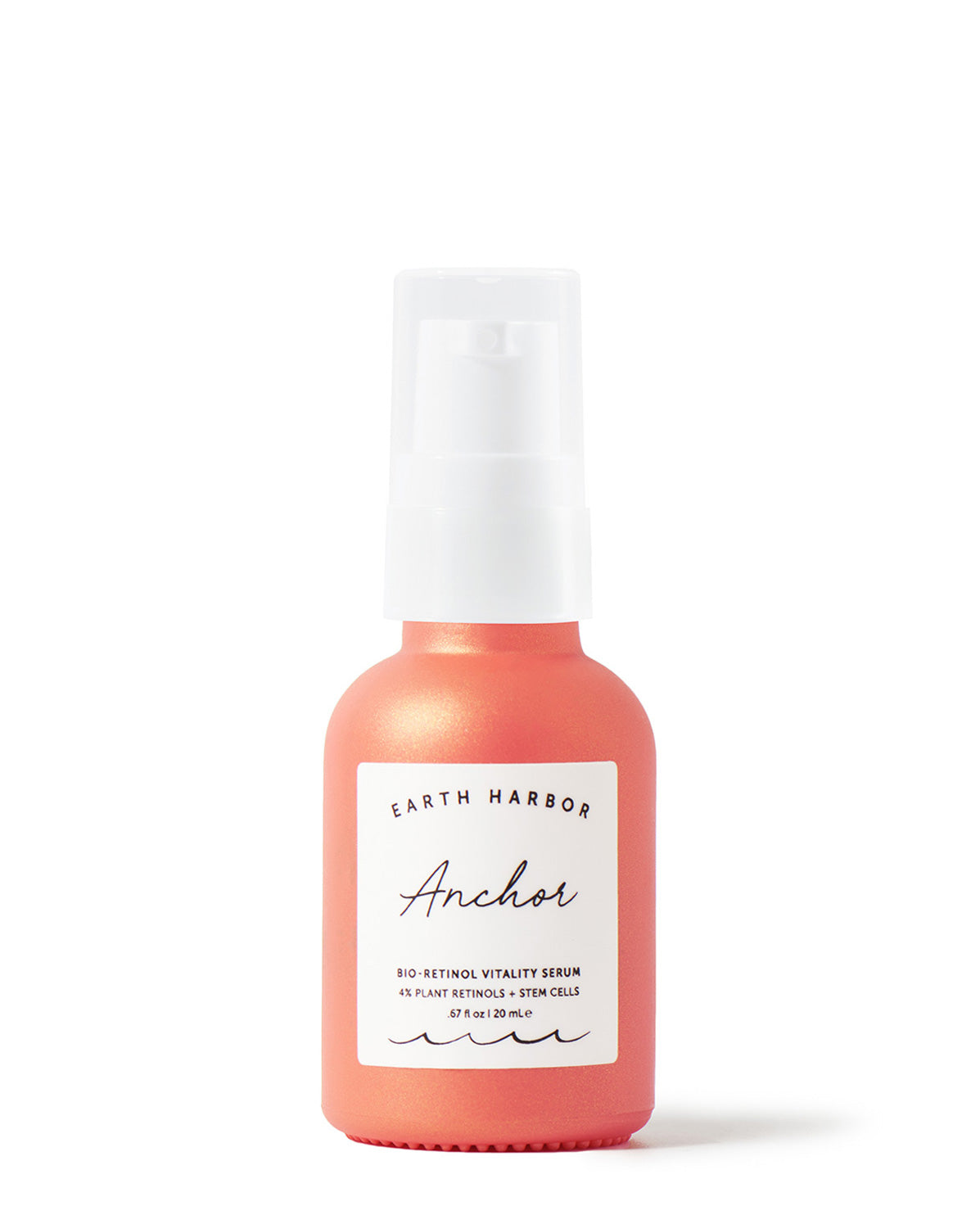
ANCHOR Bio-Retinol Vitality Serum

ANCHOR Bio-Retinol Vitality Serum
Earth Harbor Naturals
anchor-bio-retinol-vitality-serum
Serum
9818335379749
Morning or Evening?
How often will you use this product?
Notes


Highlights
WHAT IS IT?
Bio-Retinol Serum with 4% plant retinol alternatives
FEATURES
Natural retinol alternative, Smooths lines, Promotes youthful glow, Boosts complexion, Brightens, Hydrates
BEST FOR
combination
CHECKS
No Nasty Synthetics, No Gluten Added, No Soy Added, No Fillers
Who Is It For?
All AdultsWhat Does It Help With?
Fine Lines Wrinkles Uneven Skin Tone Collagen Production Rough Texture DullnessBudget
Affordable (under $30)How To Use
Which routine should it be used in?
Instructions:
Key Information


What Earth Harbor Naturals Says
Product Description:
Anchor your skin in restored radiance with Anchor Bio-Retinol Vitality Serum. With 4% plant retinol alternatives, including 8 powerful types, enjoy transformative effects. Unlike retinoids, experience a soothing yet potent solution that lighthouses skin in nature's unparalleled vitality.
About the Brand:
Ingredients Overview
Ingredients List
aqua, propanediol, isoamyl-laurate, coco-caprylate-caprate, bakuchiol, psoralea-corylifolia-seed-oil, citrus-aurantium-dulcis-callus-culture-extract, astaxanthin, litchi-chinensis-fruit-extract, rosa-canina-seed-oil
Key Ingredients
Bakuchiol, Babchi, Citrus Stem Cells, Lychee, Astaxanthin, Rosehip, Sea Buckthorn, Herbal Ursolic Acid
Ingredients Details
Astaxanthin
Common Name(s): 3,3'-dihydroxy-beta-carotene-4,4'-dione,ketocarotenoid
CAS Number: 472-61-7
DESCRIPTION
What It Does: Provides the most powerful natural antioxidant activity from the unique membrane-spanning ketocarotenoid.
Why It's Used: Maximum natural antioxidant — astaxanthin's unmatched singlet oxygen quenching capacity from marine microalgae provides superior photodamage prevention per unit applied.
How It Works: Unique spanning carotenoid structure crosses membrane bilayer quenching radicals at both inner and outer membrane surfaces simultaneously. singlet oxygen quenching kq ~3×10¹⁰ l/mol/s — highest of all carotenoids. 11 conjugated double bonds for exceptional electron transfer. inhibits nf-kb for anti-inflammatory activity.
Typically Found In: Premium anti-aging serums,sunscreen boosters,photoprotection products
TECHNICAL DETAILS
Primary Category: Active ingredient – antioxidant
Secondary Functions: Free radical scavenging,anti-aging
Application Areas:

Facial Skincare
Body Care

Hair Care
Beard Care
Color Cosmetics (Makeup)
Dietary/Oral Supplements
Typical Concentration Range: 0.01%–0.2%
SOURCING & ETHICS
Vegan Status: Conditional - supplier confirmation required
Halal Status: Unverified - supplier confirmation required
Source Notes: Plant-derived extract or synthetic. [audit 2026-07-29 rev2: status downgraded on audit. determination requires shariah-panel sign-off.]
SKIN COMPATIBILITY
Irritancy Rating: 1/5 – very low
Comedogenicity Rating: 0/5
Sensitivity Concerns: Non-irritating; well-tolerated.
Safe for Sensitive Skin: Yes
SAFETY & COMPATIBILITY
Safety Profile: Excellent safety profile. ewg score: 1.
Works Well With: Vitamin c,vitamin e,ferulic acid,spf,other antioxidants
Avoid Combining With: No significant incompatibilities
SCIENTIFIC NOTE
Astaxanthin's membrane-spanning structural uniqueness: its 3.6nm molecular length exactly spans a phospholipid bilayer membrane, allowing simultaneous quenching of radicals at both membrane surfaces. no other known antioxidant achieves this dual-surface protection — the structural basis for astaxanthin's extraordinary antioxidant potency.
Last Verified: 2026-03-12
Primary Sources: Cosing database,naguib astaxanthin antioxidant comparison study
Bakuchiol
Common Name(s): Bakuchiol,(s)-bakuchiol
CAS Number: 10309-37-2
DESCRIPTION
What It Does: Provides retinol-equivalent anti-aging gene expression from a natural plant compound without retinol's limitations.
Why It's Used: The natural retinol alternative — the first plant compound with rct evidence for equivalent anti-aging results to retinol with better safety and photostability.
How It Works: Bakuchiol activates rar beta and retinoid x receptors via allosteric binding mechanism. upregulates type i, iii, and iv collagen synthesis genes. downregulates mmp-1 and mmp-9. antioxidant via phenol radical scavenging. photostable — stable to uv exposure unlike retinol.
Typically Found In: Natural anti-aging serums,pregnancy-safe retinol alternative,photostable anti-aging
TECHNICAL DETAILS
Primary Category: Active ingredient – natural retinol alternative
Secondary Functions: Free radical scavenging,anti-aging
Application Areas:
Facial Skincare
Body Care
Hair Care
Beard Care
Color Cosmetics (Makeup)
Dietary/Oral Supplements
Typical Concentration Range: 0.5%–2%
SOURCING & ETHICS
Vegan Status: Conditional - supplier confirmation required
Halal Status: Unverified - supplier confirmation required
Source Notes: Plant-derived extract or synthetic. [audit 2026-07-29 rev2: status downgraded on audit. determination requires shariah-panel sign-off.]
SKIN COMPATIBILITY
Irritancy Rating: 1/5 – very low
Comedogenicity Rating: 0/5 – non-comedogenic
Sensitivity Concerns: Non-irritating; well-tolerated.
Safe for Sensitive Skin: Yes
SAFETY & COMPATIBILITY
Safety Profile: Excellent safety profile. ewg score: 1.
Works Well With: Vitamin c,vitamin e,ferulic acid,spf,other antioxidants
Avoid Combining With: No significant incompatibilities
SCIENTIFIC NOTE
The dhaliwal et al. (2019, british journal of dermatology) split-face rct directly compared 0.5% bakuchiol vs 0.5% retinol twice daily for 12 weeks — both groups showed equivalent reduction in fine lines and wrinkles, but bakuchiol showed significantly less scaling, stinging, and burning. this is the strongest evidence that bakuchiol provides retinol-equivalent anti-aging with better tolerability.
Last Verified: 2026-03-12
Primary Sources: Cosing database,dhaliwal et al. bakuchiol vs retinol rct
Citrus Aurantium Dulcis Callus Culture Extract
Common Name(s): Citrus aurantium dulcis callus culture extract,citrus aurantium dulcis callus culture extract,plant cell biotechnology,in-vitro standardised active
CAS Number: N/a
DESCRIPTION
What It Does: Delivers standardised plant secondary metabolites with quantifiable bioactivity — consistent batch-to-batch composition enabling reliable clinical claim substantiation.
Why It's Used: In-vitro biotechnology provides pharmaceutical-grade standardisation — eliminating the 3-10× compositional variation of field-grown botanical raw materials.
How It Works: Cell culture under elicitation stress (uv, methyl jasmonate, yeast elicitor) activates secondary metabolite biosynthesis pathways — producing 2-10× the active metabolite concentration of field-grown plants in a controlled environment.
Typically Found In: Premium actives,sustainable beauty
TECHNICAL DETAILS
Primary Category: Active ingredient – antioxidant
Secondary Functions: Free radical scavenging,anti-aging
Application Areas:
Facial Skincare
Body Care
Hair Care
Beard Care
Color Cosmetics (Makeup)
Dietary/Oral Supplements
Typical Concentration Range: 0.1%–5%
SOURCING & ETHICS
Vegan Status: Yes
Halal Status: Yes
Source Notes: Plant-derived extract or synthetic.
SKIN COMPATIBILITY
Irritancy Rating: 1/5 – very low
Comedogenicity Rating: 0/5 – non-comedogenic
Sensitivity Concerns: Non-irritating; well-tolerated.
Safe for Sensitive Skin: Yes
SAFETY & COMPATIBILITY
Safety Profile: Excellent safety profile. ewg score: 1.
Works Well With: Vitamin c,vitamin e,ferulic acid,spf,other antioxidants
Avoid Combining With: No significant incompatibilities
SCIENTIFIC NOTE
Biotechnology enables cosmetic use of actives from rare, protected, or slow-growing plants through sustainable in-vitro production.
Last Verified: 2026-03-22
Primary Sources: Cosing database,citrus aurantium dulcis callus cult plant cell biotechnology review
Coco Caprylate/caprate
Common Name(s): Coco caprylate/caprate
DESCRIPTION
What It Does: Smooths and softens skin by filling intercorneocyte spaces, reducing friction, and providing a pleasant aesthetic skin feel in formulations.
Why It's Used: Synthetic esters provide tailored aesthetic properties — spreadability, skin feel, volatility, refractive index — that natural oils alone cannot consistently deliver.
How It Works: The ester molecule fills microscopic surface irregularities between corneocytes, reducing coefficient of friction, reflecting light uniformly, and providing a lubrication layer that protects the skin surface.
Typically Found In: Moisturizers,sunscreens,color cosmetics,body lotions,lip products
TECHNICAL DETAILS
Primary Category: Synthetic emollients
Secondary Functions: Emollient
Application Areas:
Facial Skincare
Body Care
Hair Care
Beard Care
Color Cosmetics (Makeup)
Dietary/Oral Supplements
Typical Concentration Range: 1–20%
SOURCING & ETHICS
Vegan Status: Conditional - feedstock declaration required
Halal Status: Unverified - feedstock declaration required (plant, animal and petrochemical routes all exist)
Source Notes: Synthetically produced ester emollient; no animal components. [audit 2026-07-29 rev2: origin-dependent: the same inci exists in plant, animal and petrochemical versions and the name does not discriminate. determination requires shariah-panel sign-off.]
SKIN COMPATIBILITY
Irritancy Rating: 1
Comedogenicity Rating: 1
Sensitivity Concerns: Low sensitization potential at recommended use concentrations.
Safe for Sensitive Skin: Yes
SAFETY & COMPATIBILITY
Safety Profile: Well-characterized cosmetic ingredient with established safety profile. generally non-irritating at typical use concentrations. suitable for leave-on and rinse-off cosmetics.
Works Well With: Silicones,uv filters,other emollients
Avoid Combining With: Strongly alkaline conditions (risk of saponification of ester-type emollients)
SCIENTIFIC NOTE
The spreading coefficient of an emollient is governed by its surface tension, viscosity, and polarity. esters with branched alkyl chains (e.g., isopropyl, isostearyl) spread rapidly and leave a non-tacky film; linear long-chain esters provide more substantive moisturization. hlb value determines the preferred formulation system (w/o vs o/w emulsions).
Last Verified: 2025-01-15
Primary Sources: Cosing eu database; pcpc cosmetic ingredient safety reviews; ingredient-specific safety and efficacy literature