
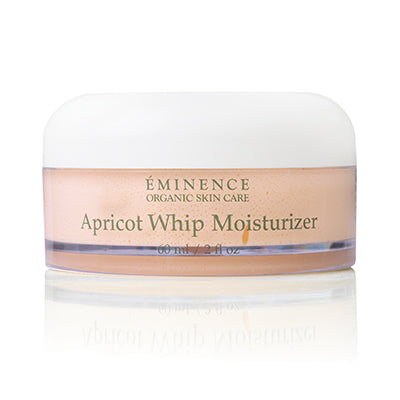

Eminence Organic Skin Care
Apricot Whip Moisturizer

Apricot Whip Moisturizer
Eminence Organic Skin Care
apricot-whip-moisturizer
Moisturize
9628194930981
Morning or Evening?
How often will you use this product?
Notes


Highlights
WHAT IS IT?
Moisturizer
FEATURES
Revitalizing, hydrating, age-defying, enriching, nourishing
BEST FOR
All skin types
CHECKS
Does not contain parabens, phthalates, sodium lauryl sulfate, propylene glycol
Who Is It For?
Adults Women And MenWhat Does It Help With?
Revitalizing Complexion Hydration Anti-agingBudget
Mid-rangeHow To Use
Which routine should it be used in?
Instructions:
Key Information


What Eminence Organic Skin Care Says
Product Description:
Revitalize your complexion with the power of pure apricot and carrot juice, infused with healthy doses of vitamins A, B, C and D. The age-defying properties of apricot will enrich and nourish your skin, giving it the appearance of a youthful glow.
About the Brand:
Ingredients Overview
Ingredients List
Apricot Pulp, Aloe Juice, Apple Juice, Apple Pulp, Grape Juice, Grape Pulp, Seabuckthorn Berry Juice, Calendula Officinalis Flower Oil, Sunflower Seed Oil, Apricot Kernel Oil, Calendula Officinalis Flower Extract, Yarrow Extract, Red Clover Flower Extract, Echinacea Root Extract, Rosemary Leaf Extract, Vegetable Glycerin, Vitamin E and Vegetable Heptyl Glucoside], Stearic Acid, Corn Germ Oil, Vegetable Glycerin, Cetearyl Alcohol, Sodium Cetearyl Sulfate, Paprika Extract, Tara Tree Gum, Vegetable Glycerin, Apricot Juice, Coco Caprylate/Caprate, Glyceryl Stearate, Carrot Root Extract, Shea Butter, Vitamin E, Benzyl Alcohol, Dehydroacetic Acid, Undecane, Tridecane, Sodium Salicylate, Vegetable Squalane, Xanthan Gum, Lactic Acid, Sodium Benzoate, Potassium Sorbate, Vitamin C Ester, Soy Lecithin, Biocomplex2™ [Acai, Lemon, Barbados Cherry, Indian Gooseberry, Baobab, Camu Camu, Carrot, Coconut Water, Goji Berry, Tapioca Starch (from Cassava Root), Alpha Lipoic Acid and Coenzyme Q10
Key Ingredients
Apricot, Carrot, Corn Germ Oil, Biocomplex2™
Ingredients Details
Aloe Juice
Common Name(s): Aloe juice,cosmetic active,functional ingredient
CAS Number: N/a
DESCRIPTION
What It Does: Delivers characteristic cosmetic function — skin conditioning, protection, preservation, or active biological benefit — at recommended use concentration.
Why It's Used: Selected for its functional contribution and formulation compatibility — supported by cosmetic science literature and regulatory safety assessment.
How It Works: Works through the mechanism of its molecular class — physicochemical interaction with the formulation or biological interaction with skin proteins, lipids, or receptors as documented in peer-reviewed literature.
Typically Found In: Skin care formulations
TECHNICAL DETAILS
Primary Category: Active ingredient – cosmetic active
Secondary Functions: Skin conditioning
Application Areas:

Facial Skincare

Body Care
Hair Care
Beard Care
Color Cosmetics (Makeup)
Dietary/Oral Supplements
Typical Concentration Range: 0.1%–10%
SOURCING & ETHICS
Vegan Status: Conditional
Halal Status: Yes
Source Notes: Commercially produced for cosmetic use. verify vegan/halal status with supplier.
SKIN COMPATIBILITY
Irritancy Rating: 1/5 – very low
Comedogenicity Rating: 0/5 – non-comedogenic
Sensitivity Concerns: Well-tolerated by most skin types.
Safe for Sensitive Skin: Yes
SAFETY & COMPATIBILITY
Safety Profile: Good safety profile at recommended concentrations. ewg score: 1–2.
Works Well With: Standard skincare actives
Avoid Combining With: No known significant incompatibilities
SCIENTIFIC NOTE
Aloe juice delivers documented functional benefit with an established safety profile within the cosmetic regulatory framework (cosing eu, cir usa).
Last Verified: Cosing database,aloe juice technical literature
Primary Sources: 2026-03-12
Apricot Kernel Oil
Common Name(s): Apricot kernel oil,botanical carrier oil,emollient fatty acid delivery
CAS Number: N/a
DESCRIPTION
What It Does: Softens and conditions skin by integrating into sc lipid bilayers, delivers essential fatty acids (oleic, linoleic, linolenic) for barrier lipid synthesis, and provides rich, non-stripping moisturisation.
Why It's Used: Natural carrier oils provide the closest compositional match to endogenous sc lipids, delivering emolliency through genuine barrier integration rather than simple surface occlusion.
How It Works: Fatty acid triglycerides partition into sc lipid bilayers — oleic acid (c18:1) provides fluid, emollient integration; linoleic acid (c18:2) acts as essential ceramide precursor; saturated fatty acids provide more occlusive barrier reinforcement.
Typically Found In: Moisturisers,facial oils,natural skin care
TECHNICAL DETAILS
Primary Category: Functional ingredient – emollient
Secondary Functions: Barrier sealing,softening
Application Areas:
Facial Skincare
Body Care
Hair Care
Beard Care
Color Cosmetics (Makeup)
Dietary/Oral Supplements
Typical Concentration Range: 1%–100%
SOURCING & ETHICS
Vegan Status: Conditional
Halal Status: Yes
Source Notes: Plant-derived, synthetic or animal-derived. verify source.
SKIN COMPATIBILITY
Irritancy Rating: 1/5 – very low
Comedogenicity Rating: 1/5 – low; formulation-dependent
Sensitivity Concerns: Non-irritating.
Safe for Sensitive Skin: Yes
SAFETY & COMPATIBILITY
Safety Profile: Excellent safety profile. ewg score: 1.
Works Well With: Humectants,ceramides,actives as carrier
Avoid Combining With: No significant incompatibilities
SCIENTIFIC NOTE
Essential fatty acids — linoleic (c18:2, n-6) and α-linolenic (c18:3, n-3) acids — cannot be synthesised by the body; topical delivery through carrier oils provides direct substrate for ceramide and eicosanoid biosynthesis in the epidermis.
Last Verified: Cosing database,apricot kernel oil carrier oil botanical review
Primary Sources: 2026-03-12
Calendula Officinalis Flower Oil
Common Name(s): Calendula officinalis flower oil,botanical oil/butter,phytochemical active
CAS Number: N/a
DESCRIPTION
What It Does: Provides emollient conditioning, essential fatty acid supplementation, and barrier lipid support.
Why It's Used: Natural carrier oils integrate into sc lipid bilayers for genuine barrier emolliency.
How It Works: Fatty acid triglycerides deliver oleic, linoleic, and linolenic acids for sc integration and essential fatty acid barrier repair.
Typically Found In: Botanical skin care
TECHNICAL DETAILS
Primary Category: Active ingredient – antioxidant
Secondary Functions: Free radical scavenging,anti-aging
Application Areas:
Facial Skincare
Body Care
Hair Care
Beard Care
Color Cosmetics (Makeup)
Dietary/Oral Supplements
Typical Concentration Range: 0.1%–30%
SOURCING & ETHICS
Vegan Status: Conditional
Halal Status: Conditional
Source Notes: Plant-derived extract or synthetic.
SKIN COMPATIBILITY
Irritancy Rating: 1/5 – very low
Comedogenicity Rating: 0/5 – non-comedogenic
Sensitivity Concerns: Non-irritating; well-tolerated.
Safe for Sensitive Skin: Yes
SAFETY & COMPATIBILITY
Safety Profile: Excellent safety profile. ewg score: 1.
Works Well With: Vitamin c,vitamin e,ferulic acid,spf,other antioxidants
Avoid Combining With: No significant incompatibilities
SCIENTIFIC NOTE
Plant secondary metabolites evolved for uv photoprotection and pathogen defence — mechanisms directly translatable to cosmetic antioxidant and anti-inflammatory activity in human skin.
Last Verified: Cosing database,calendula officinalis flower oil botanical review
Primary Sources: 2026-03-12
Sunflower Seed Oil
Common Name(s): Sunflower seed oil,botanical oil/butter,phytochemical active
CAS Number: N/a
DESCRIPTION
What It Does: Provides emollient conditioning, essential fatty acid supplementation, and barrier lipid support from the natural triglyceride/wax ester composition.
Why It's Used: Natural carrier oils provide sc-compatible lipid composition for genuine barrier integration rather than surface-only occlusion.
How It Works: Fatty acid triglycerides integrate into sc lipid bilayers delivering oleic, linoleic, and linolenic acid for emolliency and barrier repair; essential fatty acids serve as ceramide biosynthesis precursors.
Typically Found In: Botanical skin care,natural products
TECHNICAL DETAILS
Primary Category: Active ingredient – antioxidant
Secondary Functions: Free radical scavenging,anti-aging
Application Areas:
Facial Skincare
Body Care
Hair Care
Beard Care
Color Cosmetics (Makeup)
Dietary/Oral Supplements
Typical Concentration Range: 0.1%–30%
SOURCING & ETHICS
Vegan Status: Conditional
Halal Status: Conditional
Source Notes: Plant-derived extract or synthetic.
SKIN COMPATIBILITY
Irritancy Rating: 1/5 – very low
Comedogenicity Rating: 0/5 – non-comedogenic
Sensitivity Concerns: Non-irritating; well-tolerated.
Safe for Sensitive Skin: Yes
SAFETY & COMPATIBILITY
Safety Profile: Excellent safety profile. ewg score: 1.
Works Well With: Vitamin c,vitamin e,ferulic acid,spf,other antioxidants
Avoid Combining With: No significant incompatibilities
SCIENTIFIC NOTE
Plant secondary metabolites evolved for uv photoprotection and pathogen defence — mechanisms directly applicable to cosmetic antioxidant and anti-inflammatory activity in human skin.
Last Verified: Cosing database,sunflower seed oil botanical review
Primary Sources: 2026-03-12
