

Josie Maran Cosmetics
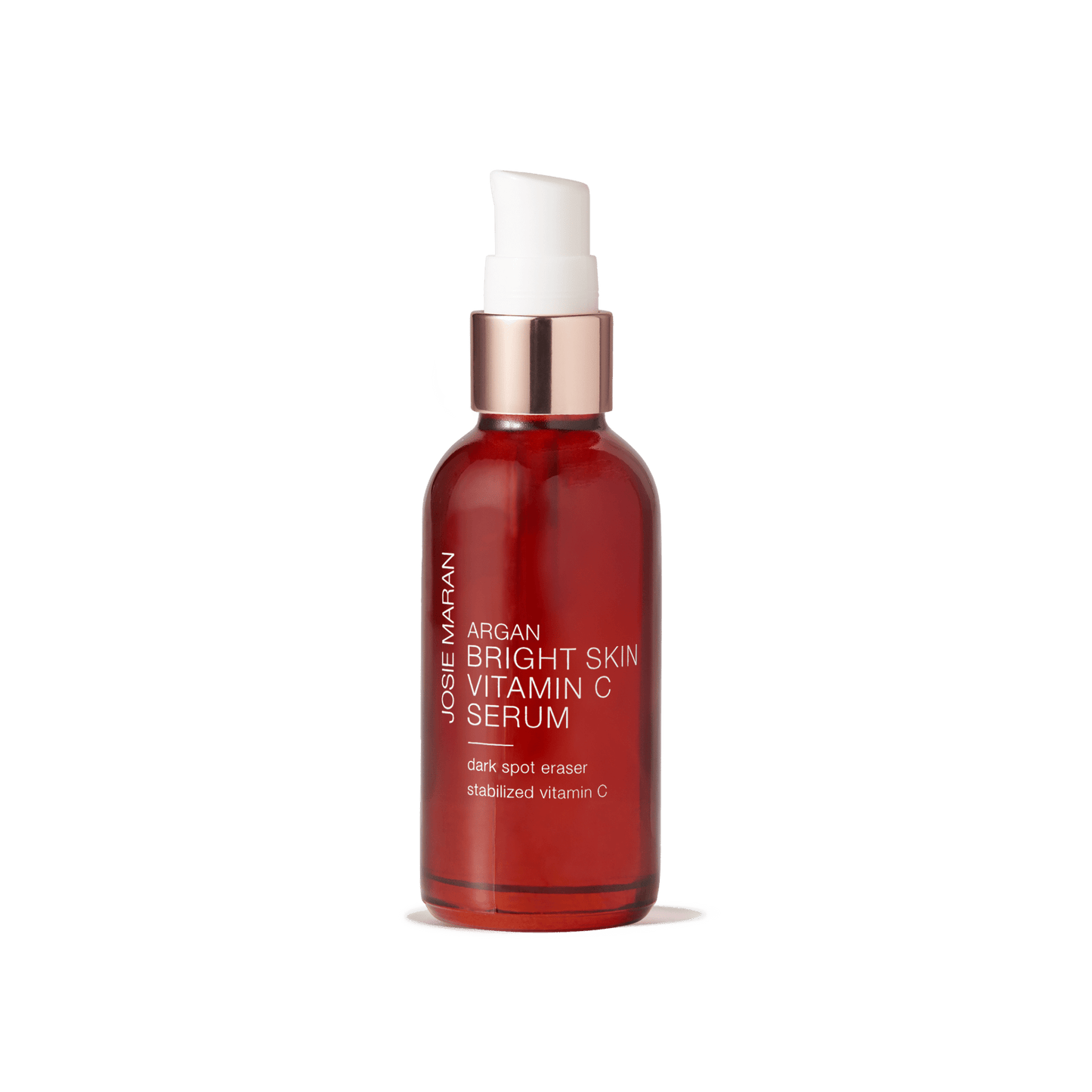
Argan Bright Skin Vitamin C Serum

Argan Bright Skin Vitamin C Serum
Josie Maran Cosmetics
argan-bright-skin-vitamin-c-serum
Serum
9628171600165
Morning or Evening?
How often will you use this product?
Notes


Highlights
WHAT IS IT?
Vitamin C serum with Argan Oil
FEATURES
Bioavailable vitamin C, hydrating, brightening, evens skin tone
BEST FOR
All skin types
CHECKS
Paraben-free, Synthetic fragrance-free
Who Is It For?
Adults Women And MenWhat Does It Help With?
Dullness Uneven Skin Tone Dark SpotsBudget
PremiumHow To Use
Which routine should it be used in?
Instructions:
Key Information


What Josie Maran Cosmetics Says
Product Description:
This revitalizing serum brightens dullness, evens tone, and fades dark spots with vitamin C and Argan Oil.
About the Brand:
Ingredients Overview
Ingredients List
Argania Spinosa (Argan) Kernel Oil, Coconut Alkanes, Oleyl Lactate, Octyldodecyl PCA, Dimethyl Isosorbide, Glyceryl Oleate, Tetrahexyldecyl Ascorbate, Isostearyl Lactate, Coco-Caprylate/Caprate, Brassica Campestris (Rapeseed) Seed Oil, Bisabolol, Squalane, Pterocarpus Marsupium Bark Extract, Glycyrrhiza Glabra (Licorice) Root Extract, Polyglyceryl-3 Diisostearate, Althaea Officinalis Root Extract, Oryza Sativa (Rice) Bran Extract, Dunaliella Salina Extract, Olea Europaea (Olive) Fruit Oil, AQUA, Phloretin.
Key Ingredients
Argan Oil, Bioavailable Vitamin C, Rice Bran Extract, Marshmallow Root Extract, Licorice Root Extract
Ingredients Details
Brassica Campestris (rapeseed) Seed Oil
Common Name(s): Brassica campestris (rapeseed) seed oil,botanical oil,phytochemical active
CAS Number: N/a
DESCRIPTION
What It Does: Provides antioxidant protection from reactive oxygen species, reduces inflammatory cytokine production in skin, and conditions skin surface through the plant's secondary metabolite complex.
Why It's Used: Chosen for its natural origin narrative, traditional use heritage, and multi-functional phytochemical profile that supports several concurrent skin care claims from one ingredient.
How It Works: Polyphenols, terpenoids, and alkaloids in the oil scavenge ros via hydrogen atom transfer, inhibit nf-kb or cox-2 inflammatory pathways, and interact with skin surface proteins for conditioning.
Typically Found In: Botanical skin care,natural products
TECHNICAL DETAILS
Primary Category: Active ingredient – antioxidant
Secondary Functions: Free radical scavenging,anti-aging
Application Areas:

Facial Skincare
Body Care

Hair Care
Beard Care
Color Cosmetics (Makeup)
Dietary/Oral Supplements
Typical Concentration Range: 0.1%–10%
SOURCING & ETHICS
Vegan Status: Yes
Halal Status: Yes
Source Notes: Plant-derived extract or synthetic.
SKIN COMPATIBILITY
Irritancy Rating: 1/5 – very low
Comedogenicity Rating: 0/5 – non-comedogenic
Sensitivity Concerns: Non-irritating; well-tolerated.
Safe for Sensitive Skin: Yes
SAFETY & COMPATIBILITY
Safety Profile: Excellent safety profile. ewg score: 1.
Works Well With: Vitamin c,vitamin e,ferulic acid,spf,other antioxidants
Avoid Combining With: No significant incompatibilities
SCIENTIFIC NOTE
Plant secondary metabolites evolved as uv photoprotectants and antimicrobial agents — mechanisms that directly translate to cosmetic antioxidant and anti-inflammatory activity in human skin.
Last Verified: 2026-03-12
Primary Sources: Cosing database,brassica campestris (rapeseed) seed botanical review
Coco Caprylate/caprate
Common Name(s): Coco caprylate/caprate
DESCRIPTION
What It Does: Smooths and softens skin by filling intercorneocyte spaces, reducing friction, and providing a pleasant aesthetic skin feel in formulations.
Why It's Used: Synthetic esters provide tailored aesthetic properties — spreadability, skin feel, volatility, refractive index — that natural oils alone cannot consistently deliver.
How It Works: The ester molecule fills microscopic surface irregularities between corneocytes, reducing coefficient of friction, reflecting light uniformly, and providing a lubrication layer that protects the skin surface.
Typically Found In: Moisturizers,sunscreens,color cosmetics,body lotions,lip products
TECHNICAL DETAILS
Primary Category: Synthetic emollients
Secondary Functions: Emollient
Application Areas:
Facial Skincare
Body Care
Hair Care
Beard Care
Color Cosmetics (Makeup)
Dietary/Oral Supplements
Typical Concentration Range: 1–20%
SOURCING & ETHICS
Vegan Status: Conditional - feedstock declaration required
Halal Status: Unverified - feedstock declaration required (plant, animal and petrochemical routes all exist)
Source Notes: Synthetically produced ester emollient; no animal components. [audit 2026-07-29 rev2: origin-dependent: the same inci exists in plant, animal and petrochemical versions and the name does not discriminate. determination requires shariah-panel sign-off.]
SKIN COMPATIBILITY
Irritancy Rating: 1
Comedogenicity Rating: 1
Sensitivity Concerns: Low sensitization potential at recommended use concentrations.
Safe for Sensitive Skin: Yes
SAFETY & COMPATIBILITY
Safety Profile: Well-characterized cosmetic ingredient with established safety profile. generally non-irritating at typical use concentrations. suitable for leave-on and rinse-off cosmetics.
Works Well With: Silicones,uv filters,other emollients
Avoid Combining With: Strongly alkaline conditions (risk of saponification of ester-type emollients)
SCIENTIFIC NOTE
The spreading coefficient of an emollient is governed by its surface tension, viscosity, and polarity. esters with branched alkyl chains (e.g., isopropyl, isostearyl) spread rapidly and leave a non-tacky film; linear long-chain esters provide more substantive moisturization. hlb value determines the preferred formulation system (w/o vs o/w emulsions).
Last Verified: 2025-01-15
Primary Sources: Cosing eu database; pcpc cosmetic ingredient safety reviews; ingredient-specific safety and efficacy literature
Coconut Alkanes
Common Name(s): Coconut alkanes,cosmetic active,functional ingredient
CAS Number: N/a
DESCRIPTION
What It Does: Delivers characteristic cosmetic function at recommended use concentration.
Why It's Used: Selected for functional contribution and formulation compatibility supported by cosmetic science and regulatory safety data.
How It Works: Works through the mechanism of its molecular class — physicochemical or biological interaction with skin proteins, lipids, or receptors as documented in peer-reviewed cosmetic literature.
Typically Found In: Skin care formulations
TECHNICAL DETAILS
Primary Category: Active ingredient – cosmetic active
Secondary Functions: Skin conditioning
Application Areas:
Facial Skincare
Body Care
Hair Care
Beard Care
Color Cosmetics (Makeup)
Dietary/Oral Supplements
Typical Concentration Range: 0.1%–10%
SOURCING & ETHICS
Vegan Status: Conditional - supplier confirmation required
Halal Status: Unverified - supplier confirmation required
Source Notes: Commercially produced for cosmetic use. verify vegan/halal status with supplier. [audit 2026-07-29 rev2: the record's own source_notes does not assert a non-animal origin, or instructs the reader to verify with the supplier; "yes" asserts knowledge the record does not hold. determination requires shariah-panel sign-off.]
SKIN COMPATIBILITY
Irritancy Rating: 1/5 – very low
Comedogenicity Rating: 0/5 – non-comedogenic
Sensitivity Concerns: Well-tolerated by most skin types.
Safe for Sensitive Skin: Yes
SAFETY & COMPATIBILITY
Safety Profile: Good safety profile at recommended concentrations. ewg score: 1–2.
Works Well With: Standard skincare actives
Avoid Combining With: No known significant incompatibilities
SCIENTIFIC NOTE
Coconut alkanes has an established safety and efficacy profile within the cosmetic regulatory framework at standard use concentrations.
Last Verified: 2026-03-12
Primary Sources: Cosing database,coconut alkanes technical literature
Dimethyl Isosorbide
Common Name(s): Dmi,isosorbide dimethyl ether,arlasolve dmi
CAS Number: 5306-85-4
DESCRIPTION
What It Does: Provides biocompatible penetration enhancement for improved active ingredient delivery.
Why It's Used: Biocompatible penetration enhancer from renewable sorbitol — dmi provides penetration enhancement without the toxicity of oleic acid or conventional chemical penetration enhancers.
How It Works: Cyclic ether from sorbitol is biocompatible and biodegradable. disrupts stratum corneum lipid packing via ether oxygen hydrogen bonding. solubilises challenging actives (retinoids, salicylic acid, ahas). enhances penetration 2–5× vs equivalent concentrations without dmi.
Typically Found In: Active delivery formulas,penetration-enhanced products,retinoid vehicles
TECHNICAL DETAILS
Primary Category: Functional ingredient – penetration-enhancing solvent
Secondary Functions: Skin conditioning
Application Areas:
Facial Skincare
Body Care
Hair Care
Beard Care
Color Cosmetics (Makeup)
Dietary/Oral Supplements
Typical Concentration Range: 1%–20%
SOURCING & ETHICS
Vegan Status: Conditional - supplier confirmation required
Halal Status: Unverified - supplier confirmation required
Source Notes: Commercially produced for cosmetic use. verify vegan/halal status with supplier. [audit 2026-07-29 rev2: the record's own source_notes does not assert a non-animal origin, or instructs the reader to verify with the supplier; "yes" asserts knowledge the record does not hold. determination requires shariah-panel sign-off.]
SKIN COMPATIBILITY
Irritancy Rating: 1/5 – very low
Comedogenicity Rating: 0/5 – non-comedogenic
Sensitivity Concerns: Well-tolerated by most skin types.
Safe for Sensitive Skin: Yes
SAFETY & COMPATIBILITY
Safety Profile: Good safety profile at recommended concentrations. ewg score: 1–2.
Works Well With: Standard skincare actives
Avoid Combining With: No known significant incompatibilities
SCIENTIFIC NOTE
Dmi's penetration enhancement mechanism differs from oleic acid's lipid disruption: dmi hydrogen bonds to stratum corneum proteins and lipids, temporarily creating more permeable protein-lipid domains without the membrane-fluidisation that causes oleic acid's irritation. this protein-hydrogen-bonding mechanism provides penetration enhancement from a different, gentler pathway.
Last Verified: 2026-03-12
Primary Sources: Cosing database,croda arlasolve dmi technical data,cir safety assessment