

Aroma Treasures
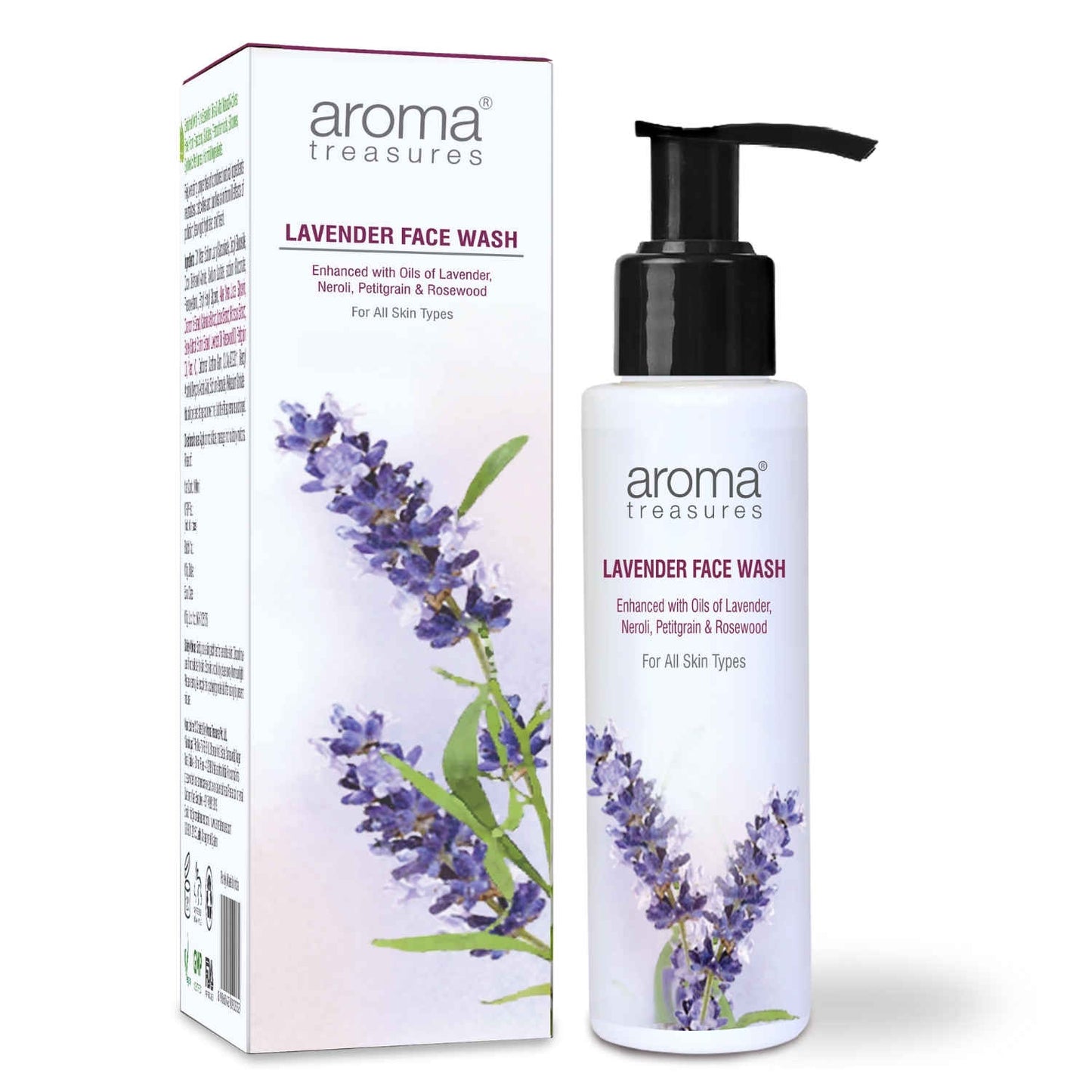
Aroma Treasures Lavender Face Wash (100 ml)

Aroma Treasures Lavender Face Wash (100 ml)
Aroma Treasures
aroma-treasures-lavender-face-wash-100-ml
Cleanse
10084969316645
Morning or Evening?
How often will you use this product?
Notes


Highlights
WHAT IS IT?
Face Wash with essential oils
FEATURES
Contains Neroli Petitgrain & Rosewood, Protects cell membranes, Neutralizes pollution effects, Removes impurities, Skin friendly ingredients, No synthetic perfumes, Not tested on animals
BEST FOR
normal
CHECKS
No synthetic perfumes, Not tested on animals
Who Is It For?
What Does It Help With?
Impurities Removal Skin Freshness Pollution ProtectionBudget
Affordable (under ₹30)How To Use
Which routine should it be used in?
Instructions:
Key Information


What Aroma Treasures Says
Product Description:
Aroma Treasures Lavender Face Wash comes with Neroli Petitgrain & Rosewood. Protects cell membrane, neutralizes ill effects of pollution. Removes all impurities and makes skin clean, fresh & smooth. Enriched with pure essential oils. No synthetic perfumes added. Skin friendly ingredients. Not tested on animals. Skin type: For all skin types.
About the Brand:
Ingredients Overview
Ingredients List
DM Water, Glycerin, Sodium Lauryl Sarcosinate, Lauryl Glucoside, Caprylyl / Capryl Glucoside, Coco Amido Propryl Betaine, Decyl Glucoside, Polyquaternium 39, Extracts of Aloe Vera, Chamomile, Lotus, Calendula, Hibiscus, Barley & Brahmi, Oils of Lavender, Neroli, Petitgrain & Rosewood, Carbomer, Phenoxyethanol, Sodium Benzoate, Potassium Sorbate, Benzyl Alcohol, Sodium Hydroxide
Key Ingredients
Neroli Petitgrain,Rosewood
Ingredients Details
Benzyl Alcohol
Common Name(s): Phenylcarbinol,benzenemethanol,alpha-hydroxytoluene
CAS Number: 100-51-6
DESCRIPTION
What It Does: Provides dual fragrance and preservative activity as an aromatic alcohol.
Why It's Used: Multi-function ingredient serving as both fragrance component and preservative – reduces formulation complexity by providing both functions in one ingredient.
How It Works: Phenylcarbinol provides antimicrobial activity via membrane disruption (effective vs gram-positive bacteria and moulds). solvent for fragrances and difficult-to-dissolve actives. mild oxidative conversion to benzaldehyde provides sweet almond-like fragrance.
Typically Found In: Fragrances,preserved cosmetics,solvent systems
TECHNICAL DETAILS
Primary Category: Fragrance component / preservative
Secondary Functions: Skin conditioning
Application Areas:

Facial Skincare

Body Care
Hair Care
Beard Care
Color Cosmetics (Makeup)
Dietary/Oral Supplements
Typical Concentration Range: 0.001%–1% (fragrance); up to 1% as preservative
SOURCING & ETHICS
Vegan Status: Yes - standard ethanol routes are non-animal; confirm denaturant origin
Halal Status: Conditional - ethanol production route and residual concentration; jurisdiction-dependent, refer to certifier stance
Source Notes: Commercially produced for cosmetic use. verify vegan/halal status with supplier. [audit 2026-07-29 rev2: ethanol pathway; determination depends on route, on whether the plant also produces beverage alcohol, and on residual concentration. determination requires shariah-panel sign-off.]
SKIN COMPATIBILITY
Irritancy Rating: 1/5 – very low
Comedogenicity Rating: 0/5 – non-comedogenic
Sensitivity Concerns: Well-tolerated by most skin types.
Safe for Sensitive Skin: Yes
SAFETY & COMPATIBILITY
Safety Profile: Eu cosmetics regulation: declared fragrance allergen. also listed as approved preservative (annex v, max 1%). dual regulatory status (fragrance + preservative) depending on function and concentration.
Works Well With: Standard skincare actives
Avoid Combining With: No known significant incompatibilities
SCIENTIFIC NOTE
Benzyl alcohol's dual regulatory status (fragrance allergen and approved preservative) creates a formulation paradox: it must be listed as a fragrance allergen if present >0.001% (leave-on) regardless of whether it was added for fragrance or preservation. this regulatory dual identity means a preservative added for antimicrobial function triggers the same allergen declaration requirement as a fragrance added for scent.
Last Verified: 2026-03-12
Primary Sources: Cosing database,ifra standards,eu preservative annex v
Carbomer
Common Name(s): Carbopol,polyacrylic acid,carboxyvinyl polymer
DESCRIPTION
What It Does: Provides transparent gel textures and thickening at very low concentrations via ph-responsive swelling.
Why It's Used: The most widely used gel thickener – provides crystal-clear, stable gels at concentrations as low as 0.1-0.5% with ph-controlled viscosity.
How It Works: Highly crosslinked polyacrylic acid remains tightly coiled at acidic ph. neutralization with naoh or triethanolamine ionizes carboxylic groups causing electrostatic repulsion that unfolds and swells the polymer coils, dramatically increasing viscosity. concentration-dependent thickening.
Typically Found In: Gels,serums,emulsions,sunscreens
TECHNICAL DETAILS
Primary Category: Functional ingredient – polyacrylic acid thickener
Secondary Functions: Skin conditioning
Application Areas:
Facial Skincare
Body Care
Hair Care
Beard Care
Color Cosmetics (Makeup)
Dietary/Oral Supplements
Typical Concentration Range: 0.1%–2%
SOURCING & ETHICS
Vegan Status: Conditional - supplier confirmation required
Halal Status: Unverified - supplier confirmation required
Source Notes: Commercially produced for cosmetic use. verify vegan/halal status with supplier. [audit 2026-07-29 rev2: the record's own source_notes does not assert a non-animal origin, or instructs the reader to verify with the supplier; "yes" asserts knowledge the record does not hold. determination requires shariah-panel sign-off.]
SKIN COMPATIBILITY
Irritancy Rating: 1/5 – very low
Comedogenicity Rating: 0/5 – non-comedogenic
Sensitivity Concerns: Well-tolerated by most skin types.
Safe for Sensitive Skin: Yes
SAFETY & COMPATIBILITY
Safety Profile: Good safety profile at recommended concentrations. ewg score: 1–2.
Works Well With: Standard skincare actives
Avoid Combining With: No known significant incompatibilities
SCIENTIFIC NOTE
Carbomer's ph-responsive swelling mechanism provides an elegant formulation control tool: a neutralized gel can be liquefied by ph reduction (adding acid) and re-thickened by reneutralization. this reversible rheology control allows two-phase products that mix on application without the need for mechanical emulsification.
Last Verified: 2026-03-12
Primary Sources: Cosing database,cir safety assessment
Chamomile
Common Name(s): Chamomile,cosmetic active,functional ingredient
CAS Number: N/a
DESCRIPTION
What It Does: Delivers characteristic cosmetic function — skin conditioning, protection, preservation, or active biological benefit — at recommended use concentration.
Why It's Used: Selected for its functional contribution and formulation compatibility — supported by cosmetic science literature and regulatory safety assessment.
How It Works: Works through the mechanism of its molecular class — physicochemical interaction with the formulation or biological interaction with skin proteins, lipids, or receptors as documented in peer-reviewed literature.
Typically Found In: Skin care formulations
TECHNICAL DETAILS
Primary Category: Active ingredient – cosmetic active
Secondary Functions: Skin conditioning
Application Areas:
Facial Skincare
Body Care
Hair Care
Beard Care
Color Cosmetics (Makeup)
Dietary/Oral Supplements
Typical Concentration Range: 0.1%–10%
SOURCING & ETHICS
Vegan Status: Conditional - supplier confirmation required
Halal Status: Unverified - supplier confirmation required
Source Notes: Commercially produced for cosmetic use. verify vegan/halal status with supplier. [audit 2026-07-29 rev2: the record's own source_notes does not assert a non-animal origin, or instructs the reader to verify with the supplier; "yes" asserts knowledge the record does not hold. determination requires shariah-panel sign-off.]
SKIN COMPATIBILITY
Irritancy Rating: 1/5 – very low
Comedogenicity Rating: 0/5 – non-comedogenic
Sensitivity Concerns: Well-tolerated by most skin types.
Safe for Sensitive Skin: Yes
SAFETY & COMPATIBILITY
Safety Profile: Good safety profile at recommended concentrations. ewg score: 1–2.
Works Well With: Standard skincare actives
Avoid Combining With: No known significant incompatibilities
SCIENTIFIC NOTE
Chamomile delivers documented functional benefit with an established safety profile within the cosmetic regulatory framework (cosing eu, cir usa).
Last Verified: 2026-03-12
Primary Sources: Cosing database,chamomile technical literature
Decyl Glucoside
Common Name(s): Capryl glucoside,apg surfactant,alkyl polyglucoside
CAS Number: 68515-73-1
DESCRIPTION
What It Does: Provides gentle non-ionic cleansing from natural glucose-derived surfactant chemistry.
Why It's Used: Leading natural-origin surfactant for green/natural formulations requiring gentle, non-ionic cleansing with excellent biodegradability credentials.
How It Works: Non-ionic surfactant with glucoside headgroup and decyl (c10) chain provides mild cleansing via micelle formation. non-ionic character provides lower irritation potential than anionic surfactants. fully biodegradable and from renewable sources.
Typically Found In: Natural cleansers,baby products,green beauty formulas,scalp cleansers
TECHNICAL DETAILS
Primary Category: Functional ingredient – alkyl glucoside surfactant
Secondary Functions: Skin conditioning
Application Areas:
Facial Skincare
Body Care
Hair Care
Beard Care
Color Cosmetics (Makeup)
Dietary/Oral Supplements
Typical Concentration Range: 2%–20%
SOURCING & ETHICS
Vegan Status: Conditional - supplier confirmation required
Halal Status: Unverified - supplier confirmation required
Source Notes: Commercially produced for cosmetic use. verify vegan/halal status with supplier. [audit 2026-07-29 rev2: the record's own source_notes does not assert a non-animal origin, or instructs the reader to verify with the supplier; "yes" asserts knowledge the record does not hold. determination requires shariah-panel sign-off.]
SKIN COMPATIBILITY
Irritancy Rating: 1/5 – very low
Comedogenicity Rating: 0/5 – non-comedogenic
Sensitivity Concerns: Well-tolerated by most skin types.
Safe for Sensitive Skin: Yes
SAFETY & COMPATIBILITY
Safety Profile: Good safety profile at recommended concentrations. ewg score: 1–2.
Works Well With: Standard skincare actives
Avoid Combining With: No known significant incompatibilities
SCIENTIFIC NOTE
Alkyl glucosides' (apgs) non-ionic character means they have no electrical charge that could interact with skin surface proteins and phospholipids – a key reason for their exceptional mildness. ionic surfactants (sulfates, carboxylates) bind to positively charged protein lysine/arginine residues causing denaturation; apgs have no such binding affinity.
Last Verified: 2026-03-12
Primary Sources: Cosing database,cir safety assessment