

The Ordinary
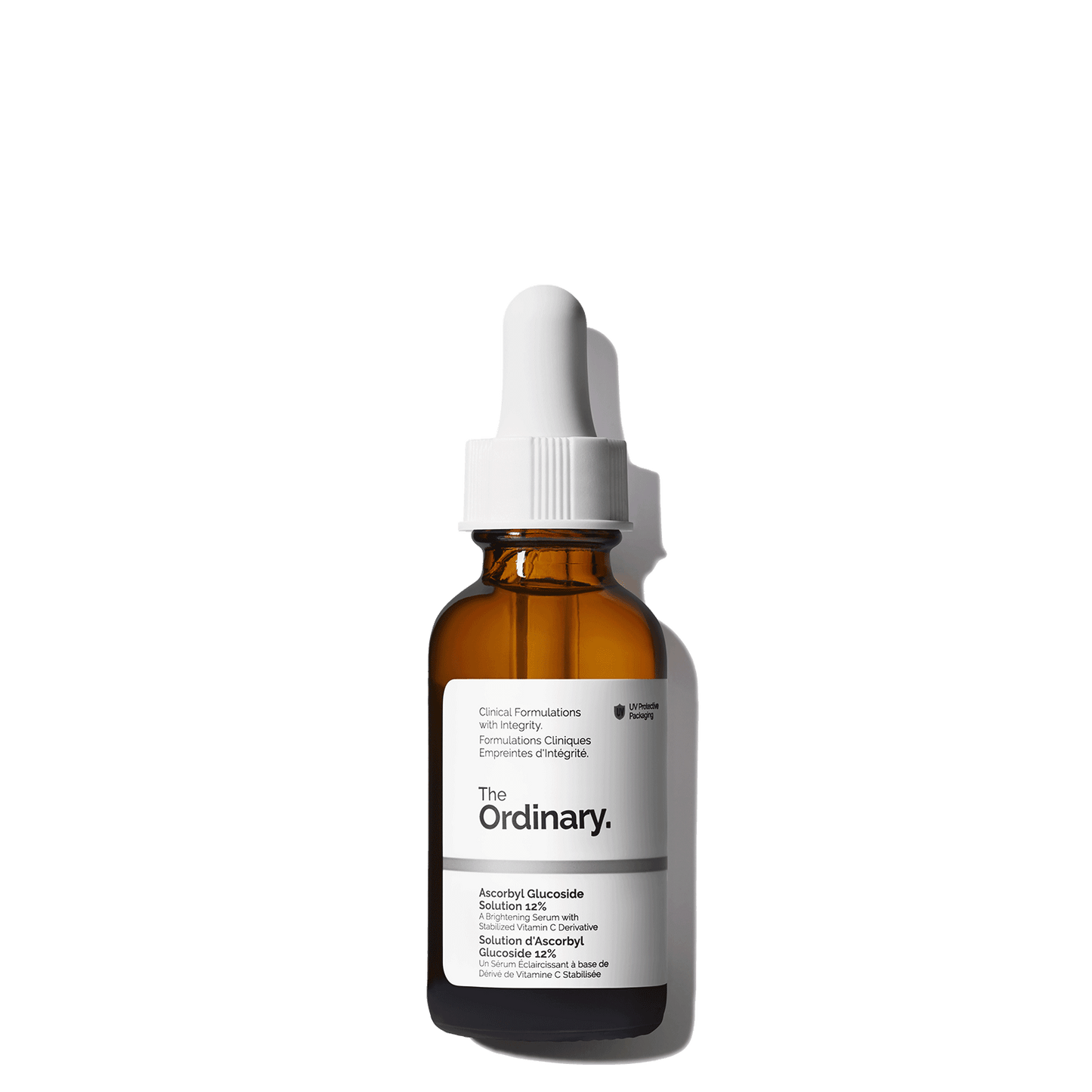
Ascorbyl Glucoside Solution 12%

Ascorbyl Glucoside Solution 12%
The Ordinary
ascorbyl-glucoside-solution-12
Serum
9784786747685
Morning or Evening?
How often will you use this product?
Notes


Highlights
WHAT IS IT?
Vitamin C derivative serum with 12% Ascorbyl Glucoside
FEATURES
Water-based formula, Less irritating than pure Vitamin C, Stable in water
BEST FOR
All skin types
CHECKS
Contains no pure Vitamin C, alcohol-free, oil-free
Who Is It For?
Adults Concerned With Aging Signs And Uneven Skin ToneWhat Does It Help With?
Brightening Uneven Skin Tone Signs Of Aging Antioxidant ProtectionBudget
Affordable (under $30)How To Use
Which routine should it be used in?
Instructions:
Key Information


What The Ordinary Says
Product Description:
A water-based formula that helps reduce signs of aging by brightening and balancing uneven skin tone
About the Brand:
Ingredients Overview
Ingredients List
Aqua,Ascorbyl-Glucoside,Propanediol,Aminomethyl-Propanol,Triethanolamine,Isoceteth-20,Xanthan-Gum,Dimethyl-Isosorbide,Ethoxydiglycol,Trisodium-Ethylenediamine-Disuccinate,1-2-Hexanediol,Caprylyl-Glycol
Key Ingredients
Ascorbyl Glucoside, Propanediol, Aminomethyl Propanol
Ingredients Details
Aminomethyl Propanol
Common Name(s): Aminomethyl propanol,cosmetic active,functional ingredient
CAS Number: N/a
DESCRIPTION
What It Does: Delivers characteristic cosmetic function at recommended use concentration.
Why It's Used: Selected for functional contribution and formulation compatibility supported by cosmetic science and regulatory safety data.
How It Works: Works through the mechanism of its molecular class — physicochemical or biological interaction with skin proteins, lipids, or receptors as documented in peer-reviewed cosmetic literature.
Typically Found In: Skin care formulations
TECHNICAL DETAILS
Primary Category: Active ingredient – cosmetic active
Secondary Functions: Skin conditioning
Application Areas:

Facial Skincare

Body Care
Hair Care
Beard Care
Color Cosmetics (Makeup)
Dietary/Oral Supplements
Typical Concentration Range: 0.1%–10%
SOURCING & ETHICS
Vegan Status: Conditional - supplier confirmation required
Halal Status: Unverified - supplier confirmation required
Source Notes: Commercially produced for cosmetic use. verify vegan/halal status with supplier. [audit 2026-07-29 rev2: the record's own source_notes does not assert a non-animal origin, or instructs the reader to verify with the supplier; "yes" asserts knowledge the record does not hold. determination requires shariah-panel sign-off.]
SKIN COMPATIBILITY
Irritancy Rating: 1/5 – very low
Comedogenicity Rating: 0/5 – non-comedogenic
Sensitivity Concerns: Well-tolerated by most skin types.
Safe for Sensitive Skin: Yes
SAFETY & COMPATIBILITY
Safety Profile: Good safety profile at recommended concentrations. ewg score: 1–2.
Works Well With: Standard skincare actives
Avoid Combining With: No known significant incompatibilities
SCIENTIFIC NOTE
Aminomethyl propanol has an established safety and efficacy profile within the cosmetic regulatory framework at standard use concentrations.
Last Verified: 2026-03-12
Primary Sources: Cosing database,aminomethyl propanol technical literature
Ascorbyl Glucoside
Common Name(s): Aa2g,2-o-alpha-d-glucopyranosyl-l-ascorbic acid
CAS Number: 129499-78-1
DESCRIPTION
What It Does: Provides stable gradual-release vitamin c activity for brightening and antioxidant protection.
Why It's Used: Most formulation-stable vitamin c derivative — ascorbyl glucoside remains stable in aqueous formulations where pure ascorbic acid oxidises within days, providing sustained vitamin c delivery over weeks of shelf life.
How It Works: Alpha-glucoside bond resists oxidation until cleaved by skin alpha-glucosidase enzymes. releases free l-ascorbic acid in viable epidermis. released ascorbic acid inhibits tyrosinase, stimulates collagen synthesis, and provides antioxidant activity. glucose group provides enhanced water solubility vs ascorbic acid.
Typically Found In: Stable vitamin c serums,brightening products,anti-aging
TECHNICAL DETAILS
Primary Category: Active ingredient – stable vitamin c glucoside
Secondary Functions: Tyrosinase inhibitor,collagen cofactor
Application Areas:
Facial Skincare
Body Care
Hair Care
Beard Care
Color Cosmetics (Makeup)
Dietary/Oral Supplements
Typical Concentration Range: 1%–5%
SOURCING & ETHICS
Vegan Status: Yes – enzymatic synthesis from ascorbic acid and glucose
Halal Status: Yes
Source Notes: Synthetically produced vitamin c derivative.
SKIN COMPATIBILITY
Irritancy Rating: 1/5 – very low
Comedogenicity Rating: 0/5 – non-comedogenic
Sensitivity Concerns: Non-irritating; suitable for all skin types.
Safe for Sensitive Skin: Yes
SAFETY & COMPATIBILITY
Safety Profile: Excellent safety profile. ewg score: 1.
Works Well With: Tocopherol,ferulic acid,niacinamide,spf
Avoid Combining With: No significant incompatibilities
SCIENTIFIC NOTE
Ascorbyl glucoside's stability advantage (18+ months in aqueous formulation vs days for ascorbic acid) arises from the glucose group's steric protection of ascorbic acid's c2 enediol that is the primary oxidation site. glucosidase cleavage in skin removes this protection in situ, releasing active ascorbic acid only where enzymatic activity exists — providing both formulation stability and bioactivation where needed.
Last Verified: ##########
Primary Sources: Cosing database,yamamoto et al. ascorbyl glucoside stability study
Caprylyl Glycol
Common Name(s): 1,2-octanediol,octanediol,sensiva sc 50
CAS Number: 1117-86-8
DESCRIPTION
What It Does: Provides the most potent antimicrobial diol activity alongside skin feel enhancement.
Why It's Used: Premium antimicrobial diol — caprylyl glycol's c8 chain provides the strongest membrane-disrupting antimicrobial activity of common diol preservative boosters with unique skin-feel enhancement.
How It Works: C8 1,2-diol: c8 chain length provides strongest bacterial and fungal membrane disruption of common diols. emollient skin feel improvement from c8 chain length interaction with skin surface. active at lower concentrations than shorter-chain diols. synergistic with ethylhexylglycerin.
Typically Found In: Natural preservation systems,skin feel enhancement
TECHNICAL DETAILS
Primary Category: Functional ingredient – antimicrobial humectant
Secondary Functions: Skin conditioning
Application Areas:
Facial Skincare
Body Care
Hair Care
Beard Care
Color Cosmetics (Makeup)
Dietary/Oral Supplements
Typical Concentration Range: 0.1%–1%
SOURCING & ETHICS
Vegan Status: Conditional - supplier confirmation required
Halal Status: Unverified - supplier confirmation required
Source Notes: Commercially produced for cosmetic use. verify vegan/halal status with supplier. [audit 2026-07-29 rev2: the record's own source_notes does not assert a non-animal origin, or instructs the reader to verify with the supplier; "yes" asserts knowledge the record does not hold. determination requires shariah-panel sign-off.]
SKIN COMPATIBILITY
Irritancy Rating: 1/5 – very low
Comedogenicity Rating: 0/5 – non-comedogenic
Sensitivity Concerns: Well-tolerated by most skin types.
Safe for Sensitive Skin: Yes
SAFETY & COMPATIBILITY
Safety Profile: Good safety profile at recommended concentrations. ewg score: 1–2.
Works Well With: Standard skincare actives
Avoid Combining With: No known significant incompatibilities
SCIENTIFIC NOTE
Caprylyl glycol's antimicrobial potency follows the chain-length dependent membrane activity of fatty acids: c8 is the optimal chain length for membrane disruption (same as caprylic acid's antimicrobial optimum), providing maximum membrane integration without the skin sensitisation associated with longer chain lengths. this chain-length pharmacophore relationship is why c8 > c6 > c5 in diol antimicrobial potency despite identical head group chemistry.
Last Verified: 2026-03-12
Primary Sources: Cosing database,schülke sensiva sc 50 technical data,cir safety assessment
Dimethyl Isosorbide
Common Name(s): Dmi,isosorbide dimethyl ether,arlasolve dmi
CAS Number: 5306-85-4
DESCRIPTION
What It Does: Provides biocompatible penetration enhancement for improved active ingredient delivery.
Why It's Used: Biocompatible penetration enhancer from renewable sorbitol — dmi provides penetration enhancement without the toxicity of oleic acid or conventional chemical penetration enhancers.
How It Works: Cyclic ether from sorbitol is biocompatible and biodegradable. disrupts stratum corneum lipid packing via ether oxygen hydrogen bonding. solubilises challenging actives (retinoids, salicylic acid, ahas). enhances penetration 2–5× vs equivalent concentrations without dmi.
Typically Found In: Active delivery formulas,penetration-enhanced products,retinoid vehicles
TECHNICAL DETAILS
Primary Category: Functional ingredient – penetration-enhancing solvent
Secondary Functions: Skin conditioning
Application Areas:
Facial Skincare
Body Care
Hair Care
Beard Care
Color Cosmetics (Makeup)
Dietary/Oral Supplements
Typical Concentration Range: 1%–20%
SOURCING & ETHICS
Vegan Status: Conditional - supplier confirmation required
Halal Status: Unverified - supplier confirmation required
Source Notes: Commercially produced for cosmetic use. verify vegan/halal status with supplier. [audit 2026-07-29 rev2: the record's own source_notes does not assert a non-animal origin, or instructs the reader to verify with the supplier; "yes" asserts knowledge the record does not hold. determination requires shariah-panel sign-off.]
SKIN COMPATIBILITY
Irritancy Rating: 1/5 – very low
Comedogenicity Rating: 0/5 – non-comedogenic
Sensitivity Concerns: Well-tolerated by most skin types.
Safe for Sensitive Skin: Yes
SAFETY & COMPATIBILITY
Safety Profile: Good safety profile at recommended concentrations. ewg score: 1–2.
Works Well With: Standard skincare actives
Avoid Combining With: No known significant incompatibilities
SCIENTIFIC NOTE
Dmi's penetration enhancement mechanism differs from oleic acid's lipid disruption: dmi hydrogen bonds to stratum corneum proteins and lipids, temporarily creating more permeable protein-lipid domains without the membrane-fluidisation that causes oleic acid's irritation. this protein-hydrogen-bonding mechanism provides penetration enhancement from a different, gentler pathway.
Last Verified: 2026-03-12
Primary Sources: Cosing database,croda arlasolve dmi technical data,cir safety assessment