

AVENE
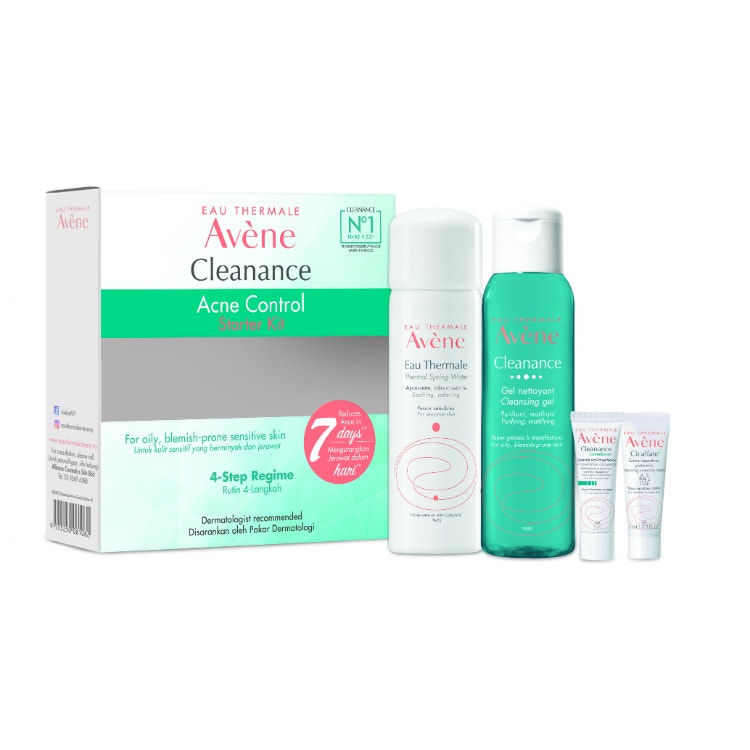
Avene Cleance Acne Control Starter Kit#

Avene Cleance Acne Control Starter Kit#
AVENE
avene-cleance-acne-control-starter-kit
Cleanse
10084893032741
Morning or Evening?
How often will you use this product?
Notes


Highlights
WHAT IS IT?
Acne Control Starter Kit with 4 products
FEATURES
4-step care for Oily, Blemish-prone skin with Avene; Helps reduce spots, blackheads and limit new blemishes
BEST FOR
oily
CHECKS
Does not contain preservatives explicitly mentioned; fragrance is included
Who Is It For?
Adults And Adolescents UnisexWhat Does It Help With?
Oily Skin Blemish-prone Skin Spots Blackheads Skin Barrier RebalancingBudget
Affordable (under $30)How To Use
Which routine should it be used in?
Instructions:
Key Information


What AVENE Says
Product Description:
- Formulated for Oily & Blemish-prone skin
- Effectively unclogs pores and eliminates impurities and excess sebum with Cleanance Cleansing Gel 100ml
- Soothe, and rebalance the skin's barrier with Thermal Spring Water 50ml
- Reduces spots, blackhead and limit the new blemishes* with Cleanance Comedomed 5ml
-Repairs skin with Cicalfate+ Protective Restorative Cream 5ml.
About the Brand:
Ingredients Overview
Ingredients List
Avene-Thermal-Spring-Water,Water,Sodium-Lauroyl-Methyl-Isethionate,Zinc-Coceth-Sulfate,Polysorbate-20,Sodium-Cocoamphoacetate,Ceteareth-60-Myristyl-Glycol,Peg-40-Hydrogenated-Castor-Oil,Citric-Acid,Disodium-Edta,Fragrance-(Parfum),Glyceryl-Laurate,Green-5-(Ci-61570),Lauric-Acid,Sodium-Benzoate,Sodium-Chloride,Sodium-Hydroxide,Sodium-Methyl-Isethionate,Zinc-Gluconate,Nitrogen,Aqua,Isopropyl-Alcohol,PEG-6,Glycerin,Silybum-Marianum-Fruit-Extract,Silica,Polyacrylate-13,Polyisobutene,Polysorbate-20,Sorbitan-Isostearate
Key Ingredients
Avene Thermal Spring Water,Zinc Gluconate,Silybum Marianum Fruit Extract
Ingredients Details
Glycerin
Common Name(s): Glycerol,glycerine,1,2,3-propanetriol
CAS Number: 56-81-5
DESCRIPTION
What It Does: Glycerin pulls water from the environment and deeper skin layers into the outer skin layer (epidermis), boosting moisture levels and keeping skin soft, smooth, and plump.
Why It's Used: It is used in virtually every moisturizer, serum, and cleanser because it is highly effective at hydrating skin, is well-tolerated by all skin types, and enhances the texture and spreadability of formulations.
How It Works: As a humectant, glycerin forms hydrogen bonds with water molecules, trapping them in the skin. it also reinforces the skin barrier by integrating into lipid structures between skin cells.
Typically Found In: Moisturizers,serums,cleansers,toners,sheet masks,sunscreens,body lotions,shampoos,conditioners
TECHNICAL DETAILS
Primary Category: Humectant
Secondary Functions: Skin barrier support,emollient,solvent
Application Areas:

Facial Skincare
Body Care
Hair Care
Beard Care

Color Cosmetics (Makeup)
Dietary/Oral Supplements
Typical Concentration Range: 1%–30% (typical: 3–10%)
SOURCING & ETHICS
Vegan Status: Conditional - feedstock declaration required
Halal Status: Unverified - feedstock declaration required (plant, animal and petrochemical routes all exist)
Source Notes: Derived from plant oils via hydrolysis or saponification; synthetic versions also available. palm-derived glycerin carries sustainability concerns. [audit 2026-07-29 rev2: origin-dependent: the same inci exists in plant, animal and petrochemical versions and the name does not discriminate. determination requires shariah-panel sign-off.]
SKIN COMPATIBILITY
Irritancy Rating: 1/5 – very low; non-irritating at all standard concentrations
Comedogenicity Rating: 0/5 – non-comedogenic
Sensitivity Concerns: Extremely rare allergic reactions; generally safe for all skin types including sensitive and baby skin
Safe for Sensitive Skin: Yes
SAFETY & COMPATIBILITY
Safety Profile: Widely recognized as safe. ewg hazard score: 1. no significant concerns for irritation, sensitization, or toxicity at typical concentrations (up to 50%).
Works Well With: Hyaluronic acid,ceramides,niacinamide,panthenol,urea,peptides,retinol,ahas/bhas
Avoid Combining With: No known incompatibilities at standard concentrations
SCIENTIFIC NOTE
Glycerin is an endogenous skin component found naturally in the stratum corneum. aquaporin-3 channels in keratinocytes facilitate glycerin transport, making it integral to natural skin hydration pathways.
Last Verified: 2026-03-12
Primary Sources: Cosing database,cir safety assessment,ewg skin deep,inci decoder
Nitrogen
Common Name(s): Nitrogen,nitrogen,inert compressed gas aerosol propellant,spray dispensing gas
CAS Number: N/a
DESCRIPTION
What It Does: Generates the vapour pressure required for aerosol dispensing — the propellant expands on valve opening providing the driving force that atomises the formulation into fine spray droplets for even, controlled application.
Why It's Used: Propellant selection determines aerosol performance characteristics: spray pattern, droplet size, particle distribution, and environmental profile. the propellant balance sets container pressure throughout the product's use life for consistent spray from full to near-empty.
How It Works: Propellant liquefies under pressure inside the container — vapour pressure (~4-10 bar) provides the driving force for spray dispensing. hydrocarbon propellants: vapour pressure from van der waals attraction in liquid phase; hfcs: vapour pressure from f-atom electronic effects on boiling point; co₂/n₂: dissolved compressed gas providing pressure from henry's law equilibrium.
Typically Found In: Aerosol products
TECHNICAL DETAILS
Primary Category: Active ingredient – cosmetic active
Secondary Functions: Skin conditioning
Application Areas:
Facial Skincare
Body Care
Hair Care
Beard Care
Color Cosmetics (Makeup)
Dietary/Oral Supplements
Typical Concentration Range: Functional — sufficient for product pressure
SOURCING & ETHICS
Vegan Status: Conditional - supplier confirmation required
Halal Status: Unverified - supplier confirmation required
Source Notes: Commercially produced for cosmetic use. verify vegan/halal status with supplier. [audit 2026-07-29 rev2: the record's own source_notes does not assert a non-animal origin, or instructs the reader to verify with the supplier; "yes" asserts knowledge the record does not hold. determination requires shariah-panel sign-off.]
SKIN COMPATIBILITY
Irritancy Rating: 1/5 – very low
Comedogenicity Rating: 0/5 – non-comedogenic
Sensitivity Concerns: Well-tolerated by most skin types.
Safe for Sensitive Skin: Yes
SAFETY & COMPATIBILITY
Safety Profile: Good safety profile at recommended concentrations. ewg score: 1–2.
Works Well With: Standard skincare actives
Avoid Combining With: No known significant incompatibilities
SCIENTIFIC NOTE
Low gwp and non-flammable — preferred for sustainable aerosol formulations.
Last Verified: 2026-03-22
Primary Sources: Eu regulation 75/324/eec aerosol,eu f-gas regulations,nitrogen propellant review
Peg-6
Common Name(s): Peg-6,peg-6,polyethylene glycol low mw,humectant co-solvent emulsifier
CAS Number: N/a
DESCRIPTION
What It Does: Provides hygroscopic moisture retention and co-solvent activity for active ingredient dissolution from the polyether backbone's multiple ether oxygen water-binding groups.
Why It's Used: Peg molecular weight determines primary function: low mw (co-solvent/humectant), medium mw (emulsifier/solubiliser), high mw (film-former/thickener) — enabling the same chemical class to address multiple formulation needs across the mw range.
How It Works: Peg ether oxygens (1 per ch₂ch₂o repeat unit) provide 2-3 h-bond acceptors per unit — the chain of ether oxygens binding water molecules creating the hygroscopic character. at low mw (liquid state), provides co-solvent dissolution; at high mw (waxy solid), provides film-forming character through chain entanglement.
Typically Found In: Versatile formulations
TECHNICAL DETAILS
Primary Category: Active ingredient – cosmetic active
Secondary Functions: Skin conditioning
Application Areas:
Facial Skincare
Body Care
Hair Care
Beard Care
Color Cosmetics (Makeup)
Dietary/Oral Supplements
Typical Concentration Range: 0.5%–20%
SOURCING & ETHICS
Vegan Status: Conditional - supplier confirmation required
Halal Status: Unverified - supplier confirmation required
Source Notes: Commercially produced for cosmetic use. verify vegan/halal status with supplier. [audit 2026-07-29 rev2: the record's own source_notes does not assert a non-animal origin, or instructs the reader to verify with the supplier; "yes" asserts knowledge the record does not hold. determination requires shariah-panel sign-off.]
SKIN COMPATIBILITY
Irritancy Rating: 1/5 – very low
Comedogenicity Rating: 0/5 – non-comedogenic
Sensitivity Concerns: Well-tolerated by most skin types.
Safe for Sensitive Skin: Yes
SAFETY & COMPATIBILITY
Safety Profile: Good safety profile at recommended concentrations. ewg score: 1–2.
Works Well With: Standard skincare actives
Avoid Combining With: No known significant incompatibilities
SCIENTIFIC NOTE
1,4-dioxane contamination monitoring: ethylene oxide polymerisation generates trace 1,4-dioxane — eu and us regulations require <10 ppm in finished products. supplier coa confirming dioxane level is required for regulatory compliance.
Last Verified: 2026-03-22
Primary Sources: Cosing database,peg-6 peg polyethylene glycol review
Polyacrylate-13
Common Name(s): Polyacrylate-13,linear acrylate film-forming polymer,film-former styling polymer
CAS Number: N/a
DESCRIPTION
What It Does: Forms a clear, flexible film on hair or skin providing styling hold or long-wear cosmetic performance — film hardness and flexibility controlled by the copolymer monomer ratio and molecular weight.
Why It's Used: Linear acrylate copolymers deliver tg-controlled films — hard monomers (mma, styrene, isobornyl acrylate) raise tg for strong hold; soft monomers (n-ba, 2-eha) lower tg for flexible conditioning films. this tg engineering provides precise sensory and performance control.
How It Works: Above tg, chains have mobility to coalesce forming a continuous film on drying. hard monomers (tg 100-130c) increase overall film tg providing rigidity; soft monomers (tg -50 to -70c) provide flexibility. ionic monomers (acrylic acid) provide ph-responsive charge for neutralised thickener function. fox equation predicts copolymer tg from monomer weight fractions.
Typically Found In: Hair care,nail products,skin care,colour cosmetics
TECHNICAL DETAILS
Primary Category: Active ingredient – cosmetic active
Secondary Functions: Skin conditioning
Application Areas:
Facial Skincare
Body Care
Hair Care
Beard Care
Color Cosmetics (Makeup)
Dietary/Oral Supplements
Typical Concentration Range: 0.1%–10%
SOURCING & ETHICS
Vegan Status: Conditional - supplier confirmation required
Halal Status: Unverified - supplier confirmation required
Source Notes: Commercially produced for cosmetic use. verify vegan/halal status with supplier. [audit 2026-07-29 rev2: the record's own source_notes does not assert a non-animal origin, or instructs the reader to verify with the supplier; "yes" asserts knowledge the record does not hold. determination requires shariah-panel sign-off.]
SKIN COMPATIBILITY
Irritancy Rating: 1/5 – very low
Comedogenicity Rating: 0/5 – non-comedogenic
Sensitivity Concerns: Well-tolerated by most skin types.
Safe for Sensitive Skin: Yes
SAFETY & COMPATIBILITY
Safety Profile: Good safety profile at recommended concentrations. ewg score: 1–2.
Works Well With: Standard skincare actives
Avoid Combining With: No known significant incompatibilities
SCIENTIFIC NOTE
Eu 2023/2055: acrylate polymers forming water-soluble solutions (neutralised polyacrylic acids, sulfonated polymers) are exempt from microplastic restrictions. insoluble film-forming polymers may require compliance assessment depending on particle-size specification.
Last Verified: 2026-03-12
Primary Sources: Cosing database,polyacrylate-13 linear film-former review