

AVENE
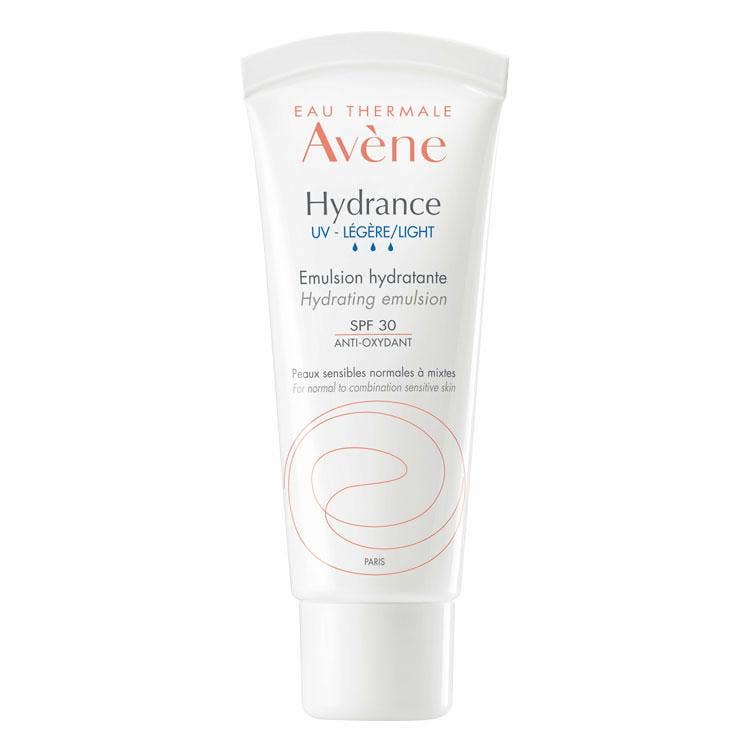
Avene Hydrating Emulsion SPF30 40ml

Avene Hydrating Emulsion SPF30 40ml
AVENE
avene-hydrating-emulsion-spf30-40ml
Moisturize
10084970660133
Morning or Evening?
How often will you use this product?
Notes


Highlights
WHAT IS IT?
Hydrating moisturiser with 22 ingredients
FEATURES
Protects skin from daily aggressions, prevents skin ageing caused by sun, limits evaporation of thermal spring water, increases skin coverage, contains sebo-absorbing capsules for mattifying effect, immediate and long-lasting hydration, paraben free
BEST FOR
combination
CHECKS
Parabens
Who Is It For?
All Genders Age Range Not SpecifiedWhat Does It Help With?
Dehydrated Sensitive Skin Sun Protection Aging PreventionBudget
Mid-range ($30-$75)How To Use
Which routine should it be used in?
Instructions:
Key Information

What AVENE Says
Product Description:
A hydrating moisturiser to protect the skin from daily aggressions and help prevent skin ageing caused by the sun. For normal to combination dehydrated sensitive skin. Based on Meiboserine which limits the evaporation of the Av_x0000_e8ne Thermal Spring Water from the skin and Lipomucine_x0000_ae which increases coverage across the skin. It also contains sebo-absorbing capsules for a light matifying effect. Immediate and intense, long-lasting hydration (upper skin layers) of the skin. Paraben-free.
About the Brand:
Ingredients Overview
Ingredients List
Avene-Thermal-Spring-Water,Ethylhexyl-Methoxycinnamate,Cyclomethicone,Octocrylene,Bis-Ethylhexyloxyphenol-Methoxyphenyl-Triazine,Aluminium-Starch-Octenylsuccinate,Glycerin,Polymethyl-Methacrylate,Potassium-Cetyl-Phosphate,Benzoic-Acid,Beta-Sitosterol,Caprylic-Capric-Triglyceride,Carbomer,Chlorphenesin,Disodium-Edta,Fragance,Parfum,Glycine-Soja,Hydrogenated-Coco-Glycerides,Lecithin,Phenoxyethanol,Poloxamer-188,Sodium-Chondroitin-Sulfate,Sodium-Hydroxide,Tocopheryl-Glucoside,Xanthan-Gum
Key Ingredients
Avene Thermal Spring Water,Meiboserine,Lipomucine,Sebo-absorbing capsules
Ingredients Details
Beta-sitosterol
Common Name(s): 22,23-dihydrostigmasterol,sitosterin
CAS Number: 83-46-5
DESCRIPTION
What It Does: Provides plant membrane sterol anti-inflammatory and barrier support with 5-alpha-reductase inhibition.
Why It's Used: Multi-function phytosterol combining barrier mimicry (identical to cholesterol structure) with anti-inflammatory and anti-androgenic activity for acne-prone and aging skin.
How It Works: Integrates into stratum corneum lipid bilayers analogous to cholesterol for barrier support. inhibits 5-alpha-reductase for dht reduction. inhibits nf-kb and cox for anti-inflammatory activity. cholesterol analog provides skin conditioning and membrane stabilization.
Typically Found In: Anti-inflammatory serums,anti-acne products,natural oils and butters (as unsaponifiable component)
TECHNICAL DETAILS
Primary Category: Active ingredient – phytosterol anti-inflammatory
Secondary Functions: Barrier cholesterol analog,5-alpha-reductase inhibition
Application Areas:

Facial Skincare
Body Care
Hair Care

Beard Care
Color Cosmetics (Makeup)
Dietary/Oral Supplements
Typical Concentration Range: 0.1%–3%
SOURCING & ETHICS
Vegan Status: Conditional - supplier confirmation required
Halal Status: Unverified - supplier confirmation required
Source Notes: Plant-derived, synthetic or animal-derived. verify source. [audit 2026-07-29 rev2: the record's own source_notes does not assert a non-animal origin, or instructs the reader to verify with the supplier; "yes" asserts knowledge the record does not hold. determination requires shariah-panel sign-off.]
SKIN COMPATIBILITY
Irritancy Rating: 1/5 – very low
Comedogenicity Rating: 1/5 – low; formulation-dependent
Sensitivity Concerns: Non-irritating.
Safe for Sensitive Skin: Yes
SAFETY & COMPATIBILITY
Safety Profile: Excellent safety profile. ewg score: 1.
Works Well With: Humectants,ceramides,actives as carrier
Avoid Combining With: No significant incompatibilities
SCIENTIFIC NOTE
Beta-sitosterol's structural identity with cholesterol (only one additional ethyl group at c-24) allows it to substitute for cholesterol in cell membrane bilayers and skin barrier lipid structures. this structural mimicry explains its barrier-supportive activity while its c-24 ethyl group subtly alters enzyme interactions, providing 5-alpha-reductase inhibition not seen with mammalian cholesterol.
Last Verified: 2026-03-12
Primary Sources: Cosing database,bouic phytosterol review,cir safety assessment
Carbomer
Common Name(s): Carbopol,polyacrylic acid,carboxyvinyl polymer
DESCRIPTION
What It Does: Provides transparent gel textures and thickening at very low concentrations via ph-responsive swelling.
Why It's Used: The most widely used gel thickener – provides crystal-clear, stable gels at concentrations as low as 0.1-0.5% with ph-controlled viscosity.
How It Works: Highly crosslinked polyacrylic acid remains tightly coiled at acidic ph. neutralization with naoh or triethanolamine ionizes carboxylic groups causing electrostatic repulsion that unfolds and swells the polymer coils, dramatically increasing viscosity. concentration-dependent thickening.
Typically Found In: Gels,serums,emulsions,sunscreens
TECHNICAL DETAILS
Primary Category: Functional ingredient – polyacrylic acid thickener
Secondary Functions: Skin conditioning
Application Areas:
Facial Skincare
Body Care
Hair Care
Beard Care
Color Cosmetics (Makeup)
Dietary/Oral Supplements
Typical Concentration Range: 0.1%–2%
SOURCING & ETHICS
Vegan Status: Conditional - supplier confirmation required
Halal Status: Unverified - supplier confirmation required
Source Notes: Commercially produced for cosmetic use. verify vegan/halal status with supplier. [audit 2026-07-29 rev2: the record's own source_notes does not assert a non-animal origin, or instructs the reader to verify with the supplier; "yes" asserts knowledge the record does not hold. determination requires shariah-panel sign-off.]
SKIN COMPATIBILITY
Irritancy Rating: 1/5 – very low
Comedogenicity Rating: 0/5 – non-comedogenic
Sensitivity Concerns: Well-tolerated by most skin types.
Safe for Sensitive Skin: Yes
SAFETY & COMPATIBILITY
Safety Profile: Good safety profile at recommended concentrations. ewg score: 1–2.
Works Well With: Standard skincare actives
Avoid Combining With: No known significant incompatibilities
SCIENTIFIC NOTE
Carbomer's ph-responsive swelling mechanism provides an elegant formulation control tool: a neutralized gel can be liquefied by ph reduction (adding acid) and re-thickened by reneutralization. this reversible rheology control allows two-phase products that mix on application without the need for mechanical emulsification.
Last Verified: 2026-03-12
Primary Sources: Cosing database,cir safety assessment
Chlorphenesin
Common Name(s): 3-(4-chlorophenoxy)-1,2-propanediol,globacid
CAS Number: 104-29-0
DESCRIPTION
What It Does: Provides gram-negative focused preservation complementary to phenoxyethanol for comprehensive spectrum coverage.
Why It's Used: Phenoxyethanol complement — chlorphenesin's gram-negative and antifungal coverage complements phenoxyethanol's gram-positive activity for full-spectrum preservation at lower individual concentrations.
How It Works: 4-chlorophenol ether glycol disrupts bacterial and fungal membranes. strong gram-negative activity (pseudomonas, e. coli). good candida antifungal activity. used with phenoxyethanol for synergistic broad-spectrum coverage. ph stable 3-9.
Typically Found In: Comprehensive preservation systems,baby products (low concentration)
TECHNICAL DETAILS
Primary Category: Functional ingredient – glycerol ether preservative
Secondary Functions: Skin conditioning
Application Areas:
Facial Skincare
Body Care
Hair Care
Beard Care
Color Cosmetics (Makeup)
Dietary/Oral Supplements
Typical Concentration Range: 0.1%–0.3%
SOURCING & ETHICS
Vegan Status: Conditional - supplier confirmation required
Halal Status: Unverified - supplier confirmation required
Source Notes: Commercially produced for cosmetic use. verify vegan/halal status with supplier. [audit 2026-07-29 rev2: the record's own source_notes does not assert a non-animal origin, or instructs the reader to verify with the supplier; "yes" asserts knowledge the record does not hold. determination requires shariah-panel sign-off.]
SKIN COMPATIBILITY
Irritancy Rating: 1/5 – very low
Comedogenicity Rating: 0/5 – non-comedogenic
Sensitivity Concerns: Well-tolerated by most skin types.
Safe for Sensitive Skin: Yes
SAFETY & COMPATIBILITY
Safety Profile: Eu max 0.3% cosmetics. good safety profile. synergistic combination with phenoxyethanol (0.3% pe + 0.1% chlorphenesin often equivalent to 1% pe alone).
Works Well With: Standard skincare actives
Avoid Combining With: No known significant incompatibilities
SCIENTIFIC NOTE
Chlorphenesin + phenoxyethanol synergy operates through a classic spectrum-filling combination: phenoxyethanol provides strong gram-positive antimicrobial activity while chlorphenesin provides gram-negative and antifungal coverage. the combination's minimum inhibitory concentration sum is subadditive (provides equivalent preservation at combined concentrations below what either alone would require) — textbook pharmacological synergy enabling lower total preservative load.
Last Verified: 2026-03-12
Primary Sources: Cosing database,eu preservative annex v,cir safety assessment
Cyclomethicone
Common Name(s): Cyclomethicone,cyclic volatile silicone,dry-touch carrier solvent
CAS Number: N/a
DESCRIPTION
What It Does: Provides a dry, weightless application vehicle that evaporates cleanly leaving actives and non-volatile silicones deposited on skin — eliminating the residual heaviness of conventional liquid carrier solvents.
Why It's Used: Cyclosiloxanes are the unique volatile silicone solvents that dissolve non-volatile silicones (dimethicone, cyclomethicone), organic uv filters, and lipophilic actives, providing the sensory-superior dry-touch application experience in premium formulations.
How It Works: Cyclosiloxane vapour pressure (d5 cyclopentasiloxane ~0.3 mmhg at 25°c) provides clean evaporation at body temperature. the cyclic ring structure provides lower boiling point than equivalent linear dimethicone, enabling faster evaporation while the ring conformation maintains the silicone's low surface energy for smooth application.
Typically Found In: Primers,antiperspirants,sunscreens
TECHNICAL DETAILS
Primary Category: Functional ingredient – emollient
Secondary Functions: Barrier sealing,softening
Application Areas:
Facial Skincare
Body Care
Hair Care
Beard Care
Color Cosmetics (Makeup)
Dietary/Oral Supplements
Typical Concentration Range: 1%–50%
SOURCING & ETHICS
Vegan Status: Conditional - supplier confirmation required
Halal Status: Unverified - supplier confirmation required
Source Notes: Plant-derived, synthetic or animal-derived. verify source. [audit 2026-07-29 rev2: the record's own source_notes does not assert a non-animal origin, or instructs the reader to verify with the supplier; "yes" asserts knowledge the record does not hold. determination requires shariah-panel sign-off.]
SKIN COMPATIBILITY
Irritancy Rating: 1/5 – very low
Comedogenicity Rating: 1/5 – low; formulation-dependent
Sensitivity Concerns: Non-irritating.
Safe for Sensitive Skin: Yes
SAFETY & COMPATIBILITY
Safety Profile: Excellent safety profile. ewg score: 1.
Works Well With: Humectants,ceramides,actives as carrier
Avoid Combining With: No significant incompatibilities
SCIENTIFIC NOTE
Cyclopentasiloxane (d5) and cyclohexasiloxane (d6) are under eu regulatory review for potential environmental persistence (pbt assessment) — formulators should monitor eu regulation 2018/35 implementation for restrictions in wash-off products.
Last Verified: 2026-03-12
Primary Sources: Cosing database,eu cyclosiloxane regulatory review