
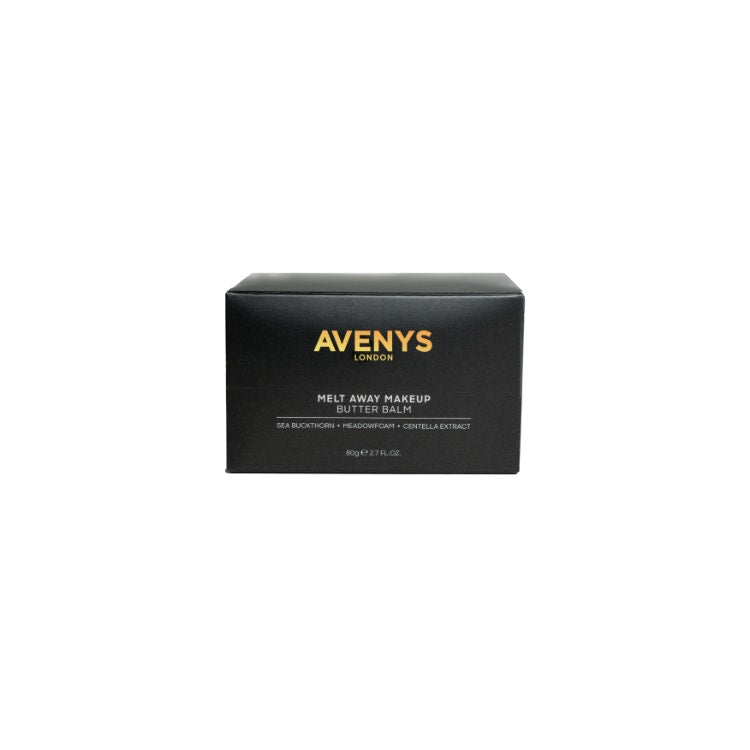

AVENYS
Avenys Melt Away Makeup Butter Balm 80G

Avenys Melt Away Makeup Butter Balm 80G
AVENYS
avenys-melt-away-makeup-butter-balm-80g
Cleanse
10085453463845
Morning or Evening?
How often will you use this product?
Notes


Highlights
WHAT IS IT?
Makeup remover balm, 4 ingredients listed
FEATURES
Transforms from balm to oil to milky emulsion, removes waterproof makeup and mineral sunscreen, non-greasy, nourishes skin, antioxidant protection
BEST FOR
sensitive
CHECKS
Does not contain fragrance, non-greasy, non-drying
Who Is It For?
All Skin Types: Normal Oily Combination Dry And Sensitive (gender And Exact Age Range Not Specified)What Does It Help With?
Removes Waterproof Makeup Mineral Sunscreen Full Coverage Foundation Longwear Lipstick; Nourishes And Softens SkinBudget
Premium ($76-$150)How To Use
Which routine should it be used in?
Instructions:
Key Information


What AVENYS Says
Product Description:
Experience a transformative, weightless makeup remover that seamlessly glides on the skin and transitions from a balm to a milky emulsion. This makeup remover effortlessly dissolves even the most stubborn makeup and mineral sunscreen, leaving no residue. It is non-scented, non-greasy, non-drying, lightweight texture that not only cleanses thoroughly but also nourishes the skin, ultimately rinsing off completely, revealing a fresh, radiant complexion. Embark on a journey through three sumptuous textures in one product. The balm becomes a luxurious oil when gently massaged onto the skin, subsequently turning into a hydrating milk when in contact with water. This unique formula effortlessly exterminates long-lasting and waterproof makeup, daily impurities, and surface pollutants, delivering a deep cleanse and skin-softening effect after every use. Enriched with the combination of Sunflower Seed Oil, Sea Buckthorn, Vitamin E, Meadowfoam, Squalane, and Centella Asiatica, our cleansing balm provides a powerhouse of benefits, delivering deep nourishment, antioxidant protection, and skin-softening effects for a radiant and revitalized complexion.
About the Brand:
Ingredients Overview
Ingredients List
sea-buckthorn,meadowfoam,centella-extract,sunflower-seed-oil
Key Ingredients
Sunflower Seed Oil, Sea Buckthorn, Vitamin E, Meadowfoam, Squalane, Centella Asiatica
Ingredients Details
Sea Buckthorn
Common Name(s): Sea buckthorn fruit oil,hippophae oil
DESCRIPTION
What It Does: Provides wound healing, barrier repair, and antioxidant benefits from a uniquely rich multi-nutrient oil.
Why It's Used: Premium multi-active natural oil combining omega-7 (unique to sea buckthorn), carotenoids, and multiple antioxidants for comprehensive wound healing and anti-aging.
How It Works: Palmitoleic acid (omega-7) is sebum's dominant fatty acid – providing skin-identical barrier repair. combined carotenoids (lycopene, beta-carotene) provide photoprotective antioxidant activity. flavonoids provide anti-inflammatory activity.
Typically Found In: Wound healing products,natural anti-aging oils,barrier repair formulas
TECHNICAL DETAILS
Primary Category: Active ingredient – sea buckthorn oil
Secondary Functions: Omega-7 sebum mimetic,wound healing,carotenoid antioxidant
Application Areas:

Facial Skincare
Body Care

Hair Care
Beard Care
Color Cosmetics (Makeup)
Dietary/Oral Supplements
Typical Concentration Range: 0.1%–10%
SOURCING & ETHICS
Vegan Status: Yes – plant-derived
Halal Status: Yes
Source Notes: Cold-pressed from hippophae rhamnoides berries. berry oil vs seed oil differ in fatty acid and carotenoid profiles.
SKIN COMPATIBILITY
Irritancy Rating: 1/5 – very low
Comedogenicity Rating: 2/5 – moderate; use diluted
Sensitivity Concerns: Non-irritating; well-tolerated.
Safe for Sensitive Skin: Yes
SAFETY & COMPATIBILITY
Safety Profile: Excellent safety profile. ewg score: 1.
Works Well With: Vitamin c,vitamin e,ferulic acid,spf,other antioxidants
Avoid Combining With: No significant incompatibilities
SCIENTIFIC NOTE
Sea buckthorn berry oil's exceptionally high carotenoid content (>100mg/100g, compared to carrot oil's ~10mg/100g) and unique omega-7 palmitoleic acid composition make it one of the most nutritionally dense plant oils for skin wound healing and anti-aging.
Last Verified: 2026-03-12
Primary Sources: Cosing database,zeb & mehmood sea buckthorn review,cir safety assessment
Squalane
Common Name(s): Perhydrosqualene,2,6,10,15,19,23-hexamethyltetracosane
CAS Number: 0111-01-03
DESCRIPTION
What It Does: Provides endogenous-skin-identical emolliency with exceptional stability and skin compatibility.
Why It's Used: The most skin-compatible emollient – chemically identical to human sebum squalene component with outstanding tolerability across all skin types.
How It Works: Fully saturated hydrocarbon with zero oxidation sites provides exceptional stability unlike squalene's 6 double bonds. integrates into stratum corneum lipid bilayers with near-perfect biocompatibility. provides antioxidant protection to formulation via radical quenching.
Typically Found In: Facial oils,serums,non-comedogenic moisturizers,luxury body care
TECHNICAL DETAILS
Primary Category: Functional ingredient – emollient
Secondary Functions: Maximum biocompatibility,antioxidant stabilizer,non-comedogenic
Application Areas:
Facial Skincare
Body Care
Hair Care
Beard Care
Color Cosmetics (Makeup)
Dietary/Oral Supplements
Typical Concentration Range: 1%–100%
SOURCING & ETHICS
Vegan Status: Conditional - feedstock declaration required
Halal Status: Unverified - feedstock declaration required (plant, animal and petrochemical routes all exist)
Source Notes: Sustainable plant-derived squalane from sugarcane fermentation (amyris) or olive oil fractionation is preferred over shark liver-derived. chemically identical regardless of source. [audit 2026-07-29 rev2: origin-dependent: the same inci exists in plant, animal and petrochemical versions and the name does not discriminate. determination requires shariah-panel sign-off.]
SKIN COMPATIBILITY
Irritancy Rating: 1/5 – very low
Comedogenicity Rating: 0/5 – non-comedogenic
Sensitivity Concerns: Non-irritating.
Safe for Sensitive Skin: Yes
SAFETY & COMPATIBILITY
Safety Profile: Excellent safety profile. ewg score: 1.
Works Well With: Humectants,ceramides,actives as carrier
Avoid Combining With: No significant incompatibilities
SCIENTIFIC NOTE
Squalene constitutes approximately 12-15% of human sebum – the highest proportion of any skin lipid. topical squalane (stable, hydrogenated form) replenishes this abundant endogenous skin lipid. the complete absence of oxidizable double bonds (unlike squalene's 6 double bonds) eliminates the pro-oxidant concerns of natural squalene oxidation.
Last Verified: 2026-03-12
Primary Sources: Cosing database,huang et al. squalane review,cir safety assessment
Sunflower Seed Oil
Common Name(s): Sunflower seed oil,botanical oil/butter,phytochemical active
CAS Number: N/a
DESCRIPTION
What It Does: Provides emollient conditioning, essential fatty acid supplementation, and barrier lipid support from the natural triglyceride/wax ester composition.
Why It's Used: Natural carrier oils provide sc-compatible lipid composition for genuine barrier integration rather than surface-only occlusion.
How It Works: Fatty acid triglycerides integrate into sc lipid bilayers delivering oleic, linoleic, and linolenic acid for emolliency and barrier repair; essential fatty acids serve as ceramide biosynthesis precursors.
Typically Found In: Botanical skin care,natural products
TECHNICAL DETAILS
Primary Category: Active ingredient – antioxidant
Secondary Functions: Free radical scavenging,anti-aging
Application Areas:
Facial Skincare
Body Care
Hair Care
Beard Care
Color Cosmetics (Makeup)
Dietary/Oral Supplements
Typical Concentration Range: 0.1%–30%
SOURCING & ETHICS
Vegan Status: Conditional - supplier confirmation required
Halal Status: Conditional - basis not stated in source record; supplier origin confirmation required to determine what evidence applies
Source Notes: Plant-derived extract or synthetic. [audit 2026-07-29 rev2: status downgraded on audit. determination requires shariah-panel sign-off.]
SKIN COMPATIBILITY
Irritancy Rating: 1/5 – very low
Comedogenicity Rating: 0/5 – non-comedogenic
Sensitivity Concerns: Non-irritating; well-tolerated.
Safe for Sensitive Skin: Yes
SAFETY & COMPATIBILITY
Safety Profile: Excellent safety profile. ewg score: 1.
Works Well With: Vitamin c,vitamin e,ferulic acid,spf,other antioxidants
Avoid Combining With: No significant incompatibilities
SCIENTIFIC NOTE
Plant secondary metabolites evolved for uv photoprotection and pathogen defence — mechanisms directly applicable to cosmetic antioxidant and anti-inflammatory activity in human skin.
Last Verified: 2026-03-12
Primary Sources: Cosing database,sunflower seed oil botanical review
Vitamin E
Common Name(s): Vitamin e,cosmetic active,functional ingredient
CAS Number: N/a
DESCRIPTION
What It Does: Delivers characteristic cosmetic function at recommended use concentration.
Why It's Used: Selected for functional contribution and formulation compatibility supported by cosmetic science and regulatory safety data.
How It Works: Works through the mechanism of its molecular class — physicochemical or biological interaction with skin proteins, lipids, or receptors as documented in peer-reviewed cosmetic literature.
Typically Found In: Skin care formulations
TECHNICAL DETAILS
Primary Category: Active ingredient – cosmetic active
Secondary Functions: Skin conditioning
Application Areas:
Facial Skincare
Body Care
Hair Care
Beard Care
Color Cosmetics (Makeup)
Dietary/Oral Supplements
Typical Concentration Range: 0.1%–10%
SOURCING & ETHICS
Vegan Status: Conditional - supplier confirmation required
Halal Status: Unverified - supplier confirmation required
Source Notes: Commercially produced for cosmetic use. verify vegan/halal status with supplier. [audit 2026-07-29 rev2: the record's own source_notes does not assert a non-animal origin, or instructs the reader to verify with the supplier; "yes" asserts knowledge the record does not hold. determination requires shariah-panel sign-off.]
SKIN COMPATIBILITY
Irritancy Rating: 1/5 – very low
Comedogenicity Rating: 0/5 – non-comedogenic
Sensitivity Concerns: Well-tolerated by most skin types.
Safe for Sensitive Skin: Yes
SAFETY & COMPATIBILITY
Safety Profile: Good safety profile at recommended concentrations. ewg score: 1–2.
Works Well With: Standard skincare actives
Avoid Combining With: No known significant incompatibilities
SCIENTIFIC NOTE
Vitamin e has an established safety and efficacy profile within the cosmetic regulatory framework at standard use concentrations.
Last Verified: 2026-03-12
Primary Sources: Cosing database,vitamin e technical literature