

Mario Badescu
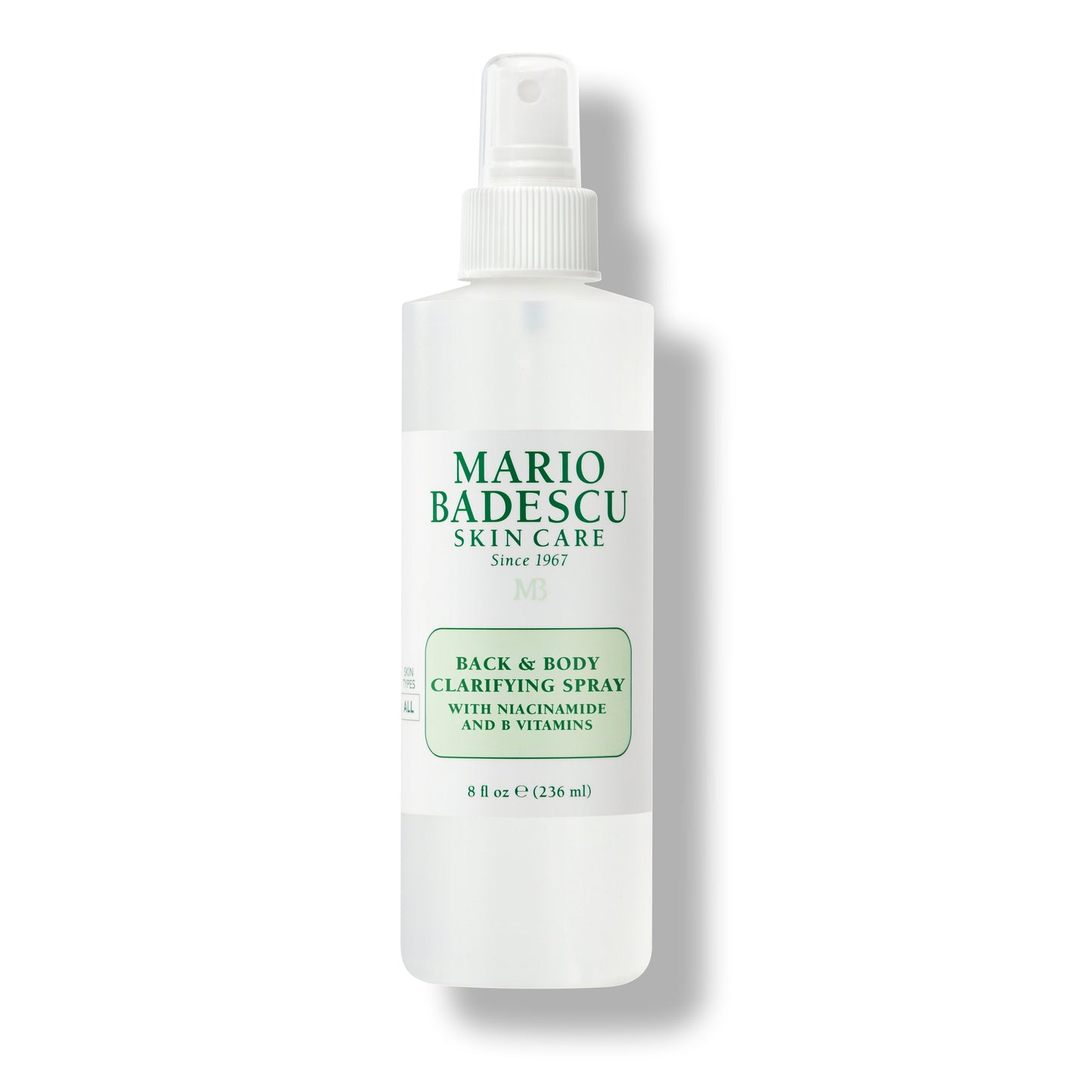
Back & Body Clarifying Spray

Back & Body Clarifying Spray
Mario Badescu
back-body-clarifying-spray
Body care
9818375127333
Morning or Evening?
How often will you use this product?
Notes


Highlights
WHAT IS IT?
Body clarifying spray with 4 key ingredients
FEATURES
Anti-inflammatory and anti-bacterial properties, reduces post-breakout hyperpigmentation, strengthens skin barrier
BEST FOR
all skin types, sensitive
CHECKS
Free of paraben, silicon, fragrance, talc, dye
Who Is It For?
All Ages All GendersWhat Does It Help With?
Bacne Body Blemishes HyperpigmentationBudget
Affordable (under $30)How To Use
Which routine should it be used in?
Instructions:
Key Information


What Mario Badescu Says
Product Description:
The Mario Badescu Back and Body Clarifying Spray is formulated with Zinc-PCA, Niacinamide, Biotin, and Panthenol to target stubborn bacne and body blemishes effectively. With consistent use, this spray can help rebalance and revitalize your body's complexion, leaving you with a renewed radiance.
About the Brand:
Ingredients Overview
Ingredients List
Water (Aqua), Isopropyl Alcohol, Camphor, Zinc PCA, Disodium Phosphate, Pyridoxine HCl, Niacinamide, Glycerin, Phenoxyethanol, Panthenol, Hydrolyzed Yeast Protein, Threonine, Allantoin, Citric Acid, Potassium Sorbate, Biotin
Key Ingredients
Zinc-PCA, Niacinamide, Biotin, Panthenol
Ingredients Details
Biotin
Common Name(s): Vitamin b7,vitamin h,d-biotin
CAS Number: 58-85-5
DESCRIPTION
What It Does: Supports keratin production for stronger hair and nails.
Why It's Used: Hair and nail keratin infrastructure support; widely marketed despite evidence being primarily oral supplementation-based.
How It Works: Coenzyme for carboxylase enzymes essential for fatty acid synthesis and amino acid metabolism relevant to hair follicle function.
Typically Found In: Hair growth shampoos,nail treatments,multivitamin products
TECHNICAL DETAILS
Primary Category: Active ingredient – vitamin b7
Secondary Functions: Hair growth support,nail strengthening
Application Areas:

Facial Skincare

Body Care
Hair Care
Beard Care
Color Cosmetics (Makeup)
Dietary/Oral Supplements
Typical Concentration Range: 0.01%–0.5%
SOURCING & ETHICS
Vegan Status: Conditional - feedstock declaration required
Halal Status: Unverified - feedstock declaration required (plant, animal and petrochemical routes all exist)
Source Notes: Synthetically produced for cosmetic use. [audit 2026-07-29 rev2: origin-dependent: the same inci exists in plant, animal and petrochemical versions and the name does not discriminate. determination requires shariah-panel sign-off.]
SKIN COMPATIBILITY
Irritancy Rating: 1/5 – very low
Comedogenicity Rating: 0/5 – non-comedogenic
Sensitivity Concerns: Non-irritating; excellent tolerability.
Safe for Sensitive Skin: Yes
SAFETY & COMPATIBILITY
Safety Profile: Excellent safety profile. ewg score: 1.
Works Well With: Other b vitamins,niacinamide,antioxidant complexes
Avoid Combining With: No significant incompatibilities
SCIENTIFIC NOTE
Evidence for topical biotin efficacy in hair growth is limited – most clinical evidence comes from oral supplementation in biotin-deficient individuals.
Last Verified: 2026-03-12
Primary Sources: Cosing database,cir safety assessment,patel et al. (2017) skin appendage disorders
Niacinamide
Common Name(s): Vitamin b3,nicotinamide,pyridine-3-carboxamide
CAS Number: 98-92-0
DESCRIPTION
What It Does: Niacinamide strengthens the skin barrier, reduces visible pore size, regulates sebum production, fades dark spots, and improves skin texture and tone.
Why It's Used: It is used because it addresses multiple skin concerns at once without irritation, making it suitable for all skin types. it is stable in formulations and pairs well with most other actives.
How It Works: Niacinamide inhibits the transfer of melanosomes (pigment packets) to skin cells, reducing hyperpigmentation. it also stimulates ceramide synthesis to strengthen the skin barrier and reduces inflammation by modulating cytokine activity.
Typically Found In: Serums,moisturizers,toners,cleansers,eye creams,sunscreens,primers
TECHNICAL DETAILS
Primary Category: Active ingredient – vitamin
Secondary Functions: Barrier repair,brightening,anti-inflammatory
Application Areas:
Facial Skincare
Body Care
Hair Care
Beard Care
Color Cosmetics (Makeup)
Dietary/Oral Supplements
Typical Concentration Range: 2%–10% (typical: 5%; higher concentrations may cause flushing in some individuals)
SOURCING & ETHICS
Vegan Status: Yes – synthetically produced
Halal Status: Yes – synthetic origin
Source Notes: Commercially produced via synthesis from nicotinic acid or 3-cyanopyridine. no animal-derived sources used in cosmetic-grade niacinamide.
SKIN COMPATIBILITY
Irritancy Rating: 1/5 – very low; concentrations above 10% may cause temporary flushing in sensitive individuals
Comedogenicity Rating: 0/5 – non-comedogenic
Sensitivity Concerns: At concentrations >10%, some users experience niacin flush (transient redness/tingling). generally very well-tolerated.
Safe for Sensitive Skin: Yes – one of the best-tolerated actives for sensitive skin
SAFETY & COMPATIBILITY
Safety Profile: Extensively studied and considered very safe. ewg hazard score: 1. no significant systemic toxicity concerns at topical concentrations.
Works Well With: Retinol,peptides,ahas/bhas,hyaluronic acid,ceramides,zinc,vitamin c,spf
Avoid Combining With: High concentrations of vitamin c (ascorbic acid) may theoretically convert to niacin – use at different times if using pure l-ascorbic acid above 15%
SCIENTIFIC NOTE
Niacinamide is a precursor to nad+ and nadp+, coenzymes vital to cellular energy metabolism. its benefits for dna repair and mitochondrial function make it a key ingredient in anti-aging strategies.
Last Verified: 2026-03-12
Primary Sources: Cosing database,cir safety assessment,ewg skin deep,pubmed clinical studies
Panthenol
Common Name(s): Provitamin b5,d-panthenol,dl-panthenol,d-pantothenyl alcohol,(r)-2,4-dihydroxy-n-(3-hydroxypropyl)-3,3-dimethylbutanamide
DESCRIPTION
What It Does: Panthenol deeply moisturizes skin and hair, soothes irritation, accelerates wound healing, strengthens the skin barrier, and improves hair elasticity and shine.
Why It's Used: It is used because it is exceptionally versatile, working in both skin and hair formulations. it is gentle enough for sensitive and post-procedure skin, and converts to the active vitamin b5 within the skin.
How It Works: Panthenol penetrates skin and hair, where it is oxidized to pantothenic acid (vitamin b5), a coenzyme a precursor essential to metabolism. in skin, it acts as a humectant and stimulates fibroblast proliferation. in hair, it coats the shaft, improving manageability.
Typically Found In: Moisturizers,serums,toners,after-sun products,wound healing products,shampoos,conditioners,hair masks,beard care
TECHNICAL DETAILS
Primary Category: Active ingredient – provitamin b5
Secondary Functions: Anti-inflammatory,wound healing,hair conditioning
Application Areas:
Facial Skincare
Body Care
Hair Care
Beard Care
Color Cosmetics (Makeup)
Dietary/Oral Supplements
Typical Concentration Range: 0.5%–5% (typical: 1–3%)
SOURCING & ETHICS
Vegan Status: Conditional - supplier confirmation required
Halal Status: Unverified - supplier confirmation required
Source Notes: Commercially synthesized. both d- and dl-forms used in cosmetics; d-panthenol is the biologically active isomer but dl-panthenol is less expensive and widely used. [audit 2026-07-29 rev2: the record's own source_notes does not assert a non-animal origin, or instructs the reader to verify with the supplier; "yes" asserts knowledge the record does not hold. determination requires shariah-panel sign-off.]
SKIN COMPATIBILITY
Irritancy Rating: 1/5 – very low; one of the most soothing ingredients in cosmetics
Comedogenicity Rating: 0/5 – non-comedogenic
Sensitivity Concerns: Extremely rare contact allergy; considered one of the safest cosmetic ingredients. suitable for all skin types.
Safe for Sensitive Skin: Yes – ideal for sensitive, reactive, and post-procedure skin
SAFETY & COMPATIBILITY
Safety Profile: Exceptionally safe. ewg hazard score: 1. no significant concerns for irritation, sensitization, or systemic toxicity. safe during pregnancy.
Works Well With: Hyaluronic acid,ceramides,allantoin,niacinamide,centella asiatica,retinol (reduces irritation),glycerin
Avoid Combining With: No known significant incompatibilities
SCIENTIFIC NOTE
Panthenol has demonstrated wound-healing properties in clinical studies, stimulating fibroblast proliferation and migration. its dual humectant and anti-inflammatory action makes it particularly effective in barrier-repair formulations.
Last Verified: 2026-03-12
Primary Sources: Cosing database,cir safety assessment,ebner et al. (2002) skin pharmacology and applied skin physiology
Zinc Pca
Common Name(s): Zinc salt of pca,zinc pyrrolidone carboxylate
CAS Number: 15454-75-8
DESCRIPTION
What It Does: Simultaneously regulates sebum and hydrates via nmf-pca component for oily-dehydrated combination skin.
Why It's Used: Unique dual-function ingredient addressing the paradox of oily-yet-dehydrated skin with sebum control (zinc) + nmf hydration (pca) from one molecule.
How It Works: Zinc ion component inhibits 5-alpha-reductase and p. acnes. pca component provides nmf-type humectant hydration. combined in the zinc-pca salt for simultaneous delivery of both activities.
Typically Found In: Combination skin products,anti-acne moisturizers,oily skin hydration
TECHNICAL DETAILS
Primary Category: Active ingredient – zinc nmf complex
Secondary Functions: Sebum control,nmf hydration,anti-acne
Application Areas:
Facial Skincare
Body Care
Hair Care
Beard Care
Color Cosmetics (Makeup)
Dietary/Oral Supplements
Typical Concentration Range: 0.1%–1%
SOURCING & ETHICS
Vegan Status: Yes – mineral/inorganic
Halal Status: Yes
Source Notes: Mineral/inorganic compound. cosmetic or pharmaceutical grade.
SKIN COMPATIBILITY
Irritancy Rating: 1/5 – very low
Comedogenicity Rating: 0/5 – non-comedogenic
Sensitivity Concerns: Non-irritating at recommended concentrations.
Safe for Sensitive Skin: Yes at recommended concentrations
SAFETY & COMPATIBILITY
Safety Profile: Excellent safety profile at cosmetic concentrations. ewg score: 1–2.
Works Well With: Niacinamide,salicylic acid,other actives
Avoid Combining With: No significant incompatibilities at standard concentrations
SCIENTIFIC NOTE
The combination of sebum regulation and nmf hydration in zinc pca addresses the clinically common oily-dehydrated skin phenotype, where excess sebum is accompanied by inadequate water binding in the stratum corneum – a condition poorly served by either humectants (worsen oiliness) or astringents alone.
Last Verified: 2026-03-12
Primary Sources: Cosing database,cir safety assessment,basf zinc pca technical data