

Nykaa E retail limited
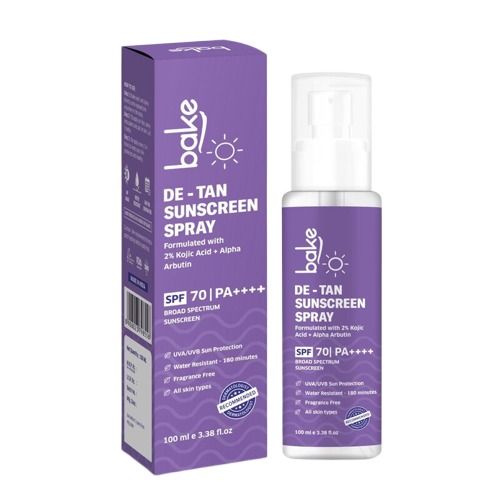
BAKE SPF 70 Sunscreen Spray PA++++ Waterproof

BAKE SPF 70 Sunscreen Spray PA++++ Waterproof
Nykaa E retail limited
bake-spf-70-sunscreen-spray-pa-waterproof
Suncare
10084855546149
Morning or Evening?
How often will you use this product?
Notes


Highlights
WHAT IS IT?
Sunscreen Spray with 5 key ingredients
FEATURES
Waterproof and sweat-resistant, Tan removal, High sun protection SPF 70 and PA+++, Fades dark spots, Lightweight and non-greasy, Vegan and cruelty-free, Free from harmful parabens, silicones, sulfates, mineral oils, SLS, petroleum, artificial preservatives and synthetic fragrances
BEST FOR
normal
CHECKS
Parabens, Harmful silicones, Cyclopentasiloxane, Sulfates, Mineral oils, SLS, Petroleum, Artificial preservatives, Synthetic fragrances
Who Is It For?
What Does It Help With?
Tan Removal Dark Spot Fading High Sun Protection Broad Spectrum Uva And Uvb ProtectionBudget
Professional (over ₹150)How To Use
Which routine should it be used in?
Instructions:
Key Information


What Nykaa E retail limited Says
Product Description:
Bake Detan 2% Kojic Acid Sunscreen Spray SPF 70 PA+++ is formulated with kojic acid and alpha-arbutin, which helps in effectively removing tan and reducing dark spots while providing broad-spectrum UVA and UVB protection. Its waterproof and sweat-resistant formula ensures long-lasting defense against sun damage, making it perfect for swimming, outdoor activities, and active lifestyles. The lightweight, non-greasy spray absorbs quickly without leaving a white cast, suitable for all skin types. Achieve a brighter, more even complexion with this essential sunscreen spray for daily use. Features: Waterproof and sweat-resistant for long-lasting protection; Tan removal with kojic acid and alpha arbutin; High sun protection SPF 70 and PA+++; Fades dark spots with antioxidants and skin-brightening agents; Vegan and cruelty-free; Free from parabens, harmful silicones, cyclopentasiloxane, sulfates, mineral oils, SLS, petroleum, artificial preservatives, and synthetic fragrances.
About the Brand:
Ingredients Overview
Ingredients List
Kojic-Acid,Alpha-Arbutin,Zinc-Oxide,Niacinamide,Glycerine
Key Ingredients
Kojic Acid, Alpha Arbutin, Zinc Oxide, Niacinamide, Glycerine
Ingredients Details
Alpha-arbutin
Common Name(s): 4-hydroxyphenyl-alpha-d-glucopyranoside
DESCRIPTION
What It Does: Provides potent tyrosinase inhibition with improved stability and tolerability over other arbutin forms.
Why It's Used: Premium arbutin — alpha configuration provides 10× greater tyrosinase inhibition than beta-arbutin at equivalent concentration, making alpha-arbutin the most effective arbutin form.
How It Works: Alpha-glucoside linkage provides enhanced metabolic stability vs beta-arbutin (less enzymatic hydrolysis to free hydroquinone in skin). inhibits tyrosinase via competitive substrate inhibition (ic50 ~24μg/ml vs beta-arbutin ~525μg/ml — 20× more potent). inhibits dopa oxidase step in melanogenesis.
Typically Found In: Brightening serums,anti-spot products,premium lightening
TECHNICAL DETAILS
Primary Category: Active ingredient – arbutin brightening agent
Secondary Functions: Melanin inhibition,hyperpigmentation reduction
Application Areas:

Facial Skincare

Body Care
Hair Care
Beard Care
Color Cosmetics (Makeup)
Dietary/Oral Supplements
Typical Concentration Range: 0.5%–2%
SOURCING & ETHICS
Vegan Status: Yes – synthetic enzymatic synthesis
Halal Status: Yes
Source Notes: Synthetic or plant-derived.
SKIN COMPATIBILITY
Irritancy Rating: 1/5 – very low
Comedogenicity Rating: 0/5 – non-comedogenic
Sensitivity Concerns: Non-irritating; well-tolerated.
Safe for Sensitive Skin: Yes
SAFETY & COMPATIBILITY
Safety Profile: Excellent safety profile. use with spf for maximum efficacy. ewg score: 1.
Works Well With: Niacinamide,vitamin c,alpha-arbutin,tranexamic acid,spf
Avoid Combining With: No significant incompatibilities
SCIENTIFIC NOTE
Alpha-arbutin's 10–20× greater potency vs beta-arbutin at equivalent concentration arises from the alpha-glycosidic bond geometry — the alpha configuration positions the hydroquinone aglycone at a specific orientation relative to the glucose that fits the tyrosinase active site copper more precisely than the beta isomer's different spatial arrangement.
Last Verified: ##########
Primary Sources: Cosing database,sugimoto et al. arbutin tyrosinase study
Glycerine
Common Name(s): Glycerin,universal humectant,water-binding skin conditioning
CAS Number: N/a
DESCRIPTION
What It Does: Attracts and retains moisture in the sc, improves skin barrier function at low concentrations, provides gentle keratolytic softening, and acts as a co-solvent for water-soluble actives.
Why It's Used: The reference humectant — lowest cost, best safety profile, universal formulation compatibility, and present naturally in the sc via lipase-mediated glycerolipid hydrolysis makes glycerin the industry standard against which all humectants are benchmarked.
How It Works: Three hydroxyl groups form 6 h-bonds with water molecules per glycerol unit — the highest oh-group density per carbon of any commercial humectant. glycerin also down-regulates epidermal serine proteases that overactivate in dry sc, improving desquamation and barrier integrity.
Typically Found In: All cosmetics,universal
TECHNICAL DETAILS
Primary Category: Functional ingredient – humectant
Secondary Functions: Tewl reduction,skin plumping
Application Areas:
Facial Skincare
Body Care
Hair Care
Beard Care
Color Cosmetics (Makeup)
Dietary/Oral Supplements
Typical Concentration Range: 1%–40%
SOURCING & ETHICS
Vegan Status: Yes
Halal Status: Yes
Source Notes: Synthetic or naturally derived. excellent aqueous solubility.
SKIN COMPATIBILITY
Irritancy Rating: 1/5 – very low
Comedogenicity Rating: 0/5 – non-comedogenic
Sensitivity Concerns: Non-irritating; suitable for all skin types.
Safe for Sensitive Skin: Yes
SAFETY & COMPATIBILITY
Safety Profile: Excellent safety profile. ewg score: 1.
Works Well With: Ceramides,emollients,occlusives,glycerin,hyaluronic acid
Avoid Combining With: No significant incompatibilities
SCIENTIFIC NOTE
Epidermal lipases hydrolyse sc glycerophospholipids during cornification, releasing glycerol that contributes to the natural nmf — topical glycerin directly supplements this endogenous sc humectant pool.
Last Verified: 2026-03-12
Primary Sources: Cosing database,glycerin universal humectant review
Niacinamide
Common Name(s): Vitamin b3,nicotinamide,pyridine-3-carboxamide
CAS Number: 98-92-0
DESCRIPTION
What It Does: Niacinamide strengthens the skin barrier, reduces visible pore size, regulates sebum production, fades dark spots, and improves skin texture and tone.
Why It's Used: It is used because it addresses multiple skin concerns at once without irritation, making it suitable for all skin types. it is stable in formulations and pairs well with most other actives.
How It Works: Niacinamide inhibits the transfer of melanosomes (pigment packets) to skin cells, reducing hyperpigmentation. it also stimulates ceramide synthesis to strengthen the skin barrier and reduces inflammation by modulating cytokine activity.
Typically Found In: Serums,moisturizers,toners,cleansers,eye creams,sunscreens,primers
TECHNICAL DETAILS
Primary Category: Active ingredient – vitamin
Secondary Functions: Barrier repair,brightening,anti-inflammatory
Application Areas:
Facial Skincare
Body Care
Hair Care
Beard Care
Color Cosmetics (Makeup)
Dietary/Oral Supplements
Typical Concentration Range: 2%–10% (typical: 5%; higher concentrations may cause flushing in some individuals)
SOURCING & ETHICS
Vegan Status: Yes – synthetically produced
Halal Status: Yes – synthetic origin
Source Notes: Commercially produced via synthesis from nicotinic acid or 3-cyanopyridine. no animal-derived sources used in cosmetic-grade niacinamide.
SKIN COMPATIBILITY
Irritancy Rating: 1/5 – very low; concentrations above 10% may cause temporary flushing in sensitive individuals
Comedogenicity Rating: 0/5 – non-comedogenic
Sensitivity Concerns: At concentrations >10%, some users experience niacin flush (transient redness/tingling). generally very well-tolerated.
Safe for Sensitive Skin: Yes – one of the best-tolerated actives for sensitive skin
SAFETY & COMPATIBILITY
Safety Profile: Extensively studied and considered very safe. ewg hazard score: 1. no significant systemic toxicity concerns at topical concentrations.
Works Well With: Retinol,peptides,ahas/bhas,hyaluronic acid,ceramides,zinc,vitamin c,spf
Avoid Combining With: High concentrations of vitamin c (ascorbic acid) may theoretically convert to niacin – use at different times if using pure l-ascorbic acid above 15%
SCIENTIFIC NOTE
Niacinamide is a precursor to nad+ and nadp+, coenzymes vital to cellular energy metabolism. its benefits for dna repair and mitochondrial function make it a key ingredient in anti-aging strategies.
Last Verified: 2026-03-12
Primary Sources: Cosing database,cir safety assessment,ewg skin deep,pubmed clinical studies