
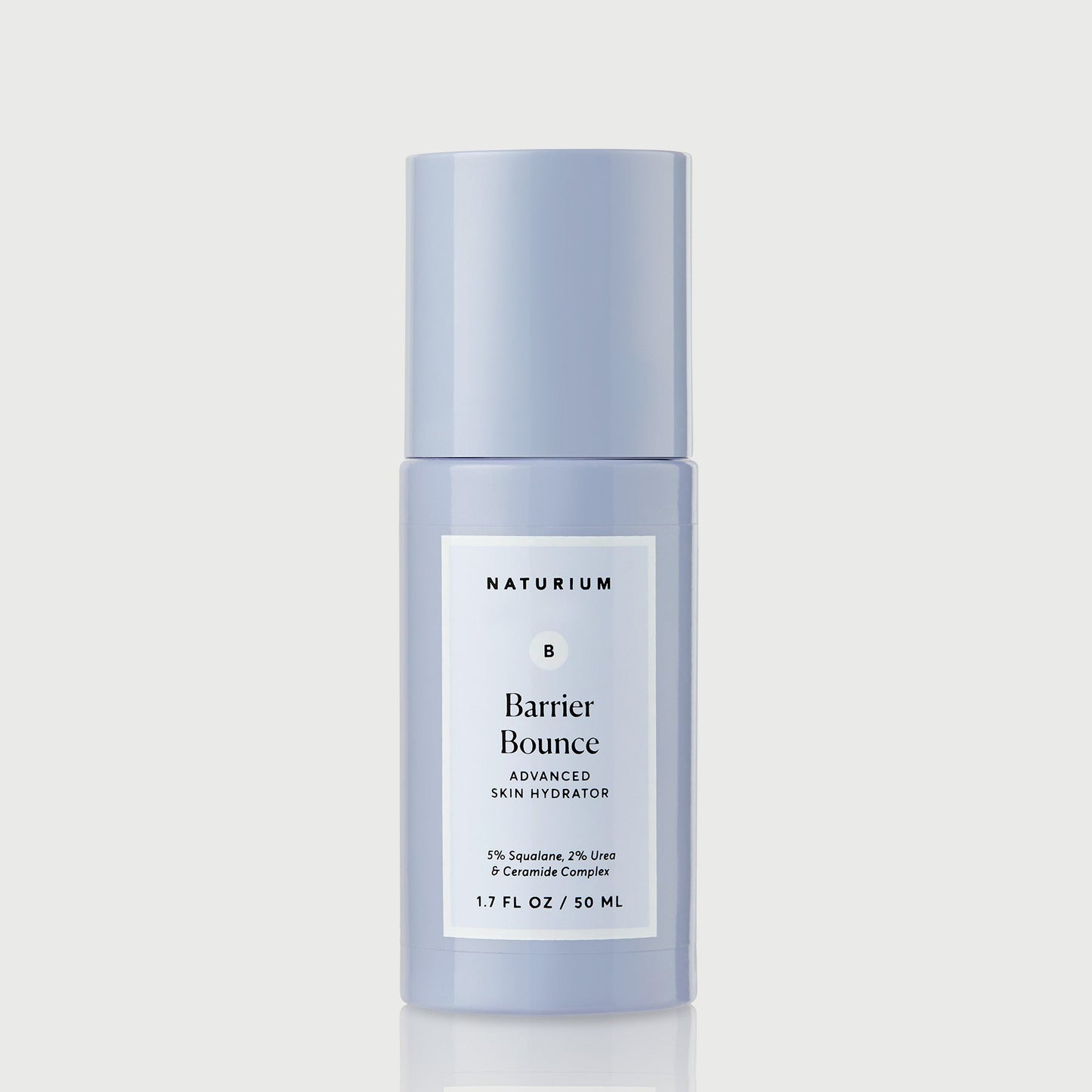

Naturium
Barrier Bounce

Barrier Bounce
Naturium
barrier-bounce
Serum
9818316800293
Morning or Evening?
How often will you use this product?
Notes


Highlights
WHAT IS IT?
Oil-serum with 5% squalane, 2% urea and ceramide complex
FEATURES
Plumps, brightens and hydrates skin, Supports healthy skin barrier
BEST FOR
all skin types
CHECKS
Free of alcohol, paraben, silicon, fragrance
Who Is It For?
All Ages And GendersWhat Does It Help With?
Hydration Barrier Support Skin Brightening PlumpingBudget
Affordable (under $30)How To Use
Which routine should it be used in?
Instructions:
Key Information


What Naturium Says
Product Description:
Our advanced skin hydrator is an oil-serum formulated with 5% squalane, 2% urea and a ceramide complex to support a healthy skin barrier. This nourishing formula plumps, brightens and hydrates skin for a glowing complexion. Shake well!
About the Brand:
Ingredients Overview
Ingredients List
Aqua/Water/Eau, Octyldodecanol, Squalane, Shea Butter Ethyl Esters, Polyglyceryl-4 Diisostearate/Polyhydroxystearate/Sebacate, Propanediol, C13-15 Alkane, Crambe Abyssinica Seed Oil Phytosterol Esters, Urea, Glycerin, Silica, Polyglyceryl-3 Polyricinoleate, Sodium Chloride, Simmondsia Chinensis (Jojoba) Seed Oil, Silybum Marianum Seed Oil, Ceramide NP, Cholesterol, Oleic Acid, Blakeslea Trispora Mycelium Extract, Salicornia Herbacea Extract, Sodium Hyaluronate, Caprylic/Capric Triglyceride, Disteardimonium Hectorite, Phytosphingosine, Hydrogenated Poly(C6-14 Olefin), Benzotriazolyl Dodecyl P-Cresol, Hydrogenated Lecithin, Lactic Acid, Butylene/Ethylene/Styrene Copolymer, Ethylene/Propylene/Styrene Copolymer, Stearic Acid, Sodium Hydroxide, Citric Acid, Ethylhexylglycerin, Pentaerythrityl Tetra-di-t-butyl Hydroxyhydrocinnamate, Sodium Sulfate, Sodium Carbonate, Tocopherol, Caprylyl Glycol, Caprylhydroxamic Acid, 1,2-Hexanediol, Phenoxyethanol, Manganese Violet (CI 77742)
Key Ingredients
squalane 5%,urea 2%,ceramide complex
Ingredients Details
Squalane
Common Name(s): Perhydrosqualene,2,6,10,15,19,23-hexamethyltetracosane
CAS Number: 0111-01-03
DESCRIPTION
What It Does: Provides endogenous-skin-identical emolliency with exceptional stability and skin compatibility.
Why It's Used: The most skin-compatible emollient – chemically identical to human sebum squalene component with outstanding tolerability across all skin types.
How It Works: Fully saturated hydrocarbon with zero oxidation sites provides exceptional stability unlike squalene's 6 double bonds. integrates into stratum corneum lipid bilayers with near-perfect biocompatibility. provides antioxidant protection to formulation via radical quenching.
Typically Found In: Facial oils,serums,non-comedogenic moisturizers,luxury body care
TECHNICAL DETAILS
Primary Category: Functional ingredient – emollient
Secondary Functions: Maximum biocompatibility,antioxidant stabilizer,non-comedogenic
Application Areas:

Facial Skincare
Body Care
Hair Care
Beard Care

Color Cosmetics (Makeup)
Dietary/Oral Supplements
Typical Concentration Range: 1%–100%
SOURCING & ETHICS
Vegan Status: Conditional - feedstock declaration required
Halal Status: Unverified - feedstock declaration required (plant, animal and petrochemical routes all exist)
Source Notes: Sustainable plant-derived squalane from sugarcane fermentation (amyris) or olive oil fractionation is preferred over shark liver-derived. chemically identical regardless of source. [audit 2026-07-29 rev2: origin-dependent: the same inci exists in plant, animal and petrochemical versions and the name does not discriminate. determination requires shariah-panel sign-off.]
SKIN COMPATIBILITY
Irritancy Rating: 1/5 – very low
Comedogenicity Rating: 0/5 – non-comedogenic
Sensitivity Concerns: Non-irritating.
Safe for Sensitive Skin: Yes
SAFETY & COMPATIBILITY
Safety Profile: Excellent safety profile. ewg score: 1.
Works Well With: Humectants,ceramides,actives as carrier
Avoid Combining With: No significant incompatibilities
SCIENTIFIC NOTE
Squalene constitutes approximately 12-15% of human sebum – the highest proportion of any skin lipid. topical squalane (stable, hydrogenated form) replenishes this abundant endogenous skin lipid. the complete absence of oxidizable double bonds (unlike squalene's 6 double bonds) eliminates the pro-oxidant concerns of natural squalene oxidation.
Last Verified: 2026-03-12
Primary Sources: Cosing database,huang et al. squalane review,cir safety assessment
Urea
Common Name(s): Urea,nmf component keratolytic,dual humectant+exfoliant
CAS Number: N/a
DESCRIPTION
What It Does: At 2–10%: provides deep humectancy, softens sc, and improves other active penetration. at 10–40%: keratolytically dissolves corneocyte protein bonds for intensive exfoliation of hyperkeratotic skin (calluses, eczema plaques, psoriasis).
Why It's Used: Urea combines two otherwise separate ingredient classes (humectant and keratolytic) in one molecule, with formulator-controlled function through concentration selection — uniquely versatile for multiple skin condition applications.
How It Works: Urea's carbonyl and amine groups form h-bonds with water (humectancy) and with corneocyte keratin (penetration). at high concentrations, urea disrupts keratin hydrogen bonds (chaotropic activity) solubilising the sc protein matrix — concentration determines whether humectant or keratolytic effect predominates.
Typically Found In: Eczema,hyperkeratosis,callus care,moisturising
TECHNICAL DETAILS
Primary Category: Functional ingredient – humectant
Secondary Functions: Tewl reduction,skin plumping
Application Areas:
Facial Skincare
Body Care
Hair Care
Beard Care
Color Cosmetics (Makeup)
Dietary/Oral Supplements
Typical Concentration Range: 2%–40%
SOURCING & ETHICS
Vegan Status: Conditional - feedstock declaration required
Halal Status: Unverified - feedstock declaration required (plant, animal and petrochemical routes all exist)
Source Notes: Synthetic or naturally derived. excellent aqueous solubility. [audit 2026-07-29 rev2: origin-dependent: the same inci exists in plant, animal and petrochemical versions and the name does not discriminate. determination requires shariah-panel sign-off.]
SKIN COMPATIBILITY
Irritancy Rating: 1/5 – very low
Comedogenicity Rating: 0/5 – non-comedogenic
Sensitivity Concerns: Non-irritating; suitable for all skin types.
Safe for Sensitive Skin: Yes
SAFETY & COMPATIBILITY
Safety Profile: Excellent safety profile. ewg score: 1.
Works Well With: Ceramides,emollients,occlusives,glycerin,hyaluronic acid
Avoid Combining With: No significant incompatibilities
SCIENTIFIC NOTE
Urea is the most concentrated natural nmf component — healthy sc contains 28 mg/g urea versus 2 mg/g in xerotic (dry) skin. topical urea application directly replenishes the physiological nmf deficit that drives dry skin conditions.
Last Verified: