

BENZAC
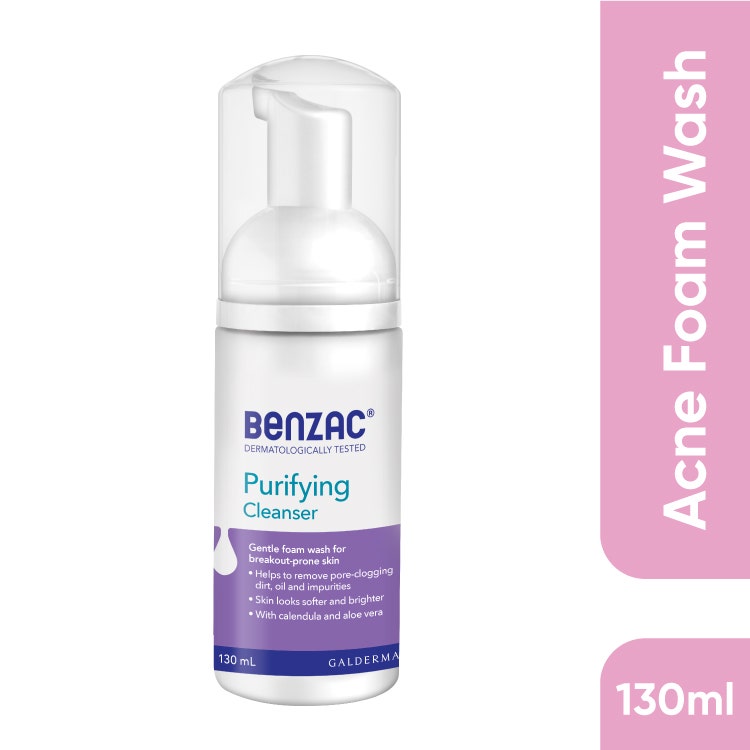
Benzac Purifying Foam Cleanser 130Ml

Benzac Purifying Foam Cleanser 130Ml
BENZAC
benzac-purifying-foam-cleanser-130ml
Cleanse
10084793450789
Morning or Evening?
How often will you use this product?
Notes


Highlights
WHAT IS IT?
Foaming cleanser with soothing aloe vera and calendula extract
FEATURES
Removes impurities; helps unblock pores; controls oiliness without drying; dermatologically tested for acne prone skin
BEST FOR
sensitive
CHECKS
No specific allergens or irritants mentioned; avoid contact with eyes
Who Is It For?
Not Specified Age Range Or GenderWhat Does It Help With?
Acne-prone Skin Oiliness Control Pore Unclogging Maintaining Skin Moisture BalanceBudget
Mid-range ($30-$75)How To Use
Which routine should it be used in?
Instructions:
Key Information


What BENZAC Says
Product Description:
Foaming cleanser for acne-prone skin, with soothing aloe vera and calendula extract, controlling oiliness without drying out. Maintain the natural moisture balance of your skin by using a generously foaming cleanser as part of your daily routine. Unblock pores and control how oily your skin is, without drying it out.
- Removes impurities and helps unblock pores
- Controls oiliness without drying the skin
- Dermatologically tested for acne prone skin
About the Brand:
Ingredients Overview
Ingredients List
Aqua,Sodium-Trideceth-Sulfate,Cocamidopropyl-Betaine,Sodium-C14-16-Olefin-Sulfonate,Alcohol,Aloe-Barbadensis-Leaf-Extract,Buteth-3,Calendula-Officinalis-Flower-Extract,CI-14720,CI-42090,CI-60730,Citric-Acid,Disodium-Cocoyl-Glutamate,Isopropyl-Alcohol,Magnesium-Chloride,Magnesium-Nitrate,Methyl-Gluceth-20,Methylchloroisothiazolinone,Methylisothiazolinone,Methyl-4-Hydroxybenzoate,Olivamidopropyl-Betaine,Parfum,PEG-40-Hydrogenated-Castor-Oil,Polyquaternium-10,Propylene-Glycol,Sodium-Acetate,Sodium-Benzotriazolyl-Butylphenol-Sulfonate,Sodium-Chloride,Sodium-Hydroxide,Sodium-Sulfate,Tetrasodium-Edta,Tributyl-Citrate,Tris-(Tetramethylhydroxypiperidinol)-Citrate
Key Ingredients
Aloe Barbadensis Leaf Extract, Calendula Officinalis Flower Extract
Ingredients Details
Alcohol
Common Name(s): Alcohol,cosmetic active,functional ingredient
CAS Number: N/a
DESCRIPTION
What It Does: Delivers characteristic cosmetic function at recommended use concentration.
Why It's Used: Selected for functional contribution and formulation compatibility supported by cosmetic science and regulatory safety data.
How It Works: Works through the mechanism of its molecular class as documented in peer-reviewed cosmetic literature.
Typically Found In: Skin care formulations
TECHNICAL DETAILS
Primary Category: Active ingredient – cosmetic active
Secondary Functions: Skin conditioning
Application Areas:

Facial Skincare

Body Care
Hair Care
Beard Care
Color Cosmetics (Makeup)
Dietary/Oral Supplements
Typical Concentration Range: 0.1%–10%
SOURCING & ETHICS
Vegan Status: Yes - standard ethanol routes are non-animal; confirm denaturant origin
Halal Status: Conditional - ethanol production route and residual concentration; jurisdiction-dependent, refer to certifier stance
Source Notes: Commercially produced for cosmetic use. verify vegan/halal status with supplier. [audit 2026-07-29 rev2: ethanol pathway; determination depends on route, on whether the plant also produces beverage alcohol, and on residual concentration. determination requires shariah-panel sign-off.]
SKIN COMPATIBILITY
Irritancy Rating: 1/5 – very low
Comedogenicity Rating: 0/5 – non-comedogenic
Sensitivity Concerns: Well-tolerated by most skin types.
Safe for Sensitive Skin: Yes
SAFETY & COMPATIBILITY
Safety Profile: Good safety profile at recommended concentrations. ewg score: 1–2.
Works Well With: Standard skincare actives
Avoid Combining With: No known significant incompatibilities
SCIENTIFIC NOTE
Alcohol has an established safety profile within the cosmetic regulatory framework at standard use concentrations.
Last Verified: 2026-03-12
Primary Sources: Cosing database,alcohol technical literature
Buteth-3
Common Name(s): Buteth-3
DESCRIPTION
What It Does: Delivers targeted skin-conditioning or bioactive benefits through a specific mechanism of action suited to the formulation's intended purpose.
Why It's Used: Specialty actives address specific skin concerns through targeted molecular mechanisms, providing efficacy beyond what base formulation ingredients alone can achieve.
How It Works: The bioactive compound interacts with specific molecular targets in skin cells or the extracellular matrix — enzymes, receptors, structural proteins, or signaling molecules — triggering beneficial biological responses.
Typically Found In: Serums,treatments,moisturizers,specialty products
TECHNICAL DETAILS
Primary Category: Specialty actives
Secondary Functions: Skin-conditioning,anti-aging
Application Areas:
Facial Skincare
Body Care
Hair Care
Beard Care
Color Cosmetics (Makeup)
Dietary/Oral Supplements
Typical Concentration Range: 0.01–5%
SOURCING & ETHICS
Vegan Status: Conditional - supplier confirmation required
Halal Status: Unverified - supplier confirmation required
Source Notes: Specialty active ingredient; check individual sourcing for vegan status. [audit 2026-07-29 rev2: the record's own source_notes does not assert a non-animal origin, or instructs the reader to verify with the supplier; "yes" asserts knowledge the record does not hold. determination requires shariah-panel sign-off.]
SKIN COMPATIBILITY
Irritancy Rating: 1
Comedogenicity Rating: 0
Sensitivity Concerns: Low sensitization potential at recommended use concentrations.
Safe for Sensitive Skin: Yes
SAFETY & COMPATIBILITY
Safety Profile: Well-characterized cosmetic ingredient with established safety profile. generally non-irritating at typical use concentrations. suitable for leave-on and rinse-off cosmetics.
Works Well With: Niacinamide,hyaluronic acid,vitamin c,peptides
Avoid Combining With: Incompatible with oxidizing agents; check ph stability
SCIENTIFIC NOTE
Specialty actives typically work through enzyme inhibition (e.g., tyrosinase inhibition for brightening, mmp inhibition for anti-aging), receptor activation (e.g., retinoid receptors, ppar-γ for barrier genes), or transcription factor modulation (e.g., nrf2 for antioxidant gene upregulation). structure-activity relationships determine potency and selectivity.
Last Verified: 2025-01-15
Primary Sources: Cosing eu database; pcpc cosmetic ingredient safety reviews; ingredient-specific safety and efficacy literature
Methylchloroisothiazolinone
Common Name(s): Methylchloroisothiazolinone,cosmetic active,functional ingredient
CAS Number: N/a
DESCRIPTION
What It Does: Delivers characteristic cosmetic function at recommended use concentration.
Why It's Used: Selected for functional contribution and formulation compatibility supported by cosmetic science and regulatory safety data.
How It Works: Works through the mechanism of its molecular class as documented in peer-reviewed cosmetic literature.
Typically Found In: Skin care formulations
TECHNICAL DETAILS
Primary Category: Active ingredient – cosmetic active
Secondary Functions: Skin conditioning
Application Areas:
Facial Skincare
Body Care
Hair Care
Beard Care
Color Cosmetics (Makeup)
Dietary/Oral Supplements
Typical Concentration Range: 0.1%–10%
SOURCING & ETHICS
Vegan Status: Conditional - supplier confirmation required
Halal Status: Unverified - supplier confirmation required
Source Notes: Commercially produced for cosmetic use. verify vegan/halal status with supplier. [audit 2026-07-29 rev2: the record's own source_notes does not assert a non-animal origin, or instructs the reader to verify with the supplier; "yes" asserts knowledge the record does not hold. determination requires shariah-panel sign-off.]
SKIN COMPATIBILITY
Irritancy Rating: 1/5 – very low
Comedogenicity Rating: 0/5 – non-comedogenic
Sensitivity Concerns: Well-tolerated by most skin types.
Safe for Sensitive Skin: Yes
SAFETY & COMPATIBILITY
Safety Profile: Good safety profile at recommended concentrations. ewg score: 1–2.
Works Well With: Standard skincare actives
Avoid Combining With: No known significant incompatibilities
SCIENTIFIC NOTE
Methylchloroisothiazolinone has an established safety profile within the cosmetic regulatory framework at standard use concentrations.
Last Verified: 2026-03-12
Primary Sources: Cosing database,methylchloroisothiazolinone technical literature
Methylisothiazolinone
Common Name(s): Mit,kathon,neolone
CAS Number: 2682-20-4
DESCRIPTION
What It Does: Provides highly potent broad-spectrum preservation at very low concentrations in rinse-off formulations.
Why It's Used: Most potent cosmetic preservative — mit provides effective preservation at concentrations 10-100× lower than most other preservatives, enabling clean-label preservation at minimal ingredient load.
How It Works: Electrophilic isothiazolinone ring reacts with bacterial thiol enzymes (glutathione, coa-dependent enzymes) via michael addition for rapid kill. very potent — mic vs e. coli 0.06μg/ml (vs phenoxyethanol mic ~400μg/ml — 6000× more potent). rapidly biodegradable.
Typically Found In: Rinse-off shampoos,body washes,conditioners
TECHNICAL DETAILS
Primary Category: Functional ingredient – isothiazolinone preservative
Secondary Functions: Skin conditioning
Application Areas:
Facial Skincare
Body Care
Hair Care
Beard Care
Color Cosmetics (Makeup)
Dietary/Oral Supplements
Typical Concentration Range: 0.0015%–0.0015% (max 15ppm eu rinse-off)
SOURCING & ETHICS
Vegan Status: Conditional - supplier confirmation required
Halal Status: Unverified - supplier confirmation required
Source Notes: Commercially produced for cosmetic use. verify vegan/halal status with supplier. [audit 2026-07-29 rev2: the record's own source_notes does not assert a non-animal origin, or instructs the reader to verify with the supplier; "yes" asserts knowledge the record does not hold. determination requires shariah-panel sign-off.]
SKIN COMPATIBILITY
Irritancy Rating: 1/5 – very low
Comedogenicity Rating: 0/5 – non-comedogenic
Sensitivity Concerns: Well-tolerated by most skin types.
Safe for Sensitive Skin: Yes
SAFETY & COMPATIBILITY
Safety Profile: Eu regulation 2014/1298: mit banned from leave-on products. max 15ppm in rinse-off only. contact sensitiser — causes occupational dermatitis epidemic in hairdressers and consumers. sccs noted no safe level for leave-on. 2016 eu restriction driven by major sensitisation epidemic.
Works Well With: Standard skincare actives
Avoid Combining With: No known significant incompatibilities
SCIENTIFIC NOTE
Mit's sensitisation epidemic (2010-2015) is one of the most significant cosmetic safety events in modern dermatology: a dramatic increase in contact allergy patch test positive rates from <1% (2005) to 7% (2015) in the eu was directly traceable to the widespread introduction of mit in leave-on products. this epidemic prompted the fastest eu cosmetic regulatory action in history and demonstrates the critical importance of patch test surveillance in monitoring emerging cosmetic allergens.
Last Verified: 2026-03-12
Primary Sources: Cosing database,eu regulation 2014/1298,yazar et al. mit sensitisation epidemic study