

Biocule
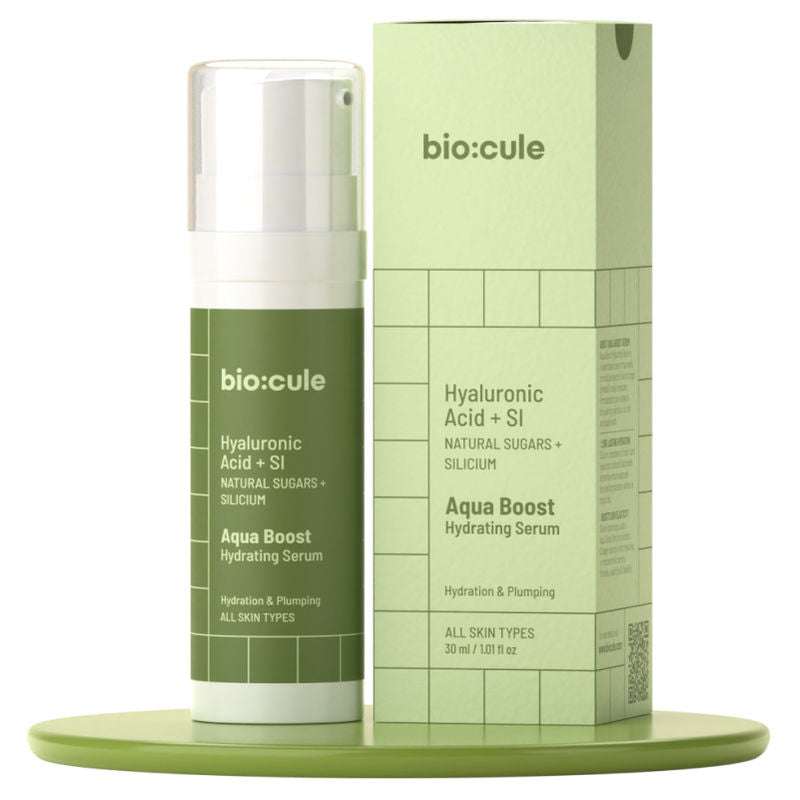
Biocule Aqua Boost Hydrating Face Serum - For All Skin Types

Biocule Aqua Boost Hydrating Face Serum - For All Skin Types
Biocule
biocule-aqua-boost-hydrating-face-serum-for-all-skin-types
Serum
10084985798949
Morning or Evening?
How often will you use this product?
Notes


Highlights
WHAT IS IT?
Hydrating serum with silicium complex of hyaluronic acid and saccharide isomerate, ingredient count 7
FEATURES
Deep and long-lasting hydration, Instant plumping and glow, Boosts skin elasticity, Suitable for all skin types, Clean, safe and effective beauty, Alcohol free, sulphate free, paraben free, silicon free, fragrance free, mineral oil free and synthetic dye free
BEST FOR
all skin types
CHECKS
Alcohol, Sulphate, Paraben, Silicon, Fragrance, Mineral Oil, Synthetic Dye
Who Is It For?
Both Women And Men All AgesWhat Does It Help With?
Dryness Hydration Skin Elasticity Plumping Glow Firmness FlexibilityBudget
Affordable (under $30)How To Use
Which routine should it be used in?
Instructions:
Key Information


What Biocule Says
Product Description:
Biocule Aqua Boost Hyaluronic Acid Serum is a light water gel formula containing silicium complex of hyaluronic acid along with saccharide isomerate from corn kernel and natural glycerine. It works on multiple layers of skin to target dryness and retain moisture. Formulated to give instant plumping and long-lasting hydration for soft and supple skin.
About the Brand:
Ingredients Overview
Ingredients List
Water, Silanetriol and Hyaluronic Acid, Butylene Glycol, Dimethylsilanol Hyaluronate, Glycerine, Saccharide Isomerate, Sodium Hyaluronate
Key Ingredients
Silicium-Complex-of-hyaluronic-acid, Saccharide-Isomerate
Ingredients Details
Butylene Glycol
Common Name(s): 1,3-butanediol,bg,1,3-butylene glycol
CAS Number: 107-88-0
DESCRIPTION
What It Does: Provides humectant hydration and active ingredient solubilization with excellent skin feel.
Why It's Used: Preferred glycol humectant in premium and k-beauty formulations for superior skin feel vs propylene glycol with equivalent functionality.
How It Works: Two hydroxyl groups at 1,3-positions provide water binding and solvent activity. better tolerated than propylene glycol with minimal sensitization risk. 4-carbon backbone provides slightly greater hydrophobic character enabling dissolution of less polar actives vs pg.
Typically Found In: Toners,essences,serums,k-beauty formulas
TECHNICAL DETAILS
Primary Category: Functional ingredient – glycol humectant
Secondary Functions: Tewl reduction,skin plumping
Application Areas:

Facial Skincare
Body Care
Hair Care

Beard Care
Color Cosmetics (Makeup)
Dietary/Oral Supplements
Typical Concentration Range: 1%–10%
SOURCING & ETHICS
Vegan Status: Yes – synthetic
Halal Status: Yes
Source Notes: Synthetic or naturally derived. excellent aqueous solubility.
SKIN COMPATIBILITY
Irritancy Rating: 1/5 – very low
Comedogenicity Rating: 0/5 – non-comedogenic
Sensitivity Concerns: Non-irritating; suitable for all skin types.
Safe for Sensitive Skin: Yes
SAFETY & COMPATIBILITY
Safety Profile: Excellent safety profile. ewg score: 1.
Works Well With: Ceramides,emollients,occlusives,glycerin,hyaluronic acid
Avoid Combining With: No significant incompatibilities
SCIENTIFIC NOTE
K-beauty's preference for butylene glycol over propylene glycol is driven by two factors: bg's superior skin feel (less tacky than pg's higher viscosity) and its lower sensitization potential (1,3-bg has better spatial distribution of hydroxyl groups that reduces protein interaction vs pg's 1,2-position oh groups).
Last Verified: Cosing database,cir safety assessment
Primary Sources: 2026-03-12
Dimethylsilanol Hyaluronate
Common Name(s): Dimethylsilanol hyaluronate,dimethylsilanol hyaluronate,dimethylsilanol hyaluronate,enhanced ha derivative
CAS Number: N/a
DESCRIPTION
What It Does: Provides 1000x water retention humectancy with silicon-enhanced barrier integration for superior hydration versus standard ha formulations.
Why It's Used: Dimethylsilanol modification provides performance advantages over standard sodium hyaluronate — the modification providing the specific functional improvement for targeted applications
How It Works: Ha backbone (beta-1,3/beta-1,4 glucuronate-glcnac disaccharide repeat) provides the 1000x water binding from polyanionic carboxylate groups. dimethylsilanol modification alters the physicochemical properties — molecular weight, charge, or lipophilicity — to provide specific delivery or retention advantages versus unmodified ha.
Typically Found In: Anti-aging hydration,premium serums
TECHNICAL DETAILS
Primary Category: Active ingredient – humectant
Secondary Functions: Moisture retention,hydration
Application Areas:
Facial Skincare
Body Care
Hair Care
Beard Care
Color Cosmetics (Makeup)
Dietary/Oral Supplements
Typical Concentration Range: 0.1%–2%
SOURCING & ETHICS
Vegan Status: Yes
Halal Status: Yes
Source Notes: Plant-derived or fermentation-produced.
SKIN COMPATIBILITY
Irritancy Rating: 1/5 – very low
Comedogenicity Rating: 0/5 – non-comedogenic
Sensitivity Concerns: Non-irritating; suitable for sensitive skin.
Safe for Sensitive Skin: Yes
SAFETY & COMPATIBILITY
Safety Profile: Excellent safety profile. ewg score: 1.
Works Well With: Ceramides,emollients,occlusives,barrier actives
Avoid Combining With: No significant incompatibilities
SCIENTIFIC NOTE
Ha molecular weight determines skin penetration vs surface hydration: ultra-low mw (<10 kda) penetrates sc to dermis; low mw (50-300 kda) intermediate penetration; high mw (>1 mda) surface film only. chemical modification (acetylation, crosslinking) provides independent control of these delivery properties.
Last Verified: Cosing database,dimethylsilanol hyaluronate ha derivative review
Primary Sources: 2026-03-22
Glycerine
Common Name(s): Glycerin,universal humectant,water-binding skin conditioning
CAS Number: N/a
DESCRIPTION
What It Does: Attracts and retains moisture in the sc, improves skin barrier function at low concentrations, provides gentle keratolytic softening, and acts as a co-solvent for water-soluble actives.
Why It's Used: The reference humectant — lowest cost, best safety profile, universal formulation compatibility, and present naturally in the sc via lipase-mediated glycerolipid hydrolysis makes glycerin the industry standard against which all humectants are benchmarked.
How It Works: Three hydroxyl groups form 6 h-bonds with water molecules per glycerol unit — the highest oh-group density per carbon of any commercial humectant. glycerin also down-regulates epidermal serine proteases that overactivate in dry sc, improving desquamation and barrier integrity.
Typically Found In: All cosmetics,universal
TECHNICAL DETAILS
Primary Category: Functional ingredient – humectant
Secondary Functions: Tewl reduction,skin plumping
Application Areas:
Facial Skincare
Body Care
Hair Care
Beard Care
Color Cosmetics (Makeup)
Dietary/Oral Supplements
Typical Concentration Range: 1%–40%
SOURCING & ETHICS
Vegan Status: Yes
Halal Status: Yes
Source Notes: Synthetic or naturally derived. excellent aqueous solubility.
SKIN COMPATIBILITY
Irritancy Rating: 1/5 – very low
Comedogenicity Rating: 0/5 – non-comedogenic
Sensitivity Concerns: Non-irritating; suitable for all skin types.
Safe for Sensitive Skin: Yes
SAFETY & COMPATIBILITY
Safety Profile: Excellent safety profile. ewg score: 1.
Works Well With: Ceramides,emollients,occlusives,glycerin,hyaluronic acid
Avoid Combining With: No significant incompatibilities
SCIENTIFIC NOTE
Epidermal lipases hydrolyse sc glycerophospholipids during cornification, releasing glycerol that contributes to the natural nmf — topical glycerin directly supplements this endogenous sc humectant pool.
Last Verified: Cosing database,glycerin universal humectant review
Primary Sources: 2026-03-12
Saccharide Isomerate
Common Name(s): Pentavitin,carbohydrate complex
CAS Number: N/a
DESCRIPTION
What It Does: Provides wash-resistant, long-lasting skin hydration through unique covalent binding to skin surface proteins.
Why It's Used: The only humectant that covalently binds to skin proteins for wash-resistant, 72-hour moisture retention – categorically different mechanism from all other humectants.
How It Works: Carbohydrate complex with aldehyde-generating groups forms reversible schiff base covalent bonds with lysine epsilon-amino groups in skin surface proteins. this covalent binding retains the humectant on skin through washing, sweat, and environmental exposure for up to 72 hours.
Typically Found In: Long-lasting moisturizers,anti-chapping products,sports skincare
TECHNICAL DETAILS
Primary Category: Active ingredient – carbohydrate complex humectant
Secondary Functions: Covalent skin binding,wash-resistant,72h hydration
Application Areas:
Facial Skincare
Body Care
Hair Care
Beard Care
Color Cosmetics (Makeup)
Dietary/Oral Supplements
Typical Concentration Range: 1%–10%
SOURCING & ETHICS
Vegan Status: Yes – from plant carbohydrates
Halal Status: Yes
Source Notes: Synthetic or naturally derived. excellent aqueous solubility.
SKIN COMPATIBILITY
Irritancy Rating: 1/5 – very low
Comedogenicity Rating: 0/5 – non-comedogenic
Sensitivity Concerns: Non-irritating; suitable for all skin types.
Safe for Sensitive Skin: Yes
SAFETY & COMPATIBILITY
Safety Profile: Excellent safety profile. ewg score: 1.
Works Well With: Ceramides,emollients,occlusives,glycerin,hyaluronic acid
Avoid Combining With: No significant incompatibilities
SCIENTIFIC NOTE
No other cosmetic humectant forms covalent bonds with skin proteins – all others (glycerin, ha, sodium pca) interact through non-covalent hydrogen bonds that are disrupted by washing or sweat. saccharide isomerate's schiff base chemistry creates bonds that survive the ph and mechanical disruption of washing, explaining clinical evidence for 72-hour hydration persistence.
Last Verified: Cosing database,codex beauty saccharide isomerate review,dsm pentavitin technical data
Primary Sources: 2026-03-12
