

Bioderma
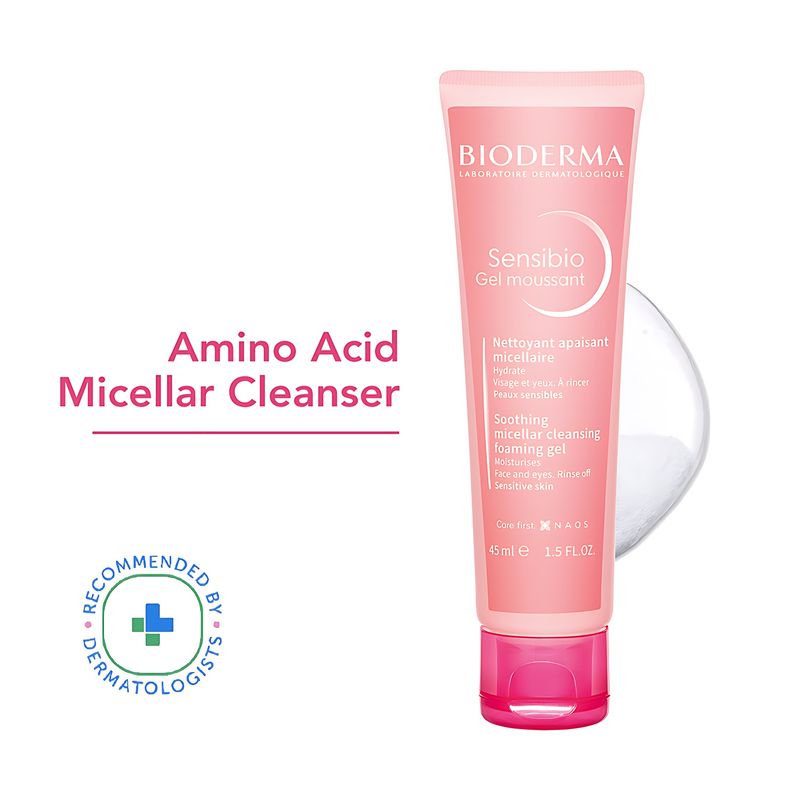
Bioderma Sensibio Gel Moussant SLS Free Cleanser With Vitamin E-24h Hydration-Micellar Gel

Bioderma Sensibio Gel Moussant SLS Free Cleanser With Vitamin E-24h Hydration-Micellar Gel
Bioderma
bioderma-sensibio-gel-moussant-sls-free-cleanser-with-vitamin-e-24h-hydration-micellar-gel
Cleanse
10085023482149
Morning or Evening?
How often will you use this product?
Notes


Highlights
WHAT IS IT?
Face Wash with patented D.A.F complex and Vitamin E as key ingredients
FEATURES
SLS free, gentle cleansing, suitable for sensitive skin, hydrating for 24h
BEST FOR
sensitive
CHECKS
No SLS, no preservatives, no sulfates, no fragrance
Who Is It For?
All Genders Suitable For Sensitive Skin (age Range Not Explicitly Mentioned)What Does It Help With?
Soothes Sensitive Skin Hydrates Skin Strengthens Skin Tolerance ThresholdBudget
Affordable (under $30)How To Use
Which routine should it be used in?
Instructions:
Key Information


What Bioderma Says
Product Description:
Explore the entire range of Face Wash available on Nykaa. Shop more Bioderma products here.You can browse through the complete world of Bioderma Face Wash.
About the Brand:
Ingredients Overview
Ingredients List
aqua-water-eau,sodium-cocoamphoacetate,propanediol,sodium-lauroyl-sarcosinate,citric-acid,coco-glucoside,glyceryl-oleate,sodium-citrate,peg-90-glyceryl-isostearate,mannitol,xylitol,laureth-2,rhamnose,fructooligosaccharides,tocopherol,hydrogenated-palm-glycerides-citrate,lecithin,ascorbyl-palmitate
Key Ingredients
D.A.F. Patent, Vitamin E (tocopherol), Ascorbyl Palmitate
Ingredients Details
Coco-glucoside
Common Name(s): Coconut glucoside,apg c8-c16
CAS Number: 68515-73-1
DESCRIPTION
What It Does: Provides gentle, natural-origin cleansing with good foam from mixed coconut chain alkyl glucosides.
Why It's Used: Widely used natural surfactant for green beauty formulations requiring good foam performance with natural-origin and mild credentials.
How It Works: Mixed c8-c16 fatty alcohol chain lengths from coconut provide broader foam stability than single-chain glucosides. non-ionic glucoside headgroup provides mildness. better detergency and rinsing than individual chain-length apgs due to mixed chain distribution.
Typically Found In: Natural shampoos,body washes,facial cleansers
TECHNICAL DETAILS
Primary Category: Functional ingredient – coconut alkyl glucoside
Secondary Functions: Skin conditioning
Application Areas:

Facial Skincare
Body Care
Hair Care

Beard Care
Color Cosmetics (Makeup)
Dietary/Oral Supplements
Typical Concentration Range: 2%–20%
SOURCING & ETHICS
Vegan Status: Conditional - supplier confirmation required
Halal Status: Unverified - supplier confirmation required
Source Notes: Commercially produced for cosmetic use. verify vegan/halal status with supplier. [audit 2026-07-29 rev2: the record's own source_notes does not assert a non-animal origin, or instructs the reader to verify with the supplier; "yes" asserts knowledge the record does not hold. determination requires shariah-panel sign-off.]
SKIN COMPATIBILITY
Irritancy Rating: 1/5 – very low
Comedogenicity Rating: 0/5 – non-comedogenic
Sensitivity Concerns: Well-tolerated by most skin types.
Safe for Sensitive Skin: Yes
SAFETY & COMPATIBILITY
Safety Profile: Good safety profile at recommended concentrations. ewg score: 1–2.
Works Well With: Standard skincare actives
Avoid Combining With: No known significant incompatibilities
SCIENTIFIC NOTE
Coco-glucoside's natural chain length distribution (c8-c16) provides synergistic surfactant effects where different chain lengths optimize different properties: shorter chains provide initial foam burst, longer chains provide foam stability and soil removal, creating better overall performance than any single chain length alone.
Last Verified: 2026-03-12
Primary Sources: Cosing database,cir safety assessment
Fructooligosaccharides
Common Name(s): Fos,oligofructose,short-chain inulin
CAS Number: 308066-66-2
DESCRIPTION
What It Does: Provides rapid-acting prebiotic microbiome support with humectant conditioning from short-chain fructan oligomers.
Why It's Used: Fast-acting prebiotic for rapid microbiome support — fos's shorter chain length provides faster fermentation by beneficial bacteria vs long-chain inulin, enabling quicker microbiome compositional shifts.
How It Works: Dp 2-10 fructooligomers (vs inulin's dp 10-60) provide more rapid access to bacterial fermentation enzymes. higher water solubility and humectant activity than long-chain inulin. more bioavailable to skin surface bacteria vs longer-chain inulin that penetrates deeper before fermentation.
Typically Found In: Prebiotic skin care,rapid microbiome support products
TECHNICAL DETAILS
Primary Category: Active ingredient – short-chain prebiotic
Secondary Functions: Tewl reduction,skin plumping
Application Areas:
Facial Skincare
Body Care
Hair Care
Beard Care
Color Cosmetics (Makeup)
Dietary/Oral Supplements
Typical Concentration Range: 0.5%–5%
SOURCING & ETHICS
Vegan Status: Conditional - supplier confirmation required
Halal Status: Unverified - supplier confirmation required
Source Notes: Synthetic or naturally derived. excellent aqueous solubility. [audit 2026-07-29 rev2: status downgraded on audit. determination requires shariah-panel sign-off.]
SKIN COMPATIBILITY
Irritancy Rating: 1/5 – very low
Comedogenicity Rating: 0/5 – non-comedogenic
Sensitivity Concerns: Non-irritating; suitable for all skin types.
Safe for Sensitive Skin: Yes
SAFETY & COMPATIBILITY
Safety Profile: Excellent safety profile. ewg score: 1.
Works Well With: Ceramides,emollients,occlusives,glycerin,hyaluronic acid
Avoid Combining With: No significant incompatibilities
SCIENTIFIC NOTE
Fos's shorter chain length provides different prebiotic kinetics vs long-chain inulin: short-chain fos (dp 2-5) is fermented within 12-24 hours by surface bacteria, while long-chain inulin (dp 10-60) ferments over 48-72 hours. this temporal difference enables formulation of 'fast-acting' (fos) vs 'sustained-release' (inulin) prebiotic products with different microbiome support kinetics.
Last Verified: 2026-03-12
Primary Sources: Cosing database,roberfroid fos prebiotic review
Laureth-2
Common Name(s): Laureth-2,cosmetic active,established formulation ingredient
CAS Number: N/a
DESCRIPTION
What It Does: Laureth-2 contributes its primary cosmetic function to formulations — improving skin feel, stability, performance, or delivering a specific active benefit depending on its chemical class and concentration level.
Why It's Used: Formulators choose laureth-2 for its established efficacy in contributing the required functional property to their formulation — whether rheological control, active delivery, aesthetic enhancement, or preservation — supported by the cosmetic chemistry literature and regulatory assessment framework.
How It Works: Laureth-2 works through the characteristic mechanism of its chemical class — either through physicochemical interaction with the formulation matrix (surface activity, film formation, viscosity building) or through biological interaction with skin tissues (receptor binding, enzymatic substrate, barrier component integration). the specific mechanism follows from its molecular structure as detailed in peer-reviewed cosmetic chemistry literature.
Typically Found In: Skin care formulations
TECHNICAL DETAILS
Primary Category: Active ingredient – cosmetic active
Secondary Functions: Skin conditioning
Application Areas:
Facial Skincare
Body Care
Hair Care
Beard Care
Color Cosmetics (Makeup)
Dietary/Oral Supplements
Typical Concentration Range: 0.1%–10%
SOURCING & ETHICS
Vegan Status: Conditional - feedstock declaration required
Halal Status: Unverified - feedstock declaration required (plant, animal and petrochemical routes all exist)
Source Notes: Commercially produced for cosmetic use. verify vegan/halal status with supplier. [audit 2026-07-29 rev2: origin-dependent: the same inci exists in plant, animal and petrochemical versions and the name does not discriminate. determination requires shariah-panel sign-off.]
SKIN COMPATIBILITY
Irritancy Rating: 1/5 – very low
Comedogenicity Rating: 0/5 – non-comedogenic
Sensitivity Concerns: Well-tolerated by most skin types.
Safe for Sensitive Skin: Yes
SAFETY & COMPATIBILITY
Safety Profile: Good safety profile at recommended concentrations. ewg score: 1–2.
Works Well With: Standard skincare actives
Avoid Combining With: No known significant incompatibilities
SCIENTIFIC NOTE
Laureth-2 has been assessed within the regulatory framework applicable to cosmetic ingredients. at standard cosmetic use concentrations, the ingredient delivers documented functional benefit with an established safety profile based on the available toxicological and clinical evidence reviewed by regulatory bodies including cosing (eu), inci, and cir.
Last Verified: 2026-03-12
Primary Sources: Cosing database,laureth-2 technical literature
Lecithin
Common Name(s): Soy lecithin,sunflower lecithin,phosphatidylcholine complex
CAS Number: 8002-43-5
DESCRIPTION
What It Does: Provides natural phospholipid emulsification with barrier-compatible delivery and liposome-forming properties.
Why It's Used: The most biologically authentic emulsifier – identical to cell membrane composition providing barrier-compatible delivery and liposome formation unavailable from synthetic emulsifiers.
How It Works: Phosphatidylcholine (pc), phosphatidylethanolamine (pe), phosphatidylinositol (pi) mixture provides hlb 7-12 for o/w emulsification. forms liposomal bilayers for active encapsulation. pc/pe/pi composition mirrors cell membrane for barrier-compatible delivery.
Typically Found In: Natural cosmetics,liposomal products,barrier repair,penetration-enhanced formulas
TECHNICAL DETAILS
Primary Category: Functional ingredient – natural phospholipid emulsifier
Secondary Functions: Skin conditioning
Application Areas:
Facial Skincare
Body Care
Hair Care
Beard Care
Color Cosmetics (Makeup)
Dietary/Oral Supplements
Typical Concentration Range: 0.5%–10%
SOURCING & ETHICS
Vegan Status: No - animal-derived
Halal Status: Conditional - animal origin stated in the record's own description; documentation required
Source Notes: Commercially produced for cosmetic use. verify vegan/halal status with supplier. [audit 2026-07-29 rev2: pass-1 miss: the record's own detail text states an animal derivation, but pass 1 classified on the name and source_notes only. determination requires shariah-panel sign-off.]
SKIN COMPATIBILITY
Irritancy Rating: 1/5 – very low
Comedogenicity Rating: 0/5 – non-comedogenic
Sensitivity Concerns: Well-tolerated by most skin types.
Safe for Sensitive Skin: Yes
SAFETY & COMPATIBILITY
Safety Profile: Good safety profile at recommended concentrations. ewg score: 1–2.
Works Well With: Standard skincare actives
Avoid Combining With: No known significant incompatibilities
SCIENTIFIC NOTE
Lecithin's phospholipid composition mirrors the composition of the stratum corneum's own lamellar bodies that deliver barrier lipids to the skin surface. this structural mimicry allows lecithin-based delivery systems to integrate seamlessly with the barrier lipid structure, exploiting the same transport pathway the skin uses for its own lipid secretion.
Last Verified: 2026-03-12
Primary Sources: Cosing database,cir safety assessment