

Dermalogica
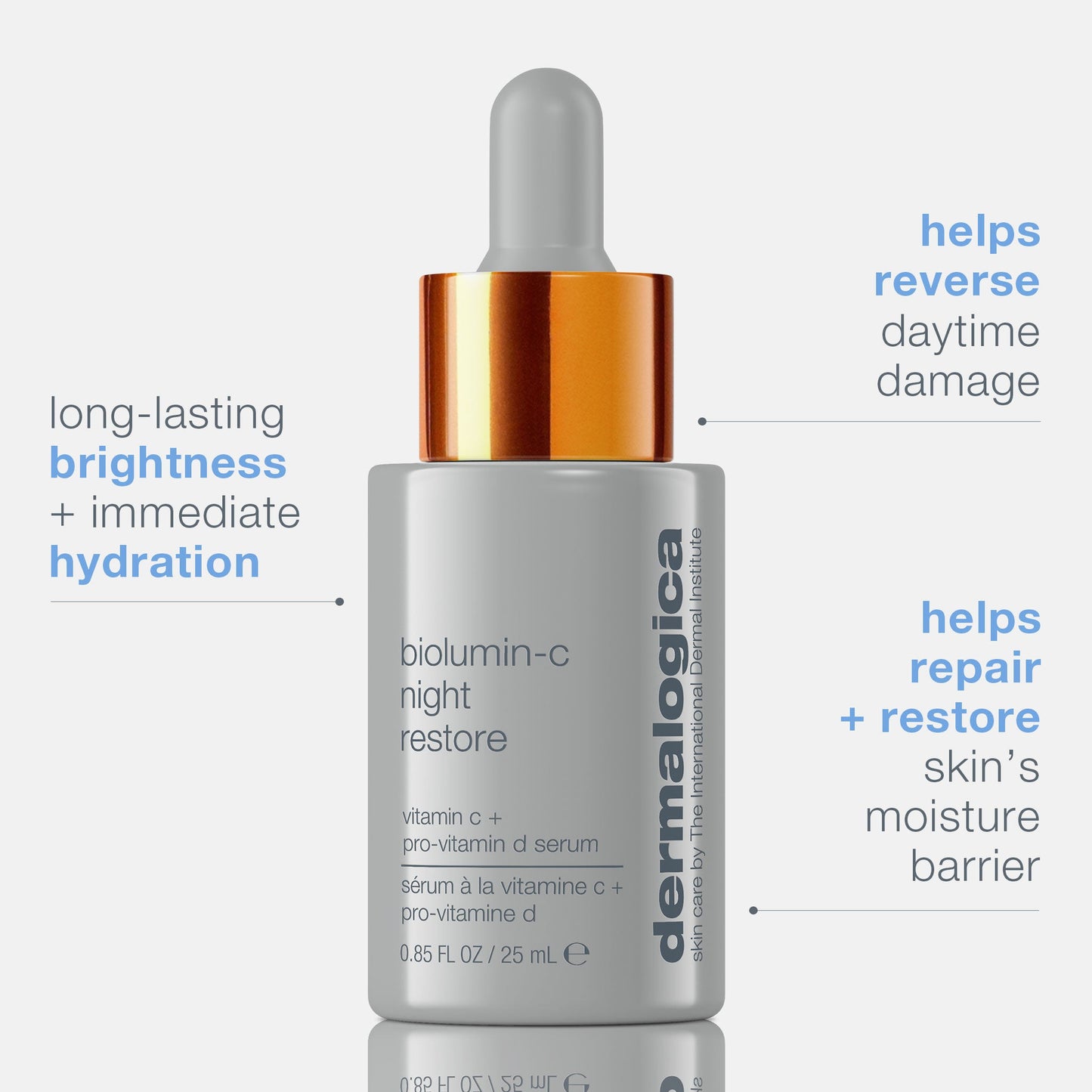
BioLumin-C Night Restore Serum

BioLumin-C Night Restore Serum
Dermalogica
biolumin-c-night-restore-serum
Serum
9784816304421
Morning or Evening?
How often will you use this product?
Notes


Highlights
WHAT IS IT?
Night Restore Serum with Vitamin C and Pro-Vitamin D Complex
FEATURES
Ultra-stable Vitamin C, nourishing Pro-Vitamin D Complex, repairs moisture barrier, provides long-lasting brightness and immediate hydration
BEST FOR
dry
CHECKS
Gluten-free, alcohol-free
Who Is It For?
Adults Experiencing Dehydration Lackluster Appearance And Damaged Moisture BarrierWhat Does It Help With?
Dehydration Lackluster Appearance Damaged Moisture Barrier Skin Radiance Hydration And ToneBudget
Premium ($76-$150)How To Use
Which routine should it be used in?
Instructions:
Key Information


What Dermalogica Says
Product Description:
A night serum that helps restore skin's radiance, hydration, and tone overnight. Features ultra-stable Vitamin C and nourishing Pro-Vitamin D Complex to repair skin's moisture barrier during sleep while providing long-lasting brightness and immediate hydration.
About the Brand:
Ingredients Overview
Ingredients List
Water/Aqua/Eau, Glycerin, Propanediol, Tranexamic Acid, Butylene Glycol, PEG-40 Hydrogenated Castor Oil, Aminopropyl Ascorbyl Phosphate, Hydroxyacetophenone, Dipotassium Glycyrrhizate, Lactic Acid, Ergothioneine, Glycine Soja (Soybean) Oil, Helianthus Annuus (Sunflower) Seed Oil, Citrus Nobilis (Mandarin Orange) Peel Oil, Ricinus Communis (Castor) Seed Oil, Chlorella Vulgaris Extract, Daucus Carota Sativa (Carrot) Root Extract, Hydrolyzed Jojoba Esters, Cichorium Intybus (Chicory) Root Extract, Opuntia Ficus-Indica Stem Extract, Citrus Aurantium Dulcis (Orange) Fruit Extract, Citrus Paradisi (Grapefruit) Fruit Extract, Citrus Aurantifolia (Lime) Oil, Cyamopsis Tetragonoloba (Guar) Gum, Tocopherol, Sodium PCA, Fructooligosaccharides, Bioflavonoids, Glycoproteins, Glycine, Squalane, Ascorbyl Methylsilanol Pectinate, Caprylyl Glycol, Beta-Carotene, Cystine, Pentylene Glycol, Mannitol, Ergosterol, Xanthan Gum, Methylpropanediol, 1,2-Hexanediol, Tetrasodium Glutamate Diacetate, Carbomer/Papain Crosspolymer, Phytic Acid, Citric Acid, Sodium Hydroxide, Acacia Senegal Gum, Polyacrylate Crosspolymer-6, Algin, Disodium Phosphate, Limonene, Citrus Species Peel Extract
Key Ingredients
Vitamin-C, Pro-Vitamin-D-Complex
Ingredients Details
Aminopropyl Ascorbyl Phosphate
Common Name(s): Vitamin c amphoteric derivative,ap ascorbyl phosphate
CAS Number: N/a
DESCRIPTION
What It Does: Provides antioxidant and brightening vitamin c activity with enhanced skin retention for prolonged efficacy.
Why It's Used: Used where sustained vitamin c activity and skin substantivity are desired in leave-on treatments.
How It Works: Aminopropyl cationic group increases electrostatic interaction with negatively charged skin proteins, extending contact time. enzymatic hydrolysis releases active ascorbate.
Typically Found In: Leave-on treatments,extended-wear vitamin c,hair care
TECHNICAL DETAILS
Primary Category: Active ingredient – vitamin c derivative
Secondary Functions: Substantive vitamin c,prolonged antioxidant
Application Areas:

Facial Skincare

Body Care
Hair Care
Beard Care
Color Cosmetics (Makeup)
Dietary/Oral Supplements
Typical Concentration Range: 1%–5%
SOURCING & ETHICS
Vegan Status: Yes – synthetic
Halal Status: Yes
Source Notes: Synthetically produced vitamin c derivative.
SKIN COMPATIBILITY
Irritancy Rating: 1/5 – very low
Comedogenicity Rating: 0/5 – non-comedogenic
Sensitivity Concerns: Non-irritating; suitable for all skin types.
Safe for Sensitive Skin: Yes
SAFETY & COMPATIBILITY
Safety Profile: Excellent safety profile. ewg score: 1.
Works Well With: Tocopherol,ferulic acid,niacinamide,spf
Avoid Combining With: No significant incompatibilities
SCIENTIFIC NOTE
Substantivity via ionic interaction extends active vitamin c presence beyond typical contact times. positive charge also contributes hair conditioning via attraction to negatively charged hair surface.
Last Verified: ##########
Primary Sources: Cosing database,cir assessment
Butylene Glycol
Common Name(s): 1,3-butanediol,bg,1,3-butylene glycol
CAS Number: 107-88-0
DESCRIPTION
What It Does: Provides humectant hydration and active ingredient solubilization with excellent skin feel.
Why It's Used: Preferred glycol humectant in premium and k-beauty formulations for superior skin feel vs propylene glycol with equivalent functionality.
How It Works: Two hydroxyl groups at 1,3-positions provide water binding and solvent activity. better tolerated than propylene glycol with minimal sensitization risk. 4-carbon backbone provides slightly greater hydrophobic character enabling dissolution of less polar actives vs pg.
Typically Found In: Toners,essences,serums,k-beauty formulas
TECHNICAL DETAILS
Primary Category: Functional ingredient – glycol humectant
Secondary Functions: Tewl reduction,skin plumping
Application Areas:
Facial Skincare
Body Care
Hair Care
Beard Care
Color Cosmetics (Makeup)
Dietary/Oral Supplements
Typical Concentration Range: 1%–10%
SOURCING & ETHICS
Vegan Status: Yes – synthetic
Halal Status: Yes
Source Notes: Synthetic or naturally derived. excellent aqueous solubility.
SKIN COMPATIBILITY
Irritancy Rating: 1/5 – very low
Comedogenicity Rating: 0/5 – non-comedogenic
Sensitivity Concerns: Non-irritating; suitable for all skin types.
Safe for Sensitive Skin: Yes
SAFETY & COMPATIBILITY
Safety Profile: Excellent safety profile. ewg score: 1.
Works Well With: Ceramides,emollients,occlusives,glycerin,hyaluronic acid
Avoid Combining With: No significant incompatibilities
SCIENTIFIC NOTE
K-beauty's preference for butylene glycol over propylene glycol is driven by two factors: bg's superior skin feel (less tacky than pg's higher viscosity) and its lower sensitization potential (1,3-bg has better spatial distribution of hydroxyl groups that reduces protein interaction vs pg's 1,2-position oh groups).
Last Verified: 2026-03-12
Primary Sources: Cosing database,cir safety assessment
Dipotassium Glycyrrhizate
Common Name(s): Dpg,dipotassium glycyrrhizinate,glycyrrhizic acid potassium salt
CAS Number: 68797-35-3
DESCRIPTION
What It Does: Provides glycyrrhizic acid anti-inflammatory and cortisol-potentiating soothing activity.
Why It's Used: The anti-inflammatory licorice active — dipotassium glycyrrhizate provides stronger anti-inflammatory activity than glabridin-containing licorice extract, making it the preferred licorice active for anti-inflammatory formulations.
How It Works: Glycyrrhizic acid inhibits 11-beta-hsd (11-beta-hydroxysteroid dehydrogenase) which inactivates cortisol to cortisone. local cortisol levels increase providing anti-inflammatory activity analogous to mild topical corticosteroid. also inhibits phospholipase a2 and prostaglandin synthesis directly.
Typically Found In: Sensitive skin serums,anti-inflammatory products,anti-itch formulas
TECHNICAL DETAILS
Primary Category: Active ingredient – anti-inflammatory licorice
Secondary Functions: Redness reduction,anti-inflammatory,calming
Application Areas:
Facial Skincare
Body Care
Hair Care
Beard Care
Color Cosmetics (Makeup)
Dietary/Oral Supplements
Typical Concentration Range: 0.1%–1%
SOURCING & ETHICS
Vegan Status: Yes – from glycyrrhiza glabra root
Halal Status: Yes
Source Notes: Plant-derived extract or synthetic.
SKIN COMPATIBILITY
Irritancy Rating: 1/5 – very low
Comedogenicity Rating: 0/5 – non-comedogenic
Sensitivity Concerns: Non-irritating; ideal for reactive and sensitive skin.
Safe for Sensitive Skin: Yes – particularly recommended for sensitive skin
SAFETY & COMPATIBILITY
Safety Profile: Excellent safety profile. ewg score: 1.
Works Well With: Ceramides,panthenol,allantoin,hyaluronic acid,centella asiatica
Avoid Combining With: No significant incompatibilities
SCIENTIFIC NOTE
Dipotassium glycyrrhizate's 11-beta-hsd inhibition provides a corticosteroid-potentiating mechanism: by preventing cortisol deactivation to cortisone, it effectively amplifies the anti-inflammatory activity of the skin's own naturally produced glucocorticoid without introducing exogenous steroids — providing a 'natural steroid potentiation' that explains why licorice preparations have been used as a topical anti-inflammatory for millennia.
Last Verified: 2026-03-12
Primary Sources: Cosing database,armanini et al. glycyrrhizate review
Ergothioneine
Common Name(s): Egt,thiohistidine betaine
CAS Number: 497-30-3
DESCRIPTION
What It Does: Provides cellular-accumulating antioxidant protection with dedicated skin uptake transporter and exceptional singlet oxygen quenching.
Why It's Used: The only antioxidant with a dedicated skin cell uptake transporter — ergothioneine's octn1 transport ensures active accumulation in keratinocytes unlike passive-diffusion antioxidants.
How It Works: Thione form provides singlet oxygen quenching (ksoq ~1.3×10⁸ m⁻¹s⁻¹). octn1 transporter actively accumulates ergothioneine intracellularly. stable in formulation and in vivo. anti-glycation and anti-carbonylation activity.
Typically Found In: Premium anti-aging serums,anti-pollution products
TECHNICAL DETAILS
Primary Category: Active ingredient – antioxidant
Secondary Functions: Free radical scavenging,anti-aging
Application Areas:
Facial Skincare
Body Care
Hair Care
Beard Care
Color Cosmetics (Makeup)
Dietary/Oral Supplements
Typical Concentration Range: 0.1%–1%
SOURCING & ETHICS
Vegan Status: Conditional - supplier confirmation required
Halal Status: Unverified - supplier confirmation required
Source Notes: Plant-derived extract or synthetic. [audit 2026-07-29 rev2: status downgraded on audit. determination requires shariah-panel sign-off.]
SKIN COMPATIBILITY
Irritancy Rating: 1/5 – very low
Comedogenicity Rating: 0/5 – non-comedogenic
Sensitivity Concerns: Non-irritating; well-tolerated.
Safe for Sensitive Skin: Yes
SAFETY & COMPATIBILITY
Safety Profile: Excellent safety profile. ewg score: 1.
Works Well With: Vitamin c,vitamin e,ferulic acid,spf,other antioxidants
Avoid Combining With: No significant incompatibilities
SCIENTIFIC NOTE
Ergothioneine's octn1 transporter creates preferential accumulation in keratinocytes where uv-induced radical generation is greatest. this active cellular uptake mechanism provides intracellular ergothioneine concentrations 100–1000× above extracellular levels — a concentration gradient impossible for passively-diffusing antioxidants to achieve.
Last Verified: