

BIORE
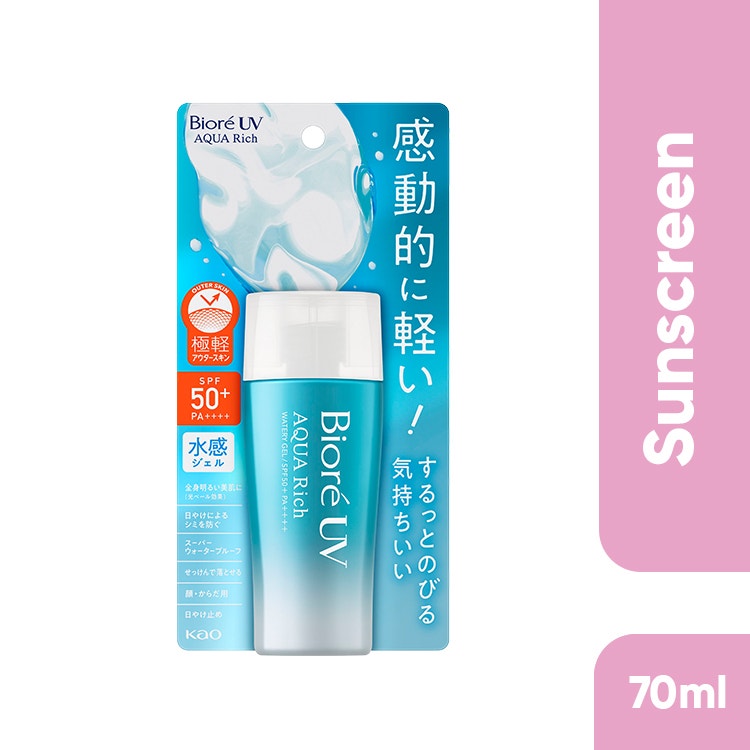
Biore Uv Aqua Rich Watery Gel Spf 50+ Pa++++ 70Ml

Biore Uv Aqua Rich Watery Gel Spf 50+ Pa++++ 70Ml
BIORE
biore-uv-aqua-rich-watery-gel-spf-50-pa-70ml
Suncare
10085493571877
Morning or Evening?
How often will you use this product?
Notes


Highlights
WHAT IS IT?
Sun Care gel with 3 key ingredients
FEATURES
Micro UV-Cut Capsule Technology, Light watery texture, spreads easily, absorbs instantly, no white cast
BEST FOR
normal
CHECKS
Does not contain white cast ingredients
Who Is It For?
All Genders No Specific Age Range StatedWhat Does It Help With?
High Uv Protection Hydration Makeup Base SuitabilityBudget
Mid-range ($30-$75)How To Use
Which routine should it be used in?
Instructions:
Key Information


What BIORE Says
Product Description:
This lightweight, fast-absorbing gel provides high protection from UV rays while keeping your skin hydrated with Biore UV Aqua Rich Watery Gel.
About the Brand:
Ingredients Overview
Ingredients List
Hyaluronic-Acid,Royal-Jelly-Extract,Moisturizing-Butylene-Glycol
Key Ingredients
Hyaluronic Acid, Royal Jelly Extract, Butylene Glycol
Ingredients Details
Butylene Glycol
Common Name(s): 1,3-butanediol,bg,1,3-butylene glycol
CAS Number: 107-88-0
DESCRIPTION
What It Does: Provides humectant hydration and active ingredient solubilization with excellent skin feel.
Why It's Used: Preferred glycol humectant in premium and k-beauty formulations for superior skin feel vs propylene glycol with equivalent functionality.
How It Works: Two hydroxyl groups at 1,3-positions provide water binding and solvent activity. better tolerated than propylene glycol with minimal sensitization risk. 4-carbon backbone provides slightly greater hydrophobic character enabling dissolution of less polar actives vs pg.
Typically Found In: Toners,essences,serums,k-beauty formulas
TECHNICAL DETAILS
Primary Category: Functional ingredient – glycol humectant
Secondary Functions: Tewl reduction,skin plumping
Application Areas:

Facial Skincare
Body Care
Hair Care

Beard Care
Color Cosmetics (Makeup)
Dietary/Oral Supplements
Typical Concentration Range: 1%–10%
SOURCING & ETHICS
Vegan Status: Yes – synthetic
Halal Status: Yes
Source Notes: Synthetic or naturally derived. excellent aqueous solubility.
SKIN COMPATIBILITY
Irritancy Rating: 1/5 – very low
Comedogenicity Rating: 0/5 – non-comedogenic
Sensitivity Concerns: Non-irritating; suitable for all skin types.
Safe for Sensitive Skin: Yes
SAFETY & COMPATIBILITY
Safety Profile: Excellent safety profile. ewg score: 1.
Works Well With: Ceramides,emollients,occlusives,glycerin,hyaluronic acid
Avoid Combining With: No significant incompatibilities
SCIENTIFIC NOTE
K-beauty's preference for butylene glycol over propylene glycol is driven by two factors: bg's superior skin feel (less tacky than pg's higher viscosity) and its lower sensitization potential (1,3-bg has better spatial distribution of hydroxyl groups that reduces protein interaction vs pg's 1,2-position oh groups).
Last Verified: Cosing database,cir safety assessment
Primary Sources: 2026-03-12
Hyaluronic Acid
Common Name(s): Ha,sodium hyaluronate (salt form),hyaluronan,d-glucuronic acid-n-acetyl-d-glucosamine polymer
CAS Number: 9004-61-9
DESCRIPTION
What It Does: Hyaluronic acid draws and locks moisture into the skin at multiple depths (surface and deeper layers depending on molecular weight), creating a plumping, smoothing, and hydrating effect.
Why It's Used: It is used because it is endogenous to human skin, making it exceptionally biocompatible and non-irritating. its unparalleled moisture-binding capacity makes it the most effective hydrating ingredient available.
How It Works: Ha binds water molecules through its many hydroxyl and carboxyl groups, creating a gel-like matrix. high molecular weight ha (>500 kda) hydrates the skin surface; low molecular weight ha (<50 kda) penetrates deeper to provide interior hydration.
Typically Found In: Serums,moisturizers,sheet masks,toners,eye creams,lip treatments,dermal fillers (injectable)
TECHNICAL DETAILS
Primary Category: Active ingredient – humectant/hydrator
Secondary Functions: Barrier repair,plumping,anti-aging
Application Areas:
Facial Skincare
Body Care
Hair Care
Beard Care
Color Cosmetics (Makeup)
Dietary/Oral Supplements
Typical Concentration Range: 0.1%–2% (effective at very low concentrations; multi-weight ha provides superior results)
SOURCING & ETHICS
Vegan Status: Yes – biotechnology-derived (microbial fermentation of streptococcus equi or b. subtilis); vegan-certified versions widely available
Halal Status: Yes
Source Notes: Originally extracted from rooster combs; now predominantly produced via biotechnology (bacterial fermentation), which is vegan and more sustainable.
SKIN COMPATIBILITY
Irritancy Rating: 1/5 – very low; one of the gentlest skincare ingredients known
Comedogenicity Rating: 0/5 – non-comedogenic
Sensitivity Concerns: In very dry environments, high-molecular-weight ha on the surface can potentially draw moisture out of the skin if not sealed with an occlusive. apply to damp skin and seal with moisturizer.
Safe for Sensitive Skin: Yes – ideal for all skin types including rosacea, eczema, and post-procedure skin
SAFETY & COMPATIBILITY
Safety Profile: Exceptional safety profile. endogenous molecule – no toxicity concerns. ewg hazard score: 1. safe during pregnancy.
Works Well With: Virtually all ingredients; especially ceramides,glycerin,peptides,retinol (reduces irritation),niacinamide,vitamin c
Avoid Combining With: No significant incompatibilities; high concentrations of alcohol in a formula may reduce its efficacy
SCIENTIFIC NOTE
Hyaluronic acid naturally degrades in skin (half-life ~1–2 days). the skin produces it endogenously, but production decreases with age. multi-molecular-weight ha formulas provide hydration at both surface and deeper skin levels.
Last Verified: Cosing database,cir safety assessment,papakonstantinou et al. (2012) dermato-endocrinology
Primary Sources: 2026-03-12
Royal Jelly Extract
Common Name(s): Royal jelly,bee milk
CAS Number: 8031-67-2
DESCRIPTION
What It Does: Provides 10-hda and royalactin bioactive complex for collagen stimulation and anti-aging.
Why It's Used: Queen bee transformation ingredient — royalactin (the protein that transforms a worker larva into a queen) provides unique growth factor-like collagen stimulation and anti-aging activity.
How It Works: 10-hda (10-hydroxy-2-decenoic acid) inhibits 5-lox for anti-inflammatory activity and stimulates collagen synthesis. royalactin activates egf-like receptor stimulating growth and differentiation. sterols and amino acids provide skin conditioning. antimicrobial activity from 10-hda fatty acid.
Typically Found In: Luxury anti-aging products,queen bee beauty
TECHNICAL DETAILS
Primary Category: Active ingredient – queen bee secretion
Secondary Functions: Skin conditioning
Application Areas:
Facial Skincare
Body Care
Hair Care
Beard Care
Color Cosmetics (Makeup)
Dietary/Oral Supplements
Typical Concentration Range: 0.1%–5%
SOURCING & ETHICS
Vegan Status: No – bee-derived
Halal Status: Conditional – bee products generally halal
Source Notes: Commercially produced for cosmetic use. verify vegan/halal status with supplier.
SKIN COMPATIBILITY
Irritancy Rating: 1/5 – very low
Comedogenicity Rating: 0/5 – non-comedogenic
Sensitivity Concerns: Well-tolerated by most skin types.
Safe for Sensitive Skin: Yes
SAFETY & COMPATIBILITY
Safety Profile: Good safety profile at recommended concentrations. ewg score: 1–2.
Works Well With: Standard skincare actives
Avoid Combining With: No known significant incompatibilities
SCIENTIFIC NOTE
Royal jelly's transformation of worker bee larvae into queen bees via royalactin is one of biology's most dramatic examples of epigenetic determination by nutrition: genetically identical larvae become morphologically and physiologically distinct (worker vs queen) solely based on royal jelly feeding. the growth-promoting royalactin that drives this transformation provides the biological rationale for royal jelly's anti-aging and cell proliferation-stimulating cosmetic claims.
Last Verified: Cosing database,fratini et al. royal jelly review
Primary Sources: 2026-03-12
