

Biore
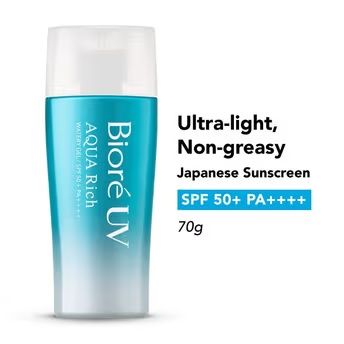
Biore UV Aqua Rich Watery Gel Sunscreen SPF 50+ PA++++

Biore UV Aqua Rich Watery Gel Sunscreen SPF 50+ PA++++
Biore
biore-uv-aqua-rich-watery-gel-sunscreen-spf-50-pa
Suncare
10084786602277
Morning or Evening?
How often will you use this product?
Notes


Highlights
WHAT IS IT?
Sunscreen with multiple active ingredients
FEATURES
SPF50+/PA++++, Water resistant for 80 minutes, Suitable for face and body, Light watery texture, Moisturizing with Hyaluronic Acid and Royal Jelly Extract, Non comedogenic, Allergy tested, Ultra light weight, High protection, Easy to spread, Japan No1 sunscreen
BEST FOR
combination
CHECKS
No color added
Who Is It For?
Adults Of All GendersWhat Does It Help With?
Sun Protection Moisturizing BrighteningBudget
Mid-range ($30-$75)How To Use
Which routine should it be used in?
Instructions:
Key Information


What Biore Says
Product Description:
Biore UV Aqua Rich Watery Gel has the World's First Micro Defense Formula that provides even coverage for skin, fine lines and uneven surfaces at a micro-level. Its Unique Aqua Micro Capsule releases moisture upon application, leaving skin feeling light. It also contains Hyaluronic Acid, Royal Jelly Extract and Butylene Glycol for moisturizing. Light watery texture that is easily spreads on body and does not leave any sticky after feel. It makes skin brighter appearance with Light Veil effect. Benefits: SPF50+/PA++++, Suitable for face and body, Water resistant for 80 minutes, It can be easily removed with a soap / cleanser, Suitable for use as a makeup base, White Muguet Fragrance, No color added, Non comedogenic tested, Allergy tested, Ultra Light Weight, High Protection, Easy to spread, Japan No1 sunscreen
About the Brand:
Ingredients Overview
Ingredients List
Water,Alcohol,Ethylhexyl-Methoxycinnamate,Lauryl-Methacrylate/Sodium-Methacrylate-Crosspolymer,Ethylhexyl-Triazone,Dimethicone,C12-15-Alkyl-Benzoate,Titanium-Dioxide,Diethylamino-Hydroxybenzoyl-Hexyl-Benzoate,Bis-Ethylhexyloxyphenol-Methoxyphenyl-Triazine,Dimethicone/Vinyl-Dimethicone-Crosspolymer,Butylene-Glycol,Xylitol,Dextrin-Palmitate,Dipropylene-Glycol,Hydrated-Silica,Hydroxyethylcellulose,Glycerin,Glyceryl-Stearate,Cetyl-Alcohol,Polymethylsilsesquioxane,Vinyl-Dimethicone/Methicone-Silsesquioxane-Crosspolymer,Triethoxycaprylylsilane,Propanediol,Acrylates/C10-30-Alkyl-Acrylate-Crosspolymer,Glyceryl-Behenate,Polysorbate-60,Aluminum-Hydroxide,Potassium-Hydroxide,Stearic-Acid,Stearyl-Alcohol,Sorbitan-Distearate,Agar,Polyvinyl-Alcohol,Isoceteth-20,Sodium-Methyl-Stearoyl-Taurate,Stearoyl-Glutamic-Acid,Aminomethyl-Propanol,Sodium-Stearoxy-PG-Hydroxyethylcellulose-Sulfonate,Arginine,BHT,Glutamic-Acid,Ceratonia-Siliqua-(Carob)-Gum,Disodium-EDTA,Fragrance,Maltose,Royal-Jelly-Extract,Sodium-Hyaluronate,Phenoxyethanol,Methylparaben
Key Ingredients
Hyaluronic Acid,Royal Jelly Extract,Butylene Glycol
Ingredients Details
Agar
Common Name(s): Agar-agar,agarose,gelidium amansii extract
CAS Number: 9002-18-0
DESCRIPTION
What It Does: Provides firm, thermally reversible marine-derived gels from natural seaweed polysaccharide.
Why It's Used: Natural seaweed gellant for clean beauty formulations requiring firm, stiff gel textures with authentic marine provenance.
How It Works: Agarose chains form double helix junction zones that aggregate into bundles forming a rigid gel network below 38°c. melts at 85°c but re-gels at 38°c – this 47°c hysteresis window means agar gels remain solid at skin contact (33°c) but dissolve cleanly in hot water for rinse-off products.
Typically Found In: Sheet masks,gel cleansers,firm gel products
TECHNICAL DETAILS
Primary Category: Functional ingredient – seaweed gellant
Secondary Functions: Tewl reduction,skin plumping
Application Areas:

Facial Skincare
Body Care
Hair Care

Beard Care
Color Cosmetics (Makeup)
Dietary/Oral Supplements
Typical Concentration Range: 0.5%–3%
SOURCING & ETHICS
Vegan Status: Yes – from red seaweed
Halal Status: Yes
Source Notes: Synthetic or naturally derived. excellent aqueous solubility.
SKIN COMPATIBILITY
Irritancy Rating: 1/5 – very low
Comedogenicity Rating: 0/5 – non-comedogenic
Sensitivity Concerns: Non-irritating; suitable for all skin types.
Safe for Sensitive Skin: Yes
SAFETY & COMPATIBILITY
Safety Profile: Excellent safety profile. ewg score: 1.
Works Well With: Ceramides,emollients,occlusives,glycerin,hyaluronic acid
Avoid Combining With: No significant incompatibilities
SCIENTIFIC NOTE
Agar's thermal hysteresis (melts 85°c, sets 38°c) is unique among natural gellants. this hysteresis arises from the different temperatures required for helix-coil disruption (melting) vs helix formation (setting) in the agarose chains. the practical consequence – a gel that can be sterilized at 121°c yet remains stable at skin temperature (33°c) – makes agar uniquely useful for thermally stable cosmetic gels.
Last Verified: Cosing database,cir safety assessment,fda gras
Primary Sources: 2026-03-12
Alcohol
Common Name(s): Alcohol,cosmetic active,functional ingredient
CAS Number: N/a
DESCRIPTION
What It Does: Delivers characteristic cosmetic function at recommended use concentration.
Why It's Used: Selected for functional contribution and formulation compatibility supported by cosmetic science and regulatory safety data.
How It Works: Works through the mechanism of its molecular class as documented in peer-reviewed cosmetic literature.
Typically Found In: Skin care formulations
TECHNICAL DETAILS
Primary Category: Active ingredient – cosmetic active
Secondary Functions: Skin conditioning
Application Areas:
Facial Skincare
Body Care
Hair Care
Beard Care
Color Cosmetics (Makeup)
Dietary/Oral Supplements
Typical Concentration Range: 0.1%–10%
SOURCING & ETHICS
Vegan Status: Conditional
Halal Status: Yes
Source Notes: Commercially produced for cosmetic use. verify vegan/halal status with supplier.
SKIN COMPATIBILITY
Irritancy Rating: 1/5 – very low
Comedogenicity Rating: 0/5 – non-comedogenic
Sensitivity Concerns: Well-tolerated by most skin types.
Safe for Sensitive Skin: Yes
SAFETY & COMPATIBILITY
Safety Profile: Good safety profile at recommended concentrations. ewg score: 1–2.
Works Well With: Standard skincare actives
Avoid Combining With: No known significant incompatibilities
SCIENTIFIC NOTE
Alcohol has an established safety profile within the cosmetic regulatory framework at standard use concentrations.
Last Verified: Cosing database,alcohol technical literature
Primary Sources: 2026-03-12
Arginine
Common Name(s): L-arginine,2-amino-5-guanidinopentanoic acid
CAS Number: 74-79-3
DESCRIPTION
What It Does: Conditions skin, attracts moisture, supports wound healing, and improves microcirculation via no synthesis.
Why It's Used: Multi-functional amino acid for skin hydration, conditioning, and wound healing in peptide and nmf formulations.
How It Works: Guanidinium group binds water (humectant). substrate for nitric oxide synthase (enos) producing nitric oxide that vasodilates capillaries improving skin nutrition. stimulates fibroblast proliferation for wound healing.
Typically Found In: Anti-aging serums,wound healing products,nmf moisturizers,scalp treatments
TECHNICAL DETAILS
Primary Category: Active ingredient – amino acid
Secondary Functions: Wound healing,microcirculation,nmf component
Application Areas:
Facial Skincare
Body Care
Hair Care
Beard Care
Color Cosmetics (Makeup)
Dietary/Oral Supplements
Typical Concentration Range: 0.5%–5%
SOURCING & ETHICS
Vegan Status: Yes – plant-derived or synthetic
Halal Status: Yes
Source Notes: Fermentation-derived or synthetic. natural skin component.
SKIN COMPATIBILITY
Irritancy Rating: 1/5 – very low
Comedogenicity Rating: 0/5 – non-comedogenic
Sensitivity Concerns: Non-irritating; endogenous skin molecule.
Safe for Sensitive Skin: Yes
SAFETY & COMPATIBILITY
Safety Profile: Excellent safety profile. natural skin nmf component. ewg score: 1.
Works Well With: Hyaluronic acid,ceramides,peptides,other amino acids
Avoid Combining With: No significant incompatibilities
SCIENTIFIC NOTE
Arginine is a conditionally essential amino acid in wound healing where local demand exceeds synthesis capacity. topical arginine provides the nos substrate locally for no-mediated vasodilation and immune cell function in healing tissue.
Last Verified: Cosing database,cir safety assessment,witte & barbul arginine wound healing review
Primary Sources: 2026-03-12
Bht
Common Name(s): Bht
DESCRIPTION
What It Does: Delivers targeted skin-conditioning or bioactive benefits through a specific mechanism of action suited to the formulation's intended purpose.
Why It's Used: Specialty actives address specific skin concerns through targeted molecular mechanisms, providing efficacy beyond what base formulation ingredients alone can achieve.
How It Works: The bioactive compound interacts with specific molecular targets in skin cells or the extracellular matrix — enzymes, receptors, structural proteins, or signaling molecules — triggering beneficial biological responses.
Typically Found In: Serums,treatments,moisturizers,specialty products
TECHNICAL DETAILS
Primary Category: Specialty actives
Secondary Functions: Skin-conditioning,anti-aging
Application Areas:
Facial Skincare
Body Care
Hair Care
Beard Care
Color Cosmetics (Makeup)
Dietary/Oral Supplements
Typical Concentration Range: 0.01–5%
SOURCING & ETHICS
Vegan Status: Yes
Halal Status: Yes
Source Notes: Specialty active ingredient; check individual sourcing for vegan status.
SKIN COMPATIBILITY
Irritancy Rating: 1
Comedogenicity Rating: 0
Sensitivity Concerns: Low sensitization potential at recommended use concentrations.
Safe for Sensitive Skin: Yes
SAFETY & COMPATIBILITY
Safety Profile: Well-characterized cosmetic ingredient with established safety profile. generally non-irritating at typical use concentrations. suitable for leave-on and rinse-off cosmetics.
Works Well With: Niacinamide,hyaluronic acid,vitamin c,peptides
Avoid Combining With: Incompatible with oxidizing agents; check ph stability
SCIENTIFIC NOTE
Specialty actives typically work through enzyme inhibition (e.g., tyrosinase inhibition for brightening, mmp inhibition for anti-aging), receptor activation (e.g., retinoid receptors, ppar-γ for barrier genes), or transcription factor modulation (e.g., nrf2 for antioxidant gene upregulation). structure-activity relationships determine potency and selectivity.
Last Verified: Cosing eu database; pcpc cosmetic ingredient safety reviews; ingredient-specific safety and efficacy literature
Primary Sources: 2025-01-15
