

Korres
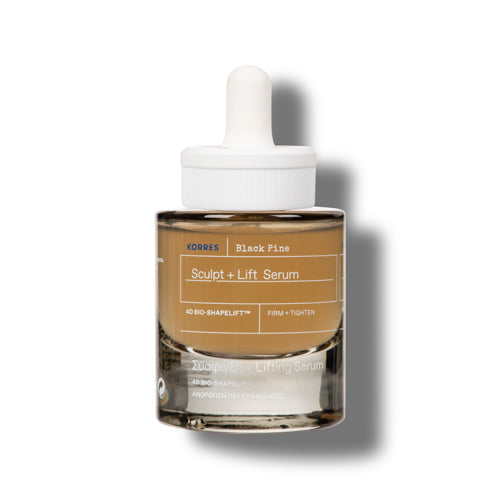
Black Pine Sculpt + Lift Serum

Black Pine Sculpt + Lift Serum
Korres
black-pine-sculpt-lift-serum
Serum
9706859102501
Morning or Evening?
How often will you use this product?
Notes


Highlights
WHAT IS IT?
Anti-aging serum
FEATURES
Firming and lifting serum
BEST FOR
for aging skin
CHECKS
Clean formulation, free of mineral oils, silicones, parabens, propylene glycol, phthalates, sulfates
Who Is It For?
For Adults With Aging Skin ConcernsWhat Does It Help With?
Fine Lines Wrinkles Loss Of Firmness And ElasticityBudget
Mid-rangeHow To Use
Which routine should it be used in?
Instructions:
Key Information


What Korres Says
Product Description:
A potent firming and lifting serum that brings the elastic bounciness back to your skin, reducing the appearance of fine lines and wrinkles visibly firming and lifting skin.
About the Brand:
Ingredients Overview
Ingredients List
AQUA/WATER/EAU, PENTYLENE GLYCOL, SINORHIZOBIUM MELILOTI FERMENT FILTRATE, SACCHAROMYCES/XYLINUM/BLACK TEA FERMENT, GLYCERIN, ASCORBYL PALMITATE, AVENA SATIVA (OAT) KERNEL EXTRACT, BENZYL ALCOHOL, BRASSICA NAPUS EXTRACT, BUTYLENE GLYCOL, CETYL HYDROXYETHYLCELLULOSE, EPIGALLOCATECHIN GALLATE, EPIGALLOCATECHIN GALLATYL GLUCOSIDE, ETHYLHEXYLGLYCERIN, GLYCERYL ACRYLATE/ACRYLIC ACID COPOLYMER, HELIANTHUS ANNUUS (SUNFLOWER) SEED OIL, HEXAPEPTIDE-11, HYDROLYZED SODIUM HYALURONATE, HYDROLYZED SOYBEAN FIBER, HYDROXYETHYLCELLULOSE, LACTIC ACID, LECITHIN, PARFUM/FRAGRANCE, PEUCEDANUM GRAVEOLENS (DILL) EXTRACT, PHENOXYETHANOL, PINUS NIGRA BUD/NEEDLE EXTRACT, POLYACRYLATE CROSSPOLYMER-6, POLYGLYCERYL-5 LAURATE, POTASSIUM SORBATE, SODIUM BENZOATE, SODIUM CARBOXYMETHYL BETA-GLUCAN, SODIUM DEHYDROACETATE, SODIUM HYALURONATE, TETRASODIUM GLUTAMATE DIACETATE, TOCOPHEROL, XANTHAN GUM.
Key Ingredients
Avena Sativa (Oat) Kernel Extract, Epigallocatechin Gallate, Epigallocatechin Gallatyl Glucoside, Pinus Nigra Bark Extract, Pinus Nigra Bud/Needle Extract, Tocopherol, Trifluoroacetyl Tripeptide-2, Lactic Acid, Glycerin, Sodium Hyaluronate
Ingredients Details
Ascorbyl Palmitate
Common Name(s): L-ascorbyl-6-palmitate,vitamin c palmitate,fat-soluble vitamin c
CAS Number: 137-66-6
DESCRIPTION
What It Does: Provides lipid-soluble antioxidant protection in skin and oil-based formulations.
Why It's Used: Oil-based formulations as fat-soluble vitamin c active and formulation antioxidant preservative (e304).
How It Works: Skin esterases cleave the bond releasing ascorbic acid and palmitic acid. lipophilic form may integrate into cell membranes for lipid-phase antioxidant protection.
Typically Found In: Oil serums,emulsions,sunscreens,anti-aging creams
TECHNICAL DETAILS
Primary Category: Active ingredient – vitamin c derivative
Secondary Functions: Lipid-soluble antioxidant,formulation preservative
Application Areas:

Facial Skincare

Body Care
Hair Care
Beard Care
Color Cosmetics (Makeup)
Dietary/Oral Supplements
Typical Concentration Range: 0.1%–1%
SOURCING & ETHICS
Vegan Status: Conditional - feedstock declaration required
Halal Status: Unverified - feedstock declaration required (plant, animal and petrochemical routes all exist)
Source Notes: Esterification of ascorbic acid with palmitic acid. gras food additive (e304). [audit 2026-07-29 rev2: origin-dependent: the same inci exists in plant, animal and petrochemical versions and the name does not discriminate. determination requires shariah-panel sign-off.]
SKIN COMPATIBILITY
Irritancy Rating: 1/5 – very low
Comedogenicity Rating: 1/5 – very low; palmitic acid minor concern
Sensitivity Concerns: Non-irritating; suitable for all skin types.
Safe for Sensitive Skin: Yes
SAFETY & COMPATIBILITY
Safety Profile: Excellent safety profile. ewg score: 1.
Works Well With: Tocopherol,ferulic acid,niacinamide,spf
Avoid Combining With: No significant incompatibilities
SCIENTIFIC NOTE
Debate exists about efficiency of ester hydrolysis in intact skin and prooxidant potential of uv degradation products. formulating with the antioxidant triad (c+e+ferulic) mitigates this concern.
Last Verified:
Avena Sativa (oat) Kernel Extract
Common Name(s): Avena sativa (oat) kernel extract,botanical extract,phytochemical active
CAS Number: N/a
DESCRIPTION
What It Does: Provides antioxidant protection from reactive oxygen species, reduces inflammatory cytokine production in skin, and conditions skin surface through the plant's secondary metabolite complex.
Why It's Used: Chosen for its natural origin narrative, traditional use heritage, and multi-functional phytochemical profile that supports several concurrent skin care claims from one ingredient.
How It Works: Polyphenols, terpenoids, and alkaloids in the extract scavenge ros via hydrogen atom transfer, inhibit nf-kb or cox-2 inflammatory pathways, and interact with skin surface proteins for conditioning.
Typically Found In: Botanical skin care,natural products
TECHNICAL DETAILS
Primary Category: Active ingredient – antioxidant
Secondary Functions: Free radical scavenging,anti-aging
Application Areas:
Facial Skincare
Body Care
Hair Care
Beard Care
Color Cosmetics (Makeup)
Dietary/Oral Supplements
Typical Concentration Range: 0.1%–10%
SOURCING & ETHICS
Vegan Status: Yes
Halal Status: Yes
Source Notes: Plant-derived extract or synthetic.
SKIN COMPATIBILITY
Irritancy Rating: 1/5 – very low
Comedogenicity Rating: 0/5 – non-comedogenic
Sensitivity Concerns: Non-irritating; well-tolerated.
Safe for Sensitive Skin: Yes
SAFETY & COMPATIBILITY
Safety Profile: Excellent safety profile. ewg score: 1.
Works Well With: Vitamin c,vitamin e,ferulic acid,spf,other antioxidants
Avoid Combining With: No significant incompatibilities
SCIENTIFIC NOTE
Plant secondary metabolites evolved as uv photoprotectants and antimicrobial agents — mechanisms that directly translate to cosmetic antioxidant and anti-inflammatory activity in human skin.
Last Verified: 2026-03-12
Primary Sources: Cosing database,avena sativa (oat) kernel extract botanical review
Benzyl Alcohol
Common Name(s): Phenylcarbinol,benzenemethanol,alpha-hydroxytoluene
CAS Number: 100-51-6
DESCRIPTION
What It Does: Provides dual fragrance and preservative activity as an aromatic alcohol.
Why It's Used: Multi-function ingredient serving as both fragrance component and preservative – reduces formulation complexity by providing both functions in one ingredient.
How It Works: Phenylcarbinol provides antimicrobial activity via membrane disruption (effective vs gram-positive bacteria and moulds). solvent for fragrances and difficult-to-dissolve actives. mild oxidative conversion to benzaldehyde provides sweet almond-like fragrance.
Typically Found In: Fragrances,preserved cosmetics,solvent systems
TECHNICAL DETAILS
Primary Category: Fragrance component / preservative
Secondary Functions: Skin conditioning
Application Areas:
Facial Skincare
Body Care
Hair Care
Beard Care
Color Cosmetics (Makeup)
Dietary/Oral Supplements
Typical Concentration Range: 0.001%–1% (fragrance); up to 1% as preservative
SOURCING & ETHICS
Vegan Status: Yes - standard ethanol routes are non-animal; confirm denaturant origin
Halal Status: Conditional - ethanol production route and residual concentration; jurisdiction-dependent, refer to certifier stance
Source Notes: Commercially produced for cosmetic use. verify vegan/halal status with supplier. [audit 2026-07-29 rev2: ethanol pathway; determination depends on route, on whether the plant also produces beverage alcohol, and on residual concentration. determination requires shariah-panel sign-off.]
SKIN COMPATIBILITY
Irritancy Rating: 1/5 – very low
Comedogenicity Rating: 0/5 – non-comedogenic
Sensitivity Concerns: Well-tolerated by most skin types.
Safe for Sensitive Skin: Yes
SAFETY & COMPATIBILITY
Safety Profile: Eu cosmetics regulation: declared fragrance allergen. also listed as approved preservative (annex v, max 1%). dual regulatory status (fragrance + preservative) depending on function and concentration.
Works Well With: Standard skincare actives
Avoid Combining With: No known significant incompatibilities
SCIENTIFIC NOTE
Benzyl alcohol's dual regulatory status (fragrance allergen and approved preservative) creates a formulation paradox: it must be listed as a fragrance allergen if present >0.001% (leave-on) regardless of whether it was added for fragrance or preservation. this regulatory dual identity means a preservative added for antimicrobial function triggers the same allergen declaration requirement as a fragrance added for scent.
Last Verified: 2026-03-12
Primary Sources: Cosing database,ifra standards,eu preservative annex v
Brassica Napus Extract
Common Name(s): Brassica napus extract,brassica napus extract,botanical extract,phytochemical active
CAS Number: N/a
DESCRIPTION
What It Does: Provides antioxidant protection from polyphenol radical scavenging, anti-inflammatory activity from terpenoid nf-kb/cox pathway inhibition, and skin conditioning from the phytochemical secondary metabolite complex.
Why It's Used: Brassica napus extract is selected for the characteristic secondary metabolite signature of brassica napus — whether polyphenols, terpenoids, alkaloids, or polysaccharides, the phytochemical profile provides antioxidant, anti-inflammatory, or skin conditioning benefits specific to this botanical species.
How It Works: Polyphenol catechol h-atom donation scavenges ros (rate constants 10⁶-10⁹ m⁻¹s⁻¹); terpenoids inhibit iκb kinase blocking nf-κb; flavonoids compete at cox-1/2; alkaloids modulate specific receptor targets for additional bioactivity.
Typically Found In: Botanical skin care
TECHNICAL DETAILS
Primary Category: Active ingredient – antioxidant
Secondary Functions: Free radical scavenging,anti-aging
Application Areas:
Facial Skincare
Body Care
Hair Care
Beard Care
Color Cosmetics (Makeup)
Dietary/Oral Supplements
Typical Concentration Range: 0.1%–10%
SOURCING & ETHICS
Vegan Status: Conditional - supplier confirmation required
Halal Status: Conditional - basis not stated in source record; supplier origin confirmation required to determine what evidence applies
Source Notes: Plant-derived extract or synthetic. [audit 2026-07-29 rev2: status downgraded on audit. determination requires shariah-panel sign-off.]
SKIN COMPATIBILITY
Irritancy Rating: 1/5 – very low
Comedogenicity Rating: 0/5 – non-comedogenic
Sensitivity Concerns: Non-irritating; well-tolerated.
Safe for Sensitive Skin: Yes
SAFETY & COMPATIBILITY
Safety Profile: Excellent safety profile. ewg score: 1.
Works Well With: Vitamin c,vitamin e,ferulic acid,spf,other antioxidants
Avoid Combining With: No significant incompatibilities
SCIENTIFIC NOTE
Standardise to marker compound for consistent bioactivity — field-grown material varies 3-10× in secondary metabolite content.
Last Verified: 2026-03-22
Primary Sources: Cosing database,brassica napus extract botanical extract review