
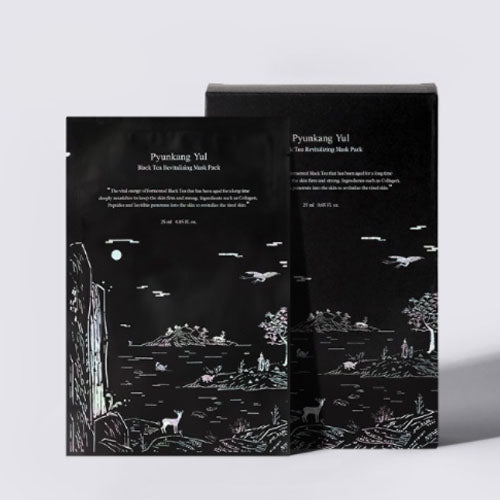

Pyunkang Yul
Black Tea Revitalizing Mask Pack 10 Sheets

Black Tea Revitalizing Mask Pack 10 Sheets
Pyunkang Yul
black-tea-revitalizing-mask-pack-10-sheets
Face Mask
9706814472485
Morning or Evening?
How often will you use this product?
Notes


Highlights
WHAT IS IT?
Face mask sheet pack with 10 sheets
FEATURES
Deep moisturizing, anti-aging, skin revitalizing
BEST FOR
All skin types
CHECKS
Free of parabens, artificial fragrances, colorants
Who Is It For?
Adults Both Men And WomenWhat Does It Help With?
Wrinkles Skin Elasticity Moisture Barrier Strengthening Skin BrighteningBudget
Mid-rangeHow To Use
Which routine should it be used in?
Instructions:
Key Information


What Pyunkang Yul Says
Product Description:
The Pyunkang Yul Black Tea Revitalizing Mask Pack offers a luxurious skincare experience, combining the powerful antioxidant benefits of fermented Black Tea (Kombucha) with the rejuvenating effects of peptides and low-molecular collagen. This mask deeply nourishes and hydrates the skin, reducing wrinkles, improving elasticity, and strengthening the moisture barrier for a firmer, more youthful complexion. Mulberry extract further brightens and evens out skin tone, while the mask's soft, moist adhesion ensures full absorption of its nutrient-rich essence, leaving the skin smooth, radiant, and revitalized after each use.
About the Brand:
Ingredients Overview
Ingredients List
Water, Butylene Glycol, Glycerin, Niacinamide, Hydroxyethyl Urea, Camellia Sinensis Leaf Extract, Saccharomyces/Xylinum/Black Tea Ferment(100ppm), Acetyl Hexapeptide-8, Copper Tripeptide-1, Hydrolyzed Collagen, Hydrolyzed Silk, Hydrolyzed Keratin, Vaccinium Angustifolium (Blueberry) Fruit Extract, Broussonetia Extract, Glycine Max (Soybean) Seed Extract, Butyrospermum Parkii (Shea) Butter, Simmondsia Chinensis (Jojoba) Seed Oil, Prunus Amygdalus Dulcis (Sweet Almond) Oil, Olea Europaea (Olive) Fruit Oil, Helianthus Annuus (Sunflower) Seed Oil, Sodium Hyaluronatem, Sodium Hyaluronate Crosspolymer, Hydrolyzed Hyaluronic Acid, Hyaluronic Acid, Hydrolyzed Sodium Hyaluronate, Hydrogenated Lecithin, Squalane, Ceramide NP, Macadamia Ternifolia Seed Oil, Cetearyl Alcohol, Betula Platyphylla Japonica Juice, Coptis Japonica Root Extract, Houttuynia Cordata Extract, Centella Asiatica Extract, Sodium Polyacryloyldimethyl Taurate, Diethoxyethyl Succinate, Hydroxyethylcellulose, Carbomer, Arginine, Caramel, Dextrin, Adenosine, Disodium EDTA, Propanediol, Hydroxyacetophenone, 1,2-Hexanediol, Dipotassium Glycyrrhizate, Caprylyl Glycol, Pentylene Glycol, Ethylhexylglycerin
Key Ingredients
Black Tea Ferment, Peptides, Collagen, Mulberry extract, Hyaluronic Acid
Ingredients Details
Acetyl Hexapeptide-8
Common Name(s): Argireline plus,snap-6,acetyl glutamyl hexapeptide-3 modified
CAS Number: 616204-22-9
DESCRIPTION
What It Does: Inhibits neuromuscular acetylcholine release for reduced facial muscle contraction and expression line formation.
Why It's Used: Enhanced argireline analog with improved stability for formulations requiring optimized neuro-inhibiting anti-wrinkle performance.
How It Works: Competes with snap-25 protein for binding to the snare complex, reducing vesicular acetylcholine release at neuromuscular junctions. reduced acetylcholine binding decreases muscle contraction amplitude, reducing expression line depth with repeated use.
Typically Found In: Anti-wrinkle creams,expression line treatments,forehead/eye area products
TECHNICAL DETAILS
Primary Category: Active ingredient – neurotransmitter-inhibiting peptide
Secondary Functions: Enhanced snare inhibition,improved stability
Application Areas:

Facial Skincare

Body Care
Hair Care
Beard Care
Color Cosmetics (Makeup)
Dietary/Oral Supplements
Typical Concentration Range: 3–1000 ppm
SOURCING & ETHICS
Vegan Status: Yes – synthetic
Halal Status: Yes
Source Notes: Synthetically produced. encapsulation may improve delivery to neuromuscular junction.
SKIN COMPATIBILITY
Irritancy Rating: 1/5 – very low
Comedogenicity Rating: 0/5 – non-comedogenic
Sensitivity Concerns: Non-irritating.
Safe for Sensitive Skin: Yes
SAFETY & COMPATIBILITY
Safety Profile: Exceptional safety profile. ewg score: 1.
Works Well With: Hyaluronic acid,ceramides,retinol,moisturizers
Avoid Combining With: No significant incompatibilities
SCIENTIFIC NOTE
Hexapeptide-8 differs from argireline (hexapeptide-3) in its c-terminal modification that increases resistance to enzymatic degradation by skin proteases. this improved stability extends the bioavailability of the active peptide at the neuromuscular junction, potentially improving clinical anti-wrinkle efficacy vs the original argireline.
Last Verified: 2026-03-12
Primary Sources: Cosing database,lipotec argireline plus data
Butylene Glycol
Common Name(s): 1,3-butanediol,bg,1,3-butylene glycol
CAS Number: 107-88-0
DESCRIPTION
What It Does: Provides humectant hydration and active ingredient solubilization with excellent skin feel.
Why It's Used: Preferred glycol humectant in premium and k-beauty formulations for superior skin feel vs propylene glycol with equivalent functionality.
How It Works: Two hydroxyl groups at 1,3-positions provide water binding and solvent activity. better tolerated than propylene glycol with minimal sensitization risk. 4-carbon backbone provides slightly greater hydrophobic character enabling dissolution of less polar actives vs pg.
Typically Found In: Toners,essences,serums,k-beauty formulas
TECHNICAL DETAILS
Primary Category: Functional ingredient – glycol humectant
Secondary Functions: Tewl reduction,skin plumping
Application Areas:
Facial Skincare
Body Care
Hair Care
Beard Care
Color Cosmetics (Makeup)
Dietary/Oral Supplements
Typical Concentration Range: 1%–10%
SOURCING & ETHICS
Vegan Status: Yes – synthetic
Halal Status: Yes
Source Notes: Synthetic or naturally derived. excellent aqueous solubility.
SKIN COMPATIBILITY
Irritancy Rating: 1/5 – very low
Comedogenicity Rating: 0/5 – non-comedogenic
Sensitivity Concerns: Non-irritating; suitable for all skin types.
Safe for Sensitive Skin: Yes
SAFETY & COMPATIBILITY
Safety Profile: Excellent safety profile. ewg score: 1.
Works Well With: Ceramides,emollients,occlusives,glycerin,hyaluronic acid
Avoid Combining With: No significant incompatibilities
SCIENTIFIC NOTE
K-beauty's preference for butylene glycol over propylene glycol is driven by two factors: bg's superior skin feel (less tacky than pg's higher viscosity) and its lower sensitization potential (1,3-bg has better spatial distribution of hydroxyl groups that reduces protein interaction vs pg's 1,2-position oh groups).
Last Verified: 2026-03-12
Primary Sources: Cosing database,cir safety assessment
Camellia Sinensis Leaf Extract
Common Name(s): Camellia sinensis leaf extract,botanical extract,phytochemical active
CAS Number: N/a
DESCRIPTION
What It Does: Provides antioxidant protection from reactive oxygen species, reduces inflammatory cytokine production in skin, and conditions skin surface through the plant's secondary metabolite complex.
Why It's Used: Chosen for its natural origin narrative, traditional use heritage, and multi-functional phytochemical profile that supports several concurrent skin care claims from one ingredient.
How It Works: Polyphenols, terpenoids, and alkaloids in the extract scavenge ros via hydrogen atom transfer, inhibit nf-kb or cox-2 inflammatory pathways, and interact with skin surface proteins for conditioning.
Typically Found In: Botanical skin care,natural products
TECHNICAL DETAILS
Primary Category: Active ingredient – antioxidant
Secondary Functions: Free radical scavenging,anti-aging
Application Areas:
Facial Skincare
Body Care
Hair Care
Beard Care
Color Cosmetics (Makeup)
Dietary/Oral Supplements
Typical Concentration Range: 0.1%–10%
SOURCING & ETHICS
Vegan Status: Yes
Halal Status: Yes
Source Notes: Plant-derived extract or synthetic.
SKIN COMPATIBILITY
Irritancy Rating: 1/5 – very low
Comedogenicity Rating: 0/5 – non-comedogenic
Sensitivity Concerns: Non-irritating; well-tolerated.
Safe for Sensitive Skin: Yes
SAFETY & COMPATIBILITY
Safety Profile: Excellent safety profile. ewg score: 1.
Works Well With: Vitamin c,vitamin e,ferulic acid,spf,other antioxidants
Avoid Combining With: No significant incompatibilities
SCIENTIFIC NOTE
Plant secondary metabolites evolved as uv photoprotectants and antimicrobial agents — mechanisms that directly translate to cosmetic antioxidant and anti-inflammatory activity in human skin.
Last Verified: 2026-03-12
Primary Sources: Cosing database,camellia sinensis leaf extract botanical review
Copper Tripeptide-1
Common Name(s): Ghk-cu,copper peptide,gly-his-lys:copper complex
CAS Number: 49557-75-7
DESCRIPTION
What It Does: Stimulates collagen and elastin, accelerates wound healing, activates antioxidant enzymes, and reduces inflammation with an exceptional evidence base.
Why It's Used: Most extensively studied carrier peptide with proven wound healing, anti-aging, and even hair growth efficacy from 50+ years of peer-reviewed research.
How It Works: Copper delivery to enzyme cofactor sites activates sod (antioxidant), lysyl oxidase (collagen crosslinking), and cytochrome c oxidase (cellular energy). ghk moiety signals tgf-beta1 for fibroblast proliferation and collagen synthesis.
Typically Found In: Anti-aging serums,wound healing products,hair growth treatments
TECHNICAL DETAILS
Primary Category: Active ingredient – ghk-cu copper carrier peptide
Secondary Functions: Copper delivery,antioxidant enzyme activation,wound healing
Application Areas:
Facial Skincare
Body Care
Hair Care
Beard Care
Color Cosmetics (Makeup)
Dietary/Oral Supplements
Typical Concentration Range: 0.1%–2%
SOURCING & ETHICS
Vegan Status: Yes – synthetic
Halal Status: Yes
Source Notes: Synthetically produced; copper-peptide complex requires careful formulation.
SKIN COMPATIBILITY
Irritancy Rating: 1/5 – very low
Comedogenicity Rating: 0/5 – non-comedogenic
Sensitivity Concerns: Non-irritating; suitable for sensitive skin.
Safe for Sensitive Skin: Yes
SAFETY & COMPATIBILITY
Safety Profile: Excellent safety profile. ewg score: 1.
Works Well With: Hyaluronic acid,ceramides,antioxidants
Avoid Combining With: Avoid mixing with high-concentration ahas (copper chelation concern); high-dose vitamin c (ascorbate competes for copper binding)
SCIENTIFIC NOTE
Ghk-cu has been shown to activate over 4,000 human genes involved in tissue remodeling and wound healing. pickart's seminal work documented the peptide's ability to restore aging skin by activating the same gene expression programs active in wound healing.
Last Verified: 2026-03-12
Primary Sources: Cosing database,pickart et al. ghk-cu 50-year review,hostynek et al. clinical study