
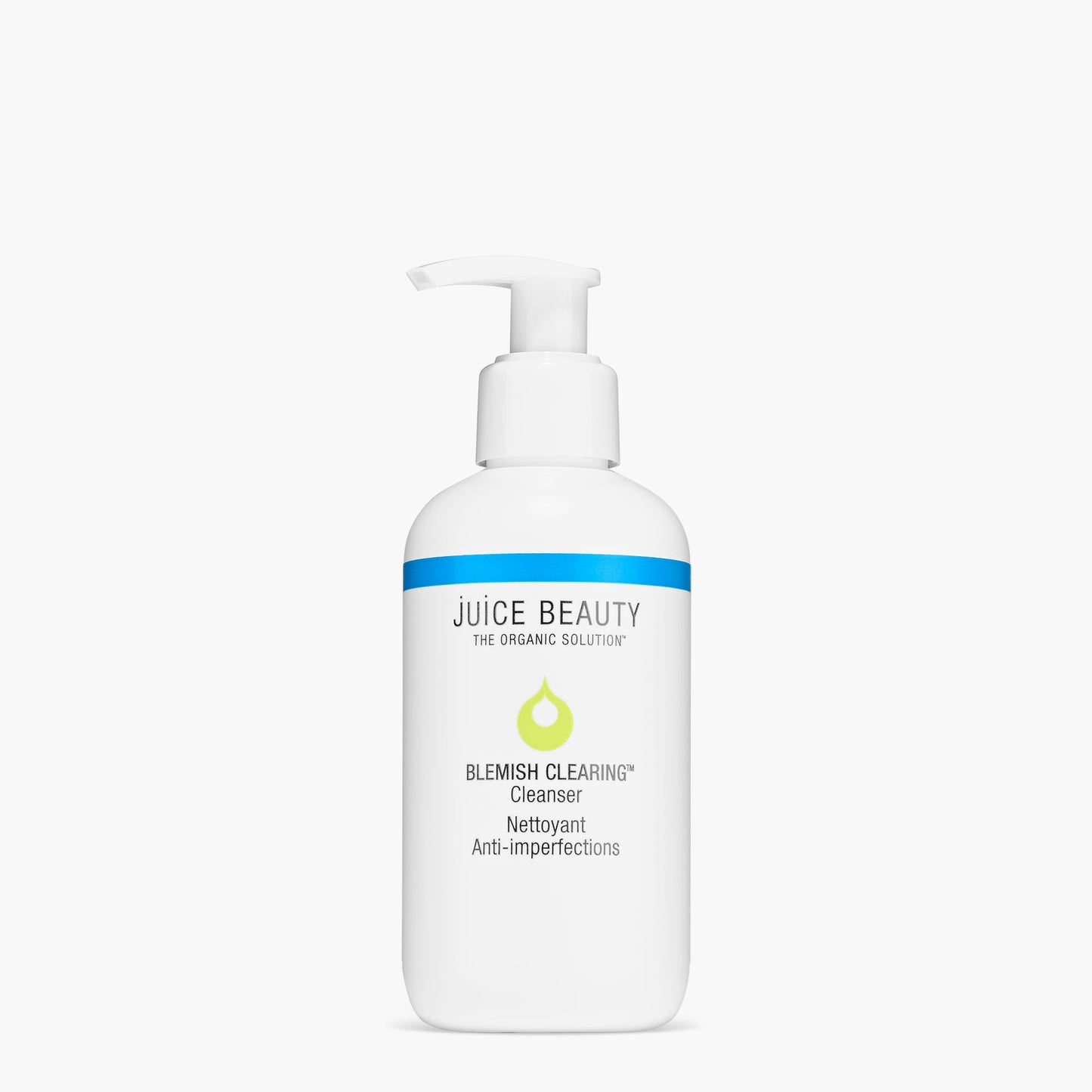

Juice Beauty
Blemish Clearing Cleanser

Blemish Clearing Cleanser
Juice Beauty
blemish-clearing-cleanser
Cleanse
9784765940005
Morning or Evening?
How often will you use this product?
Notes


Highlights
WHAT IS IT?
Blemish clearing cleanser
FEATURES
Detoxifying, deeply cleanses, purifies pores
BEST FOR
oily
CHECKS
Free of parabens, phthalates, sulfates, petroluem, pesticides, propylene, butylene glycols, PEGs, TEA, DEA, GMOs, artificial dyes, synthetic fragrances
Who Is It For?
Teens And Adults With Acne-prone SkinWhat Does It Help With?
Acne Excess Oil Blemishes Pore PurificationBudget
Affordable (under $30)How To Use
Which routine should it be used in?
Instructions:
Key Information


What Juice Beauty Says
Product Description:
Detoxifying blemish-clearing cleanser for acne-prone skin deeply cleanses skin from excess oil, dirt, makeup and helps purify the pores.
About the Brand:
Ingredients Overview
Ingredients List
Citrus Medica Limonum (Organic Lemon Juice/Jus De Citron Bio)*, Prunus Avium (Organic Sweet Cherry Juice/Jus De Cerise Sucrée Bio)*, Vitis Vinifera (Organic Red Grape Juice/Jus De Raisin Rouge Bio)*, Aloe Barbadensis (Organic Aloe Juice/Jus D'Aloès Bio)*, Decyl Glucoside+, Glycerin+, Sodium Hydroxide, Gluconolactone+, Sclerotium Gum, Xanthan Gum, Lysolecithin, Pullulan+, Sodium Benzoate, Sodium Levulinate, Salvia Officinalis (Organic Sage Leaf Extract/Extrait De Feuilles De Sauge Bio)*, Taraxacum Officinale (Dandelion Leaf Extract/Extrait De Feuilles De Pissenlit), Melissa Officinalis (Lemon Balm Leaf Extract/Extrait De Feuilles De Mélisse), Algae Extract, Retinyl Palmitate (Vitamin A/Vitamine A), Tocopherol (Vitamin E/Vitamine E), Citrus Aurantifolia (Lime Oil/Huile De Citron Vert), Tetrasodium Glutamate Diacetate+, Sodium Anisate, Citric Acid, Litsea Cubeba (Organic May Chang Oil/Huile De Chang Mai Bio)*, Citrus Aurantium Amara (Organic Bitter Orange Oil/Huile D'Orange Amère Bio)*, Cananga Odorata (Organic Ylang Ylang Oil/Huile D'Ylang Ylang Bio)*.
Key Ingredients
Sage Leaf (Organic), Lemon (Organic), Sweet Cherry (Organic)
Ingredients Details
Decyl Glucoside
Common Name(s): Capryl glucoside,apg surfactant,alkyl polyglucoside
CAS Number: 68515-73-1
DESCRIPTION
What It Does: Provides gentle non-ionic cleansing from natural glucose-derived surfactant chemistry.
Why It's Used: Leading natural-origin surfactant for green/natural formulations requiring gentle, non-ionic cleansing with excellent biodegradability credentials.
How It Works: Non-ionic surfactant with glucoside headgroup and decyl (c10) chain provides mild cleansing via micelle formation. non-ionic character provides lower irritation potential than anionic surfactants. fully biodegradable and from renewable sources.
Typically Found In: Natural cleansers,baby products,green beauty formulas,scalp cleansers
TECHNICAL DETAILS
Primary Category: Functional ingredient – alkyl glucoside surfactant
Secondary Functions: Skin conditioning
Application Areas:

Facial Skincare
Body Care
Hair Care

Beard Care
Color Cosmetics (Makeup)
Dietary/Oral Supplements
Typical Concentration Range: 2%–20%
SOURCING & ETHICS
Vegan Status: Yes – from glucose (plant) and fatty alcohols
Halal Status: Yes
Source Notes: Commercially produced for cosmetic use. verify vegan/halal status with supplier.
SKIN COMPATIBILITY
Irritancy Rating: 1/5 – very low
Comedogenicity Rating: 0/5 – non-comedogenic
Sensitivity Concerns: Well-tolerated by most skin types.
Safe for Sensitive Skin: Yes
SAFETY & COMPATIBILITY
Safety Profile: Good safety profile at recommended concentrations. ewg score: 1–2.
Works Well With: Standard skincare actives
Avoid Combining With: No known significant incompatibilities
SCIENTIFIC NOTE
Alkyl glucosides' (apgs) non-ionic character means they have no electrical charge that could interact with skin surface proteins and phospholipids – a key reason for their exceptional mildness. ionic surfactants (sulfates, carboxylates) bind to positively charged protein lysine/arginine residues causing denaturation; apgs have no such binding affinity.
Last Verified: Cosing database,cir safety assessment
Primary Sources: 2026-03-12
Gluconolactone
Common Name(s): D-gluconolactone,delta-gluconolactone
CAS Number: 90-80-2
DESCRIPTION
What It Does: Provides the gentlest chemical exfoliation with simultaneous antioxidant, moisture retention, and barrier support.
Why It's Used: Preferred exfoliant for rosacea, eczema, sensitive skin, and post-procedure recovery where standard ahas cause unacceptable irritation.
How It Works: Hydrolyzes slowly on skin surface to gluconic acid providing gentle exfoliation. multiple hydroxyl groups enable water binding (humectant) and metal chelation (antioxidant).
Typically Found In: Sensitive skin exfoliants,rosacea treatments,eczema care,post-procedure recovery
TECHNICAL DETAILS
Primary Category: Active ingredient – polyhydroxy acid (pha)
Secondary Functions: Gentle exfoliation,antioxidant,humectant
Application Areas:
Facial Skincare
Body Care
Hair Care
Beard Care
Color Cosmetics (Makeup)
Dietary/Oral Supplements
Typical Concentration Range: 5%–15%
SOURCING & ETHICS
Vegan Status: Yes – fermentation or synthetic
Halal Status: Yes
Source Notes: Fermentation-derived from glucose or synthetic. among the safest chemical exfoliants available.
SKIN COMPATIBILITY
Irritancy Rating: 1/5 – very low
Comedogenicity Rating: 0/5 – non-comedogenic
Sensitivity Concerns: No photosensitization; no stinging; suitable for very sensitive skin.
Safe for Sensitive Skin: Yes – ideal for sensitive, reactive, rosacea, and eczema-prone skin; no photosensitization
SAFETY & COMPATIBILITY
Safety Profile: Exceptional safety profile. no photosensitization. ewg score: 1.
Works Well With: Ceramides,niacinamide,hyaluronic acid,soothing actives
Avoid Combining With: No significant incompatibilities
SCIENTIFIC NOTE
Phas have molecular weights 2–3× larger than ahas, limiting penetration to superficial layers. combined humectant and antioxidant properties make them uniquely well-tolerated while providing meaningful exfoliation.
Last Verified: Cosing database,green & yu (2003) pha review,cir safety assessment
Primary Sources: 2026-03-12
Glycerin
Common Name(s): Glycerol,glycerine,1,2,3-propanetriol
CAS Number: 56-81-5
DESCRIPTION
What It Does: Glycerin pulls water from the environment and deeper skin layers into the outer skin layer (epidermis), boosting moisture levels and keeping skin soft, smooth, and plump.
Why It's Used: It is used in virtually every moisturizer, serum, and cleanser because it is highly effective at hydrating skin, is well-tolerated by all skin types, and enhances the texture and spreadability of formulations.
How It Works: As a humectant, glycerin forms hydrogen bonds with water molecules, trapping them in the skin. it also reinforces the skin barrier by integrating into lipid structures between skin cells.
Typically Found In: Moisturizers,serums,cleansers,toners,sheet masks,sunscreens,body lotions,shampoos,conditioners
TECHNICAL DETAILS
Primary Category: Humectant
Secondary Functions: Skin barrier support,emollient,solvent
Application Areas:
Facial Skincare
Body Care
Hair Care
Beard Care
Color Cosmetics (Makeup)
Dietary/Oral Supplements
Typical Concentration Range: 1%–30% (typical: 3–10%)
SOURCING & ETHICS
Vegan Status: Yes – plant-derived (coconut, soy, palm) or synthetic
Halal Status: Yes – when plant-derived or synthetic; verify source with supplier
Source Notes: Derived from plant oils via hydrolysis or saponification; synthetic versions also available. palm-derived glycerin carries sustainability concerns.
SKIN COMPATIBILITY
Irritancy Rating: 1/5 – very low; non-irritating at all standard concentrations
Comedogenicity Rating: 0/5 – non-comedogenic
Sensitivity Concerns: Extremely rare allergic reactions; generally safe for all skin types including sensitive and baby skin
Safe for Sensitive Skin: Yes
SAFETY & COMPATIBILITY
Safety Profile: Widely recognized as safe. ewg hazard score: 1. no significant concerns for irritation, sensitization, or toxicity at typical concentrations (up to 50%).
Works Well With: Hyaluronic acid,ceramides,niacinamide,panthenol,urea,peptides,retinol,ahas/bhas
Avoid Combining With: No known incompatibilities at standard concentrations
SCIENTIFIC NOTE
Glycerin is an endogenous skin component found naturally in the stratum corneum. aquaporin-3 channels in keratinocytes facilitate glycerin transport, making it integral to natural skin hydration pathways.
Last Verified: Cosing database,cir safety assessment,ewg skin deep,inci decoder
Primary Sources: 2026-03-12
Sclerotium Gum
Common Name(s): Scleroglucan,sclerotinia beta-glucan gum
CAS Number: 39464-87-4
DESCRIPTION
What It Does: Provides natural thickening while delivering beta-glucan immunomodulatory and wound healing activity.
Why It's Used: Natural thickener with functional benefit (beta-glucan immunostimulation) beyond simple rheology – combines formulation function with skin bioactivity.
How It Works: Triple-helix beta-1,3-glucan backbone with 1,6 branches provides strong entanglement-based thickening. beta-glucan activity activates dectin-1 receptors on immune cells for wound healing stimulation. excellent salt and ph stability.
Typically Found In: Natural cosmetics,wound healing products,natural gels
TECHNICAL DETAILS
Primary Category: Functional ingredient – natural microbial polysaccharide
Secondary Functions: Beta-glucan immunostimulation,wound healing
Application Areas:
Facial Skincare
Body Care
Hair Care
Beard Care
Color Cosmetics (Makeup)
Dietary/Oral Supplements
Typical Concentration Range: 0.2%–2%
SOURCING & ETHICS
Vegan Status: Yes – sclerotinia rolfsii fermentation
Halal Status: Yes
Source Notes: Commercially produced for cosmetic use. verify vegan/halal status with supplier.
SKIN COMPATIBILITY
Irritancy Rating: 1/5 – very low
Comedogenicity Rating: 0/5 – non-comedogenic
Sensitivity Concerns: Well-tolerated by most skin types.
Safe for Sensitive Skin: Yes
SAFETY & COMPATIBILITY
Safety Profile: Good safety profile at recommended concentrations. ewg score: 1–2.
Works Well With: Standard skincare actives
Avoid Combining With: No known significant incompatibilities
SCIENTIFIC NOTE
Sclerotium gum's triple-helix conformation in solution provides unusual for polysaccharides: a gel-like structured phase at very low concentrations due to helix-helix aggregation. this allows effective thickening at 0.1-0.3% concentrations, compared to xanthan's 0.3-0.5% minimum effective concentration.
Last Verified: Cosing database,cir safety assessment
Primary Sources: 2026-03-12
