
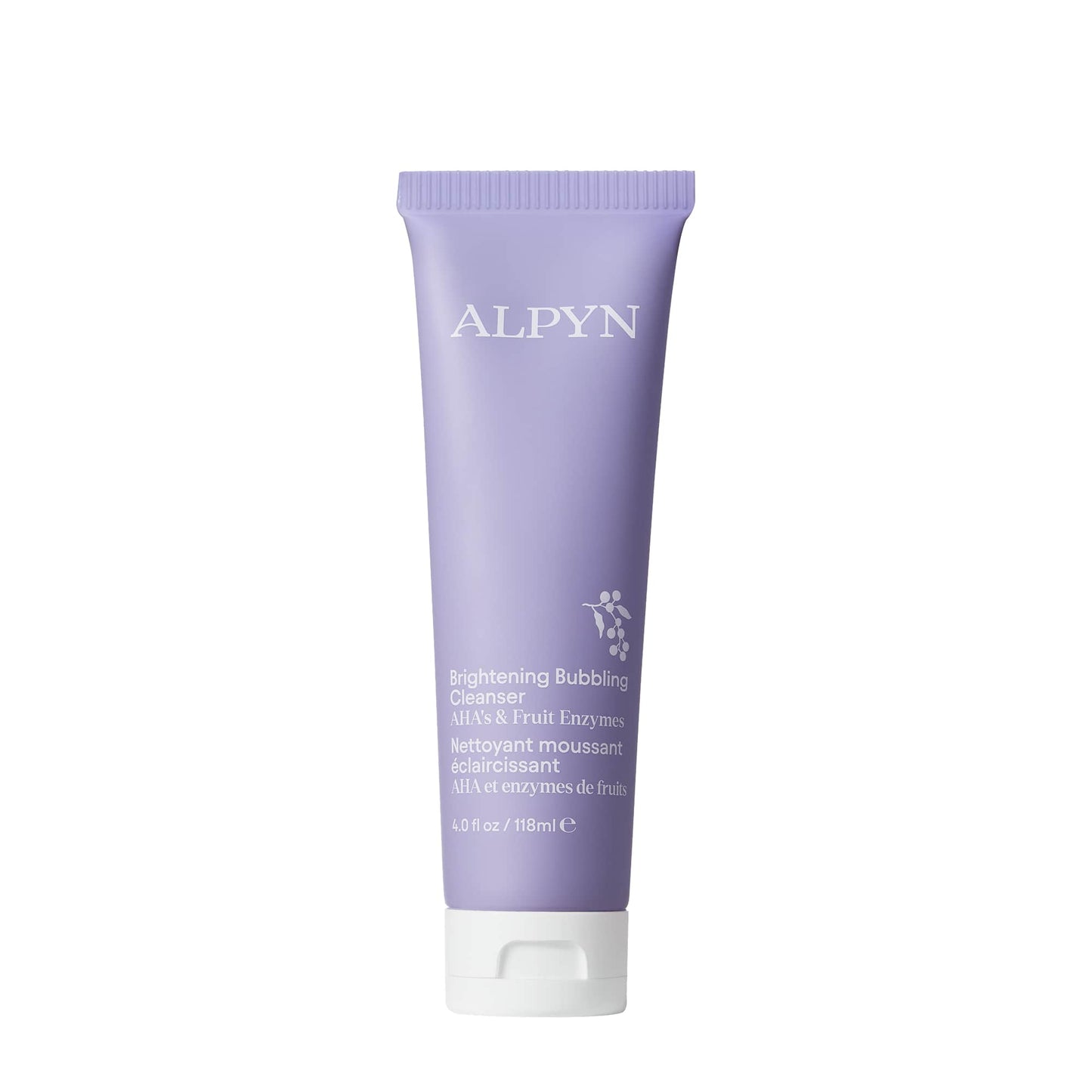

Alpyn Beauty
Brightening Bubbling Cleanser

Brightening Bubbling Cleanser
Alpyn Beauty
brightening-bubbling-cleanser
Cleanse
9818416218405
Morning or Evening?
How often will you use this product?
Notes


Highlights
WHAT IS IT?
Bubbling cleanser with AHAs and fruit enzymes
FEATURES
Dissolves dirt, oil, and makeup, Supports balanced skin-pH levels, Contains AHAs for texture improvement
BEST FOR
dry
CHECKS
Free of Phenoxyethanol, Parabens, Formaldehyde Donors, MEA/DEA/TEA, Palm Ingredients, Sulfates, Synthetic Dyes, Colors, Fragrance, Phthalates, Petrochemicals, PEG’s/ PPG’s, Metallic Aluminum, Triclosan, Talc, Mineral Oil, Petrolatum
Who Is It For?
All Ages And Genders With Parched ComplexionsWhat Does It Help With?
Skin Texture Improvement Pore Decongestion BrighteningBudget
Mid-range ($30-$75)How To Use
Which routine should it be used in?
Instructions:
Key Information


What Alpyn Beauty Says
Product Description:
A silky, sudsy cleanser—perfect for parched complexions and formulated with skin-friendly AHAs—that gently dissolves dirt, oil, and makeup while supporting balanced skin-pH levels.
About the Brand:
Ingredients Overview
Ingredients List
water/aqua/eau, glycerin, sodium cocoyl isethionate, sodium methyl cocoyl taurate, hamamelis virginiana (witch hazel) leaf extract, myristic acid, cetearyl alcohol, lactobacillus/punica granatum fruit ferment extract, stearic acid, polyacrylate-33, carica papaya (papaya) fruit extract, sodium cocoyl apple amino acids, glycolic acid, lactic acid, ascorbic acid, coconut acid, tromethamine, sodium hyaluronate, ceramide ng, linoleic acid, simmondsia chinensis (jojoba) seed oil, arnica cordifolio (arnica) flower extract, borago officinalis (borage) flower extract, calendula officinalis (calendula) flower extract, matricaria discoidea (chamomile) flower extract, salvia officinalis (sage) leaf extract, dehydroacetic acid, benzyl alcohol, potassium sorbate, alcohol, citrus aurantium dulcis (orange) peel oil, lavandula angustifolia (lavender) oil, eclipta prostrata extract, melia azadirachta leaf extract, moringa oleifera seed oil, palmitic acid, lauric acid, sodium isethionate, sodium chloride, sodium methyltaurate, hexylene glycol, tetrasodium glutamate diacetate, sodium benzoate, leuconostoc/radish root ferment filtrate, limonene, linalool
Key Ingredients
AHAs (Glycolic & Lactic Acid), Papaya & Pomegranate Enzymes, Vitamin C, Mountain Cherry
Ingredients Details
Glycolic Acid
Common Name(s): Hydroxyacetic acid,2-hydroxyacetic acid
CAS Number: 79-14-1
DESCRIPTION
What It Does: Provides maximum aha efficacy from the smallest most penetrating alpha-hydroxy acid.
Why It's Used: The most potent aha — glycolic acid's smallest molecular size provides the deepest penetration and highest efficacy of any alpha-hydroxy acid for exfoliation and anti-aging.
How It Works: Smallest aha (mw 76) provides deepest stratum corneum penetration. disrupts corneodesmosomes reducing cohesion. stimulates fibroblast collagen i and iii synthesis. efficacy is ph-dependent — free acid fraction determines activity.
Typically Found In: Chemical peels,body lotions,anti-aging serums,exfoliating toners
TECHNICAL DETAILS
Primary Category: Active ingredient – primary aha
Secondary Functions: Brightening,collagen stimulation
Application Areas:

Facial Skincare
Body Care

Hair Care
Beard Care
Color Cosmetics (Makeup)
Dietary/Oral Supplements
Typical Concentration Range: 1%–10% cosmetic; higher professional
SOURCING & ETHICS
Vegan Status: Yes – synthetic or fermentation-derived
Halal Status: Yes
Source Notes: Fermentation-derived or synthetic. ph must be ≤4.0 for aha activity.
SKIN COMPATIBILITY
Irritancy Rating: 2/5 – low to moderate
Comedogenicity Rating: 0/5 – non-comedogenic
Sensitivity Concerns: Photosensitizing – mandatory spf use. start at low frequency.
Safe for Sensitive Skin: Use with caution – spf required
SAFETY & COMPATIBILITY
Safety Profile: Eu cosmetics: max 10% leave-on, ph ≥3.5, mandatory sun protection advisory. professional peel concentrations regulated separately.
Works Well With: Niacinamide,ceramides,hyaluronic acid,spf
Avoid Combining With: Retinol in same step; multiple exfoliants simultaneously
SCIENTIFIC NOTE
Glycolic acid's ph-dependent efficacy is critical: at ph 3.0 ~100% is in the free acid (membrane-permeable) form; at ph 3.5 ~70%; at ph 4.0 ~50%. the eu ph ≥3.5 requirement reduces free acid proportion, lowering efficacy but also reducing irritation — why professional peel concentrations at lower ph are far more active than equivalent cosmetic concentrations.
Last Verified: 2026-03-12
Primary Sources: Cosing database,eu aha guidelines,cir safety assessment
Lactic Acid
Common Name(s): L-lactic acid,2-hydroxypropionic acid,milk acid
CAS Number: 50-21-5
DESCRIPTION
What It Does: Exfoliates dead skin cells, attracts and retains moisture, brightens skin tone, and improves texture.
Why It's Used: Dual exfoliant and humectant – uniquely hydrating vs other ahas. gentler and suitable for normal-to-sensitive skin.
How It Works: Disrupts desmosomes to promote exfoliation at low ph. acts as humectant. also stimulates ceramide synthesis at lower concentrations for barrier support.
Typically Found In: Chemical exfoliants,toners,serums,professional peels
TECHNICAL DETAILS
Primary Category: Active ingredient – alpha hydroxy acid (aha)
Secondary Functions: Humectant,brightening,barrier support,ceramide synthesis
Application Areas:
Facial Skincare
Body Care
Hair Care
Beard Care
Color Cosmetics (Makeup)
Dietary/Oral Supplements
Typical Concentration Range: 2%–10% (daily); 20%–90% (professional); active at ph ≤3.9
SOURCING & ETHICS
Vegan Status: Conditional - feedstock declaration required
Halal Status: Unverified - feedstock declaration required (plant, animal and petrochemical routes all exist)
Source Notes: Fermentation-derived from carbohydrates or synthetically produced. both l-form and dl-form used. [audit 2026-07-29 rev2: origin-dependent: the same inci exists in plant, animal and petrochemical versions and the name does not discriminate. determination requires shariah-panel sign-off.]
SKIN COMPATIBILITY
Irritancy Rating: 2/5 – low to moderate
Comedogenicity Rating: 0/5 – non-comedogenic
Sensitivity Concerns: Photosensitizing – spf required. better tolerated than glycolic acid for most skin types.
Safe for Sensitive Skin: Use with caution – spf required
SAFETY & COMPATIBILITY
Safety Profile: Safe at otc concentrations. eu: ≤10% leave-on at ph ≥3.5. mandatory spf advisory.
Works Well With: Niacinamide,ceramides,hyaluronic acid,spf
Avoid Combining With: Retinol in same step; multiple exfoliants simultaneously
SCIENTIFIC NOTE
Lactic acid's role as a natural moisturizing factor (nmf) component makes it uniquely hydrating among ahas. ceramide synthesis stimulation at 2% provides barrier benefits complementing exfoliating activity.
Last Verified: 2026-03-12
Primary Sources: Cosing database,stiller et al. lactic acid review,sccs aha opinion
Vitamin C
Common Name(s): Vitamin c,cosmetic active,established function
CAS Number: N/a
DESCRIPTION
What It Does: Delivers characteristic cosmetic function — skin conditioning, antioxidant protection, active biological benefit, or formulation function — at recommended use concentration.
Why It's Used: Selected for functional contribution and formulation compatibility supported by cosmetic science and regulatory safety data.
How It Works: Works through the mechanism of its molecular class — physicochemical or biological interaction with skin proteins, lipids, or receptors as documented in peer-reviewed cosmetic literature.
Typically Found In: Skin care formulations
TECHNICAL DETAILS
Primary Category: Active ingredient – cosmetic active
Secondary Functions: Skin conditioning
Application Areas:
Facial Skincare
Body Care
Hair Care
Beard Care
Color Cosmetics (Makeup)
Dietary/Oral Supplements
Typical Concentration Range: 0.1%–10%
SOURCING & ETHICS
Vegan Status: Conditional - supplier confirmation required
Halal Status: Unverified - supplier confirmation required
Source Notes: Commercially produced for cosmetic use. verify vegan/halal status with supplier. [audit 2026-07-29 rev2: the record's own source_notes does not assert a non-animal origin, or instructs the reader to verify with the supplier; "yes" asserts knowledge the record does not hold. determination requires shariah-panel sign-off.]
SKIN COMPATIBILITY
Irritancy Rating: 1/5 – very low
Comedogenicity Rating: 0/5 – non-comedogenic
Sensitivity Concerns: Well-tolerated by most skin types.
Safe for Sensitive Skin: Yes
SAFETY & COMPATIBILITY
Safety Profile: Good safety profile at recommended concentrations. ewg score: 1–2.
Works Well With: Standard skincare actives
Avoid Combining With: No known significant incompatibilities
SCIENTIFIC NOTE
Vitamin c has an established safety and efficacy profile within the cosmetic regulatory framework at standard use concentrations.
Last Verified: 2026-03-12
Primary Sources: Cosing database,vitamin c technical literature