

Brillare
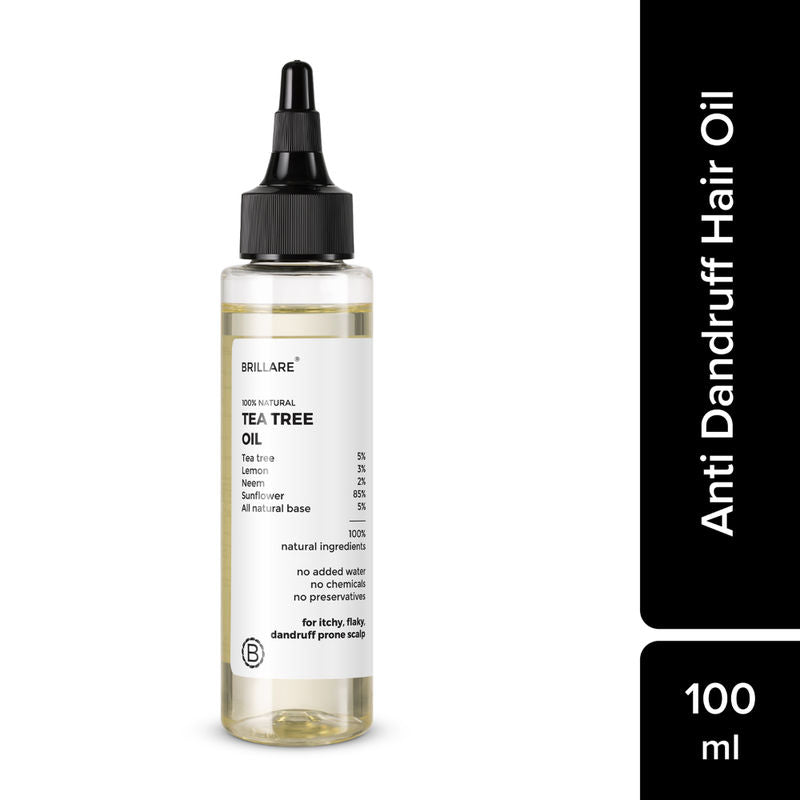
Brillare 5% Tea Tree Oil for Dandruff & Itchy Scalp Removes Dandruff From Roots
100% natural scalp clarifying oil with tea tree, lemon, and neem for itchy, flaky, dandruff prone scalp. Achieve a healthy scalp while preventing hair dryness with Brillare Tea Tree Oil that removes excess oil and promotes scalp comfort.
Paraben-free
Sulfate-free
Silicone-free
Natural
Vegan
Cruelty-free
Optimized for Your Environment & Lifestyle
Nykaa
In stock
Recommended

Brillare 5% Tea Tree Oil for Dandruff & Itchy Scalp Removes Dandruff From Roots
Brillare
brillare-5-tea-tree-oil-for-dandruff-itchy-scalp-removes-dandruff-from-roots
Hair Oil
10202918060325
Morning or Evening?
How often will you use this product?
Notes


Secure payment protection
Your Biodata Compatibility Analysis
Based on your 6 hair health indices and environmental factors
Poor Match
Significant incompatibilities
Growth Cycle Health Index
Hair Match
Hair Health Index Alignment
Optimal for OSI, SSI, DI, HSI
Ingredient Efficacy
Matching Ingredient Score
Environment Compatibility
Current UV, Air Quality & Humidity
Why This Works for Your Specific Profile
Damage Index:
Damage levels outside specified range may not benefit optimally from product formulation
Water Quality:
Fine hair becomes weighed down and greasy from heavy formulation
Hair:
No porosity-specific conflicts
Active Lifestyle:
Activity levels outside optimal range affect product performance and maintenance requirements
Your Hair Profile Integration
Your Hair Archetype

Density Level

Washing Frequency

Shedding Level

Oil Level
Your Hair Health Indices
Oil Secretion (OSI)
Very low oil production
Scalp Sensitivity (SSI)
Very low sensitivity
Growth Rate (CMR)
Poor metabolism rate
Damage Index (DI)
Minimal damage
Hair Strength (HSI)
Very weak strength
Softness Index (SI)
Significant improvement needed
Water & Environmental Integration

Water:


Expected Results & Timeline
Key Highlights

What is it?
Hair Oil with 9 key ingredients

Who Is It For
All ages, all genders

Budget
Rs. 376.65 - Rs. 753.30

Timeline
Visible dandruff reduction within a few days
Why You’ll Love It

What Does It Help With?
Dandruff, itchy scalp, flaky scalp, excess oil, hair dryness

Best for
Scalp Issues

Features
100% natural hair oil for dandruff-prone scalp and hair, enriched with tea tree, lemon, and neem, helps keep scalp flake-free, promotes healthy scalp, reduces excess oil secretion, prevents hair dryness, free from parabens, sulphates, formaldehyde, petroleum wax, mineral oil, silicon oil, artificial colour and fragrance, vegan and cruelty-free

Checks
Vegan certified by PETA, Paraben-free, Sulfate-free, Silicone-free
Ingredients Overview
Ingredients List
sunflower-oil,tea-tree-oil,lemon-oil,neem-oil,clary-sage-oil,soyabean-oil,olive-oil,plant-based-vitamin-e,wheat-germ-oil
Key Ingredients
Tea Tree Oil, Lemon Oil, Neem Oil, Sunflower Oil
Ingredients Details
Lemon Oil
Common Name(s): Lemon oil,botanical oil/butter,phytochemical active
CAS Number: N/a
DESCRIPTION
What It Does: Provides emollient conditioning and essential fatty acid supplementation.
Why It's Used: Botanical oils integrate into sc lipid bilayers for genuine barrier emolliency.
How It Works: Fatty acid triglycerides deliver oleic, linoleic, and linolenic acids for sc integration and barrier repair.
Typically Found In: Botanical skin care
TECHNICAL DETAILS
Primary Category: Active ingredient – antioxidant
Secondary Functions: Free radical scavenging,anti-aging
Application Areas:

Facial Skincare
Body Care

Hair Care
Beard Care
Color Cosmetics (Makeup)
Dietary/Oral Supplements
Typical Concentration Range: 0.1%–30%
SOURCING & ETHICS
Vegan Status: Conditional - supplier confirmation required
Halal Status: Conditional - basis not stated in source record; supplier origin confirmation required to determine what evidence applies
Source Notes: Plant-derived extract or synthetic. [audit 2026-07-29 rev2: status downgraded on audit. determination requires shariah-panel sign-off.]
SKIN COMPATIBILITY
Irritancy Rating: 1/5 – very low
Comedogenicity Rating: 0/5 – non-comedogenic
Sensitivity Concerns: Non-irritating; well-tolerated.
Safe for Sensitive Skin: Yes
SAFETY & COMPATIBILITY
Safety Profile: Excellent safety profile. ewg score: 1.
Works Well With: Vitamin c,vitamin e,ferulic acid,spf,other antioxidants
Avoid Combining With: No significant incompatibilities
SCIENTIFIC NOTE
Plant secondary metabolites evolved for uv photoprotection and pathogen defence — directly applicable to cosmetic antioxidant and anti-inflammatory activity in human skin.
Last Verified: 2026-03-12
Primary Sources: Cosing database,lemon oil botanical review
Neem Oil
Common Name(s): Essential oil,concentrated volatile aromatic,bioactive fragrance active
CAS Number: N/a
DESCRIPTION
What It Does: Provides aromatic sensory benefit alongside bioactive skin activity from concentrated plant volatile compounds — including antimicrobial activity (tea tree, thyme, clove), anti-inflammatory activity (lavender, chamomile), or circulatory stimulation (peppermint, rosemary).
Why It's Used: Essential oils provide authentic 'aromatherapy' narrative with genuine bioactive chemistry — the concentrated terpenoid constituents have documented biological activity in addition to olfactory benefit, justifying ingredient claims beyond pure fragrance.
How It Works: Essential oil complexity: steam distillation concentrates volatile terpenes (monoterpenes, sesquiterpenes), phenylpropanoids, and other volatiles. antimicrobial activity from terpenoid membrane disruption (terpinen-4-ol, eugenol, thymol disrupt bacterial membranes); anti-inflammatory from sesquiterpene nf-kb inhibition; sensitisation risk from electrophilic monoterpene oxides and aldehydes.
Typically Found In: Aromatherapy,bioactive skin care,fragrance
TECHNICAL DETAILS
Primary Category: Active ingredient – cosmetic active
Secondary Functions: Skin conditioning
Application Areas:
Facial Skincare
Body Care
Hair Care
Beard Care
Color Cosmetics (Makeup)
Dietary/Oral Supplements
Typical Concentration Range: 0.01%–2%
SOURCING & ETHICS
Vegan Status: Conditional - supplier confirmation required
Halal Status: Unverified - supplier confirmation required
Source Notes: Commercially produced for cosmetic use. verify vegan/halal status with supplier. [audit 2026-07-29 rev2: the record's own source_notes does not assert a non-animal origin, or instructs the reader to verify with the supplier; "yes" asserts knowledge the record does not hold. determination requires shariah-panel sign-off.]
SKIN COMPATIBILITY
Irritancy Rating: 1/5 – very low
Comedogenicity Rating: 0/5 – non-comedogenic
Sensitivity Concerns: Well-tolerated by most skin types.
Safe for Sensitive Skin: Yes
SAFETY & COMPATIBILITY
Safety Profile: Good safety profile at recommended concentrations. ewg score: 1–2.
Works Well With: Standard skincare actives
Avoid Combining With: No known significant incompatibilities
SCIENTIFIC NOTE
Essential oil concentration in cosmetics must respect ifra (international fragrance association) guidelines — each oil has category-specific maximum use levels based on skin sensitisation quantitative risk assessment (qra). tea tree oil maximum 0.5% (rinse-off), lavender oil 2% (leave-on skin) as examples.
Last Verified: 2026-03-12
Primary Sources: Cosing database,ifra standards,essential oil bioactive fragrance review
Sunflower Oil
Common Name(s): Sunflower oil oil
DESCRIPTION
What It Does: Nourishes and softens skin through its balanced fatty acid profile, while antioxidant compounds protect against oxidative skin damage.
Why It's Used: Plant oils provide physiologically compatible lipid structures that integrate into the skin barrier and deliver fat-soluble antioxidants directly to skin cells.
How It Works: Fatty acids integrate into stratum corneum lipid lamellae, reinforcing the lipid barrier. antioxidants (tocopherols, carotenoids, polyphenols) neutralize ros through electron donation or singlet oxygen quenching.
Typically Found In: Face oils,serums,moisturizers,hair treatments,body oils
TECHNICAL DETAILS
Primary Category: Plant oils
Secondary Functions: Emollient,antioxidant
Application Areas:
Facial Skincare
Body Care
Hair Care
Beard Care
Color Cosmetics (Makeup)
Dietary/Oral Supplements
Typical Concentration Range: 0.5–30%
SOURCING & ETHICS
Vegan Status: Yes
Halal Status: Yes
Source Notes: Cold-pressed or solvent-extracted plant oil; no animal components.
SKIN COMPATIBILITY
Irritancy Rating: 1899-12-31 00:00:00 -0800
Comedogenicity Rating: 2000-01-01 00:00:00 -0800
Sensitivity Concerns: Low sensitization potential at recommended use concentrations.
Safe for Sensitive Skin: Yes
SAFETY & COMPATIBILITY
Safety Profile: Well-characterized cosmetic ingredient with established safety profile. generally non-irritating at typical use concentrations. suitable for leave-on and rinse-off cosmetics.
Works Well With: Vitamin e,ceramides,other plant oils,squalane
Avoid Combining With: Strong oxidizers (accelerate rancidity)
SCIENTIFIC NOTE
Vegetable oils are triglyceride matrices where the fatty acid composition determines skin compatibility, barrier function, and comedogenicity. oleic acid-rich oils (>60%) soften barrier lipids and enhance penetration; linoleic acid-rich oils reinforce ceramide-poor stratum corneum; saturated fatty acid-rich oils provide occlusion without skin penetration.
Last Verified: 2025-01-15
Primary Sources: Cosing eu database; pcpc cosmetic ingredient safety reviews; aocs plant oil composition databases; fatty acid pharmacology reviews
Tea Tree Oil
Common Name(s): Tea tree oil,tto,melaleuca oil
CAS Number: 68647-73-4
DESCRIPTION
What It Does: Provides the most potent single-plant broad-spectrum antimicrobial essential oil for skin antiseptic applications.
Why It's Used: The antimicrobial essential oil – tea tree oil's terpinen-4-ol provides clinically proven broad-spectrum antimicrobial activity in rct-level clinical studies for acne and mrsa decolonisation.
How It Works: Terpinen-4-ol (30-48%) provides membrane-disrupting antimicrobial activity vs gram+/- bacteria, fungi, and enveloped viruses. iso 4730 requires minimum 30% terpinen-4-ol and maximum 5% 1,8-cineole (sensitiser). anti-biofilm activity vs staphylococcus.
Typically Found In: Anti-acne products,antiseptic formulas,natural antimicrobials,scalp treatments
TECHNICAL DETAILS
Primary Category: Active ingredient – soothing / anti-inflammatory
Secondary Functions: Redness reduction,anti-inflammatory,calming
Application Areas:
Facial Skincare
Body Care
Hair Care
Beard Care
Color Cosmetics (Makeup)
Dietary/Oral Supplements
Typical Concentration Range: 0.001%–5%
SOURCING & ETHICS
Vegan Status: Yes – from melaleuca alternifolia leaves (australia)
Halal Status: Yes
Source Notes: Plant-derived extract or synthetic.
SKIN COMPATIBILITY
Irritancy Rating: 1/5 – very low
Comedogenicity Rating: 0/5 – non-comedogenic
Sensitivity Concerns: Non-irritating; ideal for reactive and sensitive skin.
Safe for Sensitive Skin: Yes – particularly recommended for sensitive skin
SAFETY & COMPATIBILITY
Safety Profile: Iso 4730:2017 quality standard defines authentic tea tree oil. can cause contact sensitisation at high concentrations. toxic if ingested.
Works Well With: Ceramides,panthenol,allantoin,hyaluronic acid,centella asiatica
Avoid Combining With: No significant incompatibilities
SCIENTIFIC NOTE
Randomised controlled trial comparison of 5% tea tree oil gel vs 5% benzoyl peroxide lotion for acne demonstrated equivalent efficacy for acne lesion reduction at 3 months. tea tree's slower onset (8 weeks vs 4 weeks for bpo) was offset by significantly fewer side effects (dryness, irritation, peeling) in the tto group – providing evidence-based support for clinical tto use as a well-tolerated bpo alternative.
Last Verified: 2026-03-12
Primary Sources: Cosing database,bassett et al. tea tree oil acne rct,iso 4730
Personalized Usage Instructions
How to Use
Step 1
Pour sufficient oil into palm, gently massage scalp with fingertips for 3-5 minutes, rinse immediately if contact with eyes, safe on hair but recommended for scalp application
Medical Chemicals

Protein/Moisture
- Moisture
pH Level
-

Porosity Taget
-
Customized for Your Profile
Scalp Condtions
Anti-Dandruff, Oil Control, Hydrates dry scalp conditions
Climate Suitability
Humid, Dry
Clinical Claims
Frequency
Pour sufficient oil into palm, gently massage scalp with fingertips for 3-5 minutes, rinse immediately if contact with eyes, safe on hair but recommended for scalp application
Product Information

Vegan certified by PETA
Paraben-free
Sulfate-free
Silicone-free