
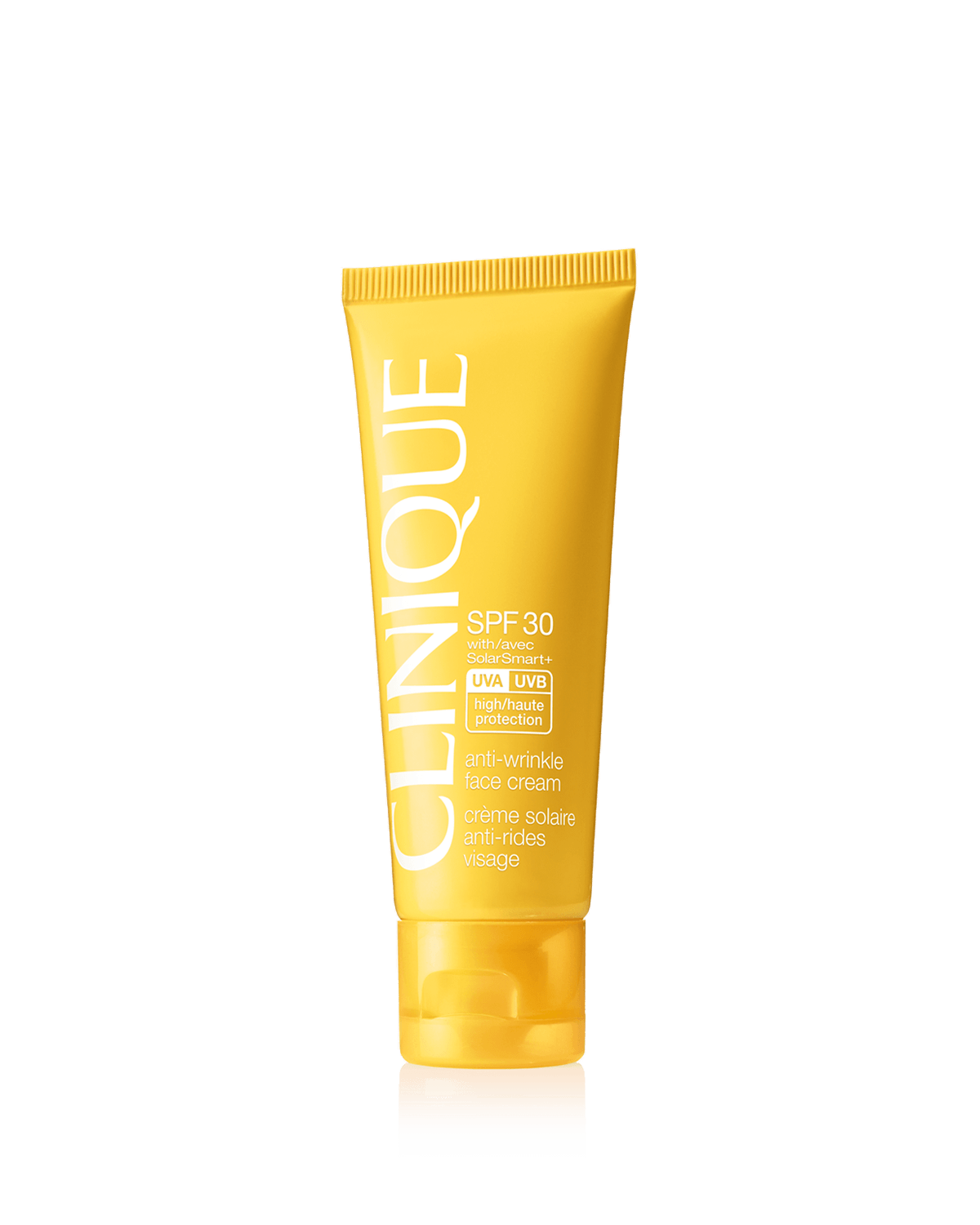

Clinique
Broad Spectrum SPF 30 Sunscreen Oil-Free Face Cream

Broad Spectrum SPF 30 Sunscreen Oil-Free Face Cream
Clinique
broad-spectrum-spf-30-sunscreen-oil-free-face-cream
Suncare
9784807194917
Morning or Evening?
How often will you use this product?
Notes


Highlights
WHAT IS IT?
Sunscreen face cream
FEATURES
Velvety formula with SolarSmart technology, oil-free, layers easily
BEST FOR
combination
CHECKS
Oil-free
Who Is It For?
All Ages All GendersWhat Does It Help With?
Sun Protection And RepairBudget
Mid-range ($30-$75)How To Use
Which routine should it be used in?
Instructions:
Key Information


What Clinique Says
Product Description:
Velvety formula with SolarSmart technology delivers oil-free sun protection and repair. Layers easily.
About the Brand:
Ingredients Overview
Ingredients List
Water\Aqua\Eau, Ethylhexyl Methoxycinnamate, C12-15 Alkyl Benzoate, Zinc Oxide (Nano), Titanium Dioxide, Ethylhexyl Salicylate, Caprylyl Methicone, Neopentyl Glycol Diheptanoate, Sucrose, Polyglyceryl-10 Pentastearate, Pentylene Glycol, Ethylhexyl Methoxycrylene, Dimethicone, Behenyl Alcohol, Peg-100 Stearate, Hydrogenated Lecithin, Butylene Glycol, Dipentaerythrityl Tri-Polyhydroxystearate, Cucumis Sativus (Cucumber) Fruit Extract, Hordeum Vulgare (Barley) Extract\Extrait D'Orge, Sigesbeckia Orientalis (St. Paul'S Wort) Extract, Glycerin, Caffeine, Sodium Rna, Sodium Hyaluronate, Propylene Glycol Dicaprate, Isohexadecane, Helianthus Annuus (Sunflower) Seedcake, Pvp/Hexadecene Copolymer, Isostearic Acid, Sodium Stearoyl Lactylate, Polyhydroxystearic Acid, Tocopheryl Acetate, Silica, Acrylamide/Sodium Acryloyldimethyltaurate Copolymer, Xanthan Gum, Polysorbate 80, Dimethicone Silylate, Polyethylene, Trisodium Edta, Bht, Phenoxyethanol
Key Ingredients
Octinoxate 7.5%, Octisalate 4.5%, Titanium Dioxide 4.6%, Zinc Oxide 5.0%
Ingredients Details
C12-15 Alkyl Benzoate
Common Name(s): C12-15 alkyl benzoate,cosmetic active,functional ingredient
CAS Number: N/a
DESCRIPTION
What It Does: Delivers characteristic cosmetic function at recommended use concentration.
Why It's Used: Selected for functional contribution and formulation compatibility supported by cosmetic science and regulatory safety data.
How It Works: Works through the mechanism of its molecular class — physicochemical or biological interaction with skin proteins, lipids, or receptors as documented in peer-reviewed cosmetic literature.
Typically Found In: Skin care formulations
TECHNICAL DETAILS
Primary Category: Active ingredient – cosmetic active
Secondary Functions: Skin conditioning
Application Areas:

Facial Skincare

Body Care
Hair Care
Beard Care
Color Cosmetics (Makeup)
Dietary/Oral Supplements
Typical Concentration Range: 0.1%–10%
SOURCING & ETHICS
Vegan Status: Conditional - supplier confirmation required
Halal Status: Unverified - supplier confirmation required
Source Notes: Commercially produced for cosmetic use. verify vegan/halal status with supplier. [audit 2026-07-29 rev2: the record's own source_notes does not assert a non-animal origin, or instructs the reader to verify with the supplier; "yes" asserts knowledge the record does not hold. determination requires shariah-panel sign-off.]
SKIN COMPATIBILITY
Irritancy Rating: 1/5 – very low
Comedogenicity Rating: 0/5 – non-comedogenic
Sensitivity Concerns: Well-tolerated by most skin types.
Safe for Sensitive Skin: Yes
SAFETY & COMPATIBILITY
Safety Profile: Good safety profile at recommended concentrations. ewg score: 1–2.
Works Well With: Standard skincare actives
Avoid Combining With: No known significant incompatibilities
SCIENTIFIC NOTE
C12-15 alkyl benzoate has an established safety and efficacy profile within the cosmetic regulatory framework at standard use concentrations.
Last Verified:
Caprylyl Methicone
Common Name(s): Caprylyl methicone,specialty silicone polymer,conditioning performance silicone
CAS Number: N/a
DESCRIPTION
What It Does: Provides specialty silicone performance — elastomeric skin feel, water-soluble silicone activity, or enhanced hair cuticle conditioning — depending on the specific functional modification.
Why It's Used: Specialty silicones deliver performance profiles unavailable from standard dimethicone: amine-modified (amodimethicone) provides the strongest hair cuticle substantivity; crosslinked elastomers provide the unique velvet-bounce feel; peg-grafted forms provide water compatibility.
How It Works: Functional modification determines mechanism: amine groups (amodimethicone) electro-statically bind negatively charged hair cuticle providing substantive conditioning deposition; crosslinks create elastic network providing deformation-recovery (velvet feel); peg grafts increase hlb providing water miscibility.
Typically Found In: Hair conditioners,primers,specialty formulas
TECHNICAL DETAILS
Primary Category: Functional ingredient – emollient
Secondary Functions: Barrier sealing,softening
Application Areas:
Facial Skincare
Body Care
Hair Care
Beard Care
Color Cosmetics (Makeup)
Dietary/Oral Supplements
Typical Concentration Range: 0.5%–20%
SOURCING & ETHICS
Vegan Status: Conditional - supplier confirmation required
Halal Status: Unverified - supplier confirmation required
Source Notes: Plant-derived, synthetic or animal-derived. verify source. [audit 2026-07-29 rev2: the record's own source_notes does not assert a non-animal origin, or instructs the reader to verify with the supplier; "yes" asserts knowledge the record does not hold. determination requires shariah-panel sign-off.]
SKIN COMPATIBILITY
Irritancy Rating: 1/5 – very low
Comedogenicity Rating: 1/5 – low; formulation-dependent
Sensitivity Concerns: Non-irritating.
Safe for Sensitive Skin: Yes
SAFETY & COMPATIBILITY
Safety Profile: Excellent safety profile. ewg score: 1.
Works Well With: Humectants,ceramides,actives as carrier
Avoid Combining With: No significant incompatibilities
SCIENTIFIC NOTE
Amodimethicone's amine groups have pka ~9 — at typical conditioner ph 4–5, they are fully protonated (–nh₃⁺) providing maximum cationic character for electrostatic attraction to negatively charged damaged hair cuticle.
Last Verified: 2026-03-12
Primary Sources: Cosing database,specialty silicone performance review
Ethylhexyl Methoxycinnamate
Common Name(s): Ethylhexyl methoxycinnamate,organic uv filter,photostabilising sunscreen active
CAS Number: N/a
DESCRIPTION
What It Does: Absorbs uv radiation at specific wavelengths (uva 320–400 nm, uvb 290–320 nm) and dissipates photon energy as heat rather than skin-damaging photochemical reactions.
Why It's Used: Organic uv filters are chosen for their high molar extinction coefficient, specific spectral coverage, and formulation compatibility — individual filters are combined to provide broad-spectrum coverage across uva+uvb.
How It Works: Uv photon absorption by the aromatic chromophore π-system excites the molecule from s₀ ground state to s₁ excited state. rapid internal conversion or photoisomerisation dissipates energy as vibrational heat before it can initiate skin photodamage.
Typically Found In: Sunscreens,photoprotective products
TECHNICAL DETAILS
Primary Category: Active ingredient – cosmetic active
Secondary Functions: Skin conditioning
Application Areas:
Facial Skincare
Body Care
Hair Care
Beard Care
Color Cosmetics (Makeup)
Dietary/Oral Supplements
Typical Concentration Range: Check local sunscreen regulations
SOURCING & ETHICS
Vegan Status: Conditional - supplier confirmation required
Halal Status: Unverified - supplier confirmation required
Source Notes: Commercially produced for cosmetic use. verify vegan/halal status with supplier. [audit 2026-07-29 rev2: the record's own source_notes does not assert a non-animal origin, or instructs the reader to verify with the supplier; "yes" asserts knowledge the record does not hold. determination requires shariah-panel sign-off.]
SKIN COMPATIBILITY
Irritancy Rating: 1/5 – very low
Comedogenicity Rating: 0/5 – non-comedogenic
Sensitivity Concerns: Well-tolerated by most skin types.
Safe for Sensitive Skin: Yes
SAFETY & COMPATIBILITY
Safety Profile: Good safety profile at recommended concentrations. ewg score: 1–2.
Works Well With: Standard skincare actives
Avoid Combining With: No known significant incompatibilities
SCIENTIFIC NOTE
Organic uv filters require photostabilisation (by avobenzone-octocrylene pairing, or triazine stabilisers) as some absorbers degrade on uv exposure — formulator must verify photostability of the chosen filter combination.
Last Verified: 2026-03-12
Primary Sources: Cosing database,ethylhexyl methoxycinnamate organic uv filter review
Ethylhexyl Methoxycrylene
Common Name(s): Ethylhexyl methoxycrylene,cosmetic active,functional ingredient
CAS Number: N/a
DESCRIPTION
What It Does: Delivers characteristic cosmetic function at recommended use concentration.
Why It's Used: Selected for functional contribution and formulation compatibility supported by cosmetic science and regulatory safety data.
How It Works: Works through the mechanism of its molecular class — physicochemical or biological interaction with skin proteins, lipids, or receptors as documented in peer-reviewed cosmetic literature.
Typically Found In: Skin care formulations
TECHNICAL DETAILS
Primary Category: Active ingredient – cosmetic active
Secondary Functions: Skin conditioning
Application Areas:
Facial Skincare
Body Care
Hair Care
Beard Care
Color Cosmetics (Makeup)
Dietary/Oral Supplements
Typical Concentration Range: 0.1%–10%
SOURCING & ETHICS
Vegan Status: Conditional - supplier confirmation required
Halal Status: Unverified - supplier confirmation required
Source Notes: Commercially produced for cosmetic use. verify vegan/halal status with supplier. [audit 2026-07-29 rev2: the record's own source_notes does not assert a non-animal origin, or instructs the reader to verify with the supplier; "yes" asserts knowledge the record does not hold. determination requires shariah-panel sign-off.]
SKIN COMPATIBILITY
Irritancy Rating: 1/5 – very low
Comedogenicity Rating: 0/5 – non-comedogenic
Sensitivity Concerns: Well-tolerated by most skin types.
Safe for Sensitive Skin: Yes
SAFETY & COMPATIBILITY
Safety Profile: Good safety profile at recommended concentrations. ewg score: 1–2.
Works Well With: Standard skincare actives
Avoid Combining With: No known significant incompatibilities
SCIENTIFIC NOTE
Ethylhexyl methoxycrylene has an established safety and efficacy profile within the cosmetic regulatory framework at standard use concentrations.
Last Verified: 2026-03-12
Primary Sources: Cosing database,ethylhexyl methoxycrylene technical literature