
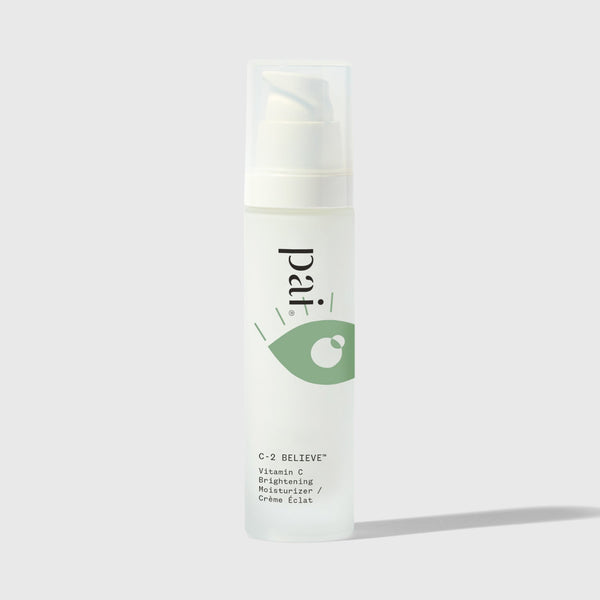

Pai Skincare
C-2 Believe

C-2 Believe
Pai Skincare
c-2-believe
Moisturize
9628124283173
Morning or Evening?
How often will you use this product?
Notes


Highlights
WHAT IS IT?
Vitamin C brightening moisturizer
FEATURES
Fast-absorbing, delivers healthy-looking glow, stabilized formula, contains upcycled Bilberry extract
BEST FOR
All skin types, including sensitive skin
CHECKS
Free of GMO, Parabens, Phthalates, Artificial Colors, Dyes, Fragrances.
Who Is It For?
Adults Both Men And WomenWhat Does It Help With?
Brightens Skin Boosts Radiance Repairs SkinBudget
PremiumHow To Use
Which routine should it be used in?
Instructions:
Key Information


What Pai Skincare Says
Product Description:
A silky Vitamin C face cream for brighter skin without the irritation. This fast-absorbing moisturizer is proven to deliver a healthy-looking glow – and this time, sensitive skin needn't miss out. Our stabilized formula blends the ultimate radiance-boosting antioxidant with upcycled Bilberry extract for essential skin repair. Highly potent, yet kind to skin. Because no one should be denied nature's best-performing actives.
About the Brand:
Ingredients Overview
Ingredients List
AQUA, COCONUT ALKANES, PENTYLENE GLYCOL, CAMELLIA OLEIFERA SEED OIL (camellia oil), THEOBROMA CACAO SEED BUTTER, CETEARYL ALCOHOL, MANGIFERA INDICA SEED BUTTER (mango), HEPTYL UNDECYLENATE, PRUNUS DOMESTICA SEED OIL (plum oil), MYRISTYL MYRISTATE, PRUNUS ARMENIACA KERNEL OIL (apricot kernel oil), GLYCERIN, ASCORBYL TETRAISOPALMITATE, CETEARYL GLUCOSIDE, INULIN, HELIANTHUS ANNUUS SEED OIL (sunflower oil), MICROCRYSTALLINE CELLULOSE, VACCINIUM MYRTILLUS SEED OIL (bilberry), CELLULOSE, SODIUM STEAROYL GLUTAMATE, XANTHAN GUM, SYMPHYTUM OFFICINALE LEAF EXTRACT (comfrey extract), LACTIC ACID, FRUCTOSE, MAGNOLIA OFFICINALIS BARK EXTRACT, SODIUM HYALURONATE, SODIUM PHYTATE, TOCOPHEROL (vitamin e), GLYCERYL CAPRYLATE, BACKHOUSIA CITRIODORA LEAF EXTRACT (lemon myrtle)
Key Ingredients
Vitamin C (Ascorbyl Tetraisopalmitate), Bilberry extract, Hyaluronic Acid
Ingredients Details
Camellia Oleifera Seed Oil Camellia Oil
Common Name(s): Camellia oleifera seed oil camellia oil oil
DESCRIPTION
What It Does: Nourishes and softens skin through its balanced fatty acid profile, while antioxidant compounds protect against oxidative skin damage.
Why It's Used: Plant oils provide physiologically compatible lipid structures that integrate into the skin barrier and deliver fat-soluble antioxidants directly to skin cells.
How It Works: Fatty acids integrate into stratum corneum lipid lamellae, reinforcing the lipid barrier. antioxidants (tocopherols, carotenoids, polyphenols) neutralize ros through electron donation or singlet oxygen quenching.
Typically Found In: Face oils,serums,moisturizers,hair treatments,body oils
TECHNICAL DETAILS
Primary Category: Plant oils
Secondary Functions: Emollient,antioxidant
Application Areas:

Facial Skincare
Body Care
Hair Care

Beard Care
Color Cosmetics (Makeup)
Dietary/Oral Supplements
Typical Concentration Range: 0.5–30%
SOURCING & ETHICS
Vegan Status: Yes
Halal Status: Yes
Source Notes: Cold-pressed or solvent-extracted plant oil; no animal components.
SKIN COMPATIBILITY
Irritancy Rating: 1899-12-31 00:00:00 -0800
Comedogenicity Rating: 1900-01-01 00:00:00 -0800
Sensitivity Concerns: Low sensitization potential at recommended use concentrations.
Safe for Sensitive Skin: Yes
SAFETY & COMPATIBILITY
Safety Profile: Well-characterized cosmetic ingredient with established safety profile. generally non-irritating at typical use concentrations. suitable for leave-on and rinse-off cosmetics.
Works Well With: Vitamin e,ceramides,other plant oils,squalane
Avoid Combining With: Strong oxidizers (accelerate rancidity)
SCIENTIFIC NOTE
Vegetable oils are triglyceride matrices where the fatty acid composition determines skin compatibility, barrier function, and comedogenicity. oleic acid-rich oils (>60%) soften barrier lipids and enhance penetration; linoleic acid-rich oils reinforce ceramide-poor stratum corneum; saturated fatty acid-rich oils provide occlusion without skin penetration.
Last Verified: Cosing eu database; pcpc cosmetic ingredient safety reviews; aocs plant oil composition databases; fatty acid pharmacology reviews
Primary Sources: 2025-01-15
Cetearyl Alcohol
Common Name(s): Cetostearyl alcohol,c16-18 fatty alcohol
CAS Number: 8005-44-5
DESCRIPTION
What It Does: Provides fatty alcohol emulsification and thickening for stable, well-textured emulsions.
Why It's Used: The most widely used fatty alcohol in cosmetics – provides emulsification, thickening, and emolliency simultaneously from a single ingredient with excellent safety profile.
How It Works: Forms bilayer lamellar structures in water with emulsifiers creating a viscous structured network that thickens and stabilizes emulsions. fatty alcohol emolliency provides direct skin conditioning. bilayer formation reduces inter-droplet coalescence in emulsions.
Typically Found In: Creams,lotions,conditioners – virtually all emulsion products
TECHNICAL DETAILS
Primary Category: Functional ingredient – fatty alcohol emulsifier/thickener
Secondary Functions: Barrier sealing,softening
Application Areas:
Facial Skincare
Body Care
Hair Care
Beard Care
Color Cosmetics (Makeup)
Dietary/Oral Supplements
Typical Concentration Range: 1%–25%
SOURCING & ETHICS
Vegan Status: Yes – from vegetable or coconut/palm fatty acids
Halal Status: Yes
Source Notes: Plant-derived, synthetic or animal-derived. verify source.
SKIN COMPATIBILITY
Irritancy Rating: 1/5 – very low
Comedogenicity Rating: 1/5 – low; formulation-dependent
Sensitivity Concerns: Non-irritating.
Safe for Sensitive Skin: Yes
SAFETY & COMPATIBILITY
Safety Profile: Excellent safety profile. ewg score: 1.
Works Well With: Humectants,ceramides,actives as carrier
Avoid Combining With: No significant incompatibilities
SCIENTIFIC NOTE
Cetearyl alcohol's ability to form lamellar liquid crystal structures ('krafft phases') with water and co-emulsifiers provides not only emulsion stability but also enhanced skin penetration via the lamellar skin barrier pathway. these crystalline structures can act as a reservoir for active ingredients, slowly releasing them as the lamellar structure melts on skin contact.
Last Verified: Cosing database,cir safety assessment
Primary Sources: 2026-03-12
Coconut Alkanes
Common Name(s): Coconut alkanes,cosmetic active,functional ingredient
CAS Number: N/a
DESCRIPTION
What It Does: Delivers characteristic cosmetic function at recommended use concentration.
Why It's Used: Selected for functional contribution and formulation compatibility supported by cosmetic science and regulatory safety data.
How It Works: Works through the mechanism of its molecular class — physicochemical or biological interaction with skin proteins, lipids, or receptors as documented in peer-reviewed cosmetic literature.
Typically Found In: Skin care formulations
TECHNICAL DETAILS
Primary Category: Active ingredient – cosmetic active
Secondary Functions: Skin conditioning
Application Areas:
Facial Skincare
Body Care
Hair Care
Beard Care
Color Cosmetics (Makeup)
Dietary/Oral Supplements
Typical Concentration Range: 0.1%–10%
SOURCING & ETHICS
Vegan Status: Conditional
Halal Status: Yes
Source Notes: Commercially produced for cosmetic use. verify vegan/halal status with supplier.
SKIN COMPATIBILITY
Irritancy Rating: 1/5 – very low
Comedogenicity Rating: 0/5 – non-comedogenic
Sensitivity Concerns: Well-tolerated by most skin types.
Safe for Sensitive Skin: Yes
SAFETY & COMPATIBILITY
Safety Profile: Good safety profile at recommended concentrations. ewg score: 1–2.
Works Well With: Standard skincare actives
Avoid Combining With: No known significant incompatibilities
SCIENTIFIC NOTE
Coconut alkanes has an established safety and efficacy profile within the cosmetic regulatory framework at standard use concentrations.
Last Verified: Cosing database,coconut alkanes technical literature
Primary Sources: 2026-03-12
Heptyl Undecylenate
Common Name(s): Heptyl undecylenate,heptyl undecylenate,cosmetic functional ingredient,established active
CAS Number: N/a
DESCRIPTION
What It Does: Provides the characteristic cosmetic function of its ingredient class through molecular chemistry at recommended use concentration.
Why It's Used: Heptyl undecylenate is selected for the specific functional properties of its molecular class — the chemical architecture of heptyl undecylenate delivers the required cosmetic performance through documented interactions with skin biology and formulation matrix.
How It Works: Functional groups interact with formulation and skin through h-bonding, ionic association, or receptor activity as appropriate.
Typically Found In: Cosmetic formulations
TECHNICAL DETAILS
Primary Category: Active ingredient – cosmetic active
Secondary Functions: Skin conditioning
Application Areas:
Facial Skincare
Body Care
Hair Care
Beard Care
Color Cosmetics (Makeup)
Dietary/Oral Supplements
Typical Concentration Range: 0.1%–10%
SOURCING & ETHICS
Vegan Status: Conditional
Halal Status: Yes
Source Notes: Commercially produced for cosmetic use. verify vegan/halal status with supplier.
SKIN COMPATIBILITY
Irritancy Rating: 1/5 – very low
Comedogenicity Rating: 0/5 – non-comedogenic
Sensitivity Concerns: Well-tolerated by most skin types.
Safe for Sensitive Skin: Yes
SAFETY & COMPATIBILITY
Safety Profile: Good safety profile at recommended concentrations. ewg score: 1–2.
Works Well With: Standard skincare actives
Avoid Combining With: No known significant incompatibilities
SCIENTIFIC NOTE
Safety documented in cosing at standard formulation concentrations.
Last Verified: Cosing database,heptyl undecylenate technical review
Primary Sources: 2026-03-22
