
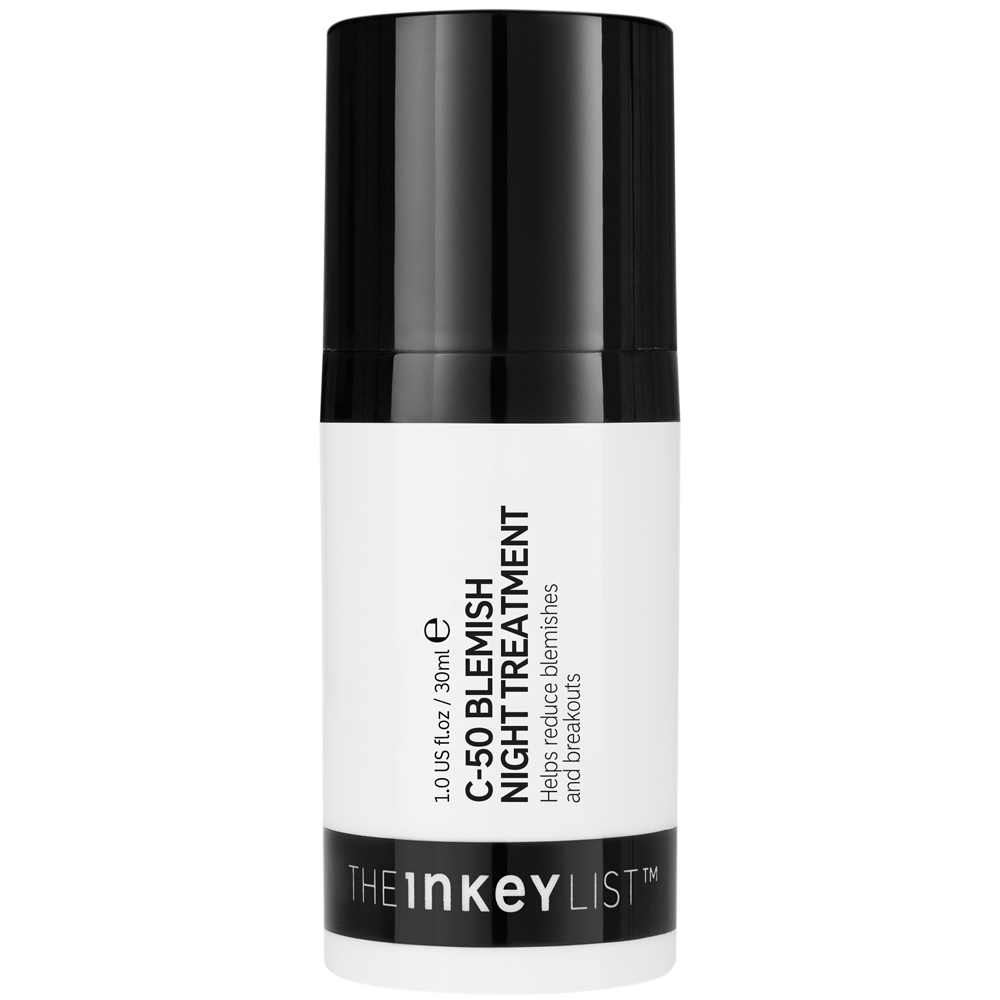

Inkey List
C-50 Blemish Night Treatment

C-50 Blemish Night Treatment
Inkey List
c-50-blemish-night-treatment
Serum
9784794251557
Morning or Evening?
How often will you use this product?
Notes


Highlights
WHAT IS IT?
Overnight gel treatment with Vitamin C and Vitamin E
FEATURES
Targets breakouts, unclogs pores, reduces redness, reduces bacteria count
BEST FOR
oily
CHECKS
Free of parabens, phthalates, sulfates, synthetic fragrances, gluten
Who Is It For?
All Ages With Acne-prone SkinWhat Does It Help With?
Breakouts Pore Congestion Redness BlemishesBudget
Affordable (under $30)How To Use
Which routine should it be used in?
Instructions:
Key Information


What Inkey List Says
Product Description:
This overnight gel treatment targets breakouts, unclogs pores and reduces the appearance of redness by morning. Its powerful combination of Vitamin C and Vitamin E helps reduce the bacteria count on your skin, helping prevent and reduce blemishes. 2% Salicylic Acid also helps to exfoliate and unclog pores, while Lotus Extract helps to balance oil.
About the Brand:
Ingredients Overview
Ingredients List
Aqua (water), Propanediol, Sodium ascorbyl phosphate, Salicylic acid, Ammonium acryloyldimethyltaurate/vp copolymer, Phenoxyethanol, Caprylyl/capryl glucoside, Xanthan gum, Glycerin, Sodium hydroxide, Madecassoside, Ethylhexylglycerin, Hydroxyacetophenone, Sodium gluconate, Sodium metabisulfite, Lecithin, Ascorbyl palmitate, Nelumbo nucifera flower extract, Nymphaea coerulea flower extract, Tocopherol, Helianthus annuus (sunflower) seed oil.
Key Ingredients
Vitamin-C, Vitamin-E, Salicylic-Acid, Lotus-Extract
Ingredients Details
Ammonium Acryloyldimethyltaurate/vp Copolymer
Common Name(s): Ammonium acryloyldimethyltaurate/vp copolymer
DESCRIPTION
What It Does: Delivers targeted skin-conditioning or bioactive benefits through a specific mechanism of action suited to the formulation's intended purpose.
Why It's Used: Specialty actives address specific skin concerns through targeted molecular mechanisms, providing efficacy beyond what base formulation ingredients alone can achieve.
How It Works: The bioactive compound interacts with specific molecular targets in skin cells or the extracellular matrix — enzymes, receptors, structural proteins, or signaling molecules — triggering beneficial biological responses.
Typically Found In: Serums,treatments,moisturizers,specialty products
TECHNICAL DETAILS
Primary Category: Specialty actives
Secondary Functions: Skin-conditioning,anti-aging
Application Areas:

Facial Skincare

Body Care
Hair Care
Beard Care
Color Cosmetics (Makeup)
Dietary/Oral Supplements
Typical Concentration Range: 0.01–5%
SOURCING & ETHICS
Vegan Status: Conditional - supplier confirmation required
Halal Status: Unverified - supplier confirmation required
Source Notes: Specialty active ingredient; check individual sourcing for vegan status. [audit 2026-07-29 rev2: the record's own source_notes does not assert a non-animal origin, or instructs the reader to verify with the supplier; "yes" asserts knowledge the record does not hold. determination requires shariah-panel sign-off.]
SKIN COMPATIBILITY
Irritancy Rating: 1
Comedogenicity Rating: 0
Sensitivity Concerns: Low sensitization potential at recommended use concentrations.
Safe for Sensitive Skin: Yes
SAFETY & COMPATIBILITY
Safety Profile: Well-characterized cosmetic ingredient with established safety profile. generally non-irritating at typical use concentrations. suitable for leave-on and rinse-off cosmetics.
Works Well With: Niacinamide,hyaluronic acid,vitamin c,peptides
Avoid Combining With: Incompatible with oxidizing agents; check ph stability
SCIENTIFIC NOTE
Specialty actives typically work through enzyme inhibition (e.g., tyrosinase inhibition for brightening, mmp inhibition for anti-aging), receptor activation (e.g., retinoid receptors, ppar-γ for barrier genes), or transcription factor modulation (e.g., nrf2 for antioxidant gene upregulation). structure-activity relationships determine potency and selectivity.
Last Verified: 2025-01-15
Primary Sources: Cosing eu database; pcpc cosmetic ingredient safety reviews; ingredient-specific safety and efficacy literature
Caprylyl/capryl Glucoside
Common Name(s): C8-c10 apg,light cleansing glucoside,natural light cleanser
CAS Number: N/a
DESCRIPTION
What It Does: Provides the lightest apg mild cleansing for facial and micellar applications.
Why It's Used: Light facial apg cleanser — c8-c10 short chain apg provides the mildest, lightest-rinse apg cleansing suited for everyday facial washing and micellar water formulation where heavier c12-c16 apgs leave residue.
How It Works: Caprylyl (c8) + capryl (c10) glucose glucoside: short chain apg. very gentle: non-ionic + short chain. very fast rinse: short chain high solubility. micellar: compatible as non-ionic surfactant. cosmos. minimal skin feel.
Typically Found In: Micellar water,gentle facial cleanser,daily cosmos wash
TECHNICAL DETAILS
Primary Category: Active ingredient – cosmetic active
Secondary Functions: Skin conditioning
Application Areas:
Facial Skincare
Body Care
Hair Care
Beard Care
Color Cosmetics (Makeup)
Dietary/Oral Supplements
Typical Concentration Range: 2%–15%
SOURCING & ETHICS
Vegan Status: Conditional - supplier confirmation required
Halal Status: Unverified - supplier confirmation required
Source Notes: Commercially produced for cosmetic use. verify vegan/halal status with supplier. [audit 2026-07-29 rev2: the record's own source_notes does not assert a non-animal origin, or instructs the reader to verify with the supplier; "yes" asserts knowledge the record does not hold. determination requires shariah-panel sign-off.]
SKIN COMPATIBILITY
Irritancy Rating: 1/5 – very low
Comedogenicity Rating: 0/5 – non-comedogenic
Sensitivity Concerns: Well-tolerated by most skin types.
Safe for Sensitive Skin: Yes
SAFETY & COMPATIBILITY
Safety Profile: Good safety profile at recommended concentrations. ewg score: 1–2.
Works Well With: Standard skincare actives
Avoid Combining With: No known significant incompatibilities
SCIENTIFIC NOTE
C8-c10 apg lighter rinse vs c12-c16 from cmc differences: shorter chain apgs have higher cmc (critical micelle concentration) → less tendency to remain on skin post-rinse as micelles vs monomer ratio favours monomer at post-rinse dilution. this higher cmc means c8-c10 apg leaves less surfactant residue on skin post-rinsing vs longer chain apgs, providing the faster 'clean rinse' sensation.
Last Verified: 2026-03-12
Primary Sources: Cosing database,short-chain apg technical literature
Ethylhexylglycerin
Common Name(s): Octylglycerin,2-ethylhexyl glycerol ether,sensiva sc 10
CAS Number: 70445-33-9
DESCRIPTION
What It Does: Provides antimicrobial skin conditioning with deodorant activity and preservation system enhancement.
Why It's Used: Multifunctional clean beauty preservation active — ethylhexylglycerin provides antimicrobial, deodorant, and skin conditioning in a single ingredient accepted in most natural cosmetic certification schemes.
How It Works: Glycerol ether provides antimicrobial via bacterial membrane phospholipid disruption. deodorant activity via reduction of underarm lipase enzyme activity (similar mechanism to triethyl citrate). skin conditioning from glycerol humectant component. synergistic with phenoxyethanol and diols.
Typically Found In: Natural preservation systems,deodorants,skin conditioning products
TECHNICAL DETAILS
Primary Category: Functional ingredient – antimicrobial glycerol ether
Secondary Functions: Skin conditioning
Application Areas:
Facial Skincare
Body Care
Hair Care
Beard Care
Color Cosmetics (Makeup)
Dietary/Oral Supplements
Typical Concentration Range: 0.1%–0.5%
SOURCING & ETHICS
Vegan Status: Conditional - supplier confirmation required
Halal Status: Unverified - supplier confirmation required
Source Notes: Commercially produced for cosmetic use. verify vegan/halal status with supplier. [audit 2026-07-29 rev2: the record's own source_notes does not assert a non-animal origin, or instructs the reader to verify with the supplier; "yes" asserts knowledge the record does not hold. determination requires shariah-panel sign-off.]
SKIN COMPATIBILITY
Irritancy Rating: 1/5 – very low
Comedogenicity Rating: 0/5 – non-comedogenic
Sensitivity Concerns: Well-tolerated by most skin types.
Safe for Sensitive Skin: Yes
SAFETY & COMPATIBILITY
Safety Profile: Good safety profile at recommended concentrations. ewg score: 1–2.
Works Well With: Standard skincare actives
Avoid Combining With: No known significant incompatibilities
SCIENTIFIC NOTE
Ethylhexylglycerin's deodorant mechanism is pharmacologically identical to triethyl citrate: both inhibit skin surface microbial lipase enzymes that convert odourless triglycerides to odorous free fatty acids. the glycerol ether structure of ethylhexylglycerin, combined with the 2-ethylhexyl chain, provides lipase inhibition similar to ester-based lipase inhibitors from a different chemical class.
Last Verified: 2026-03-12
Primary Sources: Cosing database,schülke sensiva sc 10 technical data,cir safety assessment
Glycerin
Common Name(s): Glycerol,glycerine,1,2,3-propanetriol
CAS Number: 56-81-5
DESCRIPTION
What It Does: Glycerin pulls water from the environment and deeper skin layers into the outer skin layer (epidermis), boosting moisture levels and keeping skin soft, smooth, and plump.
Why It's Used: It is used in virtually every moisturizer, serum, and cleanser because it is highly effective at hydrating skin, is well-tolerated by all skin types, and enhances the texture and spreadability of formulations.
How It Works: As a humectant, glycerin forms hydrogen bonds with water molecules, trapping them in the skin. it also reinforces the skin barrier by integrating into lipid structures between skin cells.
Typically Found In: Moisturizers,serums,cleansers,toners,sheet masks,sunscreens,body lotions,shampoos,conditioners
TECHNICAL DETAILS
Primary Category: Humectant
Secondary Functions: Skin barrier support,emollient,solvent
Application Areas:
Facial Skincare
Body Care
Hair Care
Beard Care
Color Cosmetics (Makeup)
Dietary/Oral Supplements
Typical Concentration Range: 1%–30% (typical: 3–10%)
SOURCING & ETHICS
Vegan Status: Conditional - feedstock declaration required
Halal Status: Unverified - feedstock declaration required (plant, animal and petrochemical routes all exist)
Source Notes: Derived from plant oils via hydrolysis or saponification; synthetic versions also available. palm-derived glycerin carries sustainability concerns. [audit 2026-07-29 rev2: origin-dependent: the same inci exists in plant, animal and petrochemical versions and the name does not discriminate. determination requires shariah-panel sign-off.]
SKIN COMPATIBILITY
Irritancy Rating: 1/5 – very low; non-irritating at all standard concentrations
Comedogenicity Rating: 0/5 – non-comedogenic
Sensitivity Concerns: Extremely rare allergic reactions; generally safe for all skin types including sensitive and baby skin
Safe for Sensitive Skin: Yes
SAFETY & COMPATIBILITY
Safety Profile: Widely recognized as safe. ewg hazard score: 1. no significant concerns for irritation, sensitization, or toxicity at typical concentrations (up to 50%).
Works Well With: Hyaluronic acid,ceramides,niacinamide,panthenol,urea,peptides,retinol,ahas/bhas
Avoid Combining With: No known incompatibilities at standard concentrations
SCIENTIFIC NOTE
Glycerin is an endogenous skin component found naturally in the stratum corneum. aquaporin-3 channels in keratinocytes facilitate glycerin transport, making it integral to natural skin hydration pathways.
Last Verified: 2026-03-12
Primary Sources: Cosing database,cir safety assessment,ewg skin deep,inci decoder