
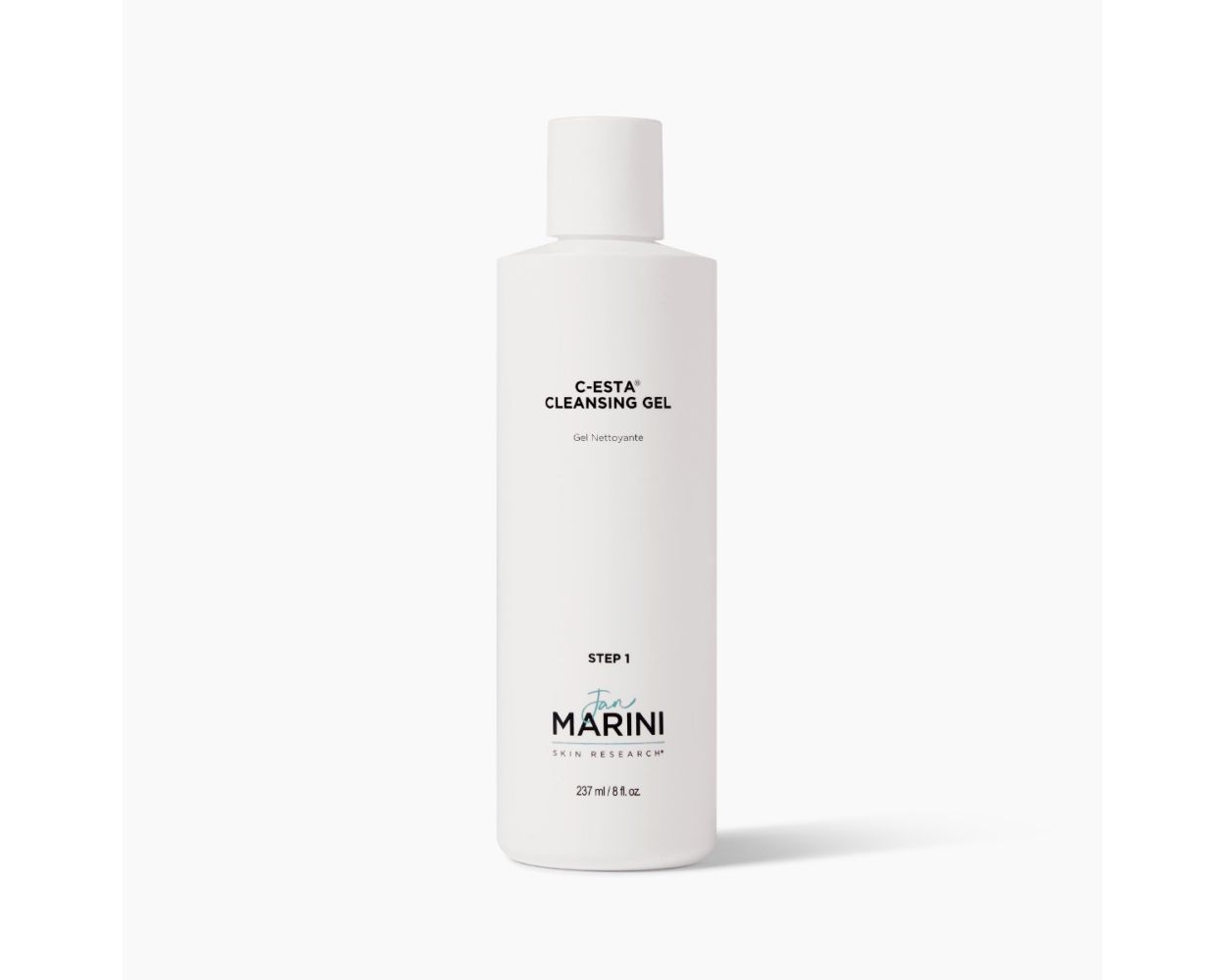

Jan Marini
C-ESTA® Cleansing Gel

C-ESTA® Cleansing Gel
Jan Marini
c-esta-r-cleansing-gel
Cleanse
9706806968613
Morning or Evening?
How often will you use this product?
Notes


Highlights
WHAT IS IT?
Vitamin C face cleanser
FEATURES
Contains Vitamin C and DMAE, potent skin conditioning cleanser, luxurious lather
BEST FOR
All skin types (Dry, Normal/Combo, Oily)
CHECKS
Paraben-free
Who Is It For?
Adults (no Specific Age Range Given) Suitable For Both Women And MenWhat Does It Help With?
Skin ConditioningBudget
Mid-rangeHow To Use
Which routine should it be used in?
Instructions:
Key Information


What Jan Marini Says
Product Description:
A potent Vitamin C face cleanser suitable for any skin type with a luxurious lather.
About the Brand:
Ingredients Overview
Ingredients List
Water /Aqua/Eau, Ammonium Lauryl Sulfate, Ammonium Laureth Sulfate, PEG-120 Methyl Glucose Dioleate, Ammonium Xylenesulfonate, Glycerin, Butylene Glycol, Hydrolyzed Wheat Protein, Quillaja Saponaria Bark Extract, Saponaria Officinalis (Soapwort) Root Extract, Yucca Schidigera Root Extract, Cocamidopropyl Betaine, Ascorbyl Palmitate, Polysorbate 20, Dimethyl Lauramine Oleate, Polyquaternium-10, Dimethyl MEA, Citric Acid, Fragrance (Parfum), Benzyl Benzoate, Limonene, Lauryl Alcohol, Ammonium Sulfate, Caprylyl Glycol, Ethylhexylglycerin, Hexylene Glycol, Oleic Acid, Sodium Acetate, Sodium Chloride, Sodium Glycolate, 3-Dimethylaminopropylamine, Isopropyl Alcohol, Sodium Metabisulfite, Sodium Sulfite, Disodium EDTA, Tetrasodium EDTA, Potassium Sorbate, Sodium Benzoate, Phenoxyethanol, Benzyl Alcohol
Key Ingredients
Ascorbyl Palmitate (Vitamin C), DMAE
Ingredients Details
Ammonium Laureth Sulfate
Common Name(s): Ammonium laureth sulfate,cosmetic active,functional ingredient
CAS Number: N/a
DESCRIPTION
What It Does: Delivers characteristic cosmetic function at recommended use concentration.
Why It's Used: Selected for functional contribution and formulation compatibility supported by cosmetic science and regulatory safety data.
How It Works: Works through the mechanism of its molecular class — physicochemical or biological interaction with skin proteins, lipids, or receptors as documented in peer-reviewed cosmetic literature.
Typically Found In: Skin care formulations
TECHNICAL DETAILS
Primary Category: Active ingredient – cosmetic active
Secondary Functions: Skin conditioning
Application Areas:

Facial Skincare

Body Care
Hair Care
Beard Care
Color Cosmetics (Makeup)
Dietary/Oral Supplements
Typical Concentration Range: 0.1%–10%
SOURCING & ETHICS
Vegan Status: Conditional - feedstock declaration required
Halal Status: Unverified - feedstock declaration required (plant, animal and petrochemical routes all exist)
Source Notes: Commercially produced for cosmetic use. verify vegan/halal status with supplier. [audit 2026-07-29 rev2: origin-dependent: the same inci exists in plant, animal and petrochemical versions and the name does not discriminate. determination requires shariah-panel sign-off.]
SKIN COMPATIBILITY
Irritancy Rating: 1/5 – very low
Comedogenicity Rating: 0/5 – non-comedogenic
Sensitivity Concerns: Well-tolerated by most skin types.
Safe for Sensitive Skin: Yes
SAFETY & COMPATIBILITY
Safety Profile: Good safety profile at recommended concentrations. ewg score: 1–2.
Works Well With: Standard skincare actives
Avoid Combining With: No known significant incompatibilities
SCIENTIFIC NOTE
Ammonium laureth sulfate has an established safety and efficacy profile within the cosmetic regulatory framework at standard use concentrations.
Last Verified: 2026-03-12
Primary Sources: Cosing database,ammonium laureth sulfate technical literature
Ammonium Lauryl Sulfate
Common Name(s): Ammonium lauryl sulfate,cosmetic active,functional ingredient
CAS Number: N/a
DESCRIPTION
What It Does: Delivers characteristic cosmetic function at recommended use concentration.
Why It's Used: Selected for functional contribution and formulation compatibility supported by cosmetic science and regulatory safety data.
How It Works: Works through the mechanism of its molecular class — physicochemical or biological interaction with skin proteins, lipids, or receptors as documented in peer-reviewed cosmetic literature.
Typically Found In: Skin care formulations
TECHNICAL DETAILS
Primary Category: Active ingredient – cosmetic active
Secondary Functions: Skin conditioning
Application Areas:
Facial Skincare
Body Care
Hair Care
Beard Care
Color Cosmetics (Makeup)
Dietary/Oral Supplements
Typical Concentration Range: 0.1%–10%
SOURCING & ETHICS
Vegan Status: Conditional - supplier confirmation required
Halal Status: Unverified - supplier confirmation required
Source Notes: Commercially produced for cosmetic use. verify vegan/halal status with supplier. [audit 2026-07-29 rev2: the record's own source_notes does not assert a non-animal origin, or instructs the reader to verify with the supplier; "yes" asserts knowledge the record does not hold. determination requires shariah-panel sign-off.]
SKIN COMPATIBILITY
Irritancy Rating: 1/5 – very low
Comedogenicity Rating: 0/5 – non-comedogenic
Sensitivity Concerns: Well-tolerated by most skin types.
Safe for Sensitive Skin: Yes
SAFETY & COMPATIBILITY
Safety Profile: Good safety profile at recommended concentrations. ewg score: 1–2.
Works Well With: Standard skincare actives
Avoid Combining With: No known significant incompatibilities
SCIENTIFIC NOTE
Ammonium lauryl sulfate has an established safety and efficacy profile within the cosmetic regulatory framework at standard use concentrations.
Last Verified: 2026-03-12
Primary Sources: Cosing database,ammonium lauryl sulfate technical literature
Ammonium Xylenesulfonate
Common Name(s): Ammonium xylenesulfonate,ammonium dimethylbenzenesulfonic acid (xylenesulfonate) ammonium salt salt,axs ammonium hydrotrope
CAS Number: 1322-21-0
DESCRIPTION
What It Does: Keeps surfactant-based formulas clear and easy to pour by helping ingredients mix properly.
Why It's Used: Used as a hydrotrope to improve cloud point and reduce viscosity in liquid surfactant systems.
How It Works: Aromatic sulfonate disrupts micellar packing of other surfactants, elevating cloud point and improving clarity.
Typically Found In: Shampoos,liquid cleansers,body washes,surfactant concentrates
TECHNICAL DETAILS
Primary Category: Functional ingredient – surfactant
Secondary Functions: Hydrotrope,viscosity controlling
Application Areas:
Facial Skincare
Body Care
Hair Care
Beard Care
Color Cosmetics (Makeup)
Dietary/Oral Supplements
Typical Concentration Range: 0.5%–5%
SOURCING & ETHICS
Vegan Status: Yes
Halal Status: Yes
Source Notes: Synthetic; petrochemical aromatic sulfonation followed by salt formation.
SKIN COMPATIBILITY
Irritancy Rating: 1/5 – very low
Comedogenicity Rating: 0/5 – non-comedogenic
Sensitivity Concerns: Non-irritating at typical use concentrations.
Safe for Sensitive Skin: Yes
SAFETY & COMPATIBILITY
Safety Profile: Good safety profile. ewg score: 1–2.
Works Well With: Anionic surfactants,amphoteric surfactants,nonionic surfactants
Avoid Combining With: No significant incompatibilities
SCIENTIFIC NOTE
Ammonium xylenesulfonate (axs, cas ~1322-21-0) is the ammonium form of the xylenesulfonate hydrotrope; similar efficacy to naxs/kxs; ammonium form preferred in some shampoo systems for scent and compatibility reasons.
Last Verified: 2026-03-27
Primary Sources: Cosing database,inci dictionary
Butylene Glycol
Common Name(s): 1,3-butanediol,bg,1,3-butylene glycol
CAS Number: 107-88-0
DESCRIPTION
What It Does: Provides humectant hydration and active ingredient solubilization with excellent skin feel.
Why It's Used: Preferred glycol humectant in premium and k-beauty formulations for superior skin feel vs propylene glycol with equivalent functionality.
How It Works: Two hydroxyl groups at 1,3-positions provide water binding and solvent activity. better tolerated than propylene glycol with minimal sensitization risk. 4-carbon backbone provides slightly greater hydrophobic character enabling dissolution of less polar actives vs pg.
Typically Found In: Toners,essences,serums,k-beauty formulas
TECHNICAL DETAILS
Primary Category: Functional ingredient – glycol humectant
Secondary Functions: Tewl reduction,skin plumping
Application Areas:
Facial Skincare
Body Care
Hair Care
Beard Care
Color Cosmetics (Makeup)
Dietary/Oral Supplements
Typical Concentration Range: 1%–10%
SOURCING & ETHICS
Vegan Status: Yes – synthetic
Halal Status: Yes
Source Notes: Synthetic or naturally derived. excellent aqueous solubility.
SKIN COMPATIBILITY
Irritancy Rating: 1/5 – very low
Comedogenicity Rating: 0/5 – non-comedogenic
Sensitivity Concerns: Non-irritating; suitable for all skin types.
Safe for Sensitive Skin: Yes
SAFETY & COMPATIBILITY
Safety Profile: Excellent safety profile. ewg score: 1.
Works Well With: Ceramides,emollients,occlusives,glycerin,hyaluronic acid
Avoid Combining With: No significant incompatibilities
SCIENTIFIC NOTE
K-beauty's preference for butylene glycol over propylene glycol is driven by two factors: bg's superior skin feel (less tacky than pg's higher viscosity) and its lower sensitization potential (1,3-bg has better spatial distribution of hydroxyl groups that reduces protein interaction vs pg's 1,2-position oh groups).
Last Verified: 2026-03-12
Primary Sources: Cosing database,cir safety assessment