
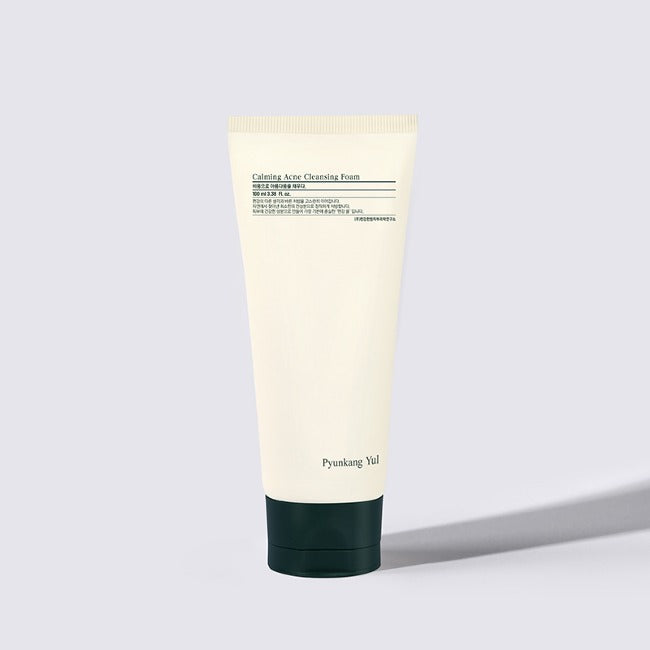

Pyunkang Yul
Calming Acne Cleansing Foam 100ml

Calming Acne Cleansing Foam 100ml
Pyunkang Yul
calming-acne-cleansing-foam-100ml
Cleanse
9706815029541
Morning or Evening?
How often will you use this product?
Notes


Highlights
WHAT IS IT?
Acne-targeting cleansing foam
FEATURES
Gentle, non-irritating, deeply cleansing, soothing for irritated skin
BEST FOR
Acne-prone, sensitive skin
CHECKS
Free of parabens, artificial fragrances, colorants
Who Is It For?
Adults (18+) Both Men And WomenWhat Does It Help With?
Acne Excess Sebum Clogged Pores InflammationBudget
AffordableHow To Use
Which routine should it be used in?
Instructions:
Key Information


What Pyunkang Yul Says
Product Description:
The Pyunkang Yul Calming Acne Cleansing Foam is a gentle, acne-targeting cleanser designed to deeply cleanse and soothe irritated skin. Formulated with Tea Tree Leaf Extract and Centella Asiatica, it helps calm inflammation, while Salicylic Acid (BHA) effectively controls excess sebum and unclogs pores. The cleanser also removes dead skin cells and impurities, thanks to its inclusion of Witch Hazel Extract for additional skin calming benefits. With a soft, non-irritating formula, this cleansing foam provides a thorough cleanse without causing dryness or tightness, and the EWG-certified safe ingredients ensure it's suitable for sensitive skin. Enhanced with 5 types of Hyaluronic Acid, it delivers essential moisture, leaving the skin soft, balanced, and refreshed.
About the Brand:
Ingredients Overview
Ingredients List
Purified Water, Sodium Methyl Oleoyl Taurate, Acrylates Copolymer, Glycerin, Disodium Cocoamphodipropionate, Dimethyl Sulfone, Pyridoxine HCl, Salix Alba (Willow) Bark Extract, Forsythia Suspensa Fruit Extract, Butylene Glycol, Centella Asiatica Extract, Polygonum Cuspidatum Root Extract, Scutellaria Baicalensis Root Extract, Camellia Sinensis Leaf Extract, Chamomilla Recutita (Matricaria) Flower Extract, Rosmarinus Officinalis (Rosemary) Leaf Extract, Sodium Chloride, Copper Tripeptide-1, Allantoin, Citric Acid, Disodium EDTA, Cocamidopropyl Betaine, PEG-75, PEG-120 Methyl Glucose Dioleate, Glycyrrhiza Glabra (Licorice) Root Extract, Potassium Hydroxide, Hydroxyacetophenone, Ethylhexylglycerin
Key Ingredients
Tea Tree Leaf Extract, Centella Asiatica, Salicylic Acid (BHA), Witch Hazel Extract, Hyaluronic Acid
Ingredients Details
Acrylates Copolymer
Common Name(s): Acrylic copolymer,carbopol ez,flexible film former
CAS Number: 25133-97-5
DESCRIPTION
What It Does: Provides versatile acrylic film formation and thickening across broad ph range.
Why It's Used: Versatile workhorse polymer for film formation and thickening across diverse cosmetic product types from acidic aha serums to alkaline cleansers.
How It Works: Copolymer of acrylic acid and methacrylic acid esters. thickens via polymer chain entanglement and electrostatic repulsion. film formation from chain entanglement on water evaporation. broad ph stability from balanced acid/neutral monomer composition.
Typically Found In: Serums,lotions,sunscreens — versatile across formulation types
TECHNICAL DETAILS
Primary Category: Functional ingredient – acrylic film former
Secondary Functions: Skin conditioning
Application Areas:

Facial Skincare

Body Care
Hair Care
Beard Care
Color Cosmetics (Makeup)
Dietary/Oral Supplements
Typical Concentration Range: 0.1%–3%
SOURCING & ETHICS
Vegan Status: Conditional - supplier confirmation required
Halal Status: Unverified - supplier confirmation required
Source Notes: Commercially produced for cosmetic use. verify vegan/halal status with supplier. [audit 2026-07-29 rev2: the record's own source_notes does not assert a non-animal origin, or instructs the reader to verify with the supplier; "yes" asserts knowledge the record does not hold. determination requires shariah-panel sign-off.]
SKIN COMPATIBILITY
Irritancy Rating: 1/5 – very low
Comedogenicity Rating: 0/5 – non-comedogenic
Sensitivity Concerns: Well-tolerated by most skin types.
Safe for Sensitive Skin: Yes
SAFETY & COMPATIBILITY
Safety Profile: Good safety profile at recommended concentrations. ewg score: 1–2.
Works Well With: Standard skincare actives
Avoid Combining With: No known significant incompatibilities
SCIENTIFIC NOTE
Acrylates copolymers' broad ph thickening stability (vs carbomer's ph-sensitive thickening, requiring neutralisation for viscosity) enables thickening of acidic aha serums (ph 3-4) without neutralisation — maintaining the low ph required for aha efficacy while providing viscosity control. this acid-stable thickening is impossible with conventional carbomers.
Last Verified:
Butylene Glycol
Common Name(s): 1,3-butanediol,bg,1,3-butylene glycol
CAS Number: 107-88-0
DESCRIPTION
What It Does: Provides humectant hydration and active ingredient solubilization with excellent skin feel.
Why It's Used: Preferred glycol humectant in premium and k-beauty formulations for superior skin feel vs propylene glycol with equivalent functionality.
How It Works: Two hydroxyl groups at 1,3-positions provide water binding and solvent activity. better tolerated than propylene glycol with minimal sensitization risk. 4-carbon backbone provides slightly greater hydrophobic character enabling dissolution of less polar actives vs pg.
Typically Found In: Toners,essences,serums,k-beauty formulas
TECHNICAL DETAILS
Primary Category: Functional ingredient – glycol humectant
Secondary Functions: Tewl reduction,skin plumping
Application Areas:
Facial Skincare
Body Care
Hair Care
Beard Care
Color Cosmetics (Makeup)
Dietary/Oral Supplements
Typical Concentration Range: 1%–10%
SOURCING & ETHICS
Vegan Status: Yes – synthetic
Halal Status: Yes
Source Notes: Synthetic or naturally derived. excellent aqueous solubility.
SKIN COMPATIBILITY
Irritancy Rating: 1/5 – very low
Comedogenicity Rating: 0/5 – non-comedogenic
Sensitivity Concerns: Non-irritating; suitable for all skin types.
Safe for Sensitive Skin: Yes
SAFETY & COMPATIBILITY
Safety Profile: Excellent safety profile. ewg score: 1.
Works Well With: Ceramides,emollients,occlusives,glycerin,hyaluronic acid
Avoid Combining With: No significant incompatibilities
SCIENTIFIC NOTE
K-beauty's preference for butylene glycol over propylene glycol is driven by two factors: bg's superior skin feel (less tacky than pg's higher viscosity) and its lower sensitization potential (1,3-bg has better spatial distribution of hydroxyl groups that reduces protein interaction vs pg's 1,2-position oh groups).
Last Verified: 2026-03-12
Primary Sources: Cosing database,cir safety assessment
Dimethyl Sulfone
Common Name(s): Msm,organic sulfur,anti-inflammatory sulfur
CAS Number: 67-71-0
DESCRIPTION
What It Does: Provides anti-inflammatory organic sulfur for skin strengthening from msm.
Why It's Used: Bioavailable organic sulfur anti-inflammatory — msm provides the sulfur required for keratin disulfide bonding and collagen sulfur amino acids alongside anti-inflammatory activity, making it a functional sulfur supplement for both structural skin proteins and inflammatory skin conditions.
How It Works: (ch3)2so2: highly bioavailable sulfur. anti-inflammatory: nf-kb inhibition + oxidative stress reduction. keratin: disulfide bond sulfur source. collagen: methionine + cysteine content. anti-acne: anti-inflammatory + antimicrobial. oral supplement: joint pain, anti-inflammatory. topical: skin brightening + anti-inflammatory.
Typically Found In: Anti-inflammatory skin care,strengthening products
TECHNICAL DETAILS
Primary Category: Active ingredient – cosmetic active
Secondary Functions: Skin conditioning
Application Areas:
Facial Skincare
Body Care
Hair Care
Beard Care
Color Cosmetics (Makeup)
Dietary/Oral Supplements
Typical Concentration Range: 1%–10%
SOURCING & ETHICS
Vegan Status: Conditional - supplier confirmation required
Halal Status: Unverified - supplier confirmation required
Source Notes: Commercially produced for cosmetic use. verify vegan/halal status with supplier. [audit 2026-07-29 rev2: the record's own source_notes does not assert a non-animal origin, or instructs the reader to verify with the supplier; "yes" asserts knowledge the record does not hold. determination requires shariah-panel sign-off.]
SKIN COMPATIBILITY
Irritancy Rating: 1/5 – very low
Comedogenicity Rating: 0/5 – non-comedogenic
Sensitivity Concerns: Well-tolerated by most skin types.
Safe for Sensitive Skin: Yes
SAFETY & COMPATIBILITY
Safety Profile: Good safety profile at recommended concentrations. ewg score: 1–2.
Works Well With: Standard skincare actives
Avoid Combining With: No known significant incompatibilities
SCIENTIFIC NOTE
Msm sulfur bioavailability: msm's dimethyl sulfone form provides sulfur without the digestive hydrogen sulfide issues of inorganic sulfates. topically, msm penetrates sc readily from low mw (94 da) + high oil-water partition compatibility, delivering sulfur to dermis for keratin/collagen synthesis cofactor function. this combination of sc penetration + sulfur bioavailability makes msm the most practical topical sulfur supplement.
Last Verified: 2026-03-12
Primary Sources: Cosing database,msm anti-inflammatory review
Disodium Cocoamphodipropionate
Common Name(s): Amphoteric surfactant,mild broad ph stable,conditioning co-surfactant
CAS Number: N/a
DESCRIPTION
What It Does: Provides amphoteric mild cleansing with broad ph compatibility.
Why It's Used: Amphoteric ph-flexible surfactant — the ability to adopt cationic, zwitterionic, or anionic character depending on ph provides inherent compatibility with all other surfactant charge types and low irritation from reduced net charge density at cosmetic formulation ph.
How It Works: Fatty chain + amino acid derivative + amphoteric chemistry. ph-dependent character. mild. broad compatibility. low irritation. baby/sensitive suitable. conditioning.
Typically Found In: Mild cleansers,baby products,sensitive skin
TECHNICAL DETAILS
Primary Category: Active ingredient – cosmetic active
Secondary Functions: Skin conditioning
Application Areas:
Facial Skincare
Body Care
Hair Care
Beard Care
Color Cosmetics (Makeup)
Dietary/Oral Supplements
Typical Concentration Range: 3%–20%
SOURCING & ETHICS
Vegan Status: Conditional - supplier confirmation required
Halal Status: Unverified - supplier confirmation required
Source Notes: Commercially produced for cosmetic use. verify vegan/halal status with supplier. [audit 2026-07-29 rev2: the record's own source_notes does not assert a non-animal origin, or instructs the reader to verify with the supplier; "yes" asserts knowledge the record does not hold. determination requires shariah-panel sign-off.]
SKIN COMPATIBILITY
Irritancy Rating: 1/5 – very low
Comedogenicity Rating: 0/5 – non-comedogenic
Sensitivity Concerns: Well-tolerated by most skin types.
Safe for Sensitive Skin: Yes
SAFETY & COMPATIBILITY
Safety Profile: Good safety profile at recommended concentrations. ewg score: 1–2.
Works Well With: Standard skincare actives
Avoid Combining With: No known significant incompatibilities
SCIENTIFIC NOTE
Amphoteric ph character: below isoelectric point (typically ph 4-5): cationic character provides conditioning substantivity; at isoelectric point (ph ~6-7): net zero charge, minimum irritation, maximum compatibility; above isoelectric point (ph>8): anionic character provides cleansing. cosmetic formulations at ph 5-7 position amphoterics near their isoelectric point — the minimum-irritation maximum-compatibility condition explaining the preferred use of amphoterics in mild sensitive skin systems.
Last Verified: 2026-03-12
Primary Sources: Cosing database,amphoteric surfactant ph character review