
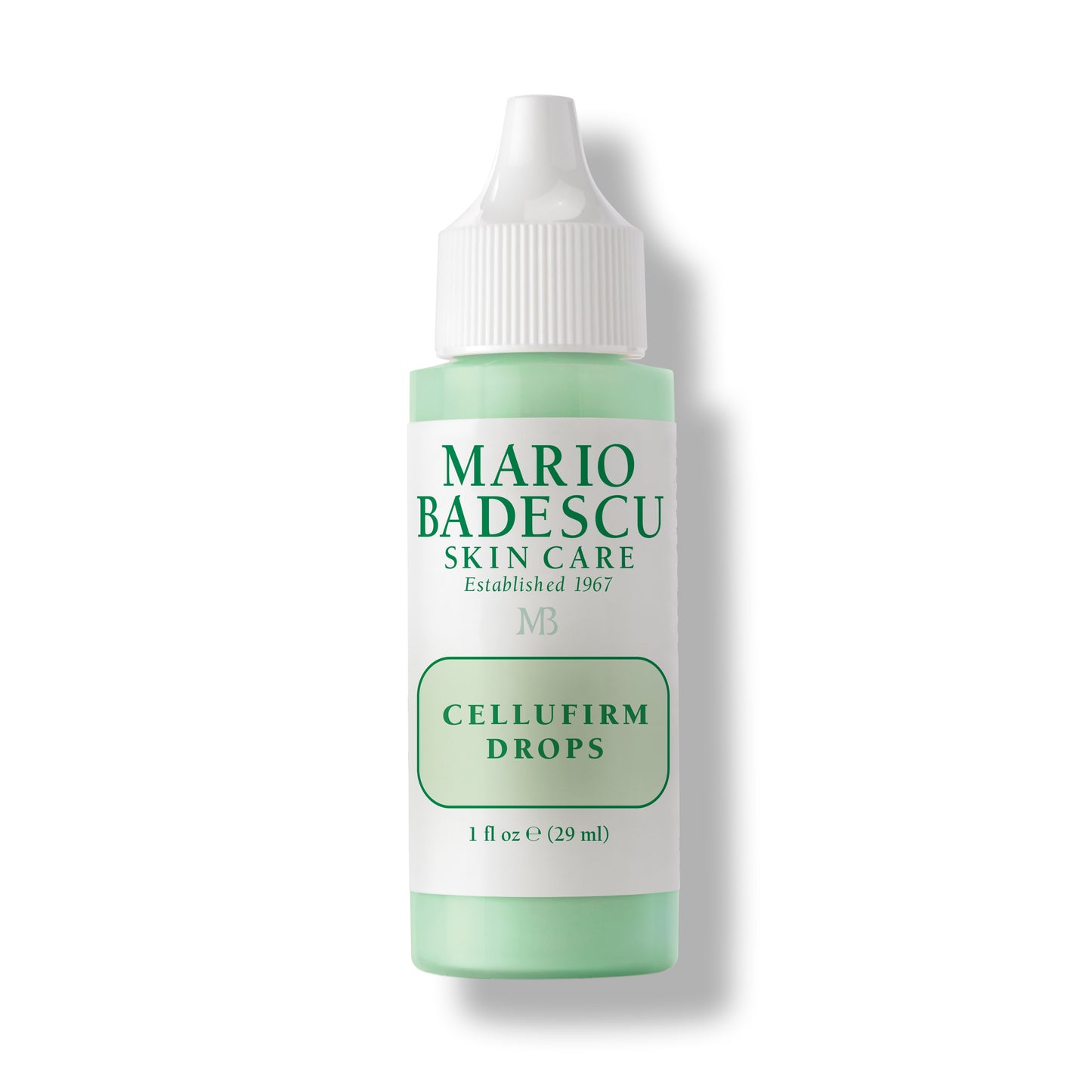

Mario Badescu
Cellufirm Drops

Cellufirm Drops
Mario Badescu
cellufirm-drops
Serum
9818355269925
Morning or Evening?
How often will you use this product?
Notes


Highlights
WHAT IS IT?
Protein-enriched serum
FEATURES
Delivers maximum skin-smoothing benefits, gives supple and youthful-looking appearance
BEST FOR
combination, dry, sensitive
CHECKS
Free of alcohol, silicon, sulfate
Who Is It For?
Adults Seeking Anti-aging BenefitsWhat Does It Help With?
Skin Smoothing Youthful Appearance SupplenessBudget
Affordable (under $30)How To Use
Which routine should it be used in?
Instructions:
Key Information


What Mario Badescu Says
Product Description:
Cellufirm Drops is a protein-enriched serum formulated with ingredients like: Collagen, Elastin, RNA, and Antioxidant Oils to deliver maximum skin-smoothing benefits that help give the complexion a supple and more youthful-looking appearance.
About the Brand:
Ingredients Overview
Ingredients List
Water, Zea Mays (Corn) Oil, Glycerin, Sclerotium Gum, Stearic Acid, Triethanolamine, Propylene Glycol, Tocopheryl Acetate, Urea, Hydrolyzed Elastin, Rna, Oligopeptide-5, Retinyl Palmitate, Hydrolyzed Glycosaminoglycans, Collagen, Pollen Extract, Glycine Soja (Soybean) Seed Extract, Olea Europaea (Olive) Fruit Extract, Fucus Vesiculosus Extract, Sodium Hyaluronate, Triticum Vulgare (Wheat) Germ Extract, Carrageenan, Carbomer, Glyceryl Acrylate/Acrylic Acid Copolymer, Parfum (Fragrance), Sodium Chloride, Diazolidinyl Urea, Methylparaben, Propylparaben, Phenoxyethanol, Limonene, Linalool, Ci 19140 (Yellow 5), Ci 42090 (Blue 1)
Key Ingredients
Tocopheryl Acetate, Glycine Soja (Soybean) Seed Extract, Retinyl Palmitate, Olea Europaea (Olive) Fruit Extract, Glycerin, Urea, Sodium Hyaluronate, Fucus Vesiculosus Extract
Ingredients Details
Bee Pollen
Common Name(s): Bee pollen,cosmetic active,functional ingredient
CAS Number: N/a
DESCRIPTION
What It Does: Delivers characteristic cosmetic function at recommended use concentration.
Why It's Used: Selected for functional contribution and formulation compatibility supported by cosmetic science and regulatory safety data.
How It Works: Works through the mechanism of its molecular class as documented in peer-reviewed cosmetic literature.
Typically Found In: Skin care formulations
TECHNICAL DETAILS
Primary Category: Active ingredient – cosmetic active
Secondary Functions: Skin conditioning
Application Areas:

Facial Skincare

Body Care
Hair Care
Beard Care
Color Cosmetics (Makeup)
Dietary/Oral Supplements
Typical Concentration Range: 0.1%–10%
SOURCING & ETHICS
Vegan Status: Conditional - supplier confirmation required
Halal Status: Unverified - supplier confirmation required
Source Notes: Commercially produced for cosmetic use. verify vegan/halal status with supplier. [audit 2026-07-29 rev2: the record's own source_notes does not assert a non-animal origin, or instructs the reader to verify with the supplier; "yes" asserts knowledge the record does not hold. determination requires shariah-panel sign-off.]
SKIN COMPATIBILITY
Irritancy Rating: 1/5 – very low
Comedogenicity Rating: 0/5 – non-comedogenic
Sensitivity Concerns: Well-tolerated by most skin types.
Safe for Sensitive Skin: Yes
SAFETY & COMPATIBILITY
Safety Profile: Good safety profile at recommended concentrations. ewg score: 1–2.
Works Well With: Standard skincare actives
Avoid Combining With: No known significant incompatibilities
SCIENTIFIC NOTE
Bee pollen has an established safety profile within the cosmetic regulatory framework at standard use concentrations.
Last Verified: 2026-03-12
Primary Sources: Cosing database,bee pollen technical literature
Collagen
Common Name(s): Collagen
DESCRIPTION
What It Does: Delivers targeted skin-conditioning or bioactive benefits through a specific mechanism of action suited to the formulation's intended purpose.
Why It's Used: Specialty actives address specific skin concerns through targeted molecular mechanisms, providing efficacy beyond what base formulation ingredients alone can achieve.
How It Works: The bioactive compound interacts with specific molecular targets in skin cells or the extracellular matrix — enzymes, receptors, structural proteins, or signaling molecules — triggering beneficial biological responses.
Typically Found In: Serums,treatments,moisturizers,specialty products
TECHNICAL DETAILS
Primary Category: Specialty actives
Secondary Functions: Skin-conditioning,anti-aging
Application Areas:
Facial Skincare
Body Care
Hair Care
Beard Care
Color Cosmetics (Makeup)
Dietary/Oral Supplements
Typical Concentration Range: 0.01–5%
SOURCING & ETHICS
Vegan Status: No - animal-derived
Halal Status: Conditional - halal slaughter certificate required (species declaration and slaughter method)
Source Notes: Contains animal-derived components (collagen...); not suitable for vegan formulations. [audit 2026-07-29 rev2: name declares rendered fat or animal tissue; halal status depends on species and slaughter, neither of which is in the record. determination requires shariah-panel sign-off.]
SKIN COMPATIBILITY
Irritancy Rating: 1
Comedogenicity Rating: 0
Sensitivity Concerns: Low sensitization potential at recommended use concentrations.
Safe for Sensitive Skin: Conditional
SAFETY & COMPATIBILITY
Safety Profile: Well-characterized cosmetic ingredient with established safety profile. generally non-irritating at typical use concentrations. suitable for leave-on and rinse-off cosmetics.
Works Well With: Niacinamide,hyaluronic acid,vitamin c,peptides
Avoid Combining With: Incompatible with oxidizing agents; check ph stability
SCIENTIFIC NOTE
Specialty actives typically work through enzyme inhibition (e.g., tyrosinase inhibition for brightening, mmp inhibition for anti-aging), receptor activation (e.g., retinoid receptors, ppar-γ for barrier genes), or transcription factor modulation (e.g., nrf2 for antioxidant gene upregulation). structure-activity relationships determine potency and selectivity.
Last Verified: 2025-01-15
Primary Sources: Cosing eu database; pcpc cosmetic ingredient safety reviews; ingredient-specific safety and efficacy literature
Elastin
Common Name(s): Elastin,cosmetic active,functional ingredient
CAS Number: N/a
DESCRIPTION
What It Does: Delivers characteristic cosmetic function at recommended use concentration.
Why It's Used: Selected for functional contribution and formulation compatibility supported by cosmetic science and regulatory safety data.
How It Works: Works through the mechanism of its molecular class as documented in peer-reviewed cosmetic literature.
Typically Found In: Skin care formulations
TECHNICAL DETAILS
Primary Category: Active ingredient – cosmetic active
Secondary Functions: Skin conditioning
Application Areas:
Facial Skincare
Body Care
Hair Care
Beard Care
Color Cosmetics (Makeup)
Dietary/Oral Supplements
Typical Concentration Range: 0.1%–10%
SOURCING & ETHICS
Vegan Status: No - animal-derived
Halal Status: Conditional - halal slaughter certificate required (species declaration and slaughter method)
Source Notes: Commercially produced for cosmetic use. verify vegan/halal status with supplier. [audit 2026-07-29 rev2: name declares rendered fat or animal tissue; halal status depends on species and slaughter, neither of which is in the record. determination requires shariah-panel sign-off.]
SKIN COMPATIBILITY
Irritancy Rating: 1/5 – very low
Comedogenicity Rating: 0/5 – non-comedogenic
Sensitivity Concerns: Well-tolerated by most skin types.
Safe for Sensitive Skin: Yes
SAFETY & COMPATIBILITY
Safety Profile: Good safety profile at recommended concentrations. ewg score: 1–2.
Works Well With: Standard skincare actives
Avoid Combining With: No known significant incompatibilities
SCIENTIFIC NOTE
Elastin has an established safety profile within the cosmetic regulatory framework at standard use concentrations.
Last Verified: 2026-03-12
Primary Sources: Cosing database,elastin technical literature
Rna
Common Name(s): Rna,rna,nucleic acid,cell communication molecule
CAS Number: N/a
DESCRIPTION
What It Does: Provides nucleoside and nucleobase delivery for adenosine receptor stimulation, nad+ precursor contribution, and cell energy metabolism support.
Why It's Used: Rna is selected for nucleic acid-mediated cell communication — rna and dna fragments activate toll-like receptor signalling for skin immunity modulation and provide purine/pyrimidine bases as nad+ and energy cofactor precursors.
How It Works: Nucleic acid fragment → tlr3 activation (dsrna) or tlr9 activation (cpg dna) → interferon signalling or a2a adenosine receptor binding → collagen fibroblast stimulation.
Typically Found In: Anti-aging,cell communication
TECHNICAL DETAILS
Primary Category: Active ingredient – antioxidant
Secondary Functions: Free radical scavenging,anti-aging
Application Areas:
Facial Skincare
Body Care
Hair Care
Beard Care
Color Cosmetics (Makeup)
Dietary/Oral Supplements
Typical Concentration Range: 0.1%–5%
SOURCING & ETHICS
Vegan Status: Yes
Halal Status: Yes
Source Notes: Plant-derived extract or synthetic.
SKIN COMPATIBILITY
Irritancy Rating: 1/5 – very low
Comedogenicity Rating: 0/5 – non-comedogenic
Sensitivity Concerns: Non-irritating; well-tolerated.
Safe for Sensitive Skin: Yes
SAFETY & COMPATIBILITY
Safety Profile: Excellent safety profile. ewg score: 1.
Works Well With: Vitamin c,vitamin e,ferulic acid,spf,other antioxidants
Avoid Combining With: No significant incompatibilities
SCIENTIFIC NOTE
Rna/dna cosmetic ingredients are hydrolysed to nucleosides/bases in formulation — the biologically active species are the purine/pyrimidine mononucleotides released by hydrolysis.
Last Verified: 2026-03-22
Primary Sources: Cosing database,rna nucleic acid skin active review