
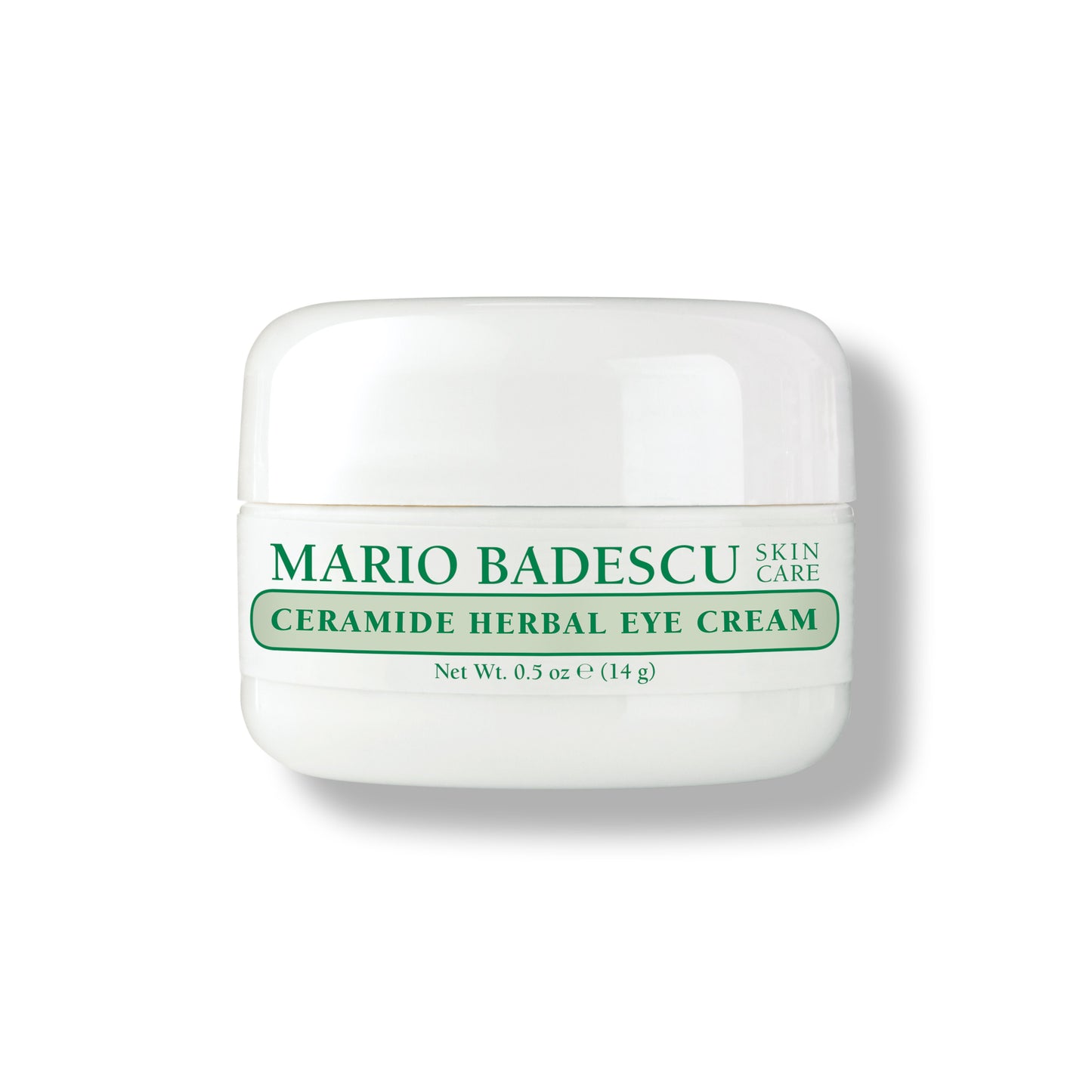

Mario Badescu
Ceramide Herbal Eye Cream

Ceramide Herbal Eye Cream
Mario Badescu
ceramide-herbal-eye-cream
Eyecare
9818362249509
Morning or Evening?
How often will you use this product?
Notes


Highlights
WHAT IS IT?
Eye cream with ceramides and herbal ingredients
FEATURES
Light balm texture, nourishing oils, easy application, replenishing properties
BEST FOR
oily
CHECKS
Free of sulfate, phthalate
Who Is It For?
All Skin TypesWhat Does It Help With?
Replenishes Softens And Boosts RadianceBudget
Affordable (under $30)How To Use
Which routine should it be used in?
Instructions:
Key Information


What Mario Badescu Says
Product Description:
Light, balm-y texture Packed with skin-loving ingredients and nourishing oils Glides across skin with beautiful slip and melts in effortlessly Replenishes, softens, and helps boost radiance
About the Brand:
Ingredients Overview
Ingredients List
Aqua (Water, Eau), Glycerin, Paraffinum Liquidum (Mineral Oil, Huile Min‚rale), Cyclopentasiloxane, Dimethicone, Cetearyl Alcohol, Olus Oil (Vegetable Oil, Huile V‚g‚tale), Rosa Canina Fruit Oil, Carthamus Tinctorius (Safflower) Seed Oil, Petrolatum, Tocopherol, Euphrasia Officinalis Extract, Hyaluronic Acid, Tocopheryl Acetate, Sodium Hyaluronate, Lecithin, Glycolipids, Caprylyl Glycol, Ceteareth-20, Dimethiconol, Ethylhexyl Cocoate, Carbomer, Propylene Glycol, Parfum (Fragrance), Glyceryl Acrylate/Acrylic Acid Copolymer, Triethanolamine, Propylparaben, PVM/MA Copolymer, Diazolidinyl Urea, Phenyl Trimethicone, Methylparaben, Polyquaternium-24, Sodium Chloride, Limonene, Linalool, Alpha-Isomethyl Ionone, CI 19140 (Yellow 5), CI 42090 (Blue 1)
Key Ingredients
Ceramides, Hyaluronic Acid, Lecithin, Sodium Hyaluronate
Ingredients Details
Ceramides
Common Name(s): Ceramides,ceramide sphingolipid,sc barrier lipid
CAS Number: N/a
DESCRIPTION
What It Does: Restores sc lamellar lipid bilayers, reduces trans-epidermal water loss, repairs barrier dysfunction in dry and eczematous skin, and strengthens the physical barrier against environmental irritants.
Why It's Used: Provides direct structural barrier lipid replacement — unlike humectants that attract water, ceramides physically rebuild the lipid bilayer architecture required to retain moisture within the skin.
How It Works: Ceramides integrate into the sc intercellular lamellar bilayer, restoring the ordered orthorhombic packing disrupted in barrier-compromised skin. the sphingosine backbone's amide bond and hydroxyl groups form the h-bonding network that stabilises the lamellar structure.
Typically Found In: Barrier repair,dry skin,eczema-prone
TECHNICAL DETAILS
Primary Category: Functional ingredient – emollient
Secondary Functions: Barrier sealing,softening
Application Areas:

Facial Skincare
Body Care
Hair Care

Beard Care
Color Cosmetics (Makeup)
Dietary/Oral Supplements
Typical Concentration Range: 0.01%–5%
SOURCING & ETHICS
Vegan Status: Conditional
Halal Status: Yes
Source Notes: Plant-derived, synthetic or animal-derived. verify source.
SKIN COMPATIBILITY
Irritancy Rating: 1/5 – very low
Comedogenicity Rating: 1/5 – low; formulation-dependent
Sensitivity Concerns: Non-irritating.
Safe for Sensitive Skin: Yes
SAFETY & COMPATIBILITY
Safety Profile: Excellent safety profile. ewg score: 1.
Works Well With: Humectants,ceramides,actives as carrier
Avoid Combining With: No significant incompatibilities
SCIENTIFIC NOTE
Sc ceramides comprise ~50% of the sc lipid mass (by weight) and are essential for barrier function; ceramide depletion in atopic dermatitis and aged skin is a primary driver of barrier dysfunction and tewl elevation.
Last Verified: Cosing database,ceramides ceramide barrier review
Primary Sources: 2026-03-12
Hyaluronic Acid
Common Name(s): Ha,sodium hyaluronate (salt form),hyaluronan,d-glucuronic acid-n-acetyl-d-glucosamine polymer
CAS Number: 9004-61-9
DESCRIPTION
What It Does: Hyaluronic acid draws and locks moisture into the skin at multiple depths (surface and deeper layers depending on molecular weight), creating a plumping, smoothing, and hydrating effect.
Why It's Used: It is used because it is endogenous to human skin, making it exceptionally biocompatible and non-irritating. its unparalleled moisture-binding capacity makes it the most effective hydrating ingredient available.
How It Works: Ha binds water molecules through its many hydroxyl and carboxyl groups, creating a gel-like matrix. high molecular weight ha (>500 kda) hydrates the skin surface; low molecular weight ha (<50 kda) penetrates deeper to provide interior hydration.
Typically Found In: Serums,moisturizers,sheet masks,toners,eye creams,lip treatments,dermal fillers (injectable)
TECHNICAL DETAILS
Primary Category: Active ingredient – humectant/hydrator
Secondary Functions: Barrier repair,plumping,anti-aging
Application Areas:
Facial Skincare
Body Care
Hair Care
Beard Care
Color Cosmetics (Makeup)
Dietary/Oral Supplements
Typical Concentration Range: 0.1%–2% (effective at very low concentrations; multi-weight ha provides superior results)
SOURCING & ETHICS
Vegan Status: Yes – biotechnology-derived (microbial fermentation of streptococcus equi or b. subtilis); vegan-certified versions widely available
Halal Status: Yes
Source Notes: Originally extracted from rooster combs; now predominantly produced via biotechnology (bacterial fermentation), which is vegan and more sustainable.
SKIN COMPATIBILITY
Irritancy Rating: 1/5 – very low; one of the gentlest skincare ingredients known
Comedogenicity Rating: 0/5 – non-comedogenic
Sensitivity Concerns: In very dry environments, high-molecular-weight ha on the surface can potentially draw moisture out of the skin if not sealed with an occlusive. apply to damp skin and seal with moisturizer.
Safe for Sensitive Skin: Yes – ideal for all skin types including rosacea, eczema, and post-procedure skin
SAFETY & COMPATIBILITY
Safety Profile: Exceptional safety profile. endogenous molecule – no toxicity concerns. ewg hazard score: 1. safe during pregnancy.
Works Well With: Virtually all ingredients; especially ceramides,glycerin,peptides,retinol (reduces irritation),niacinamide,vitamin c
Avoid Combining With: No significant incompatibilities; high concentrations of alcohol in a formula may reduce its efficacy
SCIENTIFIC NOTE
Hyaluronic acid naturally degrades in skin (half-life ~1–2 days). the skin produces it endogenously, but production decreases with age. multi-molecular-weight ha formulas provide hydration at both surface and deeper skin levels.
Last Verified: Cosing database,cir safety assessment,papakonstantinou et al. (2012) dermato-endocrinology
Primary Sources: 2026-03-12
Lecithin
Common Name(s): Soy lecithin,sunflower lecithin,phosphatidylcholine complex
CAS Number: 8002-43-5
DESCRIPTION
What It Does: Provides natural phospholipid emulsification with barrier-compatible delivery and liposome-forming properties.
Why It's Used: The most biologically authentic emulsifier – identical to cell membrane composition providing barrier-compatible delivery and liposome formation unavailable from synthetic emulsifiers.
How It Works: Phosphatidylcholine (pc), phosphatidylethanolamine (pe), phosphatidylinositol (pi) mixture provides hlb 7-12 for o/w emulsification. forms liposomal bilayers for active encapsulation. pc/pe/pi composition mirrors cell membrane for barrier-compatible delivery.
Typically Found In: Natural cosmetics,liposomal products,barrier repair,penetration-enhanced formulas
TECHNICAL DETAILS
Primary Category: Functional ingredient – natural phospholipid emulsifier
Secondary Functions: Skin conditioning
Application Areas:
Facial Skincare
Body Care
Hair Care
Beard Care
Color Cosmetics (Makeup)
Dietary/Oral Supplements
Typical Concentration Range: 0.5%–10%
SOURCING & ETHICS
Vegan Status: Conditional – soy lecithin (vegan); egg lecithin (not vegan)
Halal Status: Conditional – soy (halal); egg (verify)
Source Notes: Commercially produced for cosmetic use. verify vegan/halal status with supplier.
SKIN COMPATIBILITY
Irritancy Rating: 1/5 – very low
Comedogenicity Rating: 0/5 – non-comedogenic
Sensitivity Concerns: Well-tolerated by most skin types.
Safe for Sensitive Skin: Yes
SAFETY & COMPATIBILITY
Safety Profile: Good safety profile at recommended concentrations. ewg score: 1–2.
Works Well With: Standard skincare actives
Avoid Combining With: No known significant incompatibilities
SCIENTIFIC NOTE
Lecithin's phospholipid composition mirrors the composition of the stratum corneum's own lamellar bodies that deliver barrier lipids to the skin surface. this structural mimicry allows lecithin-based delivery systems to integrate seamlessly with the barrier lipid structure, exploiting the same transport pathway the skin uses for its own lipid secretion.
Last Verified: Cosing database,cir safety assessment
Primary Sources: 2026-03-12
Sodium Hyaluronate
Common Name(s): Sodium salt of hyaluronic acid,naha
CAS Number: 9067-32-7
DESCRIPTION
What It Does: Provides hyaluronic acid hydration in the most formulation-stable and compatible form.
Why It's Used: The standard form of ha used in cosmetics – more stable than free ha, better solubility, and equivalent skin hydration benefits.
How It Works: Sodium salt reduces the polyelectrolyte repulsion of ha chains, allowing better packing in formulations. on skin, sodium ions dissociate and the ha chain unfolds to its full water-binding conformation. provides full ha humectant and barrier benefits equivalent to free ha.
Typically Found In: Hydrating serums,toners,moisturizers,sheet masks,anti-aging products
TECHNICAL DETAILS
Primary Category: Active ingredient – ha sodium salt
Secondary Functions: Equivalent ha hydration,superior stability
Application Areas:
Facial Skincare
Body Care
Hair Care
Beard Care
Color Cosmetics (Makeup)
Dietary/Oral Supplements
Typical Concentration Range: 0.1%–2%
SOURCING & ETHICS
Vegan Status: Yes – bacterial fermentation
Halal Status: Yes
Source Notes: Synthetic or naturally derived. excellent aqueous solubility.
SKIN COMPATIBILITY
Irritancy Rating: 1/5 – very low
Comedogenicity Rating: 0/5 – non-comedogenic
Sensitivity Concerns: Non-irritating; suitable for all skin types.
Safe for Sensitive Skin: Yes
SAFETY & COMPATIBILITY
Safety Profile: Excellent safety profile. ewg score: 1.
Works Well With: Ceramides,emollients,occlusives,glycerin,hyaluronic acid
Avoid Combining With: No significant incompatibilities
SCIENTIFIC NOTE
The sodium salt form of ha has approximately 10% better water solubility than free hyaluronic acid at equivalent molecular weight due to reduced chain-chain electrostatic repulsion from partial sodium counterion screening. this improved solubility enables higher concentration formulations without viscosity issues.
Last Verified: Cosing database,cir safety assessment
Primary Sources: 2026-03-12
