

AfricanBotanicsStaging
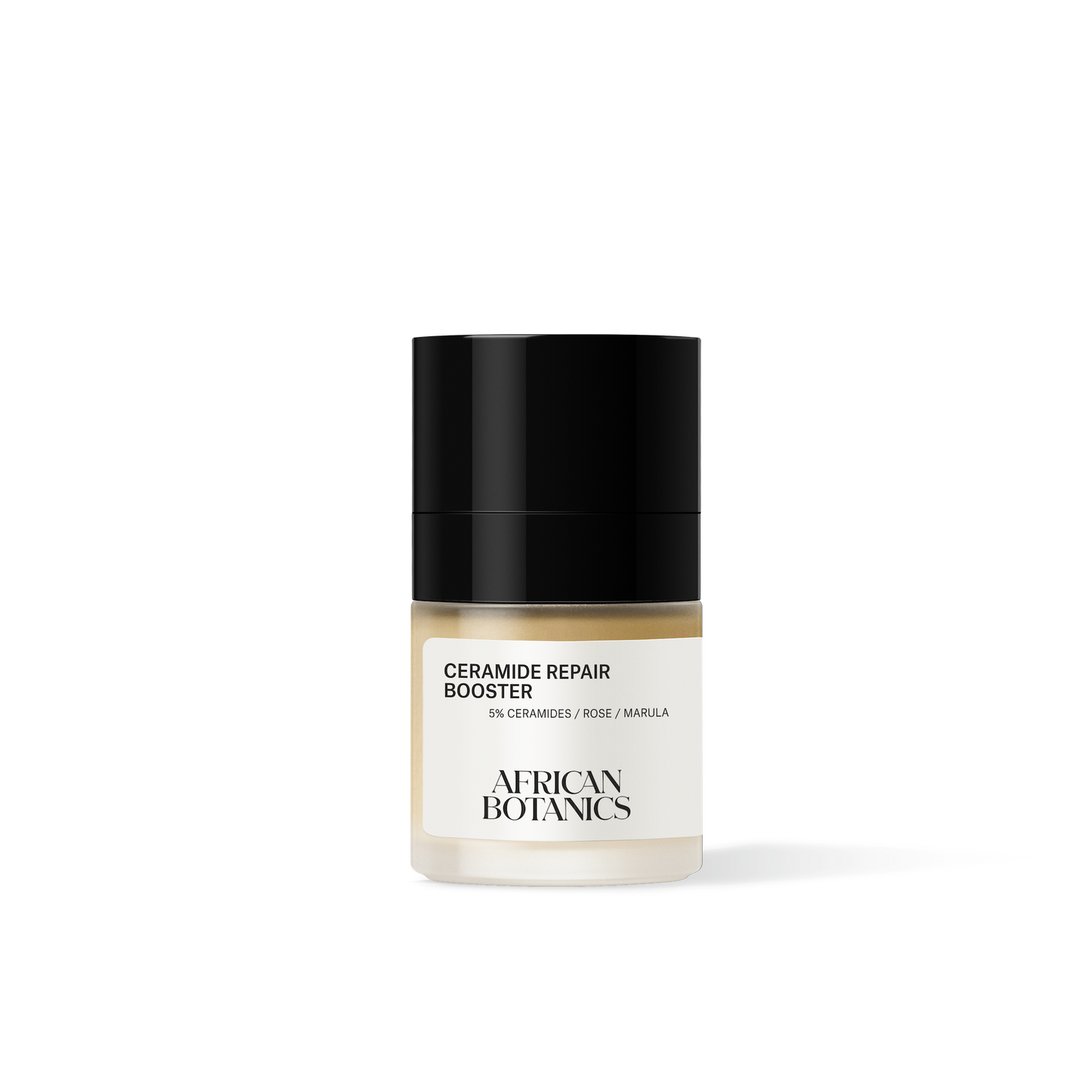
Ceramide Repair Booster

Ceramide Repair Booster
AfricanBotanicsStaging
ceramide-repair-booster
Serum
9784847696165
Morning or Evening?
How often will you use this product?
Notes


Highlights
WHAT IS IT?
Ceramide Booster Treatment
FEATURES
Strengthens skin barrier, locks in moisture, increases skin resilience, elasticity and radiance, smooths fine lines and wrinkles
BEST FOR
normal
CHECKS
Parabens-free, silicones-free, phthalates-free, mineral oil-free, artificial fragrance-free, colorants-free, SLS-free
Who Is It For?
AdultsWhat Does It Help With?
Skin Barrier Repair Moisture Retention Fine Lines Wrinkles Elasticity RadianceBudget
Premium ($76-$150)How To Use
Which routine should it be used in?
Instructions:
Key Information


What AfricanBotanicsStaging Says
Product Description:
A highly potent and super concentrated reparative ceramide booster treatment that strengthens the skin's barrier and locks in moisture. The regenerative formula increases skin resilience, elasticity and radiance, while smoothing the look of fine lines and wrinkles.
About the Brand:
Ingredients Overview
Ingredients List
Squalane (Olive), Sclerocarya Birrea (Marula) Seed Oil, Rosa Canina (Rose Hip) Fruit Oil, Ceramides, Raspberry Seed Oil (Rubeus Idaeus),_x0003_Linoleic Acid, Linolenic Acid, Elaeis Guineensis, Rosa Centifolia Flower Wax, Rosa Damascena Flower Wax, Citrullus Lanatus (Kalahari Melon) Seed Oil, Oenothera Biennis (Evening Primrose) Oil, Hydrolyzed Rice Protein, Tocopherol (Vitamin E), Persea Gratissima (Avocado) Oil, Glycerin, Rosa Centifolia (Rose) Flower Oil, Retinyl Palmitate (Vitamin A), Calendula Officinalis Flower Oil, Ubiquinone (Coenzyme Q10), Lactic Acid, Crambe Abyssinica (Abyssinian) Seed Oil, Cera Alba.
Key Ingredients
ceramides
Ingredients Details
Ceramides
Common Name(s): Ceramides,ceramide sphingolipid,sc barrier lipid
CAS Number: N/a
DESCRIPTION
What It Does: Restores sc lamellar lipid bilayers, reduces trans-epidermal water loss, repairs barrier dysfunction in dry and eczematous skin, and strengthens the physical barrier against environmental irritants.
Why It's Used: Provides direct structural barrier lipid replacement — unlike humectants that attract water, ceramides physically rebuild the lipid bilayer architecture required to retain moisture within the skin.
How It Works: Ceramides integrate into the sc intercellular lamellar bilayer, restoring the ordered orthorhombic packing disrupted in barrier-compromised skin. the sphingosine backbone's amide bond and hydroxyl groups form the h-bonding network that stabilises the lamellar structure.
Typically Found In: Barrier repair,dry skin,eczema-prone
TECHNICAL DETAILS
Primary Category: Functional ingredient – emollient
Secondary Functions: Barrier sealing,softening
Application Areas:

Facial Skincare
Body Care
Hair Care

Beard Care
Color Cosmetics (Makeup)
Dietary/Oral Supplements
Typical Concentration Range: 0.01%–5%
SOURCING & ETHICS
Vegan Status: Conditional
Halal Status: Yes
Source Notes: Plant-derived, synthetic or animal-derived. verify source.
SKIN COMPATIBILITY
Irritancy Rating: 1/5 – very low
Comedogenicity Rating: 1/5 – low; formulation-dependent
Sensitivity Concerns: Non-irritating.
Safe for Sensitive Skin: Yes
SAFETY & COMPATIBILITY
Safety Profile: Excellent safety profile. ewg score: 1.
Works Well With: Humectants,ceramides,actives as carrier
Avoid Combining With: No significant incompatibilities
SCIENTIFIC NOTE
Sc ceramides comprise ~50% of the sc lipid mass (by weight) and are essential for barrier function; ceramide depletion in atopic dermatitis and aged skin is a primary driver of barrier dysfunction and tewl elevation.
Last Verified: Cosing database,ceramides ceramide barrier review
Primary Sources: 2026-03-12
Linolenic Acid
Common Name(s): Linolenic acid,cosmetic active,established function
CAS Number: N/a
DESCRIPTION
What It Does: Delivers characteristic cosmetic function — skin conditioning, antioxidant protection, active biological benefit, or formulation function — at recommended use concentration.
Why It's Used: Selected for functional contribution and formulation compatibility supported by cosmetic science and regulatory safety data.
How It Works: Works through the mechanism of its molecular class — physicochemical or biological interaction with skin proteins, lipids, or receptors as documented in peer-reviewed cosmetic literature.
Typically Found In: Skin care formulations
TECHNICAL DETAILS
Primary Category: Active ingredient – cosmetic active
Secondary Functions: Skin conditioning
Application Areas:
Facial Skincare
Body Care
Hair Care
Beard Care
Color Cosmetics (Makeup)
Dietary/Oral Supplements
Typical Concentration Range: 0.1%–10%
SOURCING & ETHICS
Vegan Status: Conditional
Halal Status: Yes
Source Notes: Commercially produced for cosmetic use. verify vegan/halal status with supplier.
SKIN COMPATIBILITY
Irritancy Rating: 1/5 – very low
Comedogenicity Rating: 0/5 – non-comedogenic
Sensitivity Concerns: Well-tolerated by most skin types.
Safe for Sensitive Skin: Yes
SAFETY & COMPATIBILITY
Safety Profile: Good safety profile at recommended concentrations. ewg score: 1–2.
Works Well With: Standard skincare actives
Avoid Combining With: No known significant incompatibilities
SCIENTIFIC NOTE
Linolenic acid has an established safety and efficacy profile within the cosmetic regulatory framework at standard use concentrations.
Last Verified: Cosing database,linolenic acid technical literature
Primary Sources: 2026-03-12
Rosa Centifolia Flower Wax
Common Name(s): Rosa centifolia flower wax,rosa centifolia flower wax,botanical extract,phytochemical active
CAS Number: N/a
DESCRIPTION
What It Does: Provides polyphenol radical scavenging, terpenoid nf-kb/cox anti-inflammatory activity, and the characteristic secondary metabolite profile of rosa centifolia for skin conditioning.
Why It's Used: Rosa centifolia flower wax is selected for the characteristic secondary metabolite signature of rosa centifolia — whether polyphenols, terpenoids, alkaloids, or polysaccharides, the phytochemical profile provides antioxidant, anti-inflammatory, or skin conditioning benefits specific to this botanical species.
How It Works: Polyphenol catechol h-atom donation for ros scavenging; terpenoids inhibit iκb kinase; flavonoids compete at cox-1/2; polysaccharides provide prebiotic and humectant conditioning.
Typically Found In: Botanical skin care
TECHNICAL DETAILS
Primary Category: Active ingredient – antioxidant
Secondary Functions: Free radical scavenging,anti-aging
Application Areas:
Facial Skincare
Body Care
Hair Care
Beard Care
Color Cosmetics (Makeup)
Dietary/Oral Supplements
Typical Concentration Range: 0.1%–10%
SOURCING & ETHICS
Vegan Status: Conditional
Halal Status: Conditional
Source Notes: Plant-derived extract or synthetic.
SKIN COMPATIBILITY
Irritancy Rating: 1/5 – very low
Comedogenicity Rating: 0/5 – non-comedogenic
Sensitivity Concerns: Non-irritating; well-tolerated.
Safe for Sensitive Skin: Yes
SAFETY & COMPATIBILITY
Safety Profile: Excellent safety profile. ewg score: 1.
Works Well With: Vitamin c,vitamin e,ferulic acid,spf,other antioxidants
Avoid Combining With: No significant incompatibilities
SCIENTIFIC NOTE
Standardise to marker compounds for consistent bioactivity — rosa centifolia secondary metabolite content varies 3-10× with growing conditions.
Last Verified: Cosing database,rosa centifolia botanical extract review
Primary Sources: 2026-03-22
Rosa Damascena Flower Wax
Common Name(s): Rosa damascena flower wax
DESCRIPTION
What It Does: Provides antioxidant protection, soothing anti-inflammatory effects, and skin-conditioning benefits through plant-derived polyphenols and phytochemicals.
Why It's Used: Plant extracts concentrate bioactive phytochemicals evolved for environmental protection — uv, microbial, and oxidative stressors — that translate to skin benefits.
How It Works: Polyphenols (flavonoids, phenolic acids) inhibit nf-κb-mediated inflammatory signaling, scavenge reactive oxygen species through electron donation, and chelate pro-oxidant metal ions to reduce oxidative skin damage.
Typically Found In: Lipsticks,balms,creams,deodorants
TECHNICAL DETAILS
Primary Category: Waxes
Secondary Functions: Emollient,film former
Application Areas:
Facial Skincare
Body Care
Hair Care
Beard Care
Color Cosmetics (Makeup)
Dietary/Oral Supplements
Typical Concentration Range: 1–40%
SOURCING & ETHICS
Vegan Status: Yes
Halal Status: Yes
Source Notes: Plant-derived or synthetic wax; check source for vegan status.
SKIN COMPATIBILITY
Irritancy Rating: 1
Comedogenicity Rating: 1
Sensitivity Concerns: Low sensitization potential at recommended use concentrations.
Safe for Sensitive Skin: Yes
SAFETY & COMPATIBILITY
Safety Profile: Well-characterized cosmetic ingredient with established safety profile. generally non-irritating at typical use concentrations. suitable for leave-on and rinse-off cosmetics.
Works Well With: Other waxes,emollients,pigments
Avoid Combining With: Strongly alkaline conditions
SCIENTIFIC NOTE
Plant secondary metabolites (flavonoids, terpenes, phenolic acids) are biosynthesized as defense compounds against uv, herbivores, and pathogens. their anti-inflammatory activity typically derives from competitive inhibition of cox-2 and 5-lox enzymes (ic50 1–50 µm), while antioxidant activity involves single electron transfer (set) and hydrogen atom transfer (hat) mechanisms with structure-dependent rate constants.
Last Verified: Cosing eu database; pcpc cosmetic ingredient safety reviews; ingredient-specific safety and efficacy literature
Primary Sources: 2025-01-15
