

Nykaa E retail limited
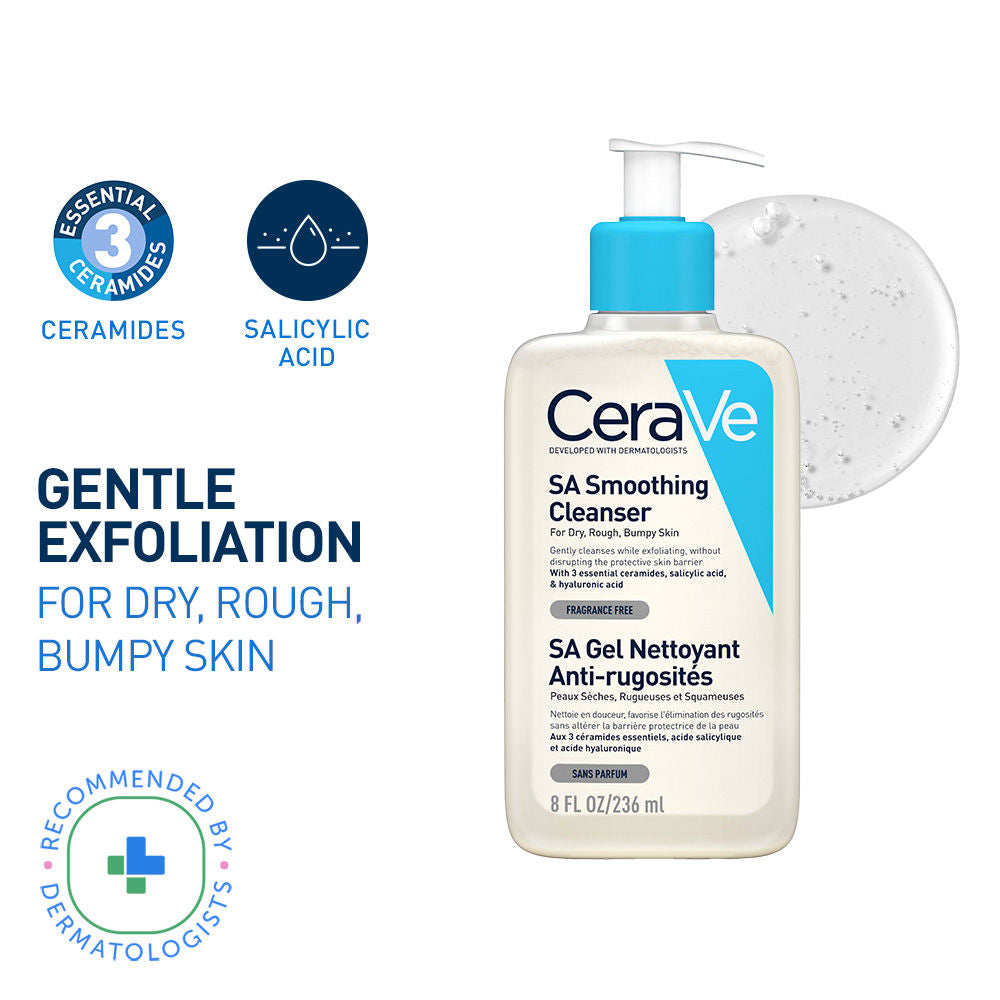
CeraVe SA Smoothing Cleanser For Dry, Rough & Bumpy Skin

CeraVe SA Smoothing Cleanser For Dry, Rough & Bumpy Skin
Nykaa E retail limited
cerave-sa-smoothing-cleanser-for-dry-rough-bumpy-skin
Cleanse
10084992549157
Morning or Evening?
How often will you use this product?
Notes


Highlights
WHAT IS IT?
Smoothing Cleanser with Salicylic Acid and Ceramides
FEATURES
Formulated for dry, rough and bumpy skin
BEST FOR
dry
CHECKS
Who Is It For?
All Ages All GendersWhat Does It Help With?
Smoothing Dry Rough And Bumpy SkinBudget
Mid-range ($30-$75)How To Use
Which routine should it be used in?
Instructions:
Key Information


What Nykaa E retail limited Says
Product Description:
Face wash with Salicylic Acid & Ceramides (236ML)
About the Brand:
Ingredients Overview
Ingredients List
Aqua / Water, Sodium Lauroyl Sarcosinate, Cocamidopropyl Hydroxysultaine, Glycerin, Niacinamide, Gluconolactone, Sodium Methyl Cocoyl Taurate, Peg-150 Pentaerythrityl Tetrastearate, Ceramide Np, Ceramide Ap, Ceramide Eop, Carbomer, Calcium Gluconate, Salicylic Acid, Sodium Benzoate, Sodium Lauroyl Lactylate, Cholesterol, Phenoxyethanol, Disodium Edta, Tetrasodium Edta, Hydrolyzed Hyaluronic Acid, Phytosphingosine, Xanthan Gum, Ethylhexylglycerin (CODE F.I.L D235671/1)
Key Ingredients
salicylic acid,ceramides
Ingredients Details
Calcium Gluconate
Common Name(s): Calcium gluconate,cosmetic active,functional ingredient
CAS Number: N/a
DESCRIPTION
What It Does: Delivers characteristic cosmetic function at recommended use concentration.
Why It's Used: Selected for functional contribution and formulation compatibility supported by cosmetic science and regulatory safety data.
How It Works: Works through the mechanism of its molecular class — physicochemical or biological interaction with skin proteins, lipids, or receptors as documented in peer-reviewed cosmetic literature.
Typically Found In: Skin care formulations
TECHNICAL DETAILS
Primary Category: Active ingredient – cosmetic active
Secondary Functions: Skin conditioning
Application Areas:

Facial Skincare

Body Care
Hair Care
Beard Care
Color Cosmetics (Makeup)
Dietary/Oral Supplements
Typical Concentration Range: 0.1%–10%
SOURCING & ETHICS
Vegan Status: Conditional
Halal Status: Yes
Source Notes: Commercially produced for cosmetic use. verify vegan/halal status with supplier.
SKIN COMPATIBILITY
Irritancy Rating: 1/5 – very low
Comedogenicity Rating: 0/5 – non-comedogenic
Sensitivity Concerns: Well-tolerated by most skin types.
Safe for Sensitive Skin: Yes
SAFETY & COMPATIBILITY
Safety Profile: Good safety profile at recommended concentrations. ewg score: 1–2.
Works Well With: Standard skincare actives
Avoid Combining With: No known significant incompatibilities
SCIENTIFIC NOTE
Calcium gluconate has an established safety and efficacy profile within the cosmetic regulatory framework at standard use concentrations.
Last Verified: Cosing database,calcium gluconate technical literature
Primary Sources: 2026-03-12
Carbomer
Common Name(s): Carbopol,polyacrylic acid,carboxyvinyl polymer
DESCRIPTION
What It Does: Provides transparent gel textures and thickening at very low concentrations via ph-responsive swelling.
Why It's Used: The most widely used gel thickener – provides crystal-clear, stable gels at concentrations as low as 0.1-0.5% with ph-controlled viscosity.
How It Works: Highly crosslinked polyacrylic acid remains tightly coiled at acidic ph. neutralization with naoh or triethanolamine ionizes carboxylic groups causing electrostatic repulsion that unfolds and swells the polymer coils, dramatically increasing viscosity. concentration-dependent thickening.
Typically Found In: Gels,serums,emulsions,sunscreens
TECHNICAL DETAILS
Primary Category: Functional ingredient – polyacrylic acid thickener
Secondary Functions: Skin conditioning
Application Areas:
Facial Skincare
Body Care
Hair Care
Beard Care
Color Cosmetics (Makeup)
Dietary/Oral Supplements
Typical Concentration Range: 0.1%–2%
SOURCING & ETHICS
Vegan Status: Yes – synthetic
Halal Status: Yes
Source Notes: Commercially produced for cosmetic use. verify vegan/halal status with supplier.
SKIN COMPATIBILITY
Irritancy Rating: 1/5 – very low
Comedogenicity Rating: 0/5 – non-comedogenic
Sensitivity Concerns: Well-tolerated by most skin types.
Safe for Sensitive Skin: Yes
SAFETY & COMPATIBILITY
Safety Profile: Good safety profile at recommended concentrations. ewg score: 1–2.
Works Well With: Standard skincare actives
Avoid Combining With: No known significant incompatibilities
SCIENTIFIC NOTE
Carbomer's ph-responsive swelling mechanism provides an elegant formulation control tool: a neutralized gel can be liquefied by ph reduction (adding acid) and re-thickened by reneutralization. this reversible rheology control allows two-phase products that mix on application without the need for mechanical emulsification.
Last Verified: Cosing database,cir safety assessment
Primary Sources: 2026-03-12
Ceramide Ap
Common Name(s): Ceramide 6 ii,n-(2-hydroxy)-stearoyl phytosphingosine,alpha-hydroxy ceramide
CAS Number: 100403-19-8
DESCRIPTION
What It Does: Provides alpha-hydroxy ceramide for complementary barrier repair alongside ceramide np and eop.
Why It's Used: Essential barrier ceramide trio component — ceramide ap's alpha-hydroxy fatty acid provides the specific lamellar body formation chemistry needed for complete barrier restoration with ceramide np and ceramide eop.
How It Works: N-(2-hydroxyfatty acid) phytosphingosine: 2-hydroxylation of fatty acid is critical for optimal packing of ceramide ap in lamellar lipid bilayers. the alpha-hydroxy group creates stronger intermolecular hydrogen bonding between ceramide ap molecules than non-hydroxylated ceramides. used in combination with ceramide np and ceramide eop for comprehensive barrier repair.
Typically Found In: Complete barrier repair formulas,triple ceramide systems,eczema treatment
TECHNICAL DETAILS
Primary Category: Active ingredient – alpha-hydroxy ceramide
Secondary Functions: Skin conditioning
Application Areas:
Facial Skincare
Body Care
Hair Care
Beard Care
Color Cosmetics (Makeup)
Dietary/Oral Supplements
Typical Concentration Range: 0.01%–1%
SOURCING & ETHICS
Vegan Status: Conditional – plant-derived phytosphingosine available
Halal Status: Yes
Source Notes: Commercially produced for cosmetic use. verify vegan/halal status with supplier.
SKIN COMPATIBILITY
Irritancy Rating: 1/5 – very low
Comedogenicity Rating: 0/5 – non-comedogenic
Sensitivity Concerns: Well-tolerated by most skin types.
Safe for Sensitive Skin: Yes
SAFETY & COMPATIBILITY
Safety Profile: Good safety profile at recommended concentrations. ewg score: 1–2.
Works Well With: Standard skincare actives
Avoid Combining With: No known significant incompatibilities
SCIENTIFIC NOTE
The ceramide np + ceramide ap + ceramide eop triple combination mimics the natural ratio of ceramide classes in healthy stratum corneum (approximately 1:0.5:0.3 ratio). clinical studies comparing single ceramide vs triple ceramide barrier repair show significantly greater tewl reduction with triple ceramide combinations — the complementary molecular packing geometries of different ceramide classes creating a more complete lamellar bilayer than any single ceramide can provide.
Last Verified: Cosing database,elias & feingold barrier ceramide review
Primary Sources: 2026-03-12
Ceramide Eop
Common Name(s): Ceramide 1,omega-hydroxy ceramide linoleate,acylceramide
CAS Number: N/a
DESCRIPTION
What It Does: Provides the essential acylceramide scaffold for stratum corneum lamellar lipid organisation and barrier architecture.
Why It's Used: The architectural ceramide — ceramide eop's covalent corneocyte envelope binding is unique among ceramides and essential for organising the lamellar lipid matrix of the stratum corneum barrier.
How It Works: Omega-hydroxy ceramide esterified with linoleic acid at the omega-end. omega-hydroxyl group covalently bonds to involucrin/envoplakin proteins of corneocyte envelope via ester bond. this covalent anchor organises the lamellar lipid bilayers around each corneocyte. linoleate deficiency impairs this covalent anchoring — the biochemical basis of linoleic acid deficiency skin disease.
Typically Found In: Complete barrier repair systems,eczema treatment,omega-ceramide products
TECHNICAL DETAILS
Primary Category: Active ingredient – linoleate acylceramide
Secondary Functions: Skin conditioning
Application Areas:
Facial Skincare
Body Care
Hair Care
Beard Care
Color Cosmetics (Makeup)
Dietary/Oral Supplements
Typical Concentration Range: 0.001%–0.5%
SOURCING & ETHICS
Vegan Status: Conditional – plant-derived linoleate available
Halal Status: Yes
Source Notes: Commercially produced for cosmetic use. verify vegan/halal status with supplier.
SKIN COMPATIBILITY
Irritancy Rating: 1/5 – very low
Comedogenicity Rating: 0/5 – non-comedogenic
Sensitivity Concerns: Well-tolerated by most skin types.
Safe for Sensitive Skin: Yes
SAFETY & COMPATIBILITY
Safety Profile: Good safety profile at recommended concentrations. ewg score: 1–2.
Works Well With: Standard skincare actives
Avoid Combining With: No known significant incompatibilities
SCIENTIFIC NOTE
Ceramide eop's covalent corneocyte envelope binding is the only covalent interaction in the stratum corneum lipid structure — all other lamellar lipids interact via non-covalent van der waals and hydrogen bonds. this unique covalent anchoring of eop to the protein envelope provides the mechanical scaffold from which the entire lamellar lipid architecture is organised, making ceramide eop architecturally irreplaceable in barrier function.
Last Verified: Cosing database,holleran et al. ceramide eop review
Primary Sources: 2026-03-12
