

Citta
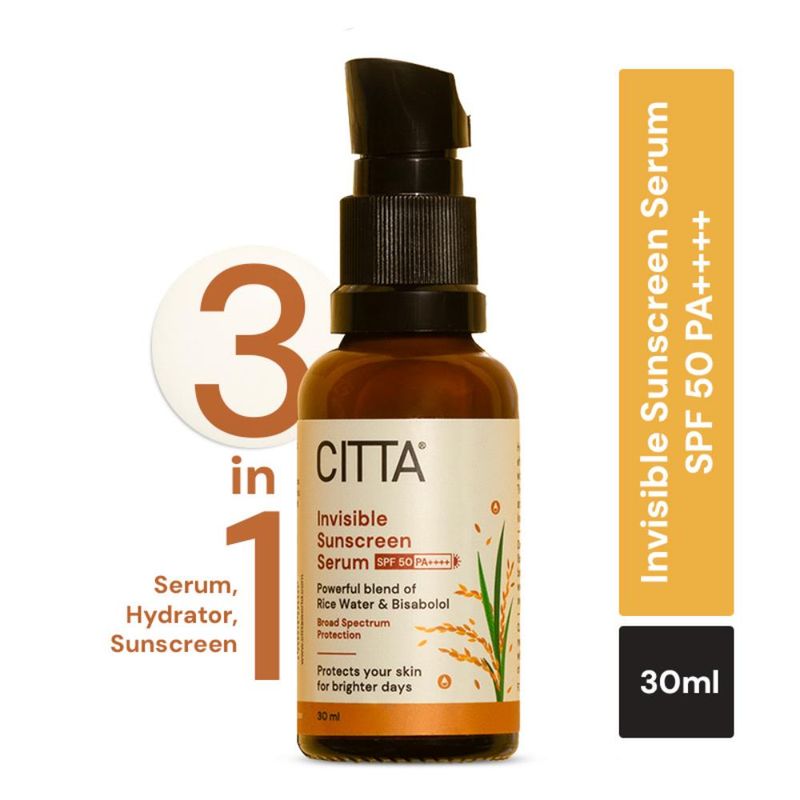
Citta Invisible Sunscreen Serum Spf 50 Pa++++ For Oily Skin, No Whitecast, Non-Greasy.

Citta Invisible Sunscreen Serum Spf 50 Pa++++ For Oily Skin, No Whitecast, Non-Greasy.
Citta
citta-invisible-sunscreen-serum-spf-50-pa-for-oily-skin-no-whitecast-non-greasy
Suncare
10084899422501
Morning or Evening?
How often will you use this product?
Notes


Highlights
WHAT IS IT?
Sunscreen serum with 16 ingredients approx
FEATURES
Broad spectrum protection, Infused with rice water, bisabolol, and thanaka, Lightweight and hydrating formula, No white cast, Non-greasy, Quick absorbing, Vegan
BEST FOR
oily
CHECKS
No white cast, Non-greasy, No sticky residue
Who Is It For?
Men And Women All AgesWhat Does It Help With?
Uv Protection Hydration Soothing Skin Nourishment Sun Damage DefenseBudget
Mid-range ($30-$75)How To Use
Which routine should it be used in?
Instructions:
Key Information


What Citta Says
Product Description:
CITTA Invisible Sunscreen Serum SPF 50 PA++++ for men and women is the ultimate shield against harmful UV rays. Infused with a power blend of rice water, bisabolol, and thanaka, this sunscreen serum for all skin types offers powerful broad-spectrum protection without the white cast. Featuring a unique watery-light texture, this sunscreen serum glides effortlessly onto the skin, providing long-lasting hydration while remaining non-greasy and quick-absorbing. Ideal for daily use, it acts as a natural sunblock while keeping the skin protected and radiant throughout the day.
About the Brand:
Ingredients Overview
Ingredients List
Aqua,Ethylhexyl-Methoxycinnamate,Butyl-Methoxydibenzoylmethane,Benzophenone-3,Glycerin,Caprylic-Capric-Triglyceride,Sodium-Acrylates-Copolymer,Lecithin,Propylene-Glycol,Carica-Papaya-Fruit-Juice,Citrus-Limon-Juice,Limonia-Acidissima-Wood-Powder,Pachyrhizus-Erosus-Root-Extract,Punica-Granatum-Fruit-Juice,Maltodextrin,Bisabolol,Phospholipids,1,3-butylene-Glycol,Phenoxyethanol,Oryza-Sativa-Bran-Water,Sodium-Gluconate,Ethylhexylglycerin
Key Ingredients
Rice water, Bisabolol, Thanaka
Ingredients Details
Benzophenone-3
Common Name(s): Oxybenzone,2-hydroxy-4-methoxybenzophenone,uva+uvb filter
CAS Number: 131-57-7
DESCRIPTION
What It Does: Provides combined uva and uvb filtration in a single chemical uv filter molecule.
Why It's Used: Combined uva+uvb filter historically used for broad-spectrum coverage in a single ingredient, now increasingly restricted.
How It Works: Benzophenone chromophore absorbs uvb (305nm) and uva-ii (326nm) via two separate n→π* transitions. water-soluble allows aqueous phase formulation. single filter providing partial broad-spectrum coverage.
Typically Found In: Sunscreens (being phased out in many markets)
TECHNICAL DETAILS
Primary Category: Active ingredient – chemical uva/uvb filter
Secondary Functions: Skin conditioning
Application Areas:

Facial Skincare

Body Care
Hair Care
Beard Care
Color Cosmetics (Makeup)
Dietary/Oral Supplements
Typical Concentration Range: Up to 6% (eu), 6% (us fda)
SOURCING & ETHICS
Vegan Status: Yes – synthetic
Halal Status: Yes
Source Notes: Commercially produced for cosmetic use. verify vegan/halal status with supplier.
SKIN COMPATIBILITY
Irritancy Rating: 1/5 – very low
Comedogenicity Rating: 0/5 – non-comedogenic
Sensitivity Concerns: Well-tolerated by most skin types.
Safe for Sensitive Skin: Yes
SAFETY & COMPATIBILITY
Safety Profile: Eu max 6%. coral reef/aquatic toxicity — banned hawaii, palau, some us states. potential endocrine activity at high systemic exposure. ewg score: 7. use declining due to regulatory pressure.
Works Well With: Standard skincare actives
Avoid Combining With: No known significant incompatibilities
SCIENTIFIC NOTE
Benzophenone-3's declining use reflects evolving understanding of environmental and endocrine impacts: discovered in coral bleaching studies, its restriction in hawaii (2018) sparked a global trend in marine-safe sunscreen formulations that is reshaping the industry away from bp-3 toward mineral filters and marine-safer organic alternatives.
Last Verified: Cosing database,fda uv filter otc monograph,hawaii bp-3 restriction law
Primary Sources: 2026-03-12
Bisabolol
Common Name(s): Alpha-bisabolol,levomenol,(-)-alpha-bisabolol
CAS Number: 515-69-5
DESCRIPTION
What It Does: Reduces skin inflammation, soothes irritation, promotes wound healing, and enhances penetration of co-formulated actives.
Why It's Used: Premium natural soothing active with combined anti-inflammatory, wound healing, and penetration-enhancing activity – clinically validated across sensitive, reactive, and irritated skin types.
How It Works: Inhibits nf-kb pathway reducing pro-inflammatory cytokines il-1β, il-6, tnf-α. enhances stratum corneum lipid fluidity increasing penetration of co-delivered actives. antimicrobial against s. aureus and c. albicans. promotes keratinocyte migration for wound healing.
Typically Found In: Sensitive skin products,post-procedure formulations,anti-irritant formulas,wound healing
TECHNICAL DETAILS
Primary Category: Active ingredient – soothing / anti-inflammatory
Secondary Functions: Anti-inflammatory,penetration enhancement,antimicrobial
Application Areas:
Facial Skincare
Body Care
Hair Care
Beard Care
Color Cosmetics (Makeup)
Dietary/Oral Supplements
Typical Concentration Range: 0.1%–1%
SOURCING & ETHICS
Vegan Status: Yes – from candeia tree (vanillosmopsis erythropappa) or synthetic
Halal Status: Yes
Source Notes: Natural (-)-alpha-bisabolol from brazilian candeia tree is more sustainable and potent than chamomile-derived bisabolol. synthetic (±)-bisabolol is racemic with slightly lower anti-inflammatory potency.
SKIN COMPATIBILITY
Irritancy Rating: 1/5 – very low
Comedogenicity Rating: 0/5 – non-comedogenic
Sensitivity Concerns: Non-irritating; ideal for reactive and sensitive skin.
Safe for Sensitive Skin: Yes – particularly recommended for sensitive skin
SAFETY & COMPATIBILITY
Safety Profile: Excellent safety profile. ewg score: 1.
Works Well With: Ceramides,panthenol,allantoin,hyaluronic acid,centella asiatica
Avoid Combining With: No significant incompatibilities
SCIENTIFIC NOTE
Bisabolol's dual function as both an anti-inflammatory and a penetration enhancer is synergistic – by reducing the inflammatory response that increases barrier tightness while simultaneously fluidizing stratum corneum lipids, it provides enhanced delivery of co-formulated actives in the very conditions where delivery is most needed.
Last Verified: Cosing database,piazza et al. bisabolol anti-inflammatory study,cir safety assessment
Primary Sources: 2026-03-12
Ethylhexylglycerin
Common Name(s): Octylglycerin,2-ethylhexyl glycerol ether,sensiva sc 10
CAS Number: 70445-33-9
DESCRIPTION
What It Does: Provides antimicrobial skin conditioning with deodorant activity and preservation system enhancement.
Why It's Used: Multifunctional clean beauty preservation active — ethylhexylglycerin provides antimicrobial, deodorant, and skin conditioning in a single ingredient accepted in most natural cosmetic certification schemes.
How It Works: Glycerol ether provides antimicrobial via bacterial membrane phospholipid disruption. deodorant activity via reduction of underarm lipase enzyme activity (similar mechanism to triethyl citrate). skin conditioning from glycerol humectant component. synergistic with phenoxyethanol and diols.
Typically Found In: Natural preservation systems,deodorants,skin conditioning products
TECHNICAL DETAILS
Primary Category: Functional ingredient – antimicrobial glycerol ether
Secondary Functions: Skin conditioning
Application Areas:
Facial Skincare
Body Care
Hair Care
Beard Care
Color Cosmetics (Makeup)
Dietary/Oral Supplements
Typical Concentration Range: 0.1%–0.5%
SOURCING & ETHICS
Vegan Status: Yes – synthetic
Halal Status: Yes
Source Notes: Commercially produced for cosmetic use. verify vegan/halal status with supplier.
SKIN COMPATIBILITY
Irritancy Rating: 1/5 – very low
Comedogenicity Rating: 0/5 – non-comedogenic
Sensitivity Concerns: Well-tolerated by most skin types.
Safe for Sensitive Skin: Yes
SAFETY & COMPATIBILITY
Safety Profile: Good safety profile at recommended concentrations. ewg score: 1–2.
Works Well With: Standard skincare actives
Avoid Combining With: No known significant incompatibilities
SCIENTIFIC NOTE
Ethylhexylglycerin's deodorant mechanism is pharmacologically identical to triethyl citrate: both inhibit skin surface microbial lipase enzymes that convert odourless triglycerides to odorous free fatty acids. the glycerol ether structure of ethylhexylglycerin, combined with the 2-ethylhexyl chain, provides lipase inhibition similar to ester-based lipase inhibitors from a different chemical class.
Last Verified: Cosing database,schülke sensiva sc 10 technical data,cir safety assessment
Primary Sources: 2026-03-12
Glycerin
Common Name(s): Glycerol,glycerine,1,2,3-propanetriol
CAS Number: 56-81-5
DESCRIPTION
What It Does: Glycerin pulls water from the environment and deeper skin layers into the outer skin layer (epidermis), boosting moisture levels and keeping skin soft, smooth, and plump.
Why It's Used: It is used in virtually every moisturizer, serum, and cleanser because it is highly effective at hydrating skin, is well-tolerated by all skin types, and enhances the texture and spreadability of formulations.
How It Works: As a humectant, glycerin forms hydrogen bonds with water molecules, trapping them in the skin. it also reinforces the skin barrier by integrating into lipid structures between skin cells.
Typically Found In: Moisturizers,serums,cleansers,toners,sheet masks,sunscreens,body lotions,shampoos,conditioners
TECHNICAL DETAILS
Primary Category: Humectant
Secondary Functions: Skin barrier support,emollient,solvent
Application Areas:
Facial Skincare
Body Care
Hair Care
Beard Care
Color Cosmetics (Makeup)
Dietary/Oral Supplements
Typical Concentration Range: 1%–30% (typical: 3–10%)
SOURCING & ETHICS
Vegan Status: Yes – plant-derived (coconut, soy, palm) or synthetic
Halal Status: Yes – when plant-derived or synthetic; verify source with supplier
Source Notes: Derived from plant oils via hydrolysis or saponification; synthetic versions also available. palm-derived glycerin carries sustainability concerns.
SKIN COMPATIBILITY
Irritancy Rating: 1/5 – very low; non-irritating at all standard concentrations
Comedogenicity Rating: 0/5 – non-comedogenic
Sensitivity Concerns: Extremely rare allergic reactions; generally safe for all skin types including sensitive and baby skin
Safe for Sensitive Skin: Yes
SAFETY & COMPATIBILITY
Safety Profile: Widely recognized as safe. ewg hazard score: 1. no significant concerns for irritation, sensitization, or toxicity at typical concentrations (up to 50%).
Works Well With: Hyaluronic acid,ceramides,niacinamide,panthenol,urea,peptides,retinol,ahas/bhas
Avoid Combining With: No known incompatibilities at standard concentrations
SCIENTIFIC NOTE
Glycerin is an endogenous skin component found naturally in the stratum corneum. aquaporin-3 channels in keratinocytes facilitate glycerin transport, making it integral to natural skin hydration pathways.
Last Verified: Cosing database,cir safety assessment,ewg skin deep,inci decoder
Primary Sources: 2026-03-12
