

dermalogica
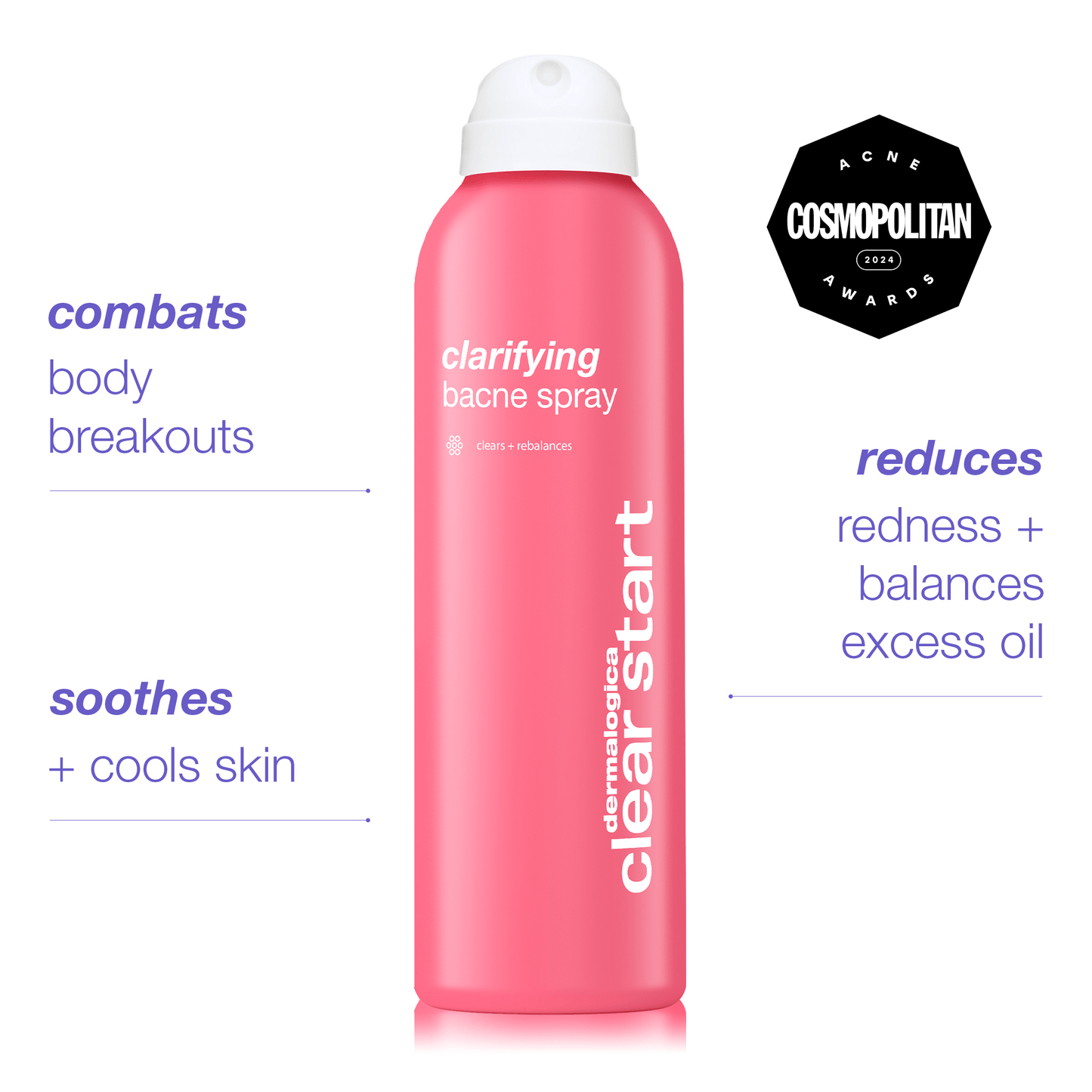
Clarifying Bacne Spray

Clarifying Bacne Spray
dermalogica
clarifying-bacne-spray
Body care
9784812241189
Morning or Evening?
How often will you use this product?
Notes


Highlights
WHAT IS IT?
Body acne treatment spray with 4 key active ingredients
FEATURES
Fast-acting, Upside-down spray functionality, Helps clear clogged pores, Minimizes future breakouts
BEST FOR
oily
CHECKS
Paraben-free, artificial colors-free, fragrances-free, gluten-free
Who Is It For?
All Ages With Body Acne ConcernsWhat Does It Help With?
Body Acne Clogged Pores Oil Balance RednessBudget
Affordable (under $30)How To Use
Which routine should it be used in?
Instructions:
Key Information


What dermalogica Says
Product Description:
This blemish-fighting body spray acts fast on those hard-to-reach areas to help clear clogged pores and minimize future body breakouts. The refreshing mist even disperses upside down so you'll never miss a spot. Exfoliating Salicylic Acid helps to remove dead skin cells, while soothing Witch Hazel, Tea Tree Oil and Moroccan Argan Oil balance oil and reduce redness.
About the Brand:
Ingredients Overview
Ingredients List
Water/Aqua/Eau, Hamamelis Virginiana (Witch Hazel) Water, Isoceteth-20, Ethoxydiglycol, Hexylene Glycol, Melaleuca Alternifolia (Tea Tree) Leaf Oil, Citrus Aurantium Dulcis (Orange) Peel Oil, Lavandula Angustifolia (Lavender) Oil, Citrus Limon (Lemon) Peel Oil, Cymbopogon Schoenanthus Oil, Argania Spinosa Kernel Oil, Citrus Reticulata (Tangerine) Leaf Oil, Camellia Sinensis Leaf Extract, Glycyrrhiza Glabra (Licorice) Root Extract, Porphyra Umbilicalis Extract, Serenoa Serrulata Fruit Extract, Sesamum Indicum (Sesame) Seed Oil, Butylene Glycol, Tocopherol, Beta-Sitosterol, Ethylhexylglycerin, Polysorbate 20, Sodium Hydroxide, Disodium EDTA, Phenoxyethanol, Benzoic Acid, Limonene, Linalool, Citral, Geraniol, Citronellol, Coumarin.
Key Ingredients
Salicylic Acid, Witch Hazel, Tea Tree Oil, Moroccan Argan Oil
Ingredients Details
Argania Spinosa Kernel Oil
Common Name(s): Argania spinosa kernel oil,botanical carrier oil,emollient fatty acid delivery
CAS Number: N/a
DESCRIPTION
What It Does: Softens and conditions skin by integrating into sc lipid bilayers, delivers essential fatty acids (oleic, linoleic, linolenic) for barrier lipid synthesis, and provides rich, non-stripping moisturisation.
Why It's Used: Natural carrier oils provide the closest compositional match to endogenous sc lipids, delivering emolliency through genuine barrier integration rather than simple surface occlusion.
How It Works: Fatty acid triglycerides partition into sc lipid bilayers — oleic acid (c18:1) provides fluid, emollient integration; linoleic acid (c18:2) acts as essential ceramide precursor; saturated fatty acids provide more occlusive barrier reinforcement.
Typically Found In: Moisturisers,facial oils,natural skin care
TECHNICAL DETAILS
Primary Category: Functional ingredient – emollient
Secondary Functions: Barrier sealing,softening
Application Areas:

Facial Skincare
Body Care
Hair Care

Beard Care
Color Cosmetics (Makeup)
Dietary/Oral Supplements
Typical Concentration Range: 1%–100%
SOURCING & ETHICS
Vegan Status: Conditional - supplier confirmation required
Halal Status: Unverified - supplier confirmation required
Source Notes: Plant-derived, synthetic or animal-derived. verify source. [audit 2026-07-29 rev2: the record's own source_notes does not assert a non-animal origin, or instructs the reader to verify with the supplier; "yes" asserts knowledge the record does not hold. determination requires shariah-panel sign-off.]
SKIN COMPATIBILITY
Irritancy Rating: 1/5 – very low
Comedogenicity Rating: 1/5 – low; formulation-dependent
Sensitivity Concerns: Non-irritating.
Safe for Sensitive Skin: Yes
SAFETY & COMPATIBILITY
Safety Profile: Excellent safety profile. ewg score: 1.
Works Well With: Humectants,ceramides,actives as carrier
Avoid Combining With: No significant incompatibilities
SCIENTIFIC NOTE
Essential fatty acids — linoleic (c18:2, n-6) and α-linolenic (c18:3, n-3) acids — cannot be synthesised by the body; topical delivery through carrier oils provides direct substrate for ceramide and eicosanoid biosynthesis in the epidermis.
Last Verified: 2026-03-12
Primary Sources: Cosing database,argania spinosa kernel oil carrier oil botanical review
Citrus Aurantium Dulcis Orange Peel Oil
Common Name(s): Citrus aurantium dulcis orange peel oil oil
DESCRIPTION
What It Does: Nourishes and softens skin through its balanced fatty acid profile, while antioxidant compounds protect against oxidative skin damage.
Why It's Used: Plant oils provide physiologically compatible lipid structures that integrate into the skin barrier and deliver fat-soluble antioxidants directly to skin cells.
How It Works: Fatty acids integrate into stratum corneum lipid lamellae, reinforcing the lipid barrier. antioxidants (tocopherols, carotenoids, polyphenols) neutralize ros through electron donation or singlet oxygen quenching.
Typically Found In: Face oils,serums,moisturizers,hair treatments,body oils
TECHNICAL DETAILS
Primary Category: Plant oils
Secondary Functions: Emollient,antioxidant
Application Areas:
Facial Skincare
Body Care
Hair Care
Beard Care
Color Cosmetics (Makeup)
Dietary/Oral Supplements
Typical Concentration Range: 0.5–30%
SOURCING & ETHICS
Vegan Status: Yes
Halal Status: Yes
Source Notes: Cold-pressed or solvent-extracted plant oil; no animal components.
SKIN COMPATIBILITY
Irritancy Rating: 1899-12-31 00:00:00 -0800
Comedogenicity Rating: 2000-01-01 00:00:00 -0800
Sensitivity Concerns: Low sensitization potential at recommended use concentrations.
Safe for Sensitive Skin: Yes
SAFETY & COMPATIBILITY
Safety Profile: Well-characterized cosmetic ingredient with established safety profile. generally non-irritating at typical use concentrations. suitable for leave-on and rinse-off cosmetics.
Works Well With: Vitamin e,ceramides,other plant oils,squalane
Avoid Combining With: Strong oxidizers (accelerate rancidity)
SCIENTIFIC NOTE
Vegetable oils are triglyceride matrices where the fatty acid composition determines skin compatibility, barrier function, and comedogenicity. oleic acid-rich oils (>60%) soften barrier lipids and enhance penetration; linoleic acid-rich oils reinforce ceramide-poor stratum corneum; saturated fatty acid-rich oils provide occlusion without skin penetration.
Last Verified: 2025-01-15
Primary Sources: Cosing eu database; pcpc cosmetic ingredient safety reviews; aocs plant oil composition databases; fatty acid pharmacology reviews
Citrus Limon Lemon Peel Oil
Common Name(s): Citrus limon lemon peel oil oil
DESCRIPTION
What It Does: Nourishes and softens skin through its balanced fatty acid profile, while antioxidant compounds protect against oxidative skin damage.
Why It's Used: Plant oils provide physiologically compatible lipid structures that integrate into the skin barrier and deliver fat-soluble antioxidants directly to skin cells.
How It Works: Fatty acids integrate into stratum corneum lipid lamellae, reinforcing the lipid barrier. antioxidants (tocopherols, carotenoids, polyphenols) neutralize ros through electron donation or singlet oxygen quenching.
Typically Found In: Face oils,serums,moisturizers,hair treatments,body oils
TECHNICAL DETAILS
Primary Category: Plant oils
Secondary Functions: Emollient,antioxidant
Application Areas:
Facial Skincare
Body Care
Hair Care
Beard Care
Color Cosmetics (Makeup)
Dietary/Oral Supplements
Typical Concentration Range: 0.5–30%
SOURCING & ETHICS
Vegan Status: Yes
Halal Status: Yes
Source Notes: Cold-pressed or solvent-extracted plant oil; no animal components.
SKIN COMPATIBILITY
Irritancy Rating: 1899-12-31 00:00:00 -0800
Comedogenicity Rating: 2000-01-01 00:00:00 -0800
Sensitivity Concerns: Low sensitization potential at recommended use concentrations.
Safe for Sensitive Skin: Yes
SAFETY & COMPATIBILITY
Safety Profile: Well-characterized cosmetic ingredient with established safety profile. generally non-irritating at typical use concentrations. suitable for leave-on and rinse-off cosmetics.
Works Well With: Vitamin e,ceramides,other plant oils,squalane
Avoid Combining With: Strong oxidizers (accelerate rancidity)
SCIENTIFIC NOTE
Vegetable oils are triglyceride matrices where the fatty acid composition determines skin compatibility, barrier function, and comedogenicity. oleic acid-rich oils (>60%) soften barrier lipids and enhance penetration; linoleic acid-rich oils reinforce ceramide-poor stratum corneum; saturated fatty acid-rich oils provide occlusion without skin penetration.
Last Verified: 2025-01-15
Primary Sources: Cosing eu database; pcpc cosmetic ingredient safety reviews; aocs plant oil composition databases; fatty acid pharmacology reviews
Cymbopogon Schoenanthus Oil
Common Name(s): Cymbopogon schoenanthus oil,cymbopogon schoenanthus oil,essential oil,concentrated volatile plant extract
CAS Number: N/a
DESCRIPTION
What It Does: Provides aromatic fragrance from volatile terpenoid constituents alongside bioactive skin activity — the same mono and sesquiterpene compounds providing both olfactory benefit and pharmacological activity at cosmetic use concentrations.
Why It's Used: Essential oils provide authentic aromatherapy narrative with genuine bioactive chemistry — concentrated terpenoid profiles delivering documented biological activity alongside fragrance function.
How It Works: Steam distillation concentrates volatile secondary metabolites. antimicrobial activity from terpenoid membrane disruption (phenols: thymol, carvacrol; monoterpene alcohols: terpinen-4-ol, linalool). anti-inflammatory from sesquiterpene nf-kb inhibition. antioxidant from phenylpropanoid radical donation. eu allergen monitoring required for individual components.
Typically Found In: Aromatherapy,natural fragrance,bioactive care
TECHNICAL DETAILS
Primary Category: Active ingredient – antioxidant
Secondary Functions: Free radical scavenging,anti-aging
Application Areas:
Facial Skincare
Body Care
Hair Care
Beard Care
Color Cosmetics (Makeup)
Dietary/Oral Supplements
Typical Concentration Range: 0.01%–2%
SOURCING & ETHICS
Vegan Status: Yes
Halal Status: Yes
Source Notes: Plant-derived extract or synthetic.
SKIN COMPATIBILITY
Irritancy Rating: 1/5 – very low
Comedogenicity Rating: 0/5 – non-comedogenic
Sensitivity Concerns: Non-irritating; well-tolerated.
Safe for Sensitive Skin: Yes
SAFETY & COMPATIBILITY
Safety Profile: Excellent safety profile. ewg score: 1.
Works Well With: Vitamin c,vitamin e,ferulic acid,spf,other antioxidants
Avoid Combining With: No significant incompatibilities
SCIENTIFIC NOTE
Ifra sets category-specific maximum use levels for each essential oil based on qra of sensitising terpenoid components. auto-oxidation of terpene constituents increases sensitisation risk in aged/improperly stored oils — antioxidant stabilisation and freshness dating recommended.
Last Verified: 2026-03-22
Primary Sources: Cosing database,ifra standards,cymbopogon schoenanthus oil essential oil review