
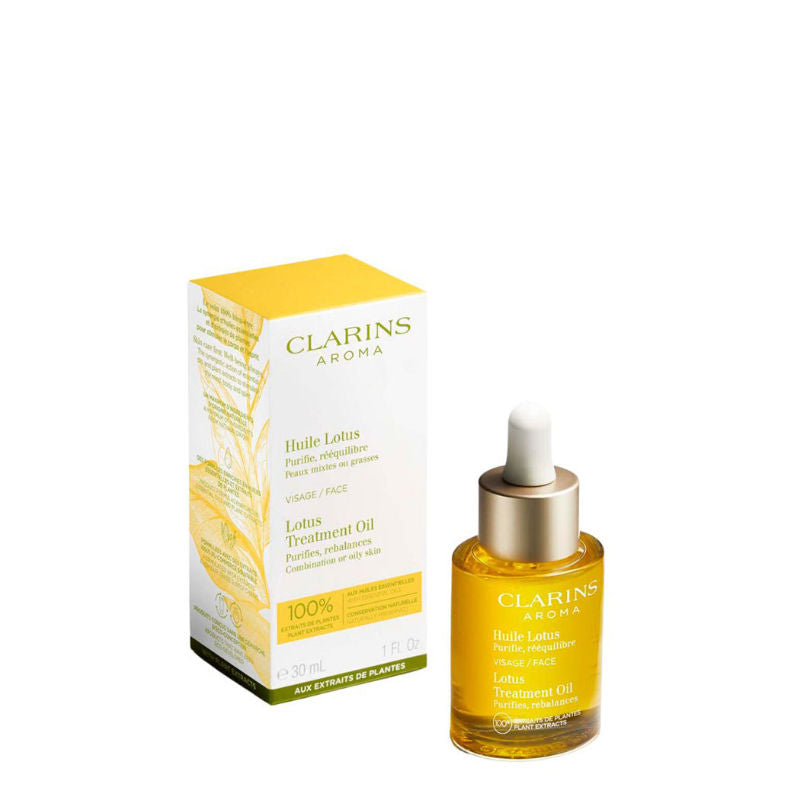

Clarins
Clarins Lotus Face Oil

Clarins Lotus Face Oil
Clarins
clarins-lotus-face-oil
Face Oil
10085016437029
Morning or Evening?
How often will you use this product?
Notes


Highlights
WHAT IS IT?
Face Oil made with 12 ingredients
FEATURES
Rebalances and tightens pores, protects against dehydration, keeps skin supple and satiny soft
BEST FOR
combination
CHECKS
Paraben-Free,Sulfate-free,PEG-free,Alcohol-free,Fragrance-free,Silicone-free
Who Is It For?
What Does It Help With?
Balances Skin Tightens Pores Protects Against Dehydration Refines Skin Texture Prevents Fine LinesBudget
Premium ($76-$150)How To Use
Which routine should it be used in?
Instructions:
Key Information


What Clarins Says
Product Description:
Perfect for combination or oily skin, this facial oil utilises the principles of aromatherapy and phytotherapy by combining plant extracts and essential oils to help balance the skin. Made from 100% pure plant extracts, it contains Clarins' exclusive blend of rosemary, geranium and lotus extracts, which purify the skin, tighten pores and refine skin texture. Hazelnut oil softens, soothes and seals in moisture to prevent fine lines and moisture loss. Benefits: Rebalances and tightens the pores, Protects against dehydration, Leaves the skin supple and satiny soft.
About the Brand:
Ingredients Overview
Ingredients List
corylus-avellana-hazel-seed-oil,pelargonium-graveolens-flower-oil,parfum-fragrance,rosmarinus-officinalis-rosemary-leaf-oil,helianthus-annuus-sunflower-seed-oil,anthemis-nobilis-flower-oil,salvia-sclarea-clary-oil,nelumbo-nucifera-flower-extract,tocopherol,citronellol,linalool,geraniol,limonene,citral,coumarin,benzyl-benzoate
Key Ingredients
hazelnut oil, rosemary extract, geranium extract, lotus extract
Ingredients Details
Citral
Common Name(s): 3,7-dimethyl-2,6-octadienal,geranial+neral mix
CAS Number: 5392-40-5
DESCRIPTION
What It Does: Provides the defining intense lemon-citrus fragrance note.
Why It's Used: The lemon scent compound – citral defines the fresh lemon scent in lemon essential oil and lemongrass with potent antimicrobial activity.
How It Works: Mixture of e-isomer (geranial) and z-isomer (neral). antimicrobial via michael addition to thiol enzymes. inhibits nf-kb for anti-inflammatory activity. antioxidant via allylic aldehyde.
Typically Found In: Citrus fragrances,antibacterial products,lemon-scented cosmetics
TECHNICAL DETAILS
Primary Category: Fragrance component – lemon aldehyde
Secondary Functions: Skin conditioning
Application Areas:

Facial Skincare

Body Care
Hair Care
Beard Care
Color Cosmetics (Makeup)
Dietary/Oral Supplements
Typical Concentration Range: 0.001%–0.5%
SOURCING & ETHICS
Vegan Status: Yes – from lemon, lemongrass, melissa oils
Halal Status: Yes
Source Notes: Commercially produced for cosmetic use. verify vegan/halal status with supplier.
SKIN COMPATIBILITY
Irritancy Rating: 1/5 – very low
Comedogenicity Rating: 0/5 – non-comedogenic
Sensitivity Concerns: Well-tolerated by most skin types.
Safe for Sensitive Skin: Yes
SAFETY & COMPATIBILITY
Safety Profile: Eu cosmetics regulation: declared fragrance allergen. high sensitisation potential from alpha,beta-unsaturated aldehyde structure. ifra strict limits.
Works Well With: Standard skincare actives
Avoid Combining With: No known significant incompatibilities
SCIENTIFIC NOTE
Citral's high sensitisation potential (llna ec3 ~0.11%) is a consequence of its alpha,beta-unsaturated aldehyde structure providing a highly reactive michael acceptor for skin protein covalent binding. the e/z mixture (geranial/neral) in natural citral means both isomers contribute to the sensitisation burden – explaining why lemongrass oil (very high citral content, ~60-80%) is one of the more common essential oil allergens.
Last Verified: Cosing database,ifra standards
Primary Sources: 2026-03-12
Citronellol
Common Name(s): (r)-3,7-dimethyl-6-octen-1-ol,rhodinol
CAS Number: 106-22-9
DESCRIPTION
What It Does: Provides soft, lasting rose-floral fragrance note.
Why It's Used: Essential rose fragrance monoterpene for lasting smooth floral notes in high-quality perfumery and cosmetic fragrances.
How It Works: Allylic alcohol monoterpene provides fixative property in fragrance blends. good skin substantivity for lasting scent. softer, rounder rose note vs geraniol's fresher character. natural in rose otto at 18-34%.
Typically Found In: Rose perfumes,floral fragrances,luxury skincare
TECHNICAL DETAILS
Primary Category: Fragrance component – monoterpene alcohol
Secondary Functions: Skin conditioning
Application Areas:
Facial Skincare
Body Care
Hair Care
Beard Care
Color Cosmetics (Makeup)
Dietary/Oral Supplements
Typical Concentration Range: 0.001%–1%
SOURCING & ETHICS
Vegan Status: Yes – from rose, geranium, citronella oils
Halal Status: Yes
Source Notes: Commercially produced for cosmetic use. verify vegan/halal status with supplier.
SKIN COMPATIBILITY
Irritancy Rating: 1/5 – very low
Comedogenicity Rating: 0/5 – non-comedogenic
Sensitivity Concerns: Well-tolerated by most skin types.
Safe for Sensitive Skin: Yes
SAFETY & COMPATIBILITY
Safety Profile: Eu cosmetics regulation: declared fragrance allergen. ifra guidelines apply.
Works Well With: Standard skincare actives
Avoid Combining With: No known significant incompatibilities
SCIENTIFIC NOTE
Citronellol's r-enantiomer (natural) vs s-enantiomer (synthetic) provide meaningfully different scent character – a remarkable demonstration of chiral scent discrimination by olfactory receptors. the (r) form provides the characteristic rose note while the (s) form has a distinctly different, less pleasant character. this enantiomeric scent difference means that the biological handedness of naturally-sourced vs racemic synthetic citronellol produces perceptibly different fragrance quality.
Last Verified: Cosing database,ifra standards
Primary Sources: 2026-03-12
Coumarin
Common Name(s): 2h-chromen-2-one,1,2-benzopyrone,tonka bean compound
CAS Number: 91-64-5
DESCRIPTION
What It Does: Provides the characteristic sweet hay-vanilla warmth central to fougère fragrance compositions.
Why It's Used: The fougère fragrance family-defining compound – coumarin is the essential warm-sweet note in lavender-oakmoss-coumarin fougère compositions that define men's cologne classics.
How It Works: Bicyclic lactone provides sweet hay-vanilla scent from its conjugated carbonyl system. good skin absorption for lasting fragrance. low volatility provides fixative properties.
Typically Found In: Fougère fragrances,men's cologne,warm oriental fragrances
TECHNICAL DETAILS
Primary Category: Fragrance component – lactone
Secondary Functions: Skin conditioning
Application Areas:
Facial Skincare
Body Care
Hair Care
Beard Care
Color Cosmetics (Makeup)
Dietary/Oral Supplements
Typical Concentration Range: 0.001%–1%
SOURCING & ETHICS
Vegan Status: Yes – synthetic; natural from dipteryx odorata
Halal Status: Yes
Source Notes: Commercially produced for cosmetic use. verify vegan/halal status with supplier.
SKIN COMPATIBILITY
Irritancy Rating: 1/5 – very low
Comedogenicity Rating: 0/5 – non-comedogenic
Sensitivity Concerns: Well-tolerated by most skin types.
Safe for Sensitive Skin: Yes
SAFETY & COMPATIBILITY
Safety Profile: Eu cosmetics regulation: declared fragrance allergen. ifra guidelines restrict due to hepatotoxicity at high oral doses (not from topical use).
Works Well With: Standard skincare actives
Avoid Combining With: No known significant incompatibilities
SCIENTIFIC NOTE
Coumarin's natural source (tonka beans, dipteryx odorata) led to its historical use in food flavouring until toxicological studies revealed hepatotoxicity at high oral doses. the restriction of coumarin from food flavouring (eu and fda) drove fragrance reformulation in some cosmetic categories, though topical exposure levels from cosmetics are orders of magnitude below hepatotoxic doses.
Last Verified: Cosing database,ifra standards
Primary Sources: 2026-03-12
Geraniol
Common Name(s): (e)-3,7-dimethyl-2,6-octadien-1-ol,geranyl alcohol
CAS Number: 106-24-1
DESCRIPTION
What It Does: Provides fresh rose-geranium floral scent with antimicrobial activity.
Why It's Used: The rose fragrance terpene – geraniol defines the fresh, sweet rose-geranium note found in more than 60 essential oils and is essential for recreating natural floral fragrance profiles.
How It Works: Monoterpene alcohol inhibits bacterial membrane integrity for antimicrobial activity. activates trpv1 for anti-nociception. inhibits nf-kb for anti-inflammatory activity. antioxidant via allylic radical scavenging.
Typically Found In: Rose-scented products,floral fragrances,natural cosmetics
TECHNICAL DETAILS
Primary Category: Fragrance component – acyclic monoterpene alcohol
Secondary Functions: Skin conditioning
Application Areas:
Facial Skincare
Body Care
Hair Care
Beard Care
Color Cosmetics (Makeup)
Dietary/Oral Supplements
Typical Concentration Range: 0.001%–1%
SOURCING & ETHICS
Vegan Status: Yes – from rose, geranium, palmarosa oils
Halal Status: Yes
Source Notes: Commercially produced for cosmetic use. verify vegan/halal status with supplier.
SKIN COMPATIBILITY
Irritancy Rating: 1/5 – very low
Comedogenicity Rating: 0/5 – non-comedogenic
Sensitivity Concerns: Well-tolerated by most skin types.
Safe for Sensitive Skin: Yes
SAFETY & COMPATIBILITY
Safety Profile: Eu cosmetics regulation: declared fragrance allergen. ifra guidelines apply.
Works Well With: Standard skincare actives
Avoid Combining With: No known significant incompatibilities
SCIENTIFIC NOTE
Geraniol's isomers (geraniol, nerol, citronellol) provide subtly different scent characters despite identical molecular formulae (c10h18o): geraniol provides the sweet, fresh rose note while its z-isomer nerol has a more delicate, neroli-like character. these isomeric scent differences arise from different spatial presentation of the hydroxyl and double bond groups to the olfactory receptor – demonstrating the extraordinary structural sensitivity of olfactory perception.
Last Verified: Cosing database,ifra standards
Primary Sources: 2026-03-12
