

Paula's Choice
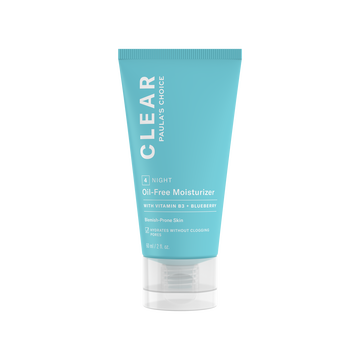
CLEAR Oil-Free Moisturizer

CLEAR Oil-Free Moisturizer
Paula's Choice
clear-oil-free-moisturizer
Moisturize
9818301169957
Morning or Evening?
How often will you use this product?
Notes


Highlights
WHAT IS IT?
Oil-free moisturizer
FEATURES
Lightweight, non-greasy formula that hydrates and soothes acne-prone skin
BEST FOR
Dry, normal, combination, oily
CHECKS
Free of alcohol, oil, fragrances, parabens, sulfates, silicon
Who Is It For?
All Ages With Acne-prone SkinWhat Does It Help With?
Hydration Acne-prone SkinBudget
Mid-range ($30-$75)How To Use
Which routine should it be used in?
Instructions:
Key Information


What Paula's Choice Says
Product Description:
Lightweight oil-free moisturizer that hydrates and calms acne-prone skin
About the Brand:
Ingredients Overview
Ingredients List
water,glycerin,sodium-hyaluronate,ceramide-3
Key Ingredients
glycerin,sodium-hyaluronate,ceramide-3
Ingredients Details
Ceramide 3
Common Name(s): Ceramide 3
DESCRIPTION
What It Does: Provides antioxidant protection, soothing anti-inflammatory effects, and skin-conditioning benefits through plant-derived polyphenols and phytochemicals.
Why It's Used: Plant extracts concentrate bioactive phytochemicals evolved for environmental protection — uv, microbial, and oxidative stressors — that translate to skin benefits.
How It Works: Polyphenols (flavonoids, phenolic acids) inhibit nf-κb-mediated inflammatory signaling, scavenge reactive oxygen species through electron donation, and chelate pro-oxidant metal ions to reduce oxidative skin damage.
Typically Found In: Lipsticks,balms,creams,deodorants
TECHNICAL DETAILS
Primary Category: Waxes
Secondary Functions: Emollient,film former
Application Areas:

Facial Skincare

Body Care
Hair Care
Beard Care
Color Cosmetics (Makeup)
Dietary/Oral Supplements
Typical Concentration Range: 1–40%
SOURCING & ETHICS
Vegan Status: Yes
Halal Status: Yes
Source Notes: Plant-derived or synthetic wax; check source for vegan status.
SKIN COMPATIBILITY
Irritancy Rating: 1
Comedogenicity Rating: 1
Sensitivity Concerns: Low sensitization potential at recommended use concentrations.
Safe for Sensitive Skin: Yes
SAFETY & COMPATIBILITY
Safety Profile: Well-characterized cosmetic ingredient with established safety profile. generally non-irritating at typical use concentrations. suitable for leave-on and rinse-off cosmetics.
Works Well With: Other waxes,emollients,pigments
Avoid Combining With: Strongly alkaline conditions
SCIENTIFIC NOTE
Plant secondary metabolites (flavonoids, terpenes, phenolic acids) are biosynthesized as defense compounds against uv, herbivores, and pathogens. their anti-inflammatory activity typically derives from competitive inhibition of cox-2 and 5-lox enzymes (ic50 1–50 µm), while antioxidant activity involves single electron transfer (set) and hydrogen atom transfer (hat) mechanisms with structure-dependent rate constants.
Last Verified: Cosing eu database; pcpc cosmetic ingredient safety reviews; ingredient-specific safety and efficacy literature
Primary Sources: 2025-01-15
Glycerin
Common Name(s): Glycerol,glycerine,1,2,3-propanetriol
CAS Number: 56-81-5
DESCRIPTION
What It Does: Glycerin pulls water from the environment and deeper skin layers into the outer skin layer (epidermis), boosting moisture levels and keeping skin soft, smooth, and plump.
Why It's Used: It is used in virtually every moisturizer, serum, and cleanser because it is highly effective at hydrating skin, is well-tolerated by all skin types, and enhances the texture and spreadability of formulations.
How It Works: As a humectant, glycerin forms hydrogen bonds with water molecules, trapping them in the skin. it also reinforces the skin barrier by integrating into lipid structures between skin cells.
Typically Found In: Moisturizers,serums,cleansers,toners,sheet masks,sunscreens,body lotions,shampoos,conditioners
TECHNICAL DETAILS
Primary Category: Humectant
Secondary Functions: Skin barrier support,emollient,solvent
Application Areas:
Facial Skincare
Body Care
Hair Care
Beard Care
Color Cosmetics (Makeup)
Dietary/Oral Supplements
Typical Concentration Range: 1%–30% (typical: 3–10%)
SOURCING & ETHICS
Vegan Status: Yes – plant-derived (coconut, soy, palm) or synthetic
Halal Status: Yes – when plant-derived or synthetic; verify source with supplier
Source Notes: Derived from plant oils via hydrolysis or saponification; synthetic versions also available. palm-derived glycerin carries sustainability concerns.
SKIN COMPATIBILITY
Irritancy Rating: 1/5 – very low; non-irritating at all standard concentrations
Comedogenicity Rating: 0/5 – non-comedogenic
Sensitivity Concerns: Extremely rare allergic reactions; generally safe for all skin types including sensitive and baby skin
Safe for Sensitive Skin: Yes
SAFETY & COMPATIBILITY
Safety Profile: Widely recognized as safe. ewg hazard score: 1. no significant concerns for irritation, sensitization, or toxicity at typical concentrations (up to 50%).
Works Well With: Hyaluronic acid,ceramides,niacinamide,panthenol,urea,peptides,retinol,ahas/bhas
Avoid Combining With: No known incompatibilities at standard concentrations
SCIENTIFIC NOTE
Glycerin is an endogenous skin component found naturally in the stratum corneum. aquaporin-3 channels in keratinocytes facilitate glycerin transport, making it integral to natural skin hydration pathways.
Last Verified: Cosing database,cir safety assessment,ewg skin deep,inci decoder
Primary Sources: 2026-03-12
Sodium Hyaluronate
Common Name(s): Sodium salt of hyaluronic acid,naha
CAS Number: 9067-32-7
DESCRIPTION
What It Does: Provides hyaluronic acid hydration in the most formulation-stable and compatible form.
Why It's Used: The standard form of ha used in cosmetics – more stable than free ha, better solubility, and equivalent skin hydration benefits.
How It Works: Sodium salt reduces the polyelectrolyte repulsion of ha chains, allowing better packing in formulations. on skin, sodium ions dissociate and the ha chain unfolds to its full water-binding conformation. provides full ha humectant and barrier benefits equivalent to free ha.
Typically Found In: Hydrating serums,toners,moisturizers,sheet masks,anti-aging products
TECHNICAL DETAILS
Primary Category: Active ingredient – ha sodium salt
Secondary Functions: Equivalent ha hydration,superior stability
Application Areas:
Facial Skincare
Body Care
Hair Care
Beard Care
Color Cosmetics (Makeup)
Dietary/Oral Supplements
Typical Concentration Range: 0.1%–2%
SOURCING & ETHICS
Vegan Status: Yes – bacterial fermentation
Halal Status: Yes
Source Notes: Synthetic or naturally derived. excellent aqueous solubility.
SKIN COMPATIBILITY
Irritancy Rating: 1/5 – very low
Comedogenicity Rating: 0/5 – non-comedogenic
Sensitivity Concerns: Non-irritating; suitable for all skin types.
Safe for Sensitive Skin: Yes
SAFETY & COMPATIBILITY
Safety Profile: Excellent safety profile. ewg score: 1.
Works Well With: Ceramides,emollients,occlusives,glycerin,hyaluronic acid
Avoid Combining With: No significant incompatibilities
SCIENTIFIC NOTE
The sodium salt form of ha has approximately 10% better water solubility than free hyaluronic acid at equivalent molecular weight due to reduced chain-chain electrostatic repulsion from partial sodium counterion screening. this improved solubility enables higher concentration formulations without viscosity issues.
Last Verified: Cosing database,cir safety assessment
Primary Sources: 2026-03-12
