

CLINELLE
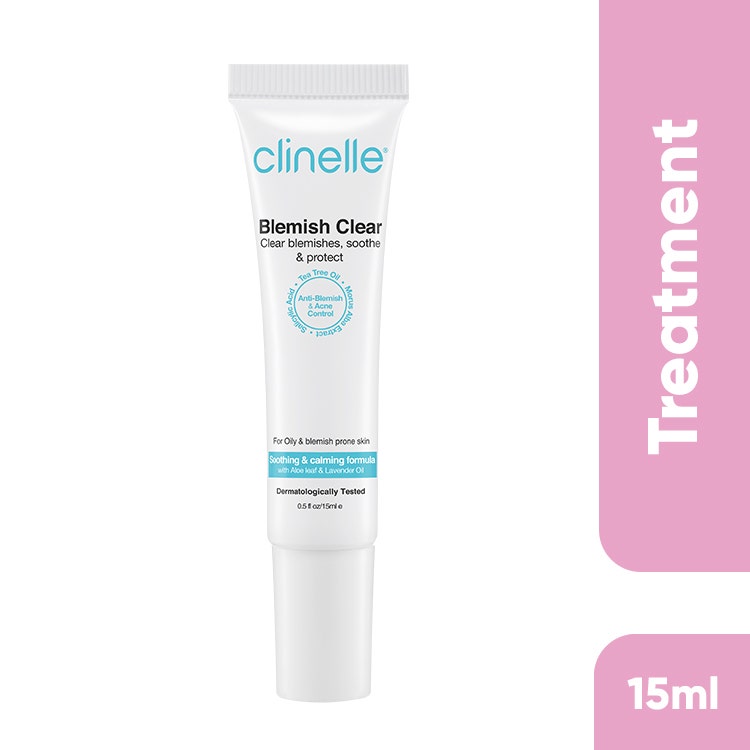
Clinelle Blemish Clear 15Ml

Clinelle Blemish Clear 15Ml
CLINELLE
clinelle-blemish-clear-15ml
Serum
10084806328613
Morning or Evening?
How often will you use this product?
Notes


Highlights
WHAT IS IT?
Anti-blemish gel with multiple active ingredients
FEATURES
Effectively clears blemishes without redness; Controls excessive sebum production; Promotes micro-circulation for cell renewal; Soothing and regenerative properties; Protects skin from free-radical damage
BEST FOR
combination
CHECKS
Contains parabens, contains fragrance
Who Is It For?
Adults UnisexWhat Does It Help With?
Blemishes Scar Lightening Controlling Sebum Skin Renewal Soothing Irritated SkinBudget
Affordable (under $30)How To Use
Which routine should it be used in?
Instructions:
Key Information


What CLINELLE Says
Product Description:
An anti-blemish gel to effectively clear blemish without redness. Contains powerful purifying agents Isodecyl Salicylate and Zinc PCA, Niacinamide (Vitamin B3)-Biotin, Panthenol (Pro-Vitamin B5), Pyridoxine HCI (Vitamin B6) to control excessive sebum production and promote micro-circulation for cell renewal. Aloe Barbadensis (Aloe Vera) Leaf Extract, Allantoin and Essential Oil of Lavender provide soothing and regenerative properties. Skin is protected from free-radical damages by Essential Oil of Citrus (Lemon).
About the Brand:
Ingredients Overview
Ingredients List
Aqua-Water,Hydrogenated-Polyisobutene,Hydrolyzed-Yeast-Protein,Orzya-Sativa-Rice-Hull-Powder,Isodecyl-Salicylate,Ammonium-Acryloyldimethyl-Taurate-VP-Copolymer,Phenoxyethanol,PPG-26-Buteth-26,PEG-40-Hydrogenated-Castor-Oil,Zinc-PCA,Methylparaben,Glycerin,Propylene-Glycol,Tetrasodium-EDTA,Aloe-Barbadensis-Leaf-Extract,Citrus-Medica-Limonum-Lemon-Peel-Oil,Lavandula-Hybrida-Oil,Butylparaben,Ethylparaben,Allantoin,Pyridoxine-HCI,Niacinamide,Panthenol,Propylparaben,Isobutylparaben,Citric-Acid,Chlorphenesin,Biotin,Tromethamine,Potassium-Sorbate,Disodium-EDTA
Key Ingredients
Isodecyl Salicylate,Zinc PCA,Niacinamide,Panthenol,Pyridoxine HCI,Aloe Barbadensis Leaf Extract,Allantoin,Essential Oil of Lavender,Essential Oil of Citrus (Lemon),Biotin
Ingredients Details
Allantoin
Common Name(s): 5-ureidohydantoin,glyoxyldiureide,aluminum dihydroxy allantoinate
CAS Number: 97-59-6
DESCRIPTION
What It Does: Soothes irritation, accelerates wound healing, promotes skin cell renewal, and provides mild keratolytic exfoliation.
Why It's Used: Gold standard multi-function soothing active – one of the most widely used cosmetic ingredients across all product types for its exceptional tolerability and clinically proven multi-action skin conditioning.
How It Works: Promotes keratinocyte proliferation and fibroblast migration for wound healing. mild keratolytic activity by disrupting corneocyte binding. anti-irritant via direct protein binding and anti-inflammatory cytokine reduction. humectant activity via hydroxyl groups.
Typically Found In: Post-procedure products,sensitive skin formulas,wound care,anti-acne treatments,baby products
TECHNICAL DETAILS
Primary Category: Active ingredient – soothing / anti-inflammatory
Secondary Functions: Wound healing,keratolytic,anti-irritant
Application Areas:

Facial Skincare
Body Care

Hair Care
Beard Care
Color Cosmetics (Makeup)
Dietary/Oral Supplements
Typical Concentration Range: 0.1%–2%
SOURCING & ETHICS
Vegan Status: Conditional - feedstock declaration required
Halal Status: Unverified - feedstock declaration required (plant, animal and petrochemical routes all exist)
Source Notes: Plant-derived extract or synthetic. [audit 2026-07-29 rev2: origin-dependent: the same inci exists in plant, animal and petrochemical versions and the name does not discriminate. determination requires shariah-panel sign-off.]
SKIN COMPATIBILITY
Irritancy Rating: 1/5 – very low
Comedogenicity Rating: 0/5 – non-comedogenic
Sensitivity Concerns: Exceptionally well-tolerated; suitable for all skin types including baby and compromised skin.
Safe for Sensitive Skin: Yes – particularly recommended for sensitive skin
SAFETY & COMPATIBILITY
Safety Profile: Excellent safety profile. ewg score: 1.
Works Well With: Ceramides,panthenol,allantoin,hyaluronic acid,centella asiatica
Avoid Combining With: No significant incompatibilities
SCIENTIFIC NOTE
Allantoin's keratinocyte proliferation stimulation occurs via receptor-mediated signaling (possibly machr activation) rather than non-specific irritation-driven proliferation, making it a true wound-healing stimulant rather than a pro-inflammatory proliferative signal.
Last Verified: 2026-03-12
Primary Sources: Cosing database,cir safety assessment,araújo et al. allantoin review
Biotin
Common Name(s): Vitamin b7,vitamin h,d-biotin
CAS Number: 58-85-5
DESCRIPTION
What It Does: Supports keratin production for stronger hair and nails.
Why It's Used: Hair and nail keratin infrastructure support; widely marketed despite evidence being primarily oral supplementation-based.
How It Works: Coenzyme for carboxylase enzymes essential for fatty acid synthesis and amino acid metabolism relevant to hair follicle function.
Typically Found In: Hair growth shampoos,nail treatments,multivitamin products
TECHNICAL DETAILS
Primary Category: Active ingredient – vitamin b7
Secondary Functions: Hair growth support,nail strengthening
Application Areas:
Facial Skincare
Body Care
Hair Care
Beard Care
Color Cosmetics (Makeup)
Dietary/Oral Supplements
Typical Concentration Range: 0.01%–0.5%
SOURCING & ETHICS
Vegan Status: Conditional - feedstock declaration required
Halal Status: Unverified - feedstock declaration required (plant, animal and petrochemical routes all exist)
Source Notes: Synthetically produced for cosmetic use. [audit 2026-07-29 rev2: origin-dependent: the same inci exists in plant, animal and petrochemical versions and the name does not discriminate. determination requires shariah-panel sign-off.]
SKIN COMPATIBILITY
Irritancy Rating: 1/5 – very low
Comedogenicity Rating: 0/5 – non-comedogenic
Sensitivity Concerns: Non-irritating; excellent tolerability.
Safe for Sensitive Skin: Yes
SAFETY & COMPATIBILITY
Safety Profile: Excellent safety profile. ewg score: 1.
Works Well With: Other b vitamins,niacinamide,antioxidant complexes
Avoid Combining With: No significant incompatibilities
SCIENTIFIC NOTE
Evidence for topical biotin efficacy in hair growth is limited – most clinical evidence comes from oral supplementation in biotin-deficient individuals.
Last Verified: 2026-03-12
Primary Sources: Cosing database,cir safety assessment,patel et al. (2017) skin appendage disorders
Butylparaben
Common Name(s): Cosmetic preservative,microbial growth inhibitor,product stability agent
CAS Number: N/a
DESCRIPTION
What It Does: Prevents microbial contamination that would otherwise render water-containing cosmetics unsafe — inhibiting bacterial, fungal, and yeast growth through membrane disruption, enzyme inhibition, or metabolic interference at permitted regulatory concentrations.
Why It's Used: Preservatives are safety-critical — un-preserved water-containing cosmetics can develop dangerous microbial contamination (pseudomonas aeruginosa eye infections, s. aureus skin infections) within days. preservation is a regulatory requirement, not an optional enhancement.
How It Works: Mechanism varies by class: organic acids (benzoic, dehydroacetic) disrupt intracellular ph in bacteria and fungi by proton flux across membranes; parabens inhibit membrane-associated enzyme function; chlorhexidine disrupts bacterial and fungal membrane integrity through divalent ion chelation of membrane phospholipids.
Typically Found In: All aqueous formulations
TECHNICAL DETAILS
Primary Category: Active ingredient – cosmetic active
Secondary Functions: Skin conditioning
Application Areas:
Facial Skincare
Body Care
Hair Care
Beard Care
Color Cosmetics (Makeup)
Dietary/Oral Supplements
Typical Concentration Range: Check annex v eu limits
SOURCING & ETHICS
Vegan Status: Conditional - supplier confirmation required
Halal Status: Unverified - supplier confirmation required
Source Notes: Commercially produced for cosmetic use. verify vegan/halal status with supplier. [audit 2026-07-29 rev2: the record's own source_notes does not assert a non-animal origin, or instructs the reader to verify with the supplier; "yes" asserts knowledge the record does not hold. determination requires shariah-panel sign-off.]
SKIN COMPATIBILITY
Irritancy Rating: 1/5 – very low
Comedogenicity Rating: 0/5 – non-comedogenic
Sensitivity Concerns: Well-tolerated by most skin types.
Safe for Sensitive Skin: Yes
SAFETY & COMPATIBILITY
Safety Profile: Good safety profile at recommended concentrations. ewg score: 1–2.
Works Well With: Standard skincare actives
Avoid Combining With: No known significant incompatibilities
SCIENTIFIC NOTE
Eu regulation 1223/2009 annex v lists all permitted preservatives with maximum concentrations — preservatives not listed are prohibited. formulators must verify both permitted status and maximum concentration for each market before finalising preservation systems.
Last Verified: 2026-03-12
Primary Sources: Eu regulation 1223/2009 annex v,cosmetic preservative regulatory review
Chlorphenesin
Common Name(s): 3-(4-chlorophenoxy)-1,2-propanediol,globacid
CAS Number: 104-29-0
DESCRIPTION
What It Does: Provides gram-negative focused preservation complementary to phenoxyethanol for comprehensive spectrum coverage.
Why It's Used: Phenoxyethanol complement — chlorphenesin's gram-negative and antifungal coverage complements phenoxyethanol's gram-positive activity for full-spectrum preservation at lower individual concentrations.
How It Works: 4-chlorophenol ether glycol disrupts bacterial and fungal membranes. strong gram-negative activity (pseudomonas, e. coli). good candida antifungal activity. used with phenoxyethanol for synergistic broad-spectrum coverage. ph stable 3-9.
Typically Found In: Comprehensive preservation systems,baby products (low concentration)
TECHNICAL DETAILS
Primary Category: Functional ingredient – glycerol ether preservative
Secondary Functions: Skin conditioning
Application Areas:
Facial Skincare
Body Care
Hair Care
Beard Care
Color Cosmetics (Makeup)
Dietary/Oral Supplements
Typical Concentration Range: 0.1%–0.3%
SOURCING & ETHICS
Vegan Status: Conditional - supplier confirmation required
Halal Status: Unverified - supplier confirmation required
Source Notes: Commercially produced for cosmetic use. verify vegan/halal status with supplier. [audit 2026-07-29 rev2: the record's own source_notes does not assert a non-animal origin, or instructs the reader to verify with the supplier; "yes" asserts knowledge the record does not hold. determination requires shariah-panel sign-off.]
SKIN COMPATIBILITY
Irritancy Rating: 1/5 – very low
Comedogenicity Rating: 0/5 – non-comedogenic
Sensitivity Concerns: Well-tolerated by most skin types.
Safe for Sensitive Skin: Yes
SAFETY & COMPATIBILITY
Safety Profile: Eu max 0.3% cosmetics. good safety profile. synergistic combination with phenoxyethanol (0.3% pe + 0.1% chlorphenesin often equivalent to 1% pe alone).
Works Well With: Standard skincare actives
Avoid Combining With: No known significant incompatibilities
SCIENTIFIC NOTE
Chlorphenesin + phenoxyethanol synergy operates through a classic spectrum-filling combination: phenoxyethanol provides strong gram-positive antimicrobial activity while chlorphenesin provides gram-negative and antifungal coverage. the combination's minimum inhibitory concentration sum is subadditive (provides equivalent preservation at combined concentrations below what either alone would require) — textbook pharmacological synergy enabling lower total preservative load.
Last Verified: 2026-03-12
Primary Sources: Cosing database,eu preservative annex v,cir safety assessment