

Clinique
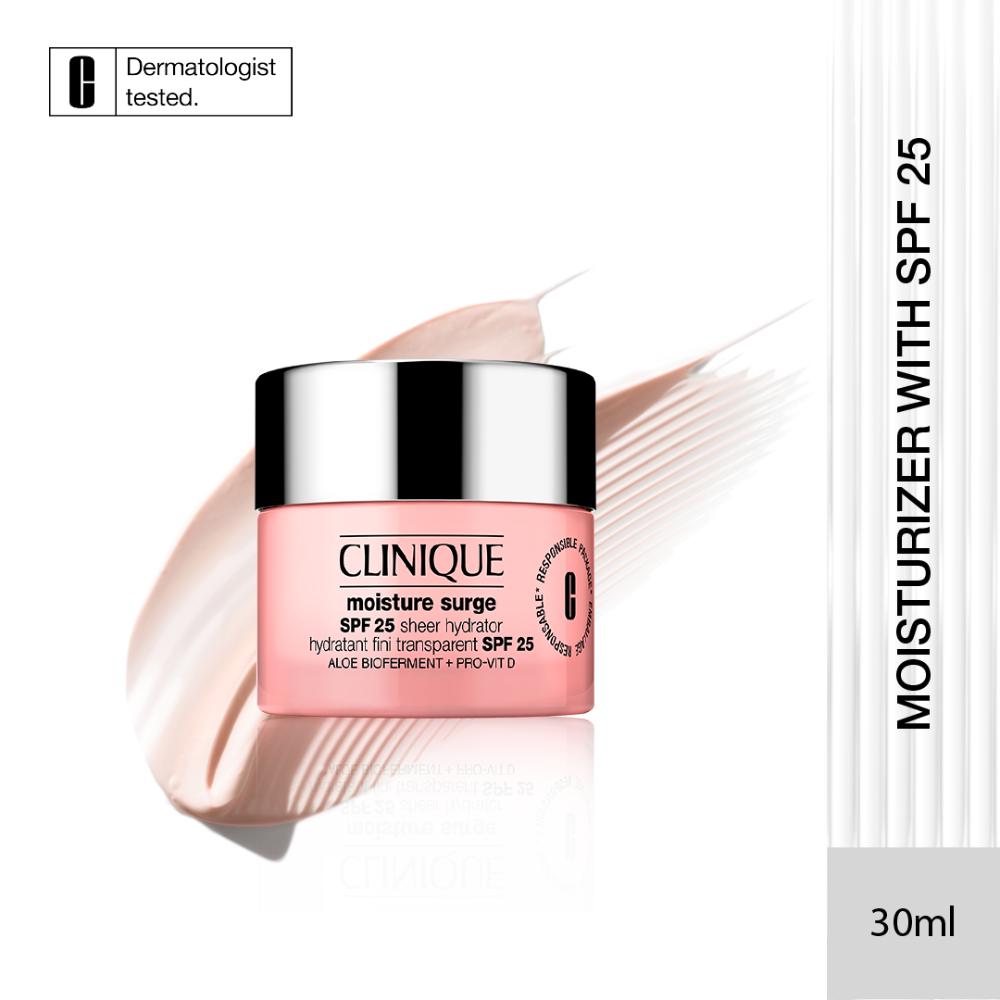
Clinique Moisture Surge SPF 25 Sheer Hydrator(Moisturiser + Sunscreen)

Clinique Moisture Surge SPF 25 Sheer Hydrator(Moisturiser + Sunscreen)
Clinique
clinique-moisture-surge-spf-25-sheer-hydrator-moisturiser-sunscreen
Moisturize
10084765270309
Morning or Evening?
How often will you use this product?
Notes


Highlights
WHAT IS IT?
Face Moisturizer with SPF 25 and 3 key ingredients
FEATURES
Deep hydration with hyaluronic acid and aloe vera bioferment; Sheer SPF 25 protection without white cast; Lightweight cream prepping skin for makeup; 100% fragrance free; Non-greasy and safe for sensitive skin
BEST FOR
all skin types (very dry, dry, combination, oily)
CHECKS
Fragrance, oil, drying alcohol
Who Is It For?
All Genders All Adult AgesWhat Does It Help With?
Hydration Uv Protection Skin Glow Moisturizing Dry To Oily SkinBudget
Premium ($76-$150)How To Use
Which routine should it be used in?
Instructions:
Key Information


What Clinique Says
Product Description:
Cloud-like face moisturiser with SPF 25 hydrates and delivers sheer sun protection even for deep skin tones. 100% instantly show a boost in hydration and glow. Benefits: Hydrates and protects. Deeply hydrates: This daily SPF moisturiser for face with SPF 25 delivers hydration with hyaluronic acid + aloe vera bioferment complex and provitamin D. SPF protects against UV rays, helps keep the sun’s glow from dulling yours. Sheer SPF for all skin tones without white cast, residue, or stickiness. Preps for makeup with a lightweight moisturiser providing a smooth canvas. Key Ingredients: Aloe vera bio-ferment + hyaluronic acid, pro-vitamin D. Hyaluronic acid creates moisture reservoir; aloe vera bioferment helps skin retain moisture. Safe for very dry, dry, combination, oily skin.
About the Brand:
Ingredients Overview
Ingredients List
Water\Aqua\Eau, Homosalate, Ethylhexyl Methoxycinnamate, Ethylhexyl Salicylate, Butylene Glycol, Butyl Methoxydibenzoylmethane, Ethylhexyl Methoxycrylene, Butyloctyl Salicylate, Dextrin Palmitate, Polymethylsilsesquioxane, Glycerin, Lactobacillus Ferment Lysate, Aloe Barbadensis Leaf Polysaccharides, Sodium Hyaluronate, Caffeine, Sodium Polyaspartate, 7-Dehydrocholesterol, Caprylyl Glycol, Acrylates Copolymer, Sorbitol, Dimethicone, Polyglyceryl-2 Stearate, Sucrose, Saccharide Isomerate, Hydroxyethyl Urea, Ppg-8-Ceteth-20, Sorbeth-30 Tetraisostearate, Glyceryl Stearate, Sorbitan Sesquiisostearate, Potassium Hydroxide, Carbomer, Dipropylene Glycol, Dehydroxanthan Gum, Stearyl Alcohol, Sodium Polyacryloyldimethyl Taurate, Hexylene Glycol, Acrylates/Beheneth-25 Methacrylate Copolymer, Acrylates/C10-30 Alkyl Acrylate Crosspolymer, Tocopheryl Acetate, Bht, Disodium Edta, Sodium Citrate, Citric Acid, Potassium Sorbate, Sodium Benzoate, Phenoxyethanol, Red 4 (Ci 14700)
Key Ingredients
aloe-vera-bio-ferment,hyaluronic-acid,pro-vitamin-d
Ingredients Details
7-dehydrocholesterol
Common Name(s): Provitamin d3,delta-7-cholesterol
CAS Number: 434-16-2
DESCRIPTION
What It Does: Serves as the skin's natural starting material for vitamin d3 production upon uvb exposure.
Why It's Used: Formulations supporting the skin's endogenous vitamin d synthesis pathway, particularly relevant when spf blocks uvb.
How It Works: Absorbs uvb (290–315 nm) and undergoes photolysis at the b-ring to form previtamin d3, which thermally isomerizes to cholecalciferol at body temperature.
Typically Found In: Specialty skin health formulations
TECHNICAL DETAILS
Primary Category: Active ingredient – provitamin d3
Secondary Functions: Provitamin d3,endogenous synthesis support
Application Areas:

Facial Skincare

Body Care
Hair Care
Beard Care
Color Cosmetics (Makeup)
Dietary/Oral Supplements
Typical Concentration Range: Research/specialty concentrations
SOURCING & ETHICS
Vegan Status: Conditional – lanolin or synthetic
Halal Status: Conditional – verify source
Source Notes: Lanolin-derived or lichen-derived (vegan). verify source.
SKIN COMPATIBILITY
Irritancy Rating: 1/5 – very low
Comedogenicity Rating: 0/5 – non-comedogenic
Sensitivity Concerns: Non-irritating at cosmetic concentrations.
Safe for Sensitive Skin: Yes at cosmetic concentrations
SAFETY & COMPATIBILITY
Safety Profile: Safe at cosmetic concentrations. ewg score: 1.
Works Well With: Ceramides,retinoids,anti-inflammatory actives
Avoid Combining With: No significant incompatibilities
SCIENTIFIC NOTE
Approximately 90% of body vitamin d3 comes from uvb-induced photosynthesis of 7-dehydrocholesterol in skin. high-spf sunscreen reduces this synthesis by 95–99%.
Last Verified: Cosing database,holick vitamin d cutaneous synthesis review
Primary Sources: 2026-03-12
Acrylates/beheneth-25 Methacrylate Copolymer
Common Name(s): Acrylates/beheneth-25 methacrylate copolymer
DESCRIPTION
What It Does: Delivers targeted skin-conditioning or bioactive benefits through a specific mechanism of action suited to the formulation's intended purpose.
Why It's Used: Specialty actives address specific skin concerns through targeted molecular mechanisms, providing efficacy beyond what base formulation ingredients alone can achieve.
How It Works: The bioactive compound interacts with specific molecular targets in skin cells or the extracellular matrix — enzymes, receptors, structural proteins, or signaling molecules — triggering beneficial biological responses.
Typically Found In: Serums,treatments,moisturizers,specialty products
TECHNICAL DETAILS
Primary Category: Specialty actives
Secondary Functions: Skin-conditioning,anti-aging
Application Areas:
Facial Skincare
Body Care
Hair Care
Beard Care
Color Cosmetics (Makeup)
Dietary/Oral Supplements
Typical Concentration Range: 0.01–5%
SOURCING & ETHICS
Vegan Status: Yes
Halal Status: Yes
Source Notes: Specialty active ingredient; check individual sourcing for vegan status.
SKIN COMPATIBILITY
Irritancy Rating: 1
Comedogenicity Rating: 0
Sensitivity Concerns: Low sensitization potential at recommended use concentrations.
Safe for Sensitive Skin: Yes
SAFETY & COMPATIBILITY
Safety Profile: Well-characterized cosmetic ingredient with established safety profile. generally non-irritating at typical use concentrations. suitable for leave-on and rinse-off cosmetics.
Works Well With: Niacinamide,hyaluronic acid,vitamin c,peptides
Avoid Combining With: Incompatible with oxidizing agents; check ph stability
SCIENTIFIC NOTE
Specialty actives typically work through enzyme inhibition (e.g., tyrosinase inhibition for brightening, mmp inhibition for anti-aging), receptor activation (e.g., retinoid receptors, ppar-γ for barrier genes), or transcription factor modulation (e.g., nrf2 for antioxidant gene upregulation). structure-activity relationships determine potency and selectivity.
Last Verified: Cosing eu database; pcpc cosmetic ingredient safety reviews; ingredient-specific safety and efficacy literature
Primary Sources: 2025-01-15
Acrylates/c10-30 Alkyl Acrylate Crosspolymer
Common Name(s): Acrylates/c10-30 alkyl acrylate crosspolymer
DESCRIPTION
What It Does: Delivers targeted skin-conditioning or bioactive benefits through a specific mechanism of action suited to the formulation's intended purpose.
Why It's Used: Specialty actives address specific skin concerns through targeted molecular mechanisms, providing efficacy beyond what base formulation ingredients alone can achieve.
How It Works: The bioactive compound interacts with specific molecular targets in skin cells or the extracellular matrix — enzymes, receptors, structural proteins, or signaling molecules — triggering beneficial biological responses.
Typically Found In: Serums,treatments,moisturizers,specialty products
TECHNICAL DETAILS
Primary Category: Specialty actives
Secondary Functions: Skin-conditioning,anti-aging
Application Areas:
Facial Skincare
Body Care
Hair Care
Beard Care
Color Cosmetics (Makeup)
Dietary/Oral Supplements
Typical Concentration Range: 0.01–5%
SOURCING & ETHICS
Vegan Status: Yes
Halal Status: Yes
Source Notes: Specialty active ingredient; check individual sourcing for vegan status.
SKIN COMPATIBILITY
Irritancy Rating: 1
Comedogenicity Rating: 0
Sensitivity Concerns: Low sensitization potential at recommended use concentrations.
Safe for Sensitive Skin: Yes
SAFETY & COMPATIBILITY
Safety Profile: Well-characterized cosmetic ingredient with established safety profile. generally non-irritating at typical use concentrations. suitable for leave-on and rinse-off cosmetics.
Works Well With: Niacinamide,hyaluronic acid,vitamin c,peptides
Avoid Combining With: Incompatible with oxidizing agents; check ph stability
SCIENTIFIC NOTE
Specialty actives typically work through enzyme inhibition (e.g., tyrosinase inhibition for brightening, mmp inhibition for anti-aging), receptor activation (e.g., retinoid receptors, ppar-γ for barrier genes), or transcription factor modulation (e.g., nrf2 for antioxidant gene upregulation). structure-activity relationships determine potency and selectivity.
Last Verified: Cosing eu database; pcpc cosmetic ingredient safety reviews; ingredient-specific safety and efficacy literature
Primary Sources: 2025-01-15
Acrylates Copolymer
Common Name(s): Acrylic copolymer,carbopol ez,flexible film former
CAS Number: 25133-97-5
DESCRIPTION
What It Does: Provides versatile acrylic film formation and thickening across broad ph range.
Why It's Used: Versatile workhorse polymer for film formation and thickening across diverse cosmetic product types from acidic aha serums to alkaline cleansers.
How It Works: Copolymer of acrylic acid and methacrylic acid esters. thickens via polymer chain entanglement and electrostatic repulsion. film formation from chain entanglement on water evaporation. broad ph stability from balanced acid/neutral monomer composition.
Typically Found In: Serums,lotions,sunscreens — versatile across formulation types
TECHNICAL DETAILS
Primary Category: Functional ingredient – acrylic film former
Secondary Functions: Skin conditioning
Application Areas:
Facial Skincare
Body Care
Hair Care
Beard Care
Color Cosmetics (Makeup)
Dietary/Oral Supplements
Typical Concentration Range: 0.1%–3%
SOURCING & ETHICS
Vegan Status: Yes – synthetic
Halal Status: Yes
Source Notes: Commercially produced for cosmetic use. verify vegan/halal status with supplier.
SKIN COMPATIBILITY
Irritancy Rating: 1/5 – very low
Comedogenicity Rating: 0/5 – non-comedogenic
Sensitivity Concerns: Well-tolerated by most skin types.
Safe for Sensitive Skin: Yes
SAFETY & COMPATIBILITY
Safety Profile: Good safety profile at recommended concentrations. ewg score: 1–2.
Works Well With: Standard skincare actives
Avoid Combining With: No known significant incompatibilities
SCIENTIFIC NOTE
Acrylates copolymers' broad ph thickening stability (vs carbomer's ph-sensitive thickening, requiring neutralisation for viscosity) enables thickening of acidic aha serums (ph 3-4) without neutralisation — maintaining the low ph required for aha efficacy while providing viscosity control. this acid-stable thickening is impossible with conventional carbomers.
Last Verified: Cosing database,cir safety assessment
Primary Sources: 2026-03-12
