

Clinique
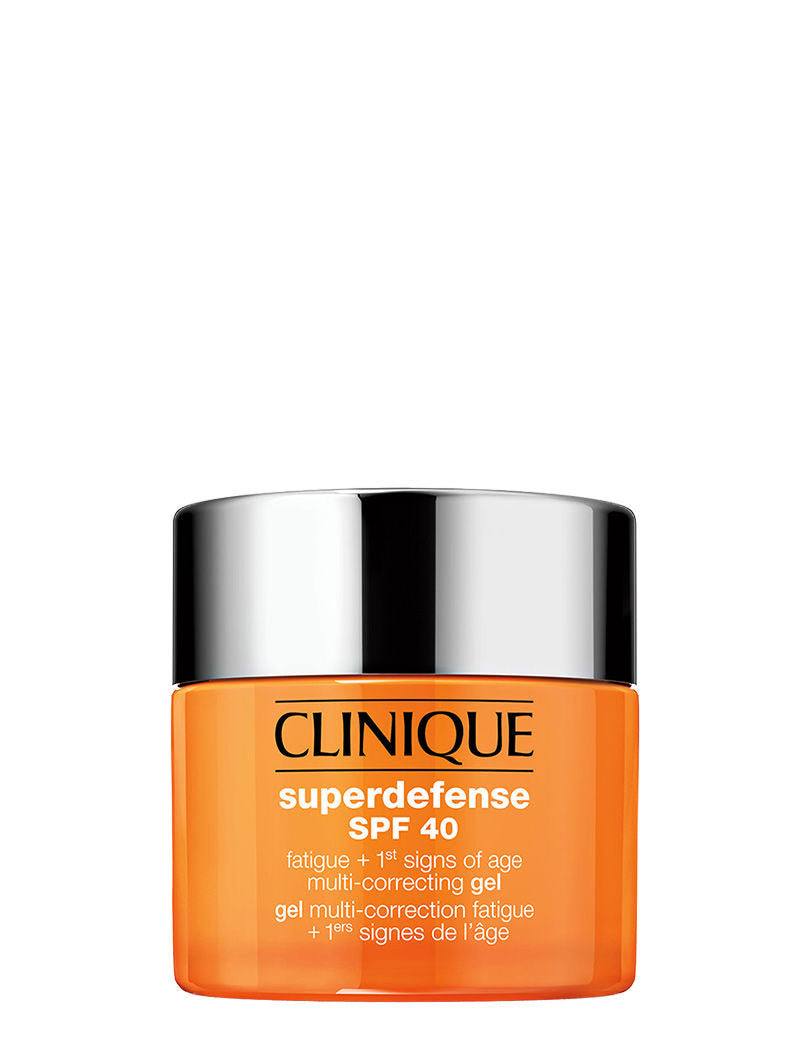
Clinique Superdefense SPF40 Fatigue + 1st Signs Of Age Multi Correcting Gel

Clinique Superdefense SPF40 Fatigue + 1st Signs Of Age Multi Correcting Gel
Clinique
clinique-superdefense-spf40-fatigue-1st-signs-of-age-multi-correcting-gel
Moisturize
10084765663525
Morning or Evening?
How often will you use this product?
Notes


Highlights
WHAT IS IT?
Gel with SPF, multiple active ingredients
FEATURES
12 hours anti-fatigue radiance, fights first signs of ageing, sweat and humidity resistant, oil-free, antioxidants protection, fermented energy blend with carnitine, full spectrum defense including UV and pollution
BEST FOR
sensitive
CHECKS
Does not contain heavy oils, non-greasy, sweat resistant
Who Is It For?
All Genders No Specific Age StatedWhat Does It Help With?
Fatigue First Signs Of Aging Uneven Texture Dullness Fine Lines Wrinkles Protection From Uv And PollutionBudget
Premium ($76-$150)How To Use
Which routine should it be used in?
Instructions:
Key Information


What Clinique Says
Product Description:
A refreshing silky gel with SPF that fights fatigue and first signs of ageing. Awakens instantly and continuously, with 12 hours of anti-fatigue radiance for more youthful-looking skin. Helps visibly correct first signs of ageing, uneven texture, dullness, fine lines and wrinkles. Helps defends against a full spectrum of modern aggressors. Sweat and humidity resistant. Oil-free.
About the Brand:
Ingredients Overview
Ingredients List
Water\\Aqua\\Eau,Dimethicone,Butylene Glycol,Glycerin,Alcohol Denat.,Disodium Phenyl Dibenzimidazole Tetrasulfonate,Ethylhexyl Methoxycinnamate,Phenylbenzimidazole Sulfonic Acid,Propanediol,Triethanolamine,Trisiloxane,Cetyl Peg/Ppg-10/1 Dimethicone,Niacinamide,Daucus Carota Sativa (Carrot) Root Extract,Vaccinium Macrocarpon (Cranberry) Fruit Extract,Brassica Oleracea Gemmifera (Brussels Sprouts) Extract,Vaccinium Angustifolium (Blueberry) Fruit Extract,Brassica Oleracea Acephala (Kale) Leaf Extract,Spinacia Oleracea (Spinach) Leaf Extract,Plankton Extract,Brassica Oleracea Italica (Broccoli) Extract,Ergothioneine,Lactobacillus Ferment,Cucumis Sativus (Cucumber) Fruit Extract,Creatine,Adenosine Phosphate,Acetyl Carnitine Hcl,Micrococcus Lysate,Laminaria Saccharina Extract,7-Dehydrocholesterol,Biosaccharide Gum-4,Hypnea Musciformis (Algae) Extract,Albizia Julibrissin Bark Extract,Sigesbeckia Orientalis (St. Paul'S Wort) Extract,Gelidiella Acerosa Extract,Caffeine,Sodium Rna,Propylene Glycol Dicaprate,Arabidopsis Thaliana Extract,Oryza Sativa (Rice) Bran Extract,Sea Whip Extract,Yeast Extract\\Faex\\Extrait De Levure,Hordeum Vulgare (Barley) Extract\\Extrait D'Orge,Helianthus Annuus (Sunflower) Seedcake,Sodium Hyaluronate,Tocopheryl Acetate,Caprylyl Glycol,Dimethiconol,Arginine,Polyethylene,Trehalose,Pentylene Glycol,Citric Acid,Sodium Hydroxide,Capryloyl Glycine,Phytic Acid,Lecithin,Tetrahexyldecyl Ascorbate,Phenoxyethanol,Bht,Mica,Titanium Dioxide (Ci 77891)
Key Ingredients
Stop Signs™ Technology,Vitamin E,Carnitine,Abovenzone,Octisalate
Ingredients Details
7-dehydrocholesterol
Common Name(s): Provitamin d3,delta-7-cholesterol
CAS Number: 434-16-2
DESCRIPTION
What It Does: Serves as the skin's natural starting material for vitamin d3 production upon uvb exposure.
Why It's Used: Formulations supporting the skin's endogenous vitamin d synthesis pathway, particularly relevant when spf blocks uvb.
How It Works: Absorbs uvb (290–315 nm) and undergoes photolysis at the b-ring to form previtamin d3, which thermally isomerizes to cholecalciferol at body temperature.
Typically Found In: Specialty skin health formulations
TECHNICAL DETAILS
Primary Category: Active ingredient – provitamin d3
Secondary Functions: Provitamin d3,endogenous synthesis support
Application Areas:

Facial Skincare

Body Care
Hair Care
Beard Care
Color Cosmetics (Makeup)
Dietary/Oral Supplements
Typical Concentration Range: Research/specialty concentrations
SOURCING & ETHICS
Vegan Status: Conditional – lanolin or synthetic
Halal Status: Conditional – verify source
Source Notes: Lanolin-derived or lichen-derived (vegan). verify source.
SKIN COMPATIBILITY
Irritancy Rating: 1/5 – very low
Comedogenicity Rating: 0/5 – non-comedogenic
Sensitivity Concerns: Non-irritating at cosmetic concentrations.
Safe for Sensitive Skin: Yes at cosmetic concentrations
SAFETY & COMPATIBILITY
Safety Profile: Safe at cosmetic concentrations. ewg score: 1.
Works Well With: Ceramides,retinoids,anti-inflammatory actives
Avoid Combining With: No significant incompatibilities
SCIENTIFIC NOTE
Approximately 90% of body vitamin d3 comes from uvb-induced photosynthesis of 7-dehydrocholesterol in skin. high-spf sunscreen reduces this synthesis by 95–99%.
Last Verified: Cosing database,holick vitamin d cutaneous synthesis review
Primary Sources: 2026-03-12
Acetyl Carnitine Hcl
Common Name(s): Acetyl carnitine hcl,cosmetic active,functional ingredient
CAS Number: N/a
DESCRIPTION
What It Does: Delivers characteristic cosmetic function — skin conditioning, protection, preservation, or active biological benefit — at recommended use concentration.
Why It's Used: Selected for its functional contribution and formulation compatibility — supported by cosmetic science literature and regulatory safety assessment.
How It Works: Works through the mechanism of its molecular class — physicochemical interaction with the formulation or biological interaction with skin proteins, lipids, or receptors as documented in peer-reviewed literature.
Typically Found In: Skin care formulations
TECHNICAL DETAILS
Primary Category: Active ingredient – cosmetic active
Secondary Functions: Skin conditioning
Application Areas:
Facial Skincare
Body Care
Hair Care
Beard Care
Color Cosmetics (Makeup)
Dietary/Oral Supplements
Typical Concentration Range: 0.1%–10%
SOURCING & ETHICS
Vegan Status: Conditional
Halal Status: Yes
Source Notes: Commercially produced for cosmetic use. verify vegan/halal status with supplier.
SKIN COMPATIBILITY
Irritancy Rating: 1/5 – very low
Comedogenicity Rating: 0/5 – non-comedogenic
Sensitivity Concerns: Well-tolerated by most skin types.
Safe for Sensitive Skin: Yes
SAFETY & COMPATIBILITY
Safety Profile: Good safety profile at recommended concentrations. ewg score: 1–2.
Works Well With: Standard skincare actives
Avoid Combining With: No known significant incompatibilities
SCIENTIFIC NOTE
Acetyl carnitine hcl delivers documented functional benefit with an established safety profile within the cosmetic regulatory framework (cosing eu, cir usa).
Last Verified: Cosing database,acetyl carnitine hcl technical literature
Primary Sources: 2026-03-12
Adenosine Phosphate
Common Name(s): Adenosine phosphate,cosmetic active,functional ingredient
CAS Number: N/a
DESCRIPTION
What It Does: Delivers characteristic cosmetic function — skin conditioning, protection, preservation, or active biological benefit — at recommended use concentration.
Why It's Used: Selected for its functional contribution and formulation compatibility — supported by cosmetic science literature and regulatory safety assessment.
How It Works: Works through the mechanism of its molecular class — physicochemical interaction with the formulation or biological interaction with skin proteins, lipids, or receptors as documented in peer-reviewed literature.
Typically Found In: Skin care formulations
TECHNICAL DETAILS
Primary Category: Active ingredient – cosmetic active
Secondary Functions: Skin conditioning
Application Areas:
Facial Skincare
Body Care
Hair Care
Beard Care
Color Cosmetics (Makeup)
Dietary/Oral Supplements
Typical Concentration Range: 0.1%–10%
SOURCING & ETHICS
Vegan Status: Conditional
Halal Status: Yes
Source Notes: Commercially produced for cosmetic use. verify vegan/halal status with supplier.
SKIN COMPATIBILITY
Irritancy Rating: 1/5 – very low
Comedogenicity Rating: 0/5 – non-comedogenic
Sensitivity Concerns: Well-tolerated by most skin types.
Safe for Sensitive Skin: Yes
SAFETY & COMPATIBILITY
Safety Profile: Good safety profile at recommended concentrations. ewg score: 1–2.
Works Well With: Standard skincare actives
Avoid Combining With: No known significant incompatibilities
SCIENTIFIC NOTE
Adenosine phosphate delivers documented functional benefit with an established safety profile within the cosmetic regulatory framework (cosing eu, cir usa).
Last Verified: Cosing database,adenosine phosphate technical literature
Primary Sources: 2026-03-12
Albizia Julibrissin Bark Extract
Common Name(s): Albizia julibrissin bark extract,botanical extract,phytochemical active
CAS Number: N/a
DESCRIPTION
What It Does: Provides antioxidant protection, anti-inflammatory activity, and skin conditioning from polyphenols, terpenoids, and phytochemicals in the extract.
Why It's Used: Natural plant extracts provide multi-functional phytochemical profiles supporting concurrent skin care claims from one ingredient with authentic botanical heritage.
How It Works: Polyphenols scavenge ros via h• donation; terpenoids inhibit nf-kb or cox inflammatory pathways; vitamins and minerals provide cofactor skin nutrition.
Typically Found In: Botanical skin care,natural products
TECHNICAL DETAILS
Primary Category: Active ingredient – antioxidant
Secondary Functions: Free radical scavenging,anti-aging
Application Areas:
Facial Skincare
Body Care
Hair Care
Beard Care
Color Cosmetics (Makeup)
Dietary/Oral Supplements
Typical Concentration Range: 0.1%–30%
SOURCING & ETHICS
Vegan Status: Conditional
Halal Status: Conditional
Source Notes: Plant-derived extract or synthetic.
SKIN COMPATIBILITY
Irritancy Rating: 1/5 – very low
Comedogenicity Rating: 0/5 – non-comedogenic
Sensitivity Concerns: Non-irritating; well-tolerated.
Safe for Sensitive Skin: Yes
SAFETY & COMPATIBILITY
Safety Profile: Excellent safety profile. ewg score: 1.
Works Well With: Vitamin c,vitamin e,ferulic acid,spf,other antioxidants
Avoid Combining With: No significant incompatibilities
SCIENTIFIC NOTE
Plant secondary metabolites evolved for uv photoprotection and pathogen defence — mechanisms directly applicable to cosmetic antioxidant and anti-inflammatory activity in human skin.
Last Verified: Cosing database,albizia julibrissin bark extract botanical review
Primary Sources: 2026-03-12
