
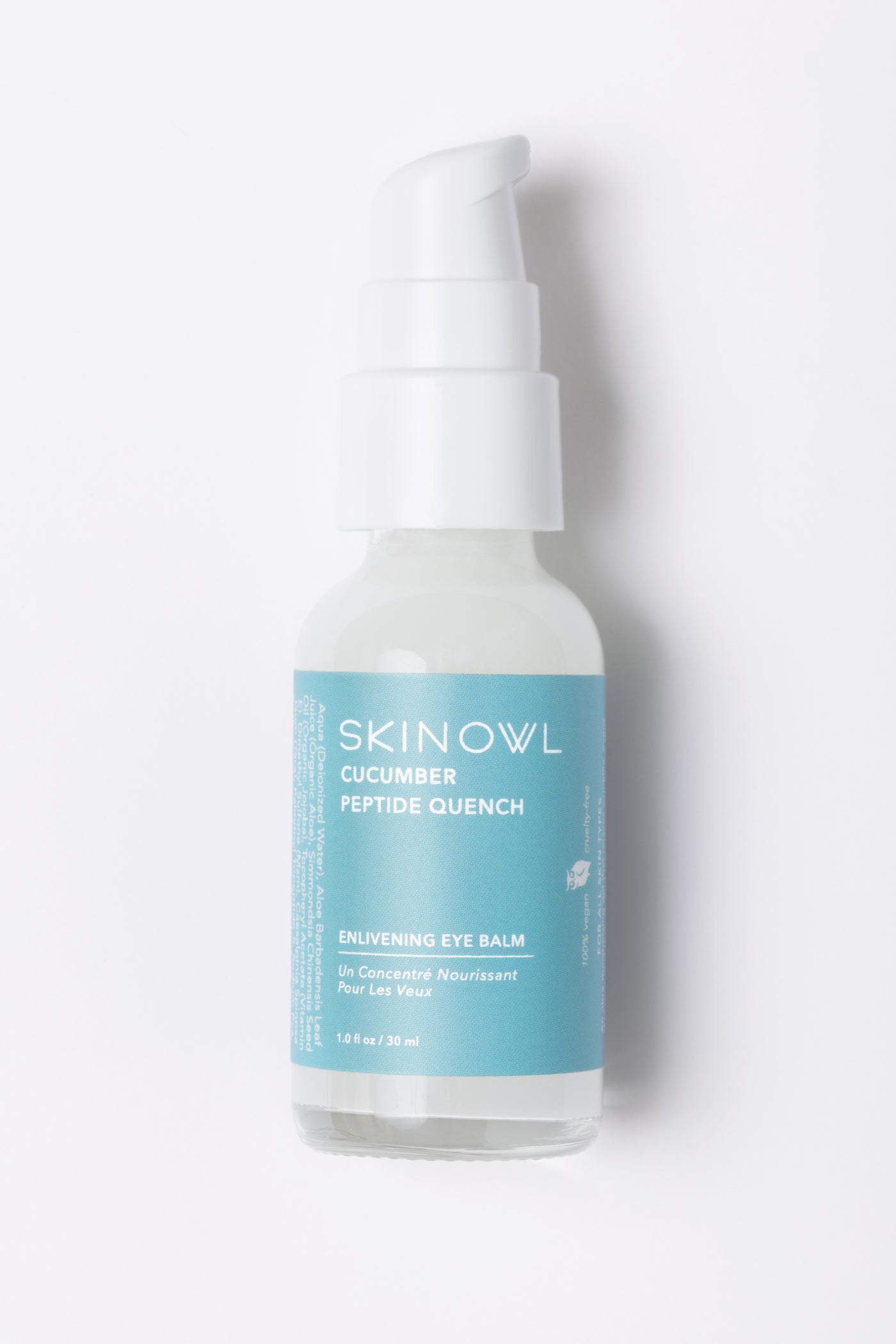

SkinOwl
Cucumber Peptide Quench

Cucumber Peptide Quench
SkinOwl
cucumber-peptide-quench
Eyecare
9706809327909
Morning or Evening?
How often will you use this product?
Notes


Highlights
WHAT IS IT?
Eye cream with multiple ingredients
FEATURES
Cooling, lightweight, brightening, plumping, depuffing
BEST FOR
suitable for tired and puffy eyes
CHECKS
Free of parabens, sulfates, phthalates, synthetic fragrances
Who Is It For?
Assumed For Adults (18+) Of All GendersWhat Does It Help With?
Puffy Eyes Tired Eyes Fatigued UndereyesBudget
Mid-rangeHow To Use
Which routine should it be used in?
Instructions:
Key Information


What SkinOwl Says
Product Description:
This cooling, lightweight, and brightening concentrate is our answer to puffy, tired, fatigued undereyes. Botanical hyaluronic acid, cucumber, periwinkle, and licorice ensure undereye plumping and awakening in minutes. Store in the fridge to promote extra smoothing and depuffing with a refreshing chill to boot.
About the Brand:
Ingredients Overview
Ingredients List
Aqua (Deionized Water), Aloe Barbadensis Leaf Juice (Organic Aloe), Simmondsia Chinensis Seed Oil (Organic Jojoba), Tocopheryl Acetate (Vitamin E), Dimethyl Sulfone (Msm), Caesalpinia Spinosa Gum (Tara), Palmitoyl Tripeptide-5, Sodium Pca, Sodium Lactate, Arginine, Aspartic Acid, Glycine, Alanine, Serine, Valine, Isoleucine, Proline, Threonine, Histidine, Phenylalanine, Cucumis Sativus Fruit Water (Cucumber Hydrosol), Vinca Major Extract (Periwinkle), Glycyrrhiza Glabra Root Extract (Organic Licorice), Glycerin (Kosher, Vegetable), Carbomer, Alcohol, Carrageenan, Hydroxyethylcellulose, Phenoxyethanol (Preservative), Ethylhexylglycerin (Preservative)
Key Ingredients
Botanical hyaluronic acid, cucumber, periwinkle, licorice
Ingredients Details
Arginine
Common Name(s): L-arginine,2-amino-5-guanidinopentanoic acid
CAS Number: 74-79-3
DESCRIPTION
What It Does: Conditions skin, attracts moisture, supports wound healing, and improves microcirculation via no synthesis.
Why It's Used: Multi-functional amino acid for skin hydration, conditioning, and wound healing in peptide and nmf formulations.
How It Works: Guanidinium group binds water (humectant). substrate for nitric oxide synthase (enos) producing nitric oxide that vasodilates capillaries improving skin nutrition. stimulates fibroblast proliferation for wound healing.
Typically Found In: Anti-aging serums,wound healing products,nmf moisturizers,scalp treatments
TECHNICAL DETAILS
Primary Category: Active ingredient – amino acid
Secondary Functions: Wound healing,microcirculation,nmf component
Application Areas:

Facial Skincare

Body Care
Hair Care
Beard Care
Color Cosmetics (Makeup)
Dietary/Oral Supplements
Typical Concentration Range: 0.5%–5%
SOURCING & ETHICS
Vegan Status: Conditional - feedstock declaration required
Halal Status: Unverified - feedstock declaration required (plant, animal and petrochemical routes all exist)
Source Notes: Fermentation-derived or synthetic. natural skin component. [audit 2026-07-29 rev2: origin-dependent: the same inci exists in plant, animal and petrochemical versions and the name does not discriminate. determination requires shariah-panel sign-off.]
SKIN COMPATIBILITY
Irritancy Rating: 1/5 – very low
Comedogenicity Rating: 0/5 – non-comedogenic
Sensitivity Concerns: Non-irritating; endogenous skin molecule.
Safe for Sensitive Skin: Yes
SAFETY & COMPATIBILITY
Safety Profile: Excellent safety profile. natural skin nmf component. ewg score: 1.
Works Well With: Hyaluronic acid,ceramides,peptides,other amino acids
Avoid Combining With: No significant incompatibilities
SCIENTIFIC NOTE
Arginine is a conditionally essential amino acid in wound healing where local demand exceeds synthesis capacity. topical arginine provides the nos substrate locally for no-mediated vasodilation and immune cell function in healing tissue.
Last Verified: 2026-03-12
Primary Sources: Cosing database,cir safety assessment,witte & barbul arginine wound healing review
Palmitoyl Tripeptide-5
Common Name(s): Syn-coll,lysyl-valyl-lysine palmitoyl
CAS Number: 623172-56-5
DESCRIPTION
What It Does: Provides direct tgf-beta pathway collagen stimulation as a growth factor-mimetic peptide.
Why It's Used: Growth factor-mimetic peptide — palmitoyl tripeptide-5 activates the same collagen synthesis pathway as tgf-beta growth factor without requiring the growth factor itself, providing collagen stimulation from a stable synthetic peptide.
How It Works: Lys-val-lys tripeptide sequence mimics thrombospondin-1's tgf-beta activating domain. activates latent tgf-beta complex releasing active tgf-beta for fibroblast collagen i synthesis. palmitoyl chain provides skin penetration and depot formation.
Typically Found In: Premium anti-aging serums,wrinkle reduction products
TECHNICAL DETAILS
Primary Category: Active ingredient – tgf-beta mimetic peptide
Secondary Functions: Collagen stimulation,skin firming,anti-aging
Application Areas:
Facial Skincare
Body Care
Hair Care
Beard Care
Color Cosmetics (Makeup)
Dietary/Oral Supplements
Typical Concentration Range: 0.0001%–0.01%
SOURCING & ETHICS
Vegan Status: Yes – synthetic
Halal Status: Yes
Source Notes: Synthetically produced by solid-phase peptide synthesis (spps). may be palmitoylated for stability.
SKIN COMPATIBILITY
Irritancy Rating: 1/5 – very low
Comedogenicity Rating: 0/5 – non-comedogenic
Sensitivity Concerns: Non-irritating; suitable for all skin types.
Safe for Sensitive Skin: Yes
SAFETY & COMPATIBILITY
Safety Profile: Exceptional safety profile. ewg score: 1.
Works Well With: Hyaluronic acid,ceramides,retinol,vitamin c,niacinamide
Avoid Combining With: Avoid mixing with high-concentration ahas at same ph (may hydrolyze peptide bonds)
SCIENTIFIC NOTE
Palmitoyl tripeptide-5's tgf-beta activation via thrombospondin-1 mimicry is clinically elegant: latent tgf-beta is abundant in skin but inactive until cleaved from its latent-associated peptide (lap). thrombospondin-1 normally triggers this activation by disrupting the lap complex. the peptide mimics this activation step, effectively turning on latent tgf-beta already present in skin without requiring exogenous growth factor — activating an endogenous collagen synthesis program.
Last Verified: 2026-03-12
Primary Sources: Cosing database,robinson et al. syn-coll clinical study
Sodium Lactate
Common Name(s): Sodium l-lactate,lactic acid sodium salt
CAS Number: 72-17-3
DESCRIPTION
What It Does: Provides superior nmf humectant activity alongside ph buffering in the optimal 4-6 cosmetic range.
Why It's Used: Primary nmf lactic acid-derived humectant with superior water binding vs glycerin and natural-origin skin compatibility.
How It Works: Sodium salt of lactic acid provides excellent water binding from both carboxylate and hydroxyl groups. highly hygroscopic – superior to glycerin at equivalent concentration at 50-80% relative humidity. nmf component produced from filaggrin proteolysis in cornification.
Typically Found In: Nmf serums,premium moisturizers,ph-buffered formulations
TECHNICAL DETAILS
Primary Category: Active ingredient – nmf lactic acid salt
Secondary Functions: Primary nmf lactate,superior hygroscopicity
Application Areas:
Facial Skincare
Body Care
Hair Care
Beard Care
Color Cosmetics (Makeup)
Dietary/Oral Supplements
Typical Concentration Range: 2%–10%
SOURCING & ETHICS
Vegan Status: Conditional - feedstock declaration required
Halal Status: Unverified - feedstock declaration required (plant, animal and petrochemical routes all exist)
Source Notes: Synthetic or naturally derived. excellent aqueous solubility. [audit 2026-07-29 rev2: origin-dependent: the same inci exists in plant, animal and petrochemical versions and the name does not discriminate. determination requires shariah-panel sign-off.]
SKIN COMPATIBILITY
Irritancy Rating: 1/5 – very low
Comedogenicity Rating: 0/5 – non-comedogenic
Sensitivity Concerns: Non-irritating; suitable for all skin types.
Safe for Sensitive Skin: Yes
SAFETY & COMPATIBILITY
Safety Profile: Excellent safety profile. ewg score: 1.
Works Well With: Ceramides,emollients,occlusives,glycerin,hyaluronic acid
Avoid Combining With: No significant incompatibilities
SCIENTIFIC NOTE
Sodium lactate's hygroscopicity (water absorption at 25°c, 80% rh) is approximately 1.8× that of glycerin at equivalent concentrations – making it functionally superior as a humectant per unit weight. this superior water binding combined with natural nmf provenance (lactic acid from filaggrin proteolysis) makes it a biomimetically superior humectant to glycerin.
Last Verified: 2026-03-12
Primary Sources: Cosing database,rawlings & harding nmf review,cir safety assessment
Sodium Pca
Common Name(s): Sodium pyroglutamate,sodium 5-oxoproline,pca sodium salt
CAS Number: 28874-51-3
DESCRIPTION
What It Does: Provides the most effective natural nmf humectant as the largest component of the skin's natural moisturising factor.
Why It's Used: The primary nmf humectant — sodium pca is the dominant single component of natural moisturising factor, providing the most effective humectant hydration of any nmf component.
How It Works: Pyrrolidone carboxylic acid (pca) forms from glutamine at the skin surface by enzymatic cyclisation during cornification. sodium salt provides strong hygroscopic water binding from both ionic and pyrrolidone ring interactions. 12% of total nmf by dry weight. declines with age and in dry skin conditions.
Typically Found In: Premium moisturisers,nmf-based products,anti-aging hydration
TECHNICAL DETAILS
Primary Category: Functional ingredient – humectant
Secondary Functions: Tewl reduction,skin plumping
Application Areas:
Facial Skincare
Body Care
Hair Care
Beard Care
Color Cosmetics (Makeup)
Dietary/Oral Supplements
Typical Concentration Range: 0.5%–5%
SOURCING & ETHICS
Vegan Status: Yes – synthetic or from glutamine fermentation
Halal Status: Yes
Source Notes: Synthetic or naturally derived. excellent aqueous solubility.
SKIN COMPATIBILITY
Irritancy Rating: 1/5 – very low
Comedogenicity Rating: 0/5 – non-comedogenic
Sensitivity Concerns: Non-irritating; suitable for all skin types.
Safe for Sensitive Skin: Yes
SAFETY & COMPATIBILITY
Safety Profile: Excellent safety profile. ewg score: 1.
Works Well With: Ceramides,emollients,occlusives,glycerin,hyaluronic acid
Avoid Combining With: No significant incompatibilities
SCIENTIFIC NOTE
Sodium pca's dominance in nmf (12% by dry weight vs next largest ha contribution of ~0.1%) makes it quantitatively the most important single nmf humectant. its decline in aged and dry skin (measurable by stratum corneum tape-strip amino acid analysis) provides both a biomarker of skin hydration state and a therapeutic target — replenishing what declining nmf production fails to provide.
Last Verified: 2026-03-12
Primary Sources: Cosing database,rawlings & matts nmf review,cir safety assessment