
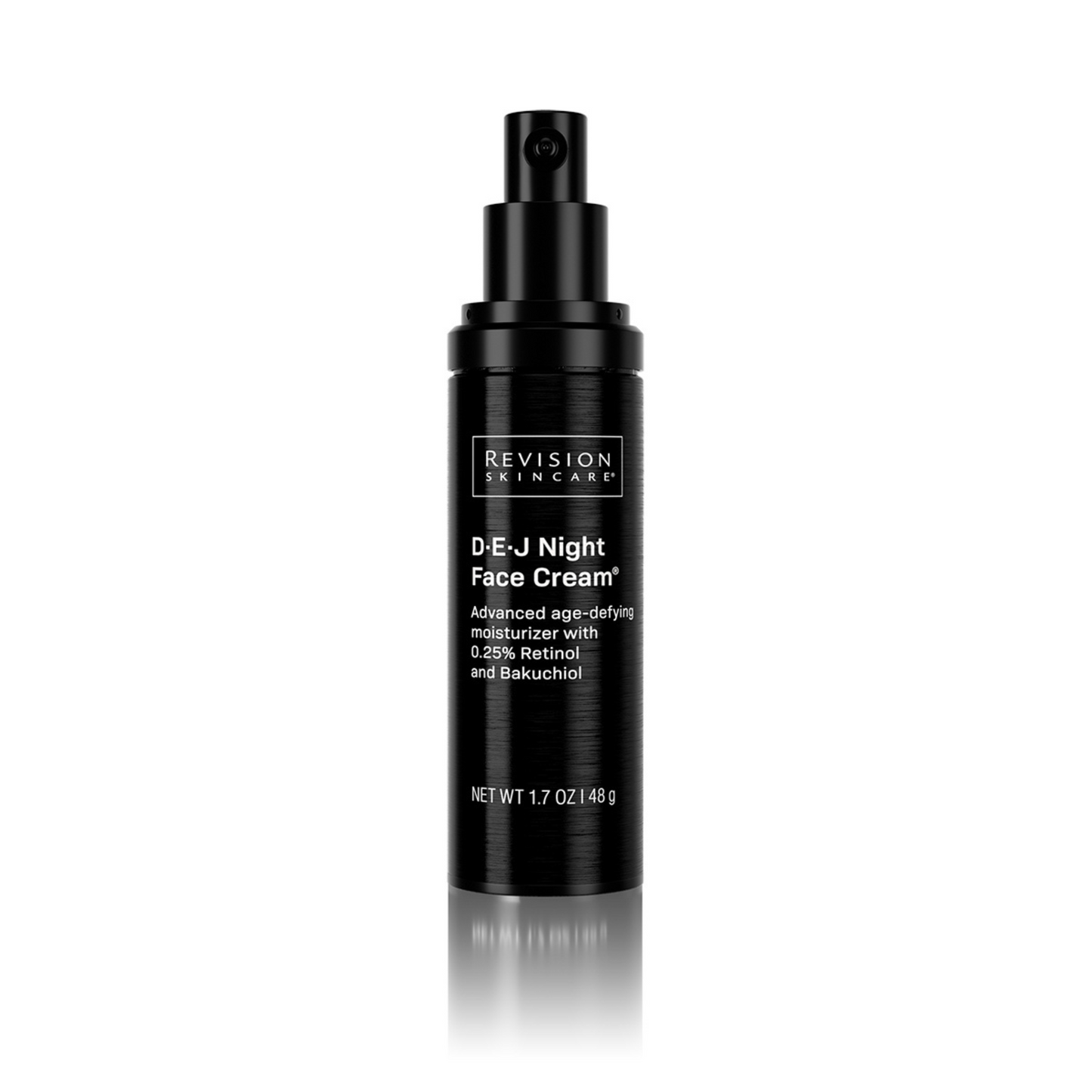

Revision Skincare
D·E·J Night Face Cream®

D·E·J Night Face Cream®
Revision Skincare
d-e-j-night-face-cream-r
Moisturize
9784773968165
Morning or Evening?
How often will you use this product?
Notes


Highlights
WHAT IS IT?
Night Face Cream with Retinol and Bakuchiol
FEATURES
Reduces fine lines and wrinkles, improves skin elasticity, corrects photodamage, improves skin texture and pore appearance, promotes healthy Microbiome
BEST FOR
combination
CHECKS
FRAGRANCE-FREE, NO ARTIFICIAL DYES, PARABEN FREE, PHTHALATES FREE, ALCOHOL FREE, FORMALDEHYDES FREE, NO HORMONES
Who Is It For?
All Skin Types AdultsWhat Does It Help With?
Fine Lines Wrinkles Elasticity Photodamage Skin Texture Pore SizeBudget
Professional (over $150)How To Use
Which routine should it be used in?
Instructions:
Key Information


What Revision Skincare Says
Product Description:
An intensive nighttime moisturizer featuring 0.25% Retinol and plant-based Bakuchiol in a hydrating, antioxidant-rich formula that minimizes irritation and reveals younger-looking skin overnight.
About the Brand:
Ingredients Overview
Ingredients List
Water (Aqua), Caprylic/Capric Triglyceride, Jojoba Esters, Cetearyl Alcohol, Cetyl, Esters, Pentylene Glycol, Cetyl Palmitate, Helianthus Annuus (Sunflower) Seed Oil Unsaponifiables, Tetrahexyldecyl Ascorbate, Lauryl Lactate, Stearyl Alcohol, Glycerin, Alpha-Glucan Oligosaccharide, Dimethicone, Bakuchiol, Hordeum Distichon (Barley) Extract, Santalum Album (Sandalwood) Extract, Phellodendron Amurense Bark Extract, Dicetyl Phosphate, Ceteth-10 Phosphate, Butylene Glycol, Tocopherol, Squalane, Ursolic Acid, Pseudoalteromonas Ferment Extract, Sodium Lauroyl Lactylate, Hydrogenated Lecithin, Ethoxydiglycol, Astragalus Membranaceus Root Extract, Sodium Hyaluronate, Silanetriol, Rhamnose, Lycium Barbarum (Goji) Fruit Extract, Acetyl Tetrapeptide-2, Lecithin, Cocos Nucifera (Coconut) Fruit Extract, Retinol, Sodium Hydroxide, Rosmarinus Officinalis (Rosemary) Leaf Extract, Ceramide NP, Sorbic Acid, Palmitoyl Hexapeptide-14, Ceramide AP, Phytosphingosine, Cholesterol, Tocopheryl Acetate, Caprylyl Glycol, Ceramide EOP, Carbomer, Hydroxyethyl Acrylate/Sodium Acryloyldimethyl Taurate Copolymer, Disodium EDTA, Methylpropanediol, Ubiquinone,Dipropylene Glycol, Glyceryl Caprylate, Propanediol, Chlorphenesin, Sodium Citrate, Xanthan Gum, Potassium Sorbate, Sodium Benzoate, Benzoic Acid, Phenoxyethanol, Allyl Methacrylates Crosspolymer, Cetyl Alcohol, Polysorbate 20, BHT (Butylated Hydroxytoluene), Sorbitan Isostearate, Polysorbate 60, Ethylhexylglycerin, Citric Acid, Propyl Gallate.
Key Ingredients
Retinol, Bakuchiol, Prebiotics, Postbiotics
Ingredients Details
Caprylic/capric Triglyceride
Common Name(s): Mct oil,fractionated coconut oil,c8/c10 triglyceride
CAS Number: 73398-61-5
DESCRIPTION
What It Does: Lightweight, stable emollient that solubilizes oil-soluble actives for excellent delivery without greasy feel.
Why It's Used: Universal lightweight emollient base and solubilizer for oil-soluble actives in serums and low-viscosity formulations where mineral oil or petrolatum would be too heavy.
How It Works: Medium-chain length provides ideal balance of spreading coefficient, penetration rate, and barrier-sealing properties. excellent solubilizer for vitamin e, retinoids, and other lipophilic actives.
Typically Found In: Serums,facial oils,sunscreens,anti-aging products,hair products
TECHNICAL DETAILS
Primary Category: Active ingredient – medium-chain triglyceride emollient
Secondary Functions: Active solubilizer,spreading agent
Application Areas:

Facial Skincare
Body Care
Hair Care

Beard Care
Color Cosmetics (Makeup)
Dietary/Oral Supplements
Typical Concentration Range: 1%–50%
SOURCING & ETHICS
Vegan Status: Conditional - feedstock declaration required
Halal Status: Unverified - feedstock declaration required (plant, animal and petrochemical routes all exist)
Source Notes: Fractionated by hydrolysis and re-esterification of coconut oil. only c8 and c10 fatty acids retained. [audit 2026-07-29 rev2: origin-dependent: the same inci exists in plant, animal and petrochemical versions and the name does not discriminate. determination requires shariah-panel sign-off.]
SKIN COMPATIBILITY
Irritancy Rating: 1/5 – very low
Comedogenicity Rating: 1/5 – very low; medium-chain length generally non-comedogenic
Sensitivity Concerns: Non-irritating.
Safe for Sensitive Skin: Yes
SAFETY & COMPATIBILITY
Safety Profile: Excellent safety profile. ewg score: 1.
Works Well With: Humectants,ceramides,actives as carrier
Avoid Combining With: No significant incompatibilities
SCIENTIFIC NOTE
Mct oil's medium-chain length (c8/c10) provides superior oxidative stability vs longer polyunsaturated chains and better skin aesthetics (lighter, less greasy) vs longer chain emollients (c16/c18). excellent solubilizer for retinoic acid, tocopheryl esters, and other lipophilic actives.
Last Verified: 2026-03-12
Primary Sources: Cosing database,cir safety assessment,ewg skin deep
Cetearyl Alcohol
Common Name(s): Cetostearyl alcohol,c16-18 fatty alcohol
CAS Number: 8005-44-5
DESCRIPTION
What It Does: Provides fatty alcohol emulsification and thickening for stable, well-textured emulsions.
Why It's Used: The most widely used fatty alcohol in cosmetics – provides emulsification, thickening, and emolliency simultaneously from a single ingredient with excellent safety profile.
How It Works: Forms bilayer lamellar structures in water with emulsifiers creating a viscous structured network that thickens and stabilizes emulsions. fatty alcohol emolliency provides direct skin conditioning. bilayer formation reduces inter-droplet coalescence in emulsions.
Typically Found In: Creams,lotions,conditioners – virtually all emulsion products
TECHNICAL DETAILS
Primary Category: Functional ingredient – fatty alcohol emulsifier/thickener
Secondary Functions: Barrier sealing,softening
Application Areas:
Facial Skincare
Body Care
Hair Care
Beard Care
Color Cosmetics (Makeup)
Dietary/Oral Supplements
Typical Concentration Range: 1%–25%
SOURCING & ETHICS
Vegan Status: Yes - standard ethanol routes are non-animal; confirm denaturant origin
Halal Status: Conditional - ethanol production route and residual concentration; jurisdiction-dependent, refer to certifier stance
Source Notes: Plant-derived, synthetic or animal-derived. verify source. [audit 2026-07-29 rev2: ethanol pathway; determination depends on route, on whether the plant also produces beverage alcohol, and on residual concentration. determination requires shariah-panel sign-off.]
SKIN COMPATIBILITY
Irritancy Rating: 1/5 – very low
Comedogenicity Rating: 1/5 – low; formulation-dependent
Sensitivity Concerns: Non-irritating.
Safe for Sensitive Skin: Yes
SAFETY & COMPATIBILITY
Safety Profile: Excellent safety profile. ewg score: 1.
Works Well With: Humectants,ceramides,actives as carrier
Avoid Combining With: No significant incompatibilities
SCIENTIFIC NOTE
Cetearyl alcohol's ability to form lamellar liquid crystal structures ('krafft phases') with water and co-emulsifiers provides not only emulsion stability but also enhanced skin penetration via the lamellar skin barrier pathway. these crystalline structures can act as a reservoir for active ingredients, slowly releasing them as the lamellar structure melts on skin contact.
Last Verified: 2026-03-12
Primary Sources: Cosing database,cir safety assessment
Cetyl Palmitate
Common Name(s): Spermaceti substitute,cetyl hexadecanoate,synthetic spermaceti
CAS Number: 0540-10-3
DESCRIPTION
What It Does: Provides spermaceti-equivalent skin conditioning as an ethical whale-free synthetic wax ester.
Why It's Used: Ethical spermaceti replacement maintaining traditional cream skin feel without animal cruelty – the synthetic version of the wax that gave historical 'cold creams' their unique skin feel.
How It Works: Wax ester of cetyl alcohol and palmitic acid provides melting point 48-52°c. semi-solid at room temperature melts on skin contact for spreadable emollient film. opacifies emulsions from crystalline light scattering.
Typically Found In: Cold creams,emollient creams,opaque lotions
TECHNICAL DETAILS
Primary Category: Functional ingredient – wax ester emollient
Secondary Functions: Barrier sealing,softening
Application Areas:
Facial Skincare
Body Care
Hair Care
Beard Care
Color Cosmetics (Makeup)
Dietary/Oral Supplements
Typical Concentration Range: 1%–10%
SOURCING & ETHICS
Vegan Status: Conditional - feedstock declaration required
Halal Status: Unverified - feedstock declaration required (plant, animal and petrochemical routes all exist)
Source Notes: Plant-derived, synthetic or animal-derived. verify source. [audit 2026-07-29 rev2: origin-dependent: the same inci exists in plant, animal and petrochemical versions and the name does not discriminate. determination requires shariah-panel sign-off.]
SKIN COMPATIBILITY
Irritancy Rating: 1/5 – very low
Comedogenicity Rating: 1/5 – low; formulation-dependent
Sensitivity Concerns: Non-irritating.
Safe for Sensitive Skin: Yes
SAFETY & COMPATIBILITY
Safety Profile: Excellent safety profile. ewg score: 1.
Works Well With: Humectants,ceramides,actives as carrier
Avoid Combining With: No significant incompatibilities
SCIENTIFIC NOTE
Historical cold creams (galen's original 2nd-century ad formulation used beeswax and rosewater) used natural spermaceti as the key emollient until whale hunting bans. cetyl palmitate's creation as a synthetic spermaceti substitute in the 1980s maintained the traditional cold cream skin feel while enabling ethical production – one of the cosmetic industry's successful cruelty-free ingredient innovations.
Last Verified: 2026-03-12
Primary Sources: Cosing database,cir safety assessment
Helianthus Annuus Sunflower Seed Oil Unsaponifiables
Common Name(s): Helianthus annuus sunflower seed oil unsaponifiables oil
DESCRIPTION
What It Does: Nourishes and softens skin through its balanced fatty acid profile, while antioxidant compounds protect against oxidative skin damage.
Why It's Used: Plant oils provide physiologically compatible lipid structures that integrate into the skin barrier and deliver fat-soluble antioxidants directly to skin cells.
How It Works: Fatty acids integrate into stratum corneum lipid lamellae, reinforcing the lipid barrier. antioxidants (tocopherols, carotenoids, polyphenols) neutralize ros through electron donation or singlet oxygen quenching.
Typically Found In: Face oils,serums,moisturizers,hair treatments,body oils
TECHNICAL DETAILS
Primary Category: Plant oils
Secondary Functions: Emollient,antioxidant
Application Areas:
Facial Skincare
Body Care
Hair Care
Beard Care
Color Cosmetics (Makeup)
Dietary/Oral Supplements
Typical Concentration Range: 0.5–30%
SOURCING & ETHICS
Vegan Status: Yes
Halal Status: Yes
Source Notes: Cold-pressed or solvent-extracted plant oil; no animal components.
SKIN COMPATIBILITY
Irritancy Rating: 1899-12-31 00:00:00 -0800
Comedogenicity Rating: 2000-01-01 00:00:00 -0800
Sensitivity Concerns: Low sensitization potential at recommended use concentrations.
Safe for Sensitive Skin: Yes
SAFETY & COMPATIBILITY
Safety Profile: Well-characterized cosmetic ingredient with established safety profile. generally non-irritating at typical use concentrations. suitable for leave-on and rinse-off cosmetics.
Works Well With: Vitamin e,ceramides,other plant oils,squalane
Avoid Combining With: Strong oxidizers (accelerate rancidity)
SCIENTIFIC NOTE
Vegetable oils are triglyceride matrices where the fatty acid composition determines skin compatibility, barrier function, and comedogenicity. oleic acid-rich oils (>60%) soften barrier lipids and enhance penetration; linoleic acid-rich oils reinforce ceramide-poor stratum corneum; saturated fatty acid-rich oils provide occlusion without skin penetration.
Last Verified: 2025-01-15
Primary Sources: Cosing eu database; pcpc cosmetic ingredient safety reviews; aocs plant oil composition databases; fatty acid pharmacology reviews