

Dabur
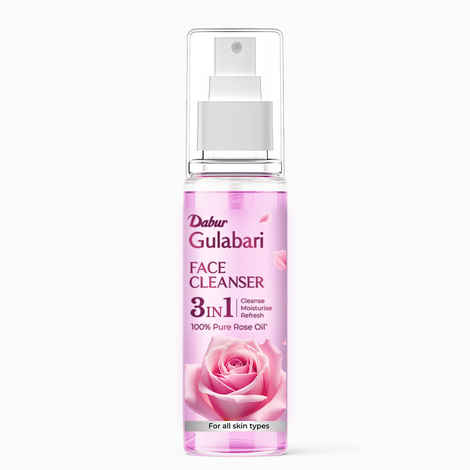
Dabur Gulabari Rose Glow Face Cleanser - 100 ml

Dabur Gulabari Rose Glow Face Cleanser - 100 ml
Dabur
dabur-gulabari-rose-glow-face-cleanser-100-ml
Cleanse
10084937597221
Morning or Evening?
How often will you use this product?
Notes


Highlights
WHAT IS IT?
Face Freshner with natural rose extracts; 3-in-1 (cleanse, moisturise, refresh)
FEATURES
Gentle face cleanser; Allows natural anti-inflammatory benefits of rose water; Cleanses dirt; Moisturises; Instantly refreshes skin; Gives rose-like glow
BEST FOR
normal
CHECKS
Does not contain sulfates, parabens, silicones, alcohol
Who Is It For?
All Genders; No Specific Age Range MentionedWhat Does It Help With?
Cleansing Moisturizing Refreshing Skin; Enhances Skin GlowBudget
Affordable (under $30)How To Use
Which routine should it be used in?
Instructions:
Key Information

What Dabur Says
Product Description:
Dabur Gulabari Face Cleanser is a gentle face cleanser which allows you to reap the natural anti-inflammatory benefits of rose water for your skin while cleansing it from deep
About the Brand:
Ingredients Overview
Ingredients List
Aqua, Ceteth 20, Fragrance, (Rooh Gulab), Rose Oil, Propylene Glycol, Lauryl Glucoside, Polyquaternium-7, Peg 12 Dimethicone, Hydroxyethyl Urea, Tris (Tetramethylhydroxypiperidinol) Citrate, Sodium Benzotriazolyl Butylphenol Sulfonate, Buteth-3, Tributyl Citrate, Sodium Laureth Sulfate, Methyl Paraben, Propyl Paraben, Bronopol, Ci 14720, Citric Acid
Key Ingredients
rose-extracts
Ingredients Details
Bronopol
Common Name(s): Formaldehyde-releasing preservative,antimicrobial preservation,formaldehyde donor
CAS Number: N/a
DESCRIPTION
What It Does: Provides broad-spectrum preservation against bacteria and fungi through controlled formaldehyde release, maintaining product safety throughout shelf life at eu-permitted concentrations.
Why It's Used: Formaldehyde-releasing preservatives provide reliable broad-spectrum preservation but face increasing consumer and regulatory scrutiny — eu requires label declaration, and many brands adopt 'formaldehyde-free' positioning due to sensitisation concerns.
How It Works: Hydrolysis in aqueous formulation releases formaldehyde (hcho) at controlled rates depending on ph and temperature. free formaldehyde cross-links bacterial proteins and nucleic acids through schiff base formation with amine groups, providing bactericidal activity. sensitisation risk from free formaldehyde's reactivity with skin proteins forming haptens.
Typically Found In: All aqueous formulations
TECHNICAL DETAILS
Primary Category: Active ingredient – cosmetic active
Secondary Functions: Skin conditioning
Application Areas:

Facial Skincare

Body Care
Hair Care
Beard Care
Color Cosmetics (Makeup)
Dietary/Oral Supplements
Typical Concentration Range: Check eu annex v limits
SOURCING & ETHICS
Vegan Status: Yes
Halal Status: Yes
Source Notes: Commercially produced for cosmetic use. verify vegan/halal status with supplier.
SKIN COMPATIBILITY
Irritancy Rating: 1/5 – very low
Comedogenicity Rating: 0/5 – non-comedogenic
Sensitivity Concerns: Well-tolerated by most skin types.
Safe for Sensitive Skin: Yes
SAFETY & COMPATIBILITY
Safety Profile: Good safety profile at recommended concentrations. ewg score: 1–2.
Works Well With: Standard skincare actives
Avoid Combining With: No known significant incompatibilities
SCIENTIFIC NOTE
Eu regulation 1223/2009 requires 'contains formaldehyde' label declaration when free formaldehyde >0.05% in the finished product. many formulators are transitioning away from formaldehyde-releasing preservatives to avoid this label requirement regardless of safety profile.
Last Verified: Cosing database,eu annex v formaldehyde-releasing preservative declaration
Primary Sources: 2026-03-12
Buteth-3
Common Name(s): Buteth-3
DESCRIPTION
What It Does: Delivers targeted skin-conditioning or bioactive benefits through a specific mechanism of action suited to the formulation's intended purpose.
Why It's Used: Specialty actives address specific skin concerns through targeted molecular mechanisms, providing efficacy beyond what base formulation ingredients alone can achieve.
How It Works: The bioactive compound interacts with specific molecular targets in skin cells or the extracellular matrix — enzymes, receptors, structural proteins, or signaling molecules — triggering beneficial biological responses.
Typically Found In: Serums,treatments,moisturizers,specialty products
TECHNICAL DETAILS
Primary Category: Specialty actives
Secondary Functions: Skin-conditioning,anti-aging
Application Areas:
Facial Skincare
Body Care
Hair Care
Beard Care
Color Cosmetics (Makeup)
Dietary/Oral Supplements
Typical Concentration Range: 0.01–5%
SOURCING & ETHICS
Vegan Status: Yes
Halal Status: Yes
Source Notes: Specialty active ingredient; check individual sourcing for vegan status.
SKIN COMPATIBILITY
Irritancy Rating: 1
Comedogenicity Rating: 0
Sensitivity Concerns: Low sensitization potential at recommended use concentrations.
Safe for Sensitive Skin: Yes
SAFETY & COMPATIBILITY
Safety Profile: Well-characterized cosmetic ingredient with established safety profile. generally non-irritating at typical use concentrations. suitable for leave-on and rinse-off cosmetics.
Works Well With: Niacinamide,hyaluronic acid,vitamin c,peptides
Avoid Combining With: Incompatible with oxidizing agents; check ph stability
SCIENTIFIC NOTE
Specialty actives typically work through enzyme inhibition (e.g., tyrosinase inhibition for brightening, mmp inhibition for anti-aging), receptor activation (e.g., retinoid receptors, ppar-γ for barrier genes), or transcription factor modulation (e.g., nrf2 for antioxidant gene upregulation). structure-activity relationships determine potency and selectivity.
Last Verified: Cosing eu database; pcpc cosmetic ingredient safety reviews; ingredient-specific safety and efficacy literature
Primary Sources: 2025-01-15
Ci 14720
Common Name(s): Ci 14720,approved cosmetic colorant,colour cosmetics pigment
CAS Number: N/a
DESCRIPTION
What It Does: Provides colour in cosmetic formulations within the permitted application areas and concentrations specified by fda 21 cfr 73/74 and eu cosmetics regulation annex iv.
Why It's Used: Regulatory compliance requires verifying both the permitted use category (fd&c, d&c, ext. d&c) and the specific application area approval for each colorant in each target market.
How It Works: Colour arises from selective wavelength absorption by the chromophore structure — electronic transitions (d-orbital for transition metal pigments; π→π* for organic chromophores) absorb specific visible wavelengths providing the perceived complementary colour.
Typically Found In: Colour cosmetics
TECHNICAL DETAILS
Primary Category: Active ingredient – mineral / metal active
Secondary Functions: Antimicrobial,sebum regulation,antioxidant enzyme cofactor
Application Areas:
Facial Skincare
Body Care
Hair Care
Beard Care
Color Cosmetics (Makeup)
Dietary/Oral Supplements
Typical Concentration Range: Per product type — check fda/eu permitted list
SOURCING & ETHICS
Vegan Status: Conditional
Halal Status: Conditional
Source Notes: Mineral/inorganic compound. cosmetic or pharmaceutical grade.
SKIN COMPATIBILITY
Irritancy Rating: 1/5 – very low
Comedogenicity Rating: 0/5 – non-comedogenic
Sensitivity Concerns: Non-irritating at recommended concentrations.
Safe for Sensitive Skin: Yes at recommended concentrations
SAFETY & COMPATIBILITY
Safety Profile: Excellent safety profile at cosmetic concentrations. ewg score: 1–2.
Works Well With: Niacinamide,salicylic acid,other actives
Avoid Combining With: No significant incompatibilities at standard concentrations
SCIENTIFIC NOTE
All cosmetic colorants in the us require fda batch certification confirming identity and purity per lot — uncertified batches cannot legally appear in finished us cosmetics. eu annex iv lists permitted colorants with specific maximum concentrations and use restrictions by product category.
Last Verified: Fda 21 cfr 73/74,eu cosmetics regulation annex iv,colorant regulatory review
Primary Sources: 2026-03-12
Citric Acid
Common Name(s): Lemon acid,2-hydroxypropane-1,2,3-tricarboxylic acid
CAS Number: 77-92-9
DESCRIPTION
What It Does: Adjusts ph to optimal ranges, chelates destabilizing metal ions, provides mild exfoliation at higher concentrations.
Why It's Used: Universal cosmetic ph adjuster and chelating agent. aha exfoliant activity is secondary.
How It Works: As ph adjuster, donates protons. as chelating agent, three carboxylic groups bind divalent metals (ca²⁺, mg²⁺, fe²⁺) preventing oxidative degradation.
Typically Found In: Nearly all cosmetic formulations,brightening products,exfoliants
TECHNICAL DETAILS
Primary Category: Active ingredient – alpha hydroxy acid (aha)
Secondary Functions: Chelating agent,ph adjustment,preservation enhancement
Application Areas:
Facial Skincare
Body Care
Hair Care
Beard Care
Color Cosmetics (Makeup)
Dietary/Oral Supplements
Typical Concentration Range: 0.1%–10%
SOURCING & ETHICS
Vegan Status: Yes – synthetic or fermentation-derived
Halal Status: Yes
Source Notes: Produced by fermentation of sugars by aspergillus niger. gras (e330). most abundant organic acid in citrus.
SKIN COMPATIBILITY
Irritancy Rating: 1/5 – very low at low concentrations; 2/5 at exfoliant concentrations
Comedogenicity Rating: 0/5 – non-comedogenic
Sensitivity Concerns: Photosensitizing – mandatory spf use. start at low frequency.
Safe for Sensitive Skin: Use with caution – spf required
SAFETY & COMPATIBILITY
Safety Profile: Safe at otc concentrations. eu: ≤10% leave-on at ph ≥3.5. mandatory spf advisory.
Works Well With: Niacinamide,ceramides,hyaluronic acid,spf
Avoid Combining With: Retinol in same step; multiple exfoliants simultaneously
SCIENTIFIC NOTE
Three carboxylic acid groups provide multiple proton donation sites and stronger chelation than monocarboxylic ahas. this makes citric acid the preferred cosmetic chelating agent alongside edta.
Last Verified: Cosing database,cir safety assessment,ewg skin deep
Primary Sources: 2026-03-12
