

dermalogica
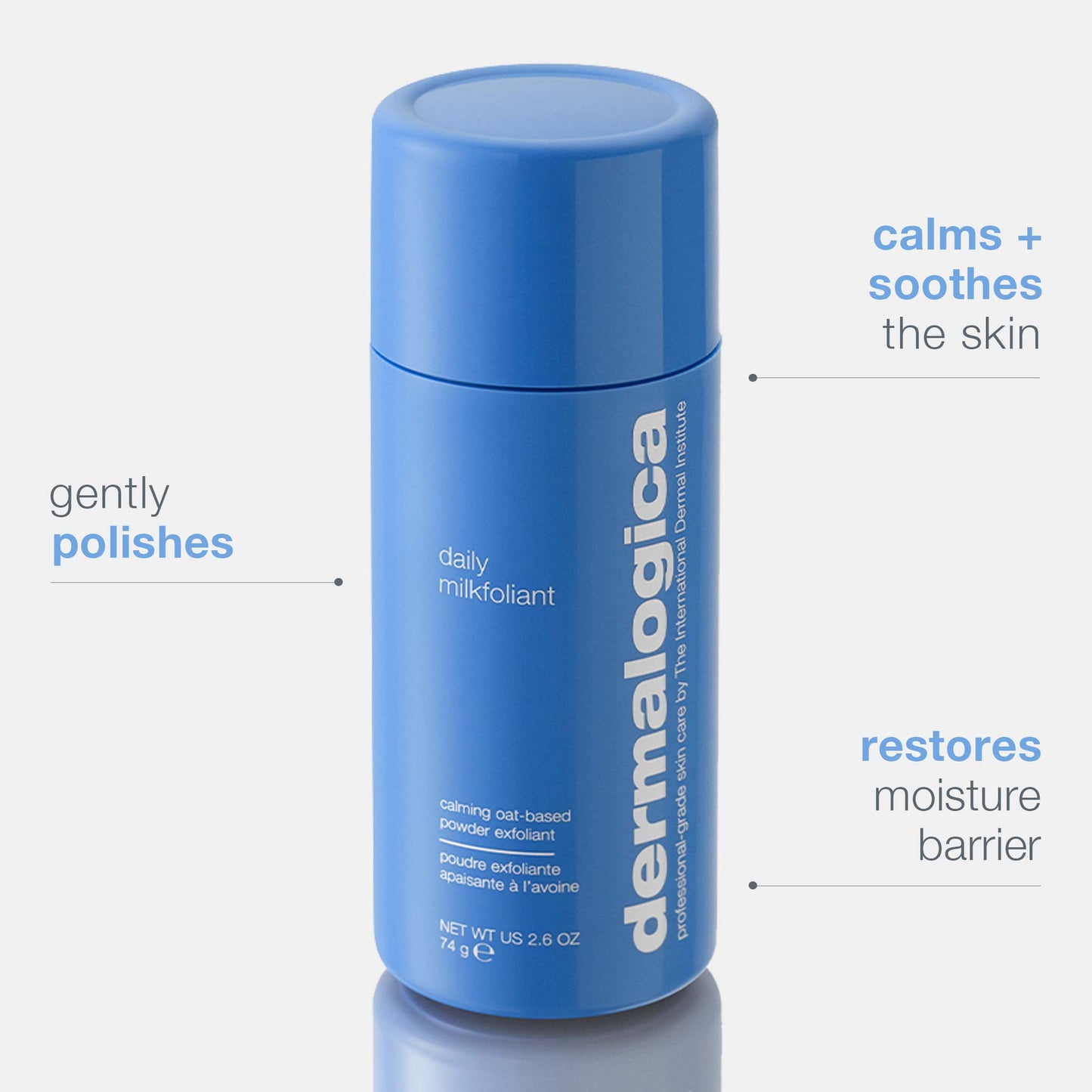
Daily Milkfoliant Exfoliator

Daily Milkfoliant Exfoliator
dermalogica
daily-milkfoliant-exfoliator
Exfoliation
9784812339493
Morning or Evening?
How often will you use this product?
Notes


Highlights
WHAT IS IT?
Vegan exfoliating powder with botanical extracts
FEATURES
Polishes skin, supports moisture barrier, contains AHAs and BHAs
BEST FOR
sensitive
CHECKS
Gluten-free, paraben-free, artificial fragrances and colors free
Who Is It For?
All Skin TypesWhat Does It Help With?
Dullness Sensitivity Redness Uneven TextureBudget
Mid-range ($30-$75)How To Use
Which routine should it be used in?
Instructions:
Key Information


What dermalogica Says
Product Description:
Calming vegan exfoliating powder polishes skin while supporting the skin's moisture barrier. Features a milky powder exfoliant with Oat and Coconut that activates upon contact with water.
About the Brand:
Ingredients Overview
Ingredients List
Sodium Cocoyl Isethionate, Microcrystalline Cellulose, Sodium Bicarbonate, Sorbitol, Zea Mays (Corn) Starch, Sodium Cocoyl Glutamate, Saccharomyces Ferment, Oryza Sativa (Rice) Starch, Magnesium Oxide, Citric Acid, Tapioca Starch, Avena Sativa (Oat) Kernel Protein, Camellia Oleifera Seed Extract, Silica, Cocos Nucifera (Coconut) Fruit Extract, Inulin, Cassia Hydroxypropyltrimonium Chloride, Silybum Marianum Seed Oil, Kaolin, Lauryl Methacrylate/Glycol Dimethacrylate Crosspolymer, Papain, Hyaluronic Acid, Avena Sativa (Oat) Kernel Extract, Helianthus Annuus (Sunflower) Seed Oil, Avena Sativa (Oat) Bran Extract, Glycine Soja (Soybean) Oil, Citrus Aurantium Dulcis (Orange) Peel Extract, Vitis Vinifera (Grape) Fruit Extract, Citrus Aurantium Bergamia (Bergamot) Fruit Oil, Aniba Rosodora (Rosewood) Wood Oil, Salvia Sclarea (Clary) Oil, Eucalyptus Globulus Leaf Oil, Chamomilla Recutita (Matricaria) Flower Oil, Cucurbita Pepo (Pumpkin) Fruit Extract, Cucumis Sativus (Cucumber) Fruit Extract, Perilla Ocymoides Leaf Extract, Daucus Carota Sativa (Carrot) Root Extract, Sea Salt (Maris Sal), Juniperus Virginiana Oil, Alpha-Glucan Oligosaccharide, Tocopherol, Castoryl Maleate, Caprylyl Glycol, Allantoin, Diglycerin, Maltodextrin, Lauroyl Lysine, Arginine, Saccharide Isomerate, Sodium Lauroyl Glutamate, Beta-Carotene, Xanthan Gum, Ethylhexylglycerin, 1,2-Hexanediol, Hydroxypropyl Methylcellulose, Dextrin, Sodium Palmitate, Sodium Chloride, Acacia Senegal Gum, Sodium Citrate, Water/Aqua/Eau, O-Cymen-5-Ol, Limonene, Linalool
Key Ingredients
Oat, Coconut, Grape Extract, Arginine, Papain Extract
Ingredients Details
Citric Acid
Common Name(s): Lemon acid,2-hydroxypropane-1,2,3-tricarboxylic acid
CAS Number: 77-92-9
DESCRIPTION
What It Does: Adjusts ph to optimal ranges, chelates destabilizing metal ions, provides mild exfoliation at higher concentrations.
Why It's Used: Universal cosmetic ph adjuster and chelating agent. aha exfoliant activity is secondary.
How It Works: As ph adjuster, donates protons. as chelating agent, three carboxylic groups bind divalent metals (ca²⁺, mg²⁺, fe²⁺) preventing oxidative degradation.
Typically Found In: Nearly all cosmetic formulations,brightening products,exfoliants
TECHNICAL DETAILS
Primary Category: Active ingredient – alpha hydroxy acid (aha)
Secondary Functions: Chelating agent,ph adjustment,preservation enhancement
Application Areas:

Facial Skincare
Body Care
Hair Care

Beard Care
Color Cosmetics (Makeup)
Dietary/Oral Supplements
Typical Concentration Range: 0.1%–10%
SOURCING & ETHICS
Vegan Status: Yes – synthetic or fermentation-derived
Halal Status: Yes
Source Notes: Produced by fermentation of sugars by aspergillus niger. gras (e330). most abundant organic acid in citrus.
SKIN COMPATIBILITY
Irritancy Rating: 1/5 – very low at low concentrations; 2/5 at exfoliant concentrations
Comedogenicity Rating: 0/5 – non-comedogenic
Sensitivity Concerns: Photosensitizing – mandatory spf use. start at low frequency.
Safe for Sensitive Skin: Use with caution – spf required
SAFETY & COMPATIBILITY
Safety Profile: Safe at otc concentrations. eu: ≤10% leave-on at ph ≥3.5. mandatory spf advisory.
Works Well With: Niacinamide,ceramides,hyaluronic acid,spf
Avoid Combining With: Retinol in same step; multiple exfoliants simultaneously
SCIENTIFIC NOTE
Three carboxylic acid groups provide multiple proton donation sites and stronger chelation than monocarboxylic ahas. this makes citric acid the preferred cosmetic chelating agent alongside edta.
Last Verified: Cosing database,cir safety assessment,ewg skin deep
Primary Sources: 2026-03-12
Magnesium Oxide
Common Name(s): Magnesium oxide,cosmetic active,established formulation ingredient
CAS Number: N/a
DESCRIPTION
What It Does: Magnesium oxide contributes its primary cosmetic function to formulations — improving skin feel, stability, performance, or delivering a specific active benefit depending on its chemical class and concentration level.
Why It's Used: Formulators choose magnesium oxide for its established efficacy in contributing the required functional property to their formulation — whether rheological control, active delivery, aesthetic enhancement, or preservation — supported by the cosmetic chemistry literature and regulatory assessment framework.
How It Works: Magnesium oxide works through the characteristic mechanism of its chemical class — either through physicochemical interaction with the formulation matrix (surface activity, film formation, viscosity building) or through biological interaction with skin tissues (receptor binding, enzymatic substrate, barrier component integration). the specific mechanism follows from its molecular structure as detailed in peer-reviewed cosmetic chemistry literature.
Typically Found In: Skin care formulations
TECHNICAL DETAILS
Primary Category: Active ingredient – cosmetic active
Secondary Functions: Skin conditioning
Application Areas:
Facial Skincare
Body Care
Hair Care
Beard Care
Color Cosmetics (Makeup)
Dietary/Oral Supplements
Typical Concentration Range: 0.1%–10%
SOURCING & ETHICS
Vegan Status: Conditional
Halal Status: Yes
Source Notes: Commercially produced for cosmetic use. verify vegan/halal status with supplier.
SKIN COMPATIBILITY
Irritancy Rating: 1/5 – very low
Comedogenicity Rating: 0/5 – non-comedogenic
Sensitivity Concerns: Well-tolerated by most skin types.
Safe for Sensitive Skin: Yes
SAFETY & COMPATIBILITY
Safety Profile: Good safety profile at recommended concentrations. ewg score: 1–2.
Works Well With: Standard skincare actives
Avoid Combining With: No known significant incompatibilities
SCIENTIFIC NOTE
Magnesium oxide has been assessed within the regulatory framework applicable to cosmetic ingredients. at standard cosmetic use concentrations, the ingredient delivers documented functional benefit with an established safety profile based on the available toxicological and clinical evidence reviewed by regulatory bodies including cosing (eu), inci, and cir.
Last Verified: Cosing database,magnesium oxide technical literature
Primary Sources: 2026-03-12
Microcrystalline Cellulose
Common Name(s): Natural or modified biopolymer thickener,rheology modifier,film-former
CAS Number: N/a
DESCRIPTION
What It Does: Builds aqueous viscosity through polymer chain entanglement above the overlap concentration, forms conditioning films on skin and hair, and stabilises suspensions through yield stress.
Why It's Used: Natural biopolymer thickeners provide elegant formulation sensory without the tight ph requirements of synthetic carbomers — preferred in shampoos and conditioners where broad ph tolerance and natural origin are both required.
How It Works: Polysaccharide chains above overlap concentration c* entangle forming a viscoelastic network — viscosity scales as c^4.7 above c*, providing steep concentration-viscosity dependence. chemical modification (hydroxypropyl, hydroxyethyl) increases water solubility and cold-processability of otherwise difficult-to-dissolve natural polysaccharides.
Typically Found In: Shampoos,conditioners,gels
TECHNICAL DETAILS
Primary Category: Active ingredient – cosmetic active
Secondary Functions: Skin conditioning
Application Areas:
Facial Skincare
Body Care
Hair Care
Beard Care
Color Cosmetics (Makeup)
Dietary/Oral Supplements
Typical Concentration Range: 0.1%–5%
SOURCING & ETHICS
Vegan Status: Yes
Halal Status: Yes
Source Notes: Commercially produced for cosmetic use. verify vegan/halal status with supplier.
SKIN COMPATIBILITY
Irritancy Rating: 1/5 – very low
Comedogenicity Rating: 0/5 – non-comedogenic
Sensitivity Concerns: Well-tolerated by most skin types.
Safe for Sensitive Skin: Yes
SAFETY & COMPATIBILITY
Safety Profile: Good safety profile at recommended concentrations. ewg score: 1–2.
Works Well With: Standard skincare actives
Avoid Combining With: No known significant incompatibilities
SCIENTIFIC NOTE
Biopolymer thickeners are sensitive to electrolyte concentration — high salt levels screen polymer charge interactions reducing viscosity. formulation salt content must be accounted for when selecting polymer concentration for target viscosity.
Last Verified: Cosing database,microcrystalline cellulose biopolymer thickener review
Primary Sources: 2026-03-12
Oryza Sativa Rice Starch
Common Name(s): Oryza sativa rice starch
DESCRIPTION
What It Does: Delivers targeted skin-conditioning or bioactive benefits through a specific mechanism of action suited to the formulation's intended purpose.
Why It's Used: Specialty actives address specific skin concerns through targeted molecular mechanisms, providing efficacy beyond what base formulation ingredients alone can achieve.
How It Works: The bioactive compound interacts with specific molecular targets in skin cells or the extracellular matrix — enzymes, receptors, structural proteins, or signaling molecules — triggering beneficial biological responses.
Typically Found In: Serums,treatments,moisturizers,specialty products
TECHNICAL DETAILS
Primary Category: Specialty actives
Secondary Functions: Skin-conditioning,anti-aging
Application Areas:
Facial Skincare
Body Care
Hair Care
Beard Care
Color Cosmetics (Makeup)
Dietary/Oral Supplements
Typical Concentration Range: 0.01–5%
SOURCING & ETHICS
Vegan Status: Yes
Halal Status: Yes
Source Notes: Specialty active ingredient; check individual sourcing for vegan status.
SKIN COMPATIBILITY
Irritancy Rating: 1899-12-31 00:00:00 -0800
Sensitivity Concerns: Low sensitization potential at recommended use concentrations.
Safe for Sensitive Skin: Yes
SAFETY & COMPATIBILITY
Safety Profile: Well-characterized cosmetic ingredient with established safety profile. generally non-irritating at typical use concentrations. suitable for leave-on and rinse-off cosmetics.
Works Well With: Niacinamide,hyaluronic acid,vitamin c,peptides
Avoid Combining With: Incompatible with oxidizing agents; check ph stability
SCIENTIFIC NOTE
Specialty actives typically work through enzyme inhibition (e.g., tyrosinase inhibition for brightening, mmp inhibition for anti-aging), receptor activation (e.g., retinoid receptors, ppar-γ for barrier genes), or transcription factor modulation (e.g., nrf2 for antioxidant gene upregulation). structure-activity relationships determine potency and selectivity.
Last Verified: Cosing eu database; pcpc cosmetic ingredient safety reviews; ingredient-specific safety and efficacy literature
Primary Sources: 2025-01-15
