

Innisfree
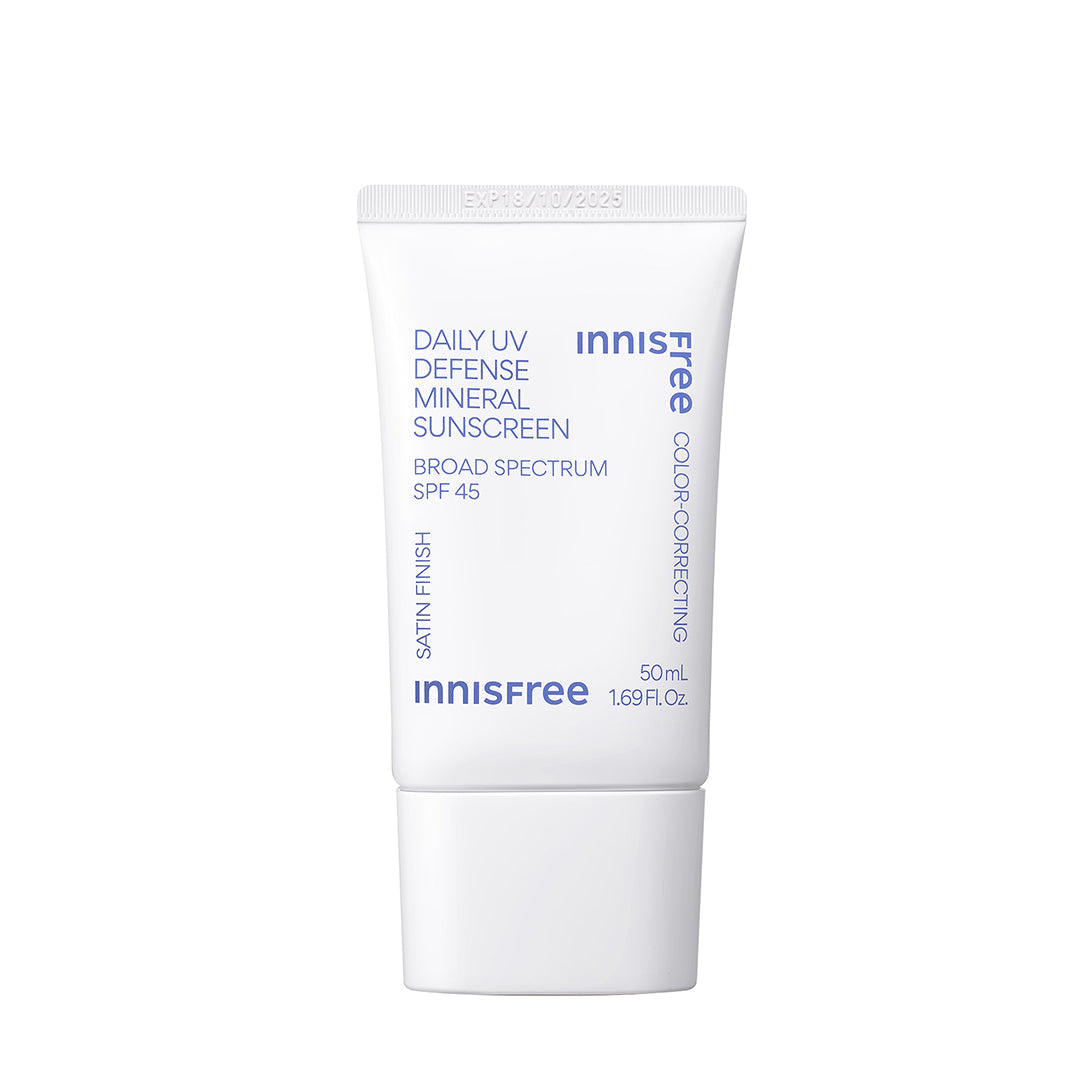
Daily UV Defense Mineral Sunscreen

Daily UV Defense Mineral Sunscreen
Innisfree
daily-uv-defense-mineral-sunscreen
Suncare
9706778493221
Morning or Evening?
How often will you use this product?
Notes


Highlights
WHAT IS IT?
Mineral sunscreen with multiple ingredients including hyaluronic acid and Cica
FEATURES
Green-tinted, neutralizes visible redness, contains 8 types of hyaluronic acid
BEST FOR
All skin types, including sensitive skin
CHECKS
Free of parabens, phthalates, formaldehyde, triclosan, tricolcarban, talc, SLS/SLES, coal tar, BHT, synthetic colors, mineral oil, animal products, synthetic fragrances, imidazolidinyl urea, polyacrylamide
Who Is It For?
Adults Both Men And WomenWhat Does It Help With?
Uv Protection Hydration Soothing Sensitive SkinBudget
Mid-rangeHow To Use
Which routine should it be used in?
Instructions:
Key Information


What Innisfree Says
Product Description:
A green-tinted mineral sunscreen with 8 types of hyaluronic acid and soothing Cica that protects while neutralizing visible redness.
About the Brand:
Ingredients Overview
Ingredients List
Active Ingredient: Zinc Oxide (17%)
Key Ingredients
Zinc Oxide, Hyaluronic Acid, Cica (Centella Asiatica), Niacinamide, Ceramide NP, Squalane
Ingredients Details
Butyloctyl Salicylate
Common Name(s): Butyloctyl salicylate,cosmetic active,functional ingredient
CAS Number: N/a
DESCRIPTION
What It Does: Delivers characteristic cosmetic function at recommended use concentration.
Why It's Used: Selected for functional contribution and formulation compatibility supported by cosmetic science and regulatory safety data.
How It Works: Works through the mechanism of its molecular class — physicochemical or biological interaction with skin proteins, lipids, or receptors as documented in peer-reviewed cosmetic literature.
Typically Found In: Skin care formulations
TECHNICAL DETAILS
Primary Category: Active ingredient – cosmetic active
Secondary Functions: Skin conditioning
Application Areas:

Facial Skincare

Body Care
Hair Care
Beard Care
Color Cosmetics (Makeup)
Dietary/Oral Supplements
Typical Concentration Range: 0.1%–10%
SOURCING & ETHICS
Vegan Status: Conditional
Halal Status: Yes
Source Notes: Commercially produced for cosmetic use. verify vegan/halal status with supplier.
SKIN COMPATIBILITY
Irritancy Rating: 1/5 – very low
Comedogenicity Rating: 0/5 – non-comedogenic
Sensitivity Concerns: Well-tolerated by most skin types.
Safe for Sensitive Skin: Yes
SAFETY & COMPATIBILITY
Safety Profile: Good safety profile at recommended concentrations. ewg score: 1–2.
Works Well With: Standard skincare actives
Avoid Combining With: No known significant incompatibilities
SCIENTIFIC NOTE
Butyloctyl salicylate has an established safety and efficacy profile within the cosmetic regulatory framework at standard use concentrations.
Last Verified: Cosing database,butyloctyl salicylate technical literature
Primary Sources: 2026-03-12
Caprylyl Methicone
Common Name(s): Caprylyl methicone,specialty silicone polymer,conditioning performance silicone
CAS Number: N/a
DESCRIPTION
What It Does: Provides specialty silicone performance — elastomeric skin feel, water-soluble silicone activity, or enhanced hair cuticle conditioning — depending on the specific functional modification.
Why It's Used: Specialty silicones deliver performance profiles unavailable from standard dimethicone: amine-modified (amodimethicone) provides the strongest hair cuticle substantivity; crosslinked elastomers provide the unique velvet-bounce feel; peg-grafted forms provide water compatibility.
How It Works: Functional modification determines mechanism: amine groups (amodimethicone) electro-statically bind negatively charged hair cuticle providing substantive conditioning deposition; crosslinks create elastic network providing deformation-recovery (velvet feel); peg grafts increase hlb providing water miscibility.
Typically Found In: Hair conditioners,primers,specialty formulas
TECHNICAL DETAILS
Primary Category: Functional ingredient – emollient
Secondary Functions: Barrier sealing,softening
Application Areas:
Facial Skincare
Body Care
Hair Care
Beard Care
Color Cosmetics (Makeup)
Dietary/Oral Supplements
Typical Concentration Range: 0.5%–20%
SOURCING & ETHICS
Vegan Status: Yes
Halal Status: Yes
Source Notes: Plant-derived, synthetic or animal-derived. verify source.
SKIN COMPATIBILITY
Irritancy Rating: 1/5 – very low
Comedogenicity Rating: 1/5 – low; formulation-dependent
Sensitivity Concerns: Non-irritating.
Safe for Sensitive Skin: Yes
SAFETY & COMPATIBILITY
Safety Profile: Excellent safety profile. ewg score: 1.
Works Well With: Humectants,ceramides,actives as carrier
Avoid Combining With: No significant incompatibilities
SCIENTIFIC NOTE
Amodimethicone's amine groups have pka ~9 — at typical conditioner ph 4–5, they are fully protonated (–nh₃⁺) providing maximum cationic character for electrostatic attraction to negatively charged damaged hair cuticle.
Last Verified: Cosing database,specialty silicone performance review
Primary Sources: 2026-03-12
Disiloxane
Common Name(s): Disiloxane,cosmetic active,functional ingredient
CAS Number: N/a
DESCRIPTION
What It Does: Delivers characteristic cosmetic function at recommended use concentration.
Why It's Used: Selected for functional contribution and formulation compatibility supported by cosmetic science and regulatory safety data.
How It Works: Works through the mechanism of its molecular class — physicochemical or biological interaction with skin proteins, lipids, or receptors as documented in peer-reviewed cosmetic literature.
Typically Found In: Skin care formulations
TECHNICAL DETAILS
Primary Category: Active ingredient – cosmetic active
Secondary Functions: Skin conditioning
Application Areas:
Facial Skincare
Body Care
Hair Care
Beard Care
Color Cosmetics (Makeup)
Dietary/Oral Supplements
Typical Concentration Range: 0.1%–10%
SOURCING & ETHICS
Vegan Status: Conditional
Halal Status: Yes
Source Notes: Commercially produced for cosmetic use. verify vegan/halal status with supplier.
SKIN COMPATIBILITY
Irritancy Rating: 1/5 – very low
Comedogenicity Rating: 0/5 – non-comedogenic
Sensitivity Concerns: Well-tolerated by most skin types.
Safe for Sensitive Skin: Yes
SAFETY & COMPATIBILITY
Safety Profile: Good safety profile at recommended concentrations. ewg score: 1–2.
Works Well With: Standard skincare actives
Avoid Combining With: No known significant incompatibilities
SCIENTIFIC NOTE
Disiloxane has an established safety and efficacy profile within the cosmetic regulatory framework at standard use concentrations.
Last Verified: Cosing database,disiloxane technical literature
Primary Sources: 2026-03-12
Disteardimonium Hectorite
Common Name(s): Disteardimonium hectorite,cosmetic active,functional ingredient
CAS Number: N/a
DESCRIPTION
What It Does: Delivers characteristic cosmetic function at recommended use concentration.
Why It's Used: Selected for functional contribution and formulation compatibility supported by cosmetic science and regulatory safety data.
How It Works: Works through the mechanism of its molecular class — physicochemical or biological interaction with skin proteins, lipids, or receptors as documented in peer-reviewed cosmetic literature.
Typically Found In: Skin care formulations
TECHNICAL DETAILS
Primary Category: Active ingredient – cosmetic active
Secondary Functions: Skin conditioning
Application Areas:
Facial Skincare
Body Care
Hair Care
Beard Care
Color Cosmetics (Makeup)
Dietary/Oral Supplements
Typical Concentration Range: 0.1%–10%
SOURCING & ETHICS
Vegan Status: Conditional
Halal Status: Yes
Source Notes: Commercially produced for cosmetic use. verify vegan/halal status with supplier.
SKIN COMPATIBILITY
Irritancy Rating: 1/5 – very low
Comedogenicity Rating: 0/5 – non-comedogenic
Sensitivity Concerns: Well-tolerated by most skin types.
Safe for Sensitive Skin: Yes
SAFETY & COMPATIBILITY
Safety Profile: Good safety profile at recommended concentrations. ewg score: 1–2.
Works Well With: Standard skincare actives
Avoid Combining With: No known significant incompatibilities
SCIENTIFIC NOTE
Disteardimonium hectorite has an established safety and efficacy profile within the cosmetic regulatory framework at standard use concentrations.
Last Verified: Cosing database,disteardimonium hectorite technical literature
Primary Sources: 2026-03-12
