

Nykaa E retail limited
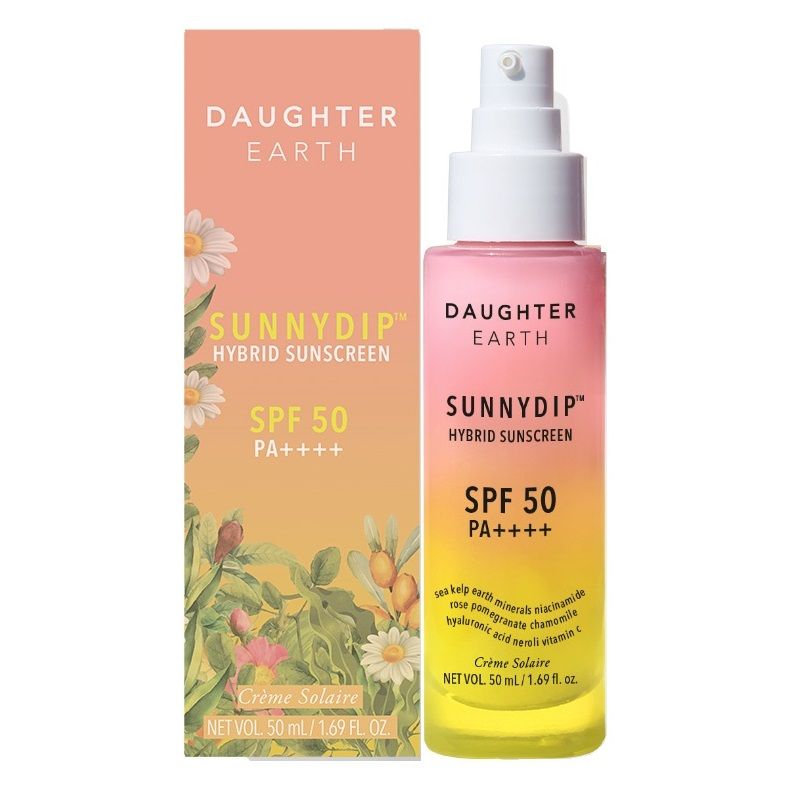
Daughter Earth Sunnydip Hybrid Sunscreen With SPF 50 PA++++

Daughter Earth Sunnydip Hybrid Sunscreen With SPF 50 PA++++
Nykaa E retail limited
daughter-earth-sunnydip-hybrid-sunscreen-with-spf-50-pa
Suncare
10084901552421
Morning or Evening?
How often will you use this product?
Notes


Highlights
WHAT IS IT?
hybrid sunscreen with 29 ingredients
FEATURES
botanical packed with Sea Kelp, Chamomile, Pomegranate, Carrot seed and Aloe vera; multi-vitamin infused with Vitamin C, B12, E; contains Hyaluronic Acid, Shea butter; free from Octinoxate & Oxybenzone; no white cast; silky glide; 100% Vegan and Cruelty-Free
BEST FOR
sensitive
CHECKS
No Parabens, No Silicones, No Sulfates, Free from Octinoxate & Oxybenzone
Who Is It For?
What Does It Help With?
Broad Spectrum Uva And Uvb Protection Anti-inflammation Healing NourishmentBudget
Premium ($76-$150)How To Use
Which routine should it be used in?
Instructions:
Key Information


What Nykaa E retail limited Says
Product Description:
A botanical-packed SPF 50 with broad spectrum UVA and UVB protection(PA++++)this sunscreen provides superior protection and nourishment for your skin and smells like a sensual treat with rose and neroli. Lightweight, no white cast with a dewy finish. Features include botanical ingredients like Sea Kelp, Chamomile, Pomegranate, Carrot seed, Aloe vera; infused with Vitamin C, Vitamin B12 and Vitamin E; contains Hyaluronic Acid and Shea butter; free from Octinoxate & Oxybenzone; 100% Vegan and Cruelty-Free; resolves whitecast and greasiness typical of physical sunscreens; silky glide texture without white-cast.
About the Brand:
Ingredients Overview
Ingredients List
aqua, homosalate, ethylhexyl-salicylate, butyl-methoxydibenzoylmethane-avobenzone, glycerin, 1-3-propanediol, caprylic-capric-triglyceride, cetyl-alcohol, ceteareth-20, cetostearyl-alcohol, c15-19-alkane, niacinamide, sorbitan-stearate, cetearyl-alcohol, cetearyl-glucoside, c14-22-alcohols, c12-20-alkyl-glucoside, heptyl-glucoside, sodium-hyaluronate, 3-o-ethyl-ascorbic-acid-vit-c, aloe-barbadensis-leaf-aloe-vera-extract, tocopheryl-acetate-vit-e, daucus-carota-sativa-carrot-seed-oil, butyrospermum-parkii-shea-butter, sucrose-cocoate, carbomer, phenoxyethanol, silica, sodium-gluconate, chamomilla-recutita-chamomile-flower-extract, punica-granatum-pomegranate-seed-oil, citrus-aurantium-amara-neroli-distillate, macrocystis-pyrifera-sea-kelp-extract, rosa-indica-rose-oil, sodium-hydroxide, xanthan-gum
Key Ingredients
Sea Kelp, Chamomile, Pomegranate, Carrot seed, Aloe vera, Vitamin C, Vitamin B12, Vitamin E, Hyaluronic Acid, Shea butter
Ingredients Details
Carbomer
Common Name(s): Carbopol,polyacrylic acid,carboxyvinyl polymer
DESCRIPTION
What It Does: Provides transparent gel textures and thickening at very low concentrations via ph-responsive swelling.
Why It's Used: The most widely used gel thickener – provides crystal-clear, stable gels at concentrations as low as 0.1-0.5% with ph-controlled viscosity.
How It Works: Highly crosslinked polyacrylic acid remains tightly coiled at acidic ph. neutralization with naoh or triethanolamine ionizes carboxylic groups causing electrostatic repulsion that unfolds and swells the polymer coils, dramatically increasing viscosity. concentration-dependent thickening.
Typically Found In: Gels,serums,emulsions,sunscreens
TECHNICAL DETAILS
Primary Category: Functional ingredient – polyacrylic acid thickener
Secondary Functions: Skin conditioning
Application Areas:

Facial Skincare

Body Care
Hair Care
Beard Care
Color Cosmetics (Makeup)
Dietary/Oral Supplements
Typical Concentration Range: 0.1%–2%
SOURCING & ETHICS
Vegan Status: Yes – synthetic
Halal Status: Yes
Source Notes: Commercially produced for cosmetic use. verify vegan/halal status with supplier.
SKIN COMPATIBILITY
Irritancy Rating: 1/5 – very low
Comedogenicity Rating: 0/5 – non-comedogenic
Sensitivity Concerns: Well-tolerated by most skin types.
Safe for Sensitive Skin: Yes
SAFETY & COMPATIBILITY
Safety Profile: Good safety profile at recommended concentrations. ewg score: 1–2.
Works Well With: Standard skincare actives
Avoid Combining With: No known significant incompatibilities
SCIENTIFIC NOTE
Carbomer's ph-responsive swelling mechanism provides an elegant formulation control tool: a neutralized gel can be liquefied by ph reduction (adding acid) and re-thickened by reneutralization. this reversible rheology control allows two-phase products that mix on application without the need for mechanical emulsification.
Last Verified: Cosing database,cir safety assessment
Primary Sources: 2026-03-12
Ceteareth-20
Common Name(s): Polyethylene glycol cetearyl ether,peg-20 cetearyl ether
CAS Number: 68439-49-6
DESCRIPTION
What It Does: Provides high-hlb o/w emulsification for stable cream formation from ethoxylated cetearyl alcohol.
Why It's Used: Classic self-emulsifying wax component for standard pharmaceutical and cosmetic cream formulation.
How It Works: 20 eo units on cetearyl alcohol chain provide hlb ~15-17 for strong o/w emulsification. often pre-blended with cetearyl alcohol as 'emulsifying wax' for simplified cream making. combined low-hlb cetearyl alcohol + high-hlb ceteareth-20 forms a balanced self-emulsifying system.
Typically Found In: Classic pharmaceutical and cosmetic creams
TECHNICAL DETAILS
Primary Category: Functional ingredient – ethoxylated fatty alcohol emulsifier
Secondary Functions: Skin conditioning
Application Areas:
Facial Skincare
Body Care
Hair Care
Beard Care
Color Cosmetics (Makeup)
Dietary/Oral Supplements
Typical Concentration Range: 1%–8%
SOURCING & ETHICS
Vegan Status: Conditional – peg petroleum; cetearyl vegetable
Halal Status: Yes
Source Notes: Commercially produced for cosmetic use. verify vegan/halal status with supplier.
SKIN COMPATIBILITY
Irritancy Rating: 1/5 – very low
Comedogenicity Rating: 0/5 – non-comedogenic
Sensitivity Concerns: Well-tolerated by most skin types.
Safe for Sensitive Skin: Yes
SAFETY & COMPATIBILITY
Safety Profile: Good safety profile at recommended concentrations. ewg score: 1–2.
Works Well With: Standard skincare actives
Avoid Combining With: No known significant incompatibilities
SCIENTIFIC NOTE
Ceteareth-20's combination with cetearyl alcohol in the classic 'emulsifying wax nf' creates what is called a 'mixed emulsifier system' where the fatty alcohol forms lamellar crystal phases that physically trap and stabilize oil droplets. this physical (lamellar crystal) + chemical (hlb balance) dual stabilization provides superior stability compared to either component alone.
Last Verified: Cosing database,cir safety assessment
Primary Sources: 2026-03-12
Glycerin
Common Name(s): Glycerol,glycerine,1,2,3-propanetriol
CAS Number: 56-81-5
DESCRIPTION
What It Does: Glycerin pulls water from the environment and deeper skin layers into the outer skin layer (epidermis), boosting moisture levels and keeping skin soft, smooth, and plump.
Why It's Used: It is used in virtually every moisturizer, serum, and cleanser because it is highly effective at hydrating skin, is well-tolerated by all skin types, and enhances the texture and spreadability of formulations.
How It Works: As a humectant, glycerin forms hydrogen bonds with water molecules, trapping them in the skin. it also reinforces the skin barrier by integrating into lipid structures between skin cells.
Typically Found In: Moisturizers,serums,cleansers,toners,sheet masks,sunscreens,body lotions,shampoos,conditioners
TECHNICAL DETAILS
Primary Category: Humectant
Secondary Functions: Skin barrier support,emollient,solvent
Application Areas:
Facial Skincare
Body Care
Hair Care
Beard Care
Color Cosmetics (Makeup)
Dietary/Oral Supplements
Typical Concentration Range: 1%–30% (typical: 3–10%)
SOURCING & ETHICS
Vegan Status: Yes – plant-derived (coconut, soy, palm) or synthetic
Halal Status: Yes – when plant-derived or synthetic; verify source with supplier
Source Notes: Derived from plant oils via hydrolysis or saponification; synthetic versions also available. palm-derived glycerin carries sustainability concerns.
SKIN COMPATIBILITY
Irritancy Rating: 1/5 – very low; non-irritating at all standard concentrations
Comedogenicity Rating: 0/5 – non-comedogenic
Sensitivity Concerns: Extremely rare allergic reactions; generally safe for all skin types including sensitive and baby skin
Safe for Sensitive Skin: Yes
SAFETY & COMPATIBILITY
Safety Profile: Widely recognized as safe. ewg hazard score: 1. no significant concerns for irritation, sensitization, or toxicity at typical concentrations (up to 50%).
Works Well With: Hyaluronic acid,ceramides,niacinamide,panthenol,urea,peptides,retinol,ahas/bhas
Avoid Combining With: No known incompatibilities at standard concentrations
SCIENTIFIC NOTE
Glycerin is an endogenous skin component found naturally in the stratum corneum. aquaporin-3 channels in keratinocytes facilitate glycerin transport, making it integral to natural skin hydration pathways.
Last Verified: Cosing database,cir safety assessment,ewg skin deep,inci decoder
Primary Sources: 2026-03-12
Homosalate
Common Name(s): Hms,3,3,5-trimethylcyclohexyl salicylate
CAS Number: 118-56-9
DESCRIPTION
What It Does: Provides uvb filtration and co-solvent function enabling higher uv filter concentrations in high-spf formulas.
Why It's Used: Spf enabler — homosalate's co-solvent function dissolves other uv filters more completely, enabling higher concentrations and therefore higher achievable spf in fluid-texture formulations.
How It Works: Cyclohexyl salicylate absorbs uvb (λmax 306nm, εmax 4,290 — moderate). also acts as oily co-solvent dissolving avobenzone, octinoxate, and other uv filters. photostable cyclohexyl structure.
Typically Found In: High-spf combination sunscreens
TECHNICAL DETAILS
Primary Category: Active ingredient – cyclohexyl salicylate uvb filter
Secondary Functions: Skin conditioning
Application Areas:
Facial Skincare
Body Care
Hair Care
Beard Care
Color Cosmetics (Makeup)
Dietary/Oral Supplements
Typical Concentration Range: Up to 15% (eu), 10% (us fda)
SOURCING & ETHICS
Vegan Status: Yes – synthetic
Halal Status: Yes
Source Notes: Commercially produced for cosmetic use. verify vegan/halal status with supplier.
SKIN COMPATIBILITY
Irritancy Rating: 1/5 – very low
Comedogenicity Rating: 0/5 – non-comedogenic
Sensitivity Concerns: Well-tolerated by most skin types.
Safe for Sensitive Skin: Yes
SAFETY & COMPATIBILITY
Safety Profile: Eu max 15% (sccs 2019 reduced limit). fda: 10%. potential endocrine activity at high concentrations. ewg score: 4.
Works Well With: Standard skincare actives
Avoid Combining With: No known significant incompatibilities
SCIENTIFIC NOTE
Homosalate's maximum concentration in eu was reduced from 10% to 15% in sccs opinion 2019 (counter-intuitively raised, not reduced) specifically to enable effective uv filter dissolution — demonstrating that homosalate's primary value is as a co-solvent enabling other uv filters to function, not solely as a uv filter itself.
Last Verified: Cosing database,fda uv filter otc monograph,sccs homosalate opinion
Primary Sources: 2026-03-12
